
As Amazon Associates, we earn from qualifying purchases. This means we may receive a small commission at no extra cost to you if you click through and make a purchase.
Shoppers researching modern desktop fabrication often find themselves searching for the flashforge adventurer 5x series, which leads straight to the Flashforge Adventurer 5M. If you want a rapid, dependable machine that skips the manual calibration rituals of traditional printers, this unit represents a substantial evolutionary step. It ditches old Cartesian bed-slinging mechanics in favor of a rigid CoreXY platform engineered to maintain sharp dimensional accuracy even when pushed to high velocities. For everyday hobbyists, students, and functional makers, it offers an approachable path to consistent printing without the steep learning curve.
In this detailed flashforge adventurer 5m review, we analyze how the hardware performs across daily projects, examine the standout engineering choices, and assess whether high velocity compromises finish quality. We break down the motion system, thermal capabilities, automatic bed leveling, and remote management workflow. By reviewing the real-world trade-offs and configuration choices, this guide will help you determine whether the machine suits your production needs or if an alternative setup fits your workshop better.
What You Get With the Flashforge Adventurer 5M
Flashforge Adventurer 5M
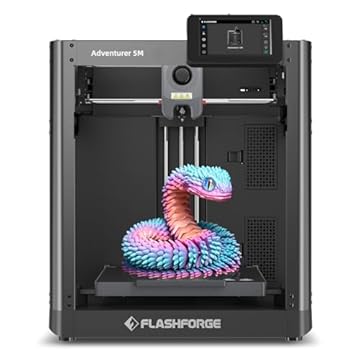
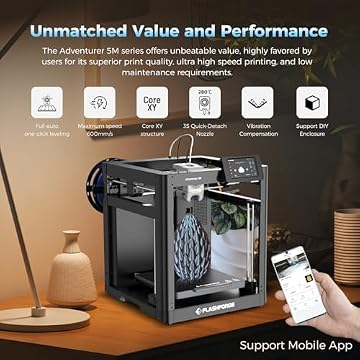


Photographs published on the Amazon listing.
The Flashforge Adventurer 5M comes configured out of the box with modern motion components, a compact structural footprint, and features designed to eliminate setup friction. Zhejiang Flashforge 3D Technology Co., Ltd. assembled this hardware package to cater to rapid turnaround times and straightforward operation.
- Rigid all-metal CoreXY framework built for structural stability at speed
- Direct drive extruder rated up to 280°C for handling diverse filament types
- Detachable 0.4mm nozzle with a three-second quick-release mechanism
- High-flow hotend capable of volumetric delivery up to 32mm³/s
- Rapid heating element reaching 200°C in roughly 35 seconds
- Dual-sided flexible PEI platform for simple print detachment
- Fully automated bed leveling system requiring zero manual thumbwheel adjustments
- Integrated dual-fan cooling system paired with vibration compensation
- Remote management and status alerts enabled through the Flash Studio application
- Standard build volume measuring 220 by 220 by 220 millimeters
Key Specifications
A closer look at the manufacturer data reveals how the mechanical components are balanced. Below are the essential flashforge adventurer 5m specs sourced directly from the manufacturer documentation.
Feature
Specification
- Kinematics Architecture
- CoreXY All Metal Structure
- Maximum Travel Speed
- 600 mm/s
- Maximum Acceleration
- 20000 mm/s²
- Usable Build Dimensions
- 220 x 220 x 220 mm
- Extruder Architecture
- 280°C Direct Drive Extruder
- Nozzle Flow Capacity
- 32 mm³/s high-flow delivery
- Nozzle Heating Rate
- Reaches 200°C in approximately 35 seconds
- Build Surface Material
- Dual-sided PEI spring steel platform
- Physical Dimensions
- 16 inches Deep x 14 inches Wide x 18 inches High
- Unit Weight
- 22 pounds
Copied from the Amazon listing. These figures were not measured here.
CoreXY Motion and Print Speed Performance
The standout mechanical feature is the CoreXY architecture, which replaces the heavy moving beds found on older Cartesian machines with stationary stepper motors driving lightweight belts. This structural configuration enables a top travel velocity of 600mm/s and an aggressive acceleration profile of 20000mm/s². By keeping the build plate stationary along the X and Y axes and only stepping downward along the Z axis, the flashforge adventurer 5m corexy platform reduces mechanical inertia, allowing the toolhead to execute sharp directional changes without destabilizing the printed part.
Speed without stability often results in ringing, ghosting, and stepped layer lines. To counteract these artifacts, the machine incorporates active vibration compensation alongside its all-metal chassis. When the printer accelerates through intricate toolpaths, the onboard sensors and algorithms dampen mechanical resonance before it transfers onto the surface of your model. This combination keeps the flashforge 5m print speed viable for high-detail functional prototypes rather than just rough drafting exercises.
For workshop production, these speed metrics significantly compress turnaround cycles. Tasks that traditionally demanded an entire afternoon can often be completed during a brief lunch break. The high-flow 32mm³/s hotend ensures that plastic melts uniformly even when the toolhead races across the build area, preventing under-extrusion issues during long, continuous infill runs.
Auto Leveling and First Layer Reliability
Getting a smooth, perfectly squished first layer is historically the most error-prone stage of 3D printing. The flashforge 5m auto leveling system eliminates this obstacle entirely through a one-click automated calibration routine. Rather than forcing users to slide sheets of paper beneath hotends or turn manual bed knobs beneath the build deck, the printer maps the surface electronically to compensate for microscopic height variations across the bed.
This automated calibration makes the flashforge adventurer 5m for beginners an exceptionally approachable option. New users do not need to understand Z-offset calculations or mechanical bed tramming theory to achieve reliable adhesion. When you send a print job, the machine verifies surface orientation and applies corrective offsets across the entire 220x220x220mm area, ensuring uniform adhesion regardless of where a model is placed on the build sheet.
The build sheet itself is a dual-sided textured PEI spring steel plate. PEI provides strong mechanical grab when heated, holding parts firmly in place against toolhead drag. Once the print cycle finishes and the platform cools down, the flexible sheet can be lifted off the magnetic bed and bent slightly, allowing completed prints to pop off cleanly without requiring scrapers, razor blades, or chemical release agents.
Direct Drive Extruder and Quick Swap Nozzle System
Filament delivery is managed by a specialized flashforge ad5x extruder assembly featuring a compact direct drive mechanism rated for operating temperatures up to 280°C. Because the drive gears sit directly above the hotend rather than across a long Bowden tube, the flashforge direct drive extruder provides crisp retraction control. This tight grip minimizes stringing, prevents filament grinding, and improves consistency when working with flexible or temperature-sensitive materials.
Maintaining the hotend is equally streamlined thanks to the flashforge quick swap nozzle mechanism. Unlike standard threaded hotends that demand heated tool wrenches, heat breaks, and delicate wire handling, this system uses a three-second detachable nozzle design. Swapping between different toolheads involves disengaging a quick-release clip, letting you pull out the assembly cleanly without burning your fingers or risking stripped threads.
The printer ships with a standard 0.4mm nozzle, but the platform also accepts optional sizes ranging from ultra-fine 0.25mm tips up to wide-bore 0.8mm nozzles for rapid structural infill. If you find yourself comparing variations in the series, including the enclosed flashforge 5m pro, this toolless maintenance setup represents one of the strongest practical benefits for users who regularly switch between fine-detail decorative miniatures and thick, heavy-duty brackets.
Workspace Footprint and Remote App Monitoring
Physical space is always at a premium in home offices and small workshops. Measuring 16 inches deep, 14 inches wide, and 18 inches high, the Adventurer 5M fits comfortably on standard utility desks or utility shelving. Weighing in at 22 pounds, the metal and polycarbonate chassis retains enough mass to resist rocking during rapid 20000mm/s² directional snaps, yet remains light enough to reposition around your workspace whenever necessary.
Operating status and machine control are handled via the Flash Studio application, which provides real-time mobile monitoring. Users can track job completion percentages, change basic print parameters on the fly, and receive instant alerts when a build concludes. This wireless connectivity reduces the need to physically hover over the machine during lengthy print operations, giving you confidence to step away while prototypes run in the background.
One trade-off to keep in mind is the open-frame chassis design. Because this model does not feature a fully enclosed chamber, ambient drafts can influence cooling rates on advanced engineering plastics, and mechanical fan noise is more perceptible in quiet rooms. For users focused on standard printing materials, the open design provides great visibility and immediate access to the build area, but buyers needing absolute temperature isolation may need to evaluate enclosed alternatives within the broader flashforge 3d printer pro product ecosystem.
Flashforge Adventurer 5M Pros and Cons
Pros
- High-speed CoreXY motion reaching 600mm/s travel
- One-click fully automated bed leveling system
- Toolless three-second quick swap nozzle design
- High-flow 280°C direct drive extruder mechanism
- Flexible dual-sided PEI spring steel build platform
- Rapid hotend warm-up to 200°C in 35 seconds
Cons
- Open frame chassis lacks an integrated chamber enclosure
- Alternative nozzle sizes must be purchased separately
- Remote app monitoring is restricted to Flash Studio
Check Flashforge Adventurer 5M on Amazon
Is the Flashforge Adventurer 5M Worth It
When considering whether the machine is worth buying, the primary factor is your willingness to deal with manual calibration. If you have previously owned entry-level machines where hours were wasted leveling aluminum beds, chasing uneven first layers, and clearing clogged threaded nozzles, the Adventurer 5M resolves nearly all of those pain points out of the box. Its combination of rapid travel speeds, one-touch leveling, and quick-swap tooling offers enormous practical utility.
For educational environments, small businesses, and busy hobbyists who treat 3D printing as an enabling tool rather than a tinkering hobby, the Adventurer 5M delivers remarkable day-to-day value. You spend significantly more time designing and using parts and far less time adjusting mechanical fasteners or monitoring first layers. The 220x220x220mm envelope is spacious enough for the vast majority of household repairs, mechanical enclosures, and decorative prints.
However, if your primary goal is printing warp-prone industrial materials that strictly require heated enclosures and passive chamber heat retention, an open-frame platform has inherent physical limitations. If you mostly intend to produce standard PLA, PETG, or TPU parts with minimal downtime and maximum speed, the machine represents a remarkably capable, dependable investment that sets a high standard for desktop usability.
Other Options to Consider
MakerWorld Model Library suits creators who require integrated multi-color capabilities and an extensive shared print profile ecosystem right out of the box rather than focusing strictly on single-extrusion production.

Beginner-Friendly Ecosystem with MakerWorld Model is ideal for users who need a factory-enclosed CoreXY chamber to shield their prints from ambient room drafts and reduce operating noise in quiet living spaces.
Dual-Color Printing serves hobbyists seeking dual-color extrusion combined with an enclosed build chamber and an integrated touchscreen interface for multi-shade decorative models.

FAQ
What makes the Flashforge Adventurer 5M suitable for beginners?
The machine eliminates the most difficult setup hurdles for novices by including fully automated bed leveling, a flexible dual-sided PEI sheet for effortless part removal, and a quick-swap nozzle assembly. Beginners can start printing immediately without learning complicated manual bed tramming or adjusting Z-axis offset microsteps.
How fast can the Flashforge Adventurer 5M actually print?
The printer achieves a maximum travel velocity of 600mm/s with an acceleration ceiling of 20000mm/s² on its CoreXY motion chassis. Supported by a 32mm³/s high-flow hotend and dual-fan cooling, it cuts traditional print run durations significantly while maintaining sharp surface definition via active vibration compensation.
How does the quick swap nozzle system operate?
The hotend features a toolless three-second detachment mechanism. Instead of heating up the hotend and using wrenches to unscrew threaded metal nozzles, users release a retention clip and detach the nozzle module safely, making nozzle size swaps and unclogging tasks exceptionally fast.
Does the Adventurer 5M require any manual bed tramming?
No, the listing specifies that the machine features fully automatic bed leveling with one-click operation. There are no manual thumbwheels or adjustment screws beneath the build platform; the printer probes the print surface electronically to ensure uniform first-layer adhesion automatically.
What build volume does the Adventurer 5M provide?
The Adventurer 5M provides a usable build volume of 220 by 220 by 220 millimeters. This offers plenty of room for everyday functional parts, prototyping projects, and tabletop figures while keeping the machine’s external footprint compact at 16 by 14 by 18 inches.


