As Amazon Associates, we earn from qualifying purchases. This means we may receive a small commission at no extra cost to you if you click through and make a purchase.
Finding a reliable whole-home mesh solution that eliminates wireless dead zones while handling dozens of active devices can be challenging. The TP-Link Deco 7 Pro addresses these common household bottlenecks by combining tri-band Wi-Fi 7 technology with robust multi-gigabit wired connectivity. Designed for expansive properties up to 7,600 square feet, this 3-pack mesh system supports over 200 devices without degrading throughput. If you need steady speeds across several floors for heavy video streaming, local network transfers, or responsive online play, this system offers an advanced hardware foundation.
In this tp link deco pro review, we evaluate the real-world utility of the hardware rather than relying on abstract marketing promises. We look closely at how the BE10000 wireless rating performs across three separate wireless bands, examine the port selection for wired backhaul, and explain how the companion mobile app streamlines day-to-day administration. We also compare its capabilities to older options like the tp link deco xe75 to help you determine whether upgrading makes sense for your living space.
What You Get With the TP-Link Deco 7 Pro
TP-Link Deco 7 Pro
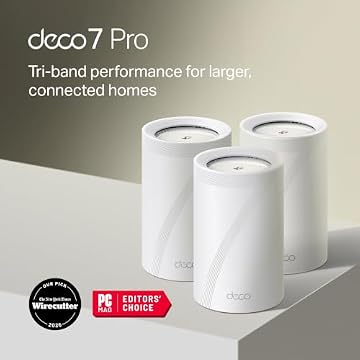



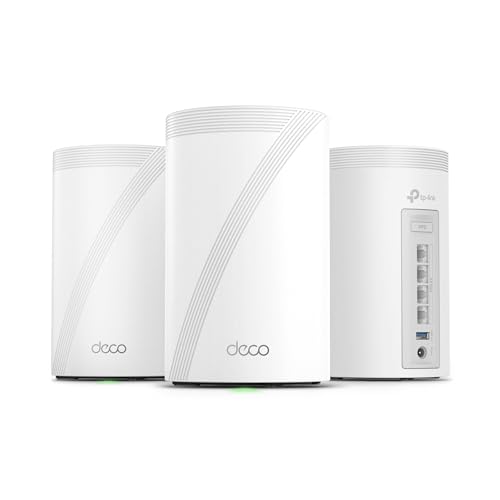
Photographs published on the Amazon listing.
The TP-Link Deco 7 Pro arrives as a three-unit mesh package designed to create a single, continuous wireless network across large residential layouts.
- Three Deco BE10000 whole-home mesh nodes delivering tri-band Wi-Fi 7 connectivity.
- Whole-home coverage rated up to 7,600 square feet for multi-story residences.
- BE10000 speed distribution reaching up to 5,188 Mbps on 6 GHz, 4,324 Mbps on 5 GHz, and 574 Mbps on 2.4 GHz.
- High-density client handling supporting more than 200 connected devices concurrently.
- One 10 Gbps WAN/LAN port and four 2.5 Gbps WAN/LAN ports per unit for multi-gigabit wired routing.
- One integrated USB 3.0 port per unit for local network data and storage sharing.
- Simultaneous wired and wireless backhaul balancing traffic across 10G Ethernet and Wi-Fi 7.
- TP-Link HomeShield software suite offering real-time IoT security, parental controls, and network protection.
- Deco mobile application support for rapid installation, remote management, and voice control compatibility.
Key Specifications
Specification
Detail
- Wi-Fi Generation
- Wi-Fi 7 (802.11be, backward compatible with 802.11ax/ac/g/n)
- Speed Rating
- BE10000 (10 Gbps total theoretical capacity)
- Wireless Frequencies
- Tri-Band: 6 GHz (5,188 Mbps), 5 GHz (4,324 Mbps), 2.4 GHz (574 Mbps)
- Coverage Area
- Up to 7,600 sq. ft. (3-pack configuration)
- Device Capacity
- Over 200 connected devices
- Wired Ports
- One 10 Gbps WAN/LAN port, Four 2.5 Gbps WAN/LAN ports
- Auxiliary Port
- One USB 3.0 port
- Antenna Design
- 4 internal antennas per node
- Security Protocols
- WPA-PSK, WPA2-PSK, WPA3, Advanced Router Firewall Security
- Management Platform
- Deco App, Omada OS, Voice Control, WPS
Copied from the Amazon listing. These figures were not measured here.
Network Throughput and Wi-Fi 7 Performance Standards
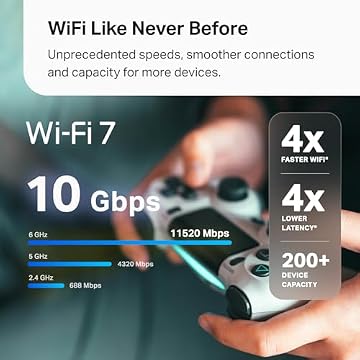
The primary attraction of adopting next-generation hardware like the tp link be19000 family or this Deco system is the tri-band Wi-Fi 7 architecture. With the tp link deco 7 pro wifi 7 standard, network traffic is partitioned across three separate bands: a clean 6 GHz channel capable of up to 5,188 Mbps, a wide 5 GHz band reaching up to 4,324 Mbps, and a standard 2.4 GHz band delivering up to 574 Mbps. This tri-band configuration isolates data-heavy transfers, 4K/8K media streams, and virtual reality gaming from background smart home sensors and appliances.
A closer look at the tp link deco pro specs shows that real-world wireless throughput always depends on household conditions, wall density, and physical range. However, having access to wide 6 GHz frequencies significantly curtails the wireless congestion common in suburban neighborhoods. In homes with multi-gigabit internet connections, the tp link deco be10000 mesh provides sufficient bandwidth headroom to ensure multiple household members can download massive files or stream high-definition media simultaneously without triggering sluggish speeds or buffering.
Coverage Scale and Handling High Device Counts
Evaluating tp link deco pro coverage demonstrates that the three-unit package is designed for substantial square footage, officially rated to blanket up to 7,600 square feet. Instead of depending on a single central router that struggles to reach far corners, the three nodes coordinate to establish a uniform network blanket. Each unit relies on four internal antennas positioned to project signals evenly across multiple floors, allowing you to eliminate dead zones in basements, home offices, and remote bedrooms without running unsightly surface wiring.
Smart home density poses another common connectivity hurdle as modern households incorporate smart thermostats, security cameras, smart lighting, and personal electronics. The TP-Link Deco 7 Pro is engineered to maintain active connections for over 200 devices without degrading system performance. Using AI-driven seamless roaming technology, the mesh setup dynamically evaluates signal levels and client distance, smoothly transitioning your smartphone or laptop between nodes under a single network name so you never drop video meetings while walking through your home.
Multi-Gigabit Port Options and Wired Backhaul Stability
Physical connectivity is a significant highlight of the TP-Link Deco 7 Pro, setting it apart from standard gigabit routers like the tp link deco ax3000. Each node features a fast 10 Gbps WAN/LAN port paired with four 2.5 Gbps WAN/LAN ports. This expansive layout allows power users to connect multi-gigabit modems, local network-attached storage units, and desktop computers at full speed. Additionally, the inclusion of a USB 3.0 port enables direct network file sharing using an external storage drive.
The system also excels in maintaining backhaul stability between units. The tp link deco pro wired backhaul operates simultaneously alongside tri-band Wi-Fi 7 wireless signals, balancing inter-node traffic across both 10G Ethernet cabling and wireless frequencies. This dual-pathway approach maximizes data flow across the network, making the tp link deco pro for gaming an exceptionally responsive choice for players seeking minimal latency and stable ping times. To take advantage of backhaul balancing, you must deploy at least two Deco units across your residence.
Setup Simplicity and Network Management Features
Configuring your home network is straightforward thanks to the streamlined tp link deco pro setup workflow guided by the Deco mobile app. After plugging your primary node into your ISP modem, the app presents clear visual prompts to name your network and connect the additional satellite nodes in minutes. The application serves as a central hub for routine maintenance, facilitating one-tap firmware updates, QoS bandwidth prioritization, access point mode switching, and guest network configuration without requiring complex technical knowledge.
Security is integrated through TP-Link HomeShield, which includes real-time IoT security scans, robust parental controls, and an advanced router firewall. Powered by the Omada operating system with WPA3 encryption, the hardware also provides comprehensive VPN client and server support. This allows designated home electronics to browse through remote VPN tunnels without individual software installs, while unencrypted traffic routes directly to the web across the wider tp deco mesh wifi system.
TP-Link Deco 7 Pro Pros and Cons
Pros
- Expansive 7,600 sq. ft. three-pack coverage
- BE10000 tri-band speeds with Wi-Fi 7
- 10G port and four 2.5G ports per unit
- Simultaneous wired and wireless backhaul support
- Over 200 connected device capacity
Cons
- Requires a separate standalone modem
- Full backhaul balancing requires multiple units
- Real-world wireless speeds vary by physical obstacles
Check TP-Link Deco 7 Pro on Amazon
Is the TP-Link Deco 7 Pro Worth It
Deciding if the tp link deco pro is worth it depends on the scale of your property, your active broadband tier, and your household bandwidth habits. If you live in a large multi-story home, subscribe to a multi-gigabit internet plan, and manage dozens of high-demand devices streaming 4K video or transferring large files, this system directly eliminates common wireless bottlenecks. The combination of a 10 Gbps port, four 2.5 Gbps ports per node, and Wi-Fi 7 wireless performance provides long-term network stability.
Conversely, if you live in a compact apartment or a home under 2,000 square feet with standard broadband speeds under one gigabit, this hardware package is likely more powerful than you need. The BE10000 tri-band wireless capacity and extensive multi-gigabit port selection are built for demanding multi-node environments. For smaller residences without dead zones or intense data demands, an entry-level mesh system or single router will comfortably satisfy standard daily web use.
Other Options to Consider
Up to 6,600 Sq.Ft: This Deco BE25 3-pack dual-band BE5000 Wi-Fi 7 mesh system provides 4-stream throughput up to 5 Gbps across 240 MHz bandwidth and covers up to 6,600 square feet. Equipped with two 2.5G wired backhaul ports, MLO, and HomeShield security, it serves homeowners seeking dependable whole-home Wi-Fi 7 coverage without needing dedicated 6 GHz frequencies or a 10 Gbps Ethernet port.

Google Nest WiFi Pro: Operating on the Wi-Fi 6E standard and offered in a fog enclosure with non-retail packaging, this mesh router emphasizes fast whole-home coverage and quick WPS pairing. It is best suited for shoppers invested in Google hardware who favor an unobtrusive, minimalist aesthetic over multi-gigabit physical port options.
4-Stream: This Deco BE25 1-pack dual-band BE5000 mesh router covers up to 2,600 square feet with 5 Gbps theoretical speeds, two 2.5G wired backhaul ports, and HomeShield network protection. It is an excellent choice for individuals in smaller homes or apartments who want standalone Wi-Fi 7 performance without purchasing excess satellite units.

FAQ
Does the TP-Link Deco 7 Pro require a separate modem?
Yes, all Deco Wi-Fi routers require a separate modem connected via Ethernet to access your internet service provider’s network.
Can the TP-Link Deco 7 Pro handle online gaming without latency spikes?
Yes, the system is well-equipped for online gaming due to its low-latency Wi-Fi 7 standard, fast 6 GHz band, QoS traffic prioritization, and multi-gigabit wired Ethernet ports.
How does simultaneous wired and wireless backhaul work?
The system balances inter-node communication by utilizing both 10G Ethernet cabling and tri-band Wi-Fi 7 wireless signals simultaneously, creating a faster and more stable whole-home network backbone.
Are older Wi-Fi devices compatible with the Deco BE10000 mesh?
Yes, the system is backward compatible with all previous Wi-Fi generations, including 802.11ax, 802.11ac, 802.11n, and 802.11g devices.
What is the purpose of the USB 3.0 port on the Deco hardware?
The integrated USB 3.0 port allows you to connect an external hard drive or flash storage device to share files across your local network.