As Amazon Associates, we earn from qualifying purchases. This means we may receive a small commission at no extra cost to you if you click through and make a purchase.
If you are searching for a straightforward way to automate your home climate without unnecessary gadgetry, the Honeywell Home T5 offers a balanced set of smart controls tailored to central heating and cooling systems. Built around a clean, square black-and-white touch interface, this Wi-Fi thermostat targets homeowners who want to set recurring temperature routines, monitor climate habits, and make adjustments remotely from a smartphone or tablet. The device handles standard central heating and cooling setups, heat pumps, and furnaces, bridging the gap between basic programmable units and overly complicated home automation gear.
In this comprehensive Honeywell Home T5 review, we break down everything you need to know before buying, from the critical C-wire power requirements to real-world scheduling behaviors and voice assistant integration. You will learn how its geofencing routines compare to standard 7-day timers, what equipment it safely supports, and whether your home wiring is ready for installation. We also evaluate the unit against three alternative options so you can pick the right thermostat for your specific equipment.
What You Get With the Honeywell Home T5
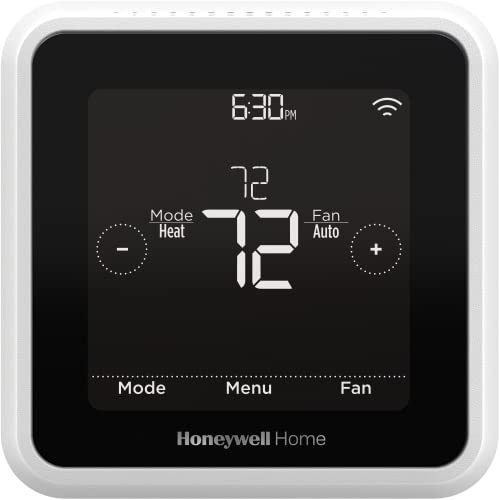
Honeywell Home T5


Photographs published on the Amazon listing.
The Honeywell Home T5 arrives as a complete wall-mount hardware package engineered to replace traditional low-voltage thermostats. Inside the packaging and highlighted across its specifications, you will find the core hardware and software capabilities necessary to establish remote climate automation across your property.
- Honeywell Home T5 touch-screen thermostat unit with a 4.95-inch monochrome LCD display
- Wall-mounting hardware and low-voltage terminal plate for multi-wire HVAC connections
- Wi-Fi connectivity module supporting remote management via iOS and Android devices
- Built-in 7-day flexible scheduling engine alongside location-based temperature management
- Integrated geofence technology enabling automated Home and Away mode adjustments
- Broad platform support across Apple HomeKit, Amazon Alexa, and Google Assistant
- ENERGY STAR certified energy tracking with monthly reporting and efficiency guidance
- Internal hardware supporting single AAA battery placement for system operation as specified by the manufacturer
Key Specifications
Reviewing the technical baseline of the Honeywell Home T5 helps identify whether its electrical requirements and dimensions match your current wall cutout and HVAC control board.
Specification Attribute
Manufacturer Detail
- Product Style
- A. Wi-Fi Thermostat Gen2
- Display Type
- 4.95-inch LCD Touchpad
- Dimensions and Shape
- Square profile, Black and White finish
- Control Method
- Touchpad Control and Smartphone/Tablet App
- Power Source
- Corded Electric (24 Volts, 24 Watts)
- Battery Requirement
- 1 AAA battery required
- Connectivity Protocol
- Wi-Fi
- Supported Systems
- Air Conditioner, Furnace, Heat Pump
- Controller Compatibility
- Apple HomeKit, Amazon Alexa, Google Assistant, iOS, Android
- Efficiency Rating
- ENERGY STAR Certified
Copied from the Amazon listing. These figures were not measured here.
Setup and the C-Wire Requirement
Before purchasing or mounting the Honeywell Home T5 smart thermostat setup, you must verify how your existing HVAC system supplies continuous low-voltage electricity. The T5 operates on 24-volt power and explicitly mandates a dedicated common wire (C-wire) or an external C-wire power adapter to run its Wi-Fi radio, backlit screen, and digital processor. If you pull your existing wall thermostat away and see only two or four thin wires without a dedicated blue or black C-wire terminal, the unit will not power on reliably without adding an adapter or running new cabling from your furnace control board.
System compatibility also comes with strict fuel-type caveats that homeowners must inspect. While the T5 works reliably with standard forced-air heating, electric air conditioning, and heat pumps, fuel-oil systems require extra scrutiny. The manufacturer notes that the device works with most combined heat-and-cool oil furnace systems, but it will not work with heating-only oil furnaces unless a continuous C-wire is present at the wall. If you run an older hydronic or dedicated oil heater without cooling stages, checking your terminal block before ordering is essential to avoid setup failure. Buyers exploring alternative wiring configurations often compare this model with commercial-line siblings like the honeywell home t6 pro to see how different backplates accommodate complex wiring harnesses.
Physical mounting is straightforward once power needs are sorted. The square backplate covers standard electrical junction footprints, and the terminals use push-in connectors labeled for heating, cooling, fan, and reversing valves. The listing notes that 1 AAA battery is required, providing auxiliary backup while primary operation relies on constant 24-volt line current. Once wired to your wall, the initial boot sequence walks you through equipment selection so the internal relays operate your compressor and blower stages in the correct operational order.
Scheduling Versus Geofencing Comfort
The daily operation of this Honeywell Home T5 wifi thermostat revolves around two distinct automation philosophies: classic 7-day scheduling and smartphone-driven geofencing. With standard 7-day flexible scheduling, you program target temperatures across four routine time blocks per day, establishing distinct setpoints for waking up, leaving for work, returning home, and sleeping. This traditional approach provides complete predictability, letting you run your equipment on a strict schedule regardless of where your family members carry their mobile phones.
For individuals with unpredictable routines, Honeywell Home T5 geofencing offers an adaptive alternative. Instead of relying strictly on clock times, the thermostat syncs with the companion mobile application on your iOS or Android device to monitor your geographical distance from home. When the app detects that your smartphone has crossed your customized digital perimeter, the thermostat automatically switches into Away mode, relaxing temperature limits to reduce heating and cooling runtimes. Once your smartphone crosses back into the home perimeter, the system triggers Home mode, bringing living spaces back to your preferred comfort level before you walk through the front door.
The practical advantage of combining Auto Home and Away modes with flexible programming is measurable efficiency. According to the manufacturer, high use of the scheduling feature on the T5 thermostat saved customers between 8 and 16 percent on heating and cooling bills, based on nationwide average annual energy usage in single-family detached homes. While actual savings fluctuate based on local climate conditions and home insulation quality, the ability to switch between calendar-based logic and location-based triggers prevents conditioning empty rooms throughout the day.
Smart Platform Integration and Voice Control
Smart home integration is one of the standout aspects of the Honeywell Home T5 specs. Unlike many entry-tier digital thermostats that limit remote management to a proprietary walled-garden application, the T5 supports Amazon Alexa, Google Assistant, and Apple HomeKit natively. This broad ecosystem integration allows you to adjust setpoints using hands-free voice commands, group heating zones into broader room scenes, and view current indoor temperatures through your preferred mobile dashboard without opening a separate utility app.
For Apple households, the Honeywell Home T5 for HomeKit integration is particularly attractive because setup connects directly through standard iOS pairing. You can integrate target temperatures into your existing Good Morning or Good Night routines, linking climate control with lighting, smart plugs, and motorized blinds. Android and Google Home users receive identical voice command responsiveness, allowing quick temperature bumps when you are occupied in the kitchen or resting on the couch. Homeowners comparing digital wall controls frequently cross-reference the T5 with dedicated wireless solutions like the honeywell t6 wifi to verify how software updates handle multi-platform smart home commands.
Stable connectivity requires a solid wireless link between the thermostat and your residential network. Because the T5 relies on 24-volt current to keep its Wi-Fi chip active, placing the unit within reasonable range of a dual-band access point or an everyday household router like the tp link ac1900 guarantees that remote app inputs reach your wall controller instantly. When wireless connectivity drops temporarily, the thermostat maintains its locally stored schedule and touchpad controls, ensuring your living space never loses heating or cooling protection during internet outages.
Energy Star Certification and Utility Incentives
Earning an independent efficiency credential is vital for any modern climate controller, and the Honeywell Home T5 energy star designation guarantees compliance with rigorous performance metrics. Energy Star certified thermostats must prove they dynamically adapt to occupancy shifts, manage deadband temperature cycles without short-cycling compressors, and provide actionable consumption insights. With the T5, users gain access to monthly energy reports that outline heating and cooling runtimes alongside customized conservation suggestions to help rein in seasonal consumption spikes.
An additional operational benefit comes via local utility rewards and demand-management options. Because the T5 meets certified smart thermostat standards, eligible homeowners can apply for energy efficiency rebates through their local electrical or natural gas utilities to offset hardware costs. Furthermore, eligible customers have the option to enroll in their regional utility’s Demand Response Program. Under this arrangement, your service provider can slightly adjust your air conditioner or furnace temperature targets during peak grid stress events, rewarding your household with credits or bill incentives while preventing regional brownouts.
Combining automated setbacks with utility-backed demand programs creates long-term operational efficiency. Rather than relying on guesswork to figure out which temperature swings impact your equipment, the monthly energy breakdown tracks your operational hours transparently. The system provides clear insight into how small setpoint changes alter total HVAC cycling times, giving budget-conscious households verifiable feedback every billing cycle.
Honeywell Home T5 Pros and Cons
Pros
- ENERGY STAR certified efficiency tracking
- 7-day scheduling and smartphone geofencing
- Works with Alexa Google Assistant and HomeKit
- Estimated 8 to 16 percent HVAC savings
- Responsive 4.95-inch LCD touch display
- Eligible for utility demand response rebates
Cons
- C-wire or power adapter strictly required
- Incompatible with heating-only oil furnaces without C-wire
- Limited to single-stage or basic HVAC equipment
Check Honeywell Home T5 on Amazon
Is the Honeywell Home T5 Worth It
Deciding if the Honeywell Home T5 is worth it depends largely on your home wiring and your preference for climate automation. For homeowners with standard 24-volt HVAC systems that already contain a functioning C-wire, the T5 delivers exceptional day-to-day utility. It strips away the unnecessary bulk, proprietary camera sensors, and steep learning curves found on higher-tier alternatives, focusing instead on dependable touch controls, remote phone access, and rock-solid platform support across Alexa, Google, and Apple ecosystems.
However, the value proposition softens if your home features complex multi-stage equipment, dedicated baseboard line-voltage heaters, or lacks continuous low-voltage power cabling. Installing an external C-wire adapter adds physical labor, and homes with heating-only oil furnaces will find the device incompatible unless specialized wiring modifications are carried out. Those seeking advanced features like remote room-by-room environmental sensors might prefer stepping up to modern platforms like the honeywell home t9 smart thermostat, which accommodates external probes across multi-story layouts.
For the typical single-family house with central forced air, the T5 hits an ideal sweet spot of modern functionality and reliable build quality. Its documented potential to cut heating and cooling bills by 8 to 16 percent through scheduled setbacks, paired with broad smart platform support, makes it a sensible investment for anyone seeking practical, jargon-free climate automation.
Other Options to Consider
RTH20B Single-Stage suits shoppers who want a strictly basic, non-connected climate controller without any Wi-Fi radios or smartphone requirements. This white Honeywell Home X2P programmable thermostat offers 1 Heat/1 Cool system compatibility alongside a fixed 5-2 day schedule, making it a dependable, low-maintenance pick for rental properties, guest suites, or users who prefer simple push-button programming directly on the wall.

Aowel Non Programmable Thermostat is tailored for homeowners who want completely manual operation combined with immediate ambient climate feedback. Built for single-stage 1 Heat/1 Cool residential systems, this non-programmable unit features an LCD blue backlit screen that displays current indoor humidity alongside temperature, serving users who dislike automatic schedule changes and want total manual control without apps or network setup.
for 2007 2008 2009 2010 is an automotive replacement engine coolant thermostat housing assembly designed specifically for 2007 through 2011 Jeep Wrangler JK vehicles equipped with 3.8L V6 engines. This is a mechanical automotive cooling part matching OEM part numbers like 4666149AA and 902-3038, meaning it is intended solely for automotive vehicle engine repairs and is completely unrelated to residential household HVAC systems.

FAQ
Does the Honeywell Home T5 require a C-wire for installation?
Yes, the Honeywell Home T5 requires continuous 24-volt power provided by a dedicated C-wire or a compatible C-wire power adapter. The manufacturer explicitly advises checking your system compatibility before purchasing, as the thermostat will not power its Wi-Fi components without this electrical line.
Can I use the Honeywell Home T5 with an oil furnace?
The T5 works with most combined heat-and-cool oil furnace systems. However, the manufacturer specifies that it will not work with heating-only oil furnace setups unless an active C-wire is present at the thermostat wall plate.
How does geofencing work on the Honeywell Home T5?
Geofencing uses your smartphone location through the mobile app to detect when you leave or approach your home. When you cross your designated boundary, the thermostat switches between Home and Away modes automatically to prevent conditioning an empty home.
Which smart home voice assistants work with the Honeywell Home T5?
The Honeywell Home T5 features broad controller compatibility, supporting Apple HomeKit, Amazon Alexa, and Google Assistant, as well as native mobile control through both iOS and Android apps.
Is the Honeywell Home T5 certified for energy efficiency?
Yes, the Honeywell Home T5 is ENERGY STAR certified. It provides monthly energy reporting with personalized tips to help track usage, and high utilization of its scheduling feature has saved customers between 8 and 16 percent on heating and cooling bills.