
As Amazon Associates, we earn from qualifying purchases. This means we may receive a small commission at no extra cost to you if you click through and make a purchase.
Finding a dependable desktop machine often forces creators to pick between sluggish entry-level printers and complicated assembly kits that demand constant manual calibration. The Flashforge Adventurer 5M bridges that divide by delivering rapid CoreXY motion and hands-off calibration in a pre-assembled desktop package. Designed for hobbyists, educators, and rapid prototypers who want fast turnaround times without assembly headaches, this printer focuses on delivering consistent results right out of the box while eliminating the tedious bed-leveling routines that traditionally frustrate newcomers.
In this detailed review, we examine the mechanical construction, thermal capabilities, and real-world workflow of this high-speed printer to help you decide if it fits your workshop. We will explore its motion architecture, quick-swap nozzle assembly, software connectivity, and the practical implications of its open frame. By assessing the full Flashforge Adventurer 5M specs alongside practical day-to-day considerations, this guide outlines what you can expect before making a purchasing decision.
What You Get With the Flashforge Adventurer 5M
Flashforge Adventurer 5M
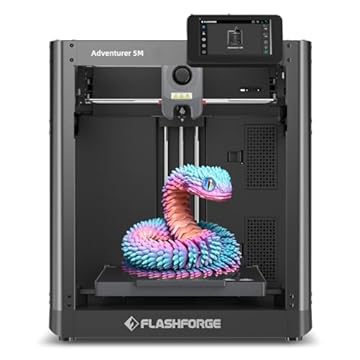
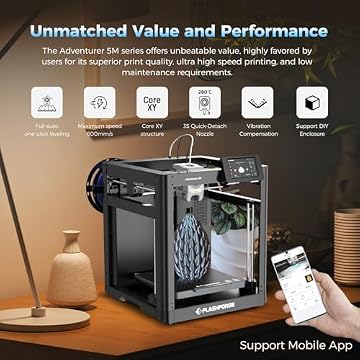


Photographs published on the Amazon listing.
The printer arrives as a largely pre-assembled desktop manufacturing station built around a rigid CoreXY metal chassis, requiring minimal preparation before starting your first print.
- CoreXY all-metal structural frame engineered for high-speed stability and vibration dampening
- Direct drive extruder reaching maximum operating temperatures of 280°C
- Standard 0.4mm high-flow nozzle capable of volumetric extrusion rates up to 32mm³/s
- Dual-sided textured PEI spring steel build platform measuring 220x220x220mm
- Fully automatic bed leveling system with real-time sensor-driven height compensation
- Integrated dual-fan auxiliary cooling assembly paired with active vibration compensation
- Ceramic hotend heating element achieving 200°C in approximately 35 seconds
- Integrated Wi-Fi module supporting real-time remote monitoring via the Flash Studio application
Key Specifications
Feature
Manufacturer Specification
- Motion Architecture
- CoreXY All Metal Structure
- Build Volume
- 220 x 220 x 220 mm
- Maximum Travel Speed
- 600 mm/s
- Maximum Acceleration
- 20000 mm/s²
- Extruder Style
- Direct Drive Extruder (280°C Max)
- Included Nozzle
- 0.4mm High-Flow (32mm³/s Flow Rate, 3-Second Detachable)
- Supported Optional Nozzles
- 0.25mm, 0.6mm, 0.8mm
- Bed Leveling
- Fully Automatic Bed Leveling
- Build Surface
- Dual-Sided Flexible PEI Sheet
- Physical Dimensions & Weight
- 16"D x 14"W x 18"H, 22 pounds
Copied from the Amazon listing. These figures were not measured here.
Flashforge Adventurer 5M Speed and Motion Mechanics
The primary appeal of this printer rests on its motion configuration. Traditional bedslinger printers move the heavy build plate back and forth along the Y-axis, creating mechanical inertia that forces operators to reduce speeds to prevent layer shifting and surface defects. In contrast, the Flashforge Adventurer 5M speed stems from its CoreXY layout, where two stationary stepper motors work in tandem to maneuver a lightweight toolhead along the X and Y axes while the build platform moves downward along the Z-axis.
With maximum travel speeds reaching up to 600mm/s and acceleration topping out at 20000mm/s², the printer dramatically cuts down project turnaround times. High mechanical speeds require more than fast motors; they require rapid melting and aggressive part cooling. Flashforge pairs the motion system with a high-flow hotend capable of delivering 32mm³/s of molten filament, assisted by dual-fan cooling. Integrated vibration compensation dynamically counteracts mechanical resonance, preventing the ringing and ghosting artifacts that often appear during high-speed directional changes.
For designers working on multi-part assemblies, this speed turns day-long print jobs into rapid afternoon iterations. The rigid all-metal frame prevents mechanical twisting during violent direction changes, maintaining dimensional accuracy across complex models. While operators needing an enclosed build chamber for temperature-sensitive technical filaments might look toward enclosed platforms like the flashforge 5m pro, this open platform maximizes airflow for standard prototyping materials.
Flashforge Adventurer 5M Setup and Auto Leveling Performance
First-layer adhesion is essential in FDM printing, and leveling errors remain a common source of print failure. The Flashforge Adventurer 5M auto leveling system removes manual calibration entirely by eliminating thumbscrews and paper clearance tests. The printer uses a multi-point sensor sequence across the dual-sided PEI build plate to generate a digital height mesh, automatically compensating for minor bed variations during the initial extrusion phase.
The physical Flashforge Adventurer 5M setup is straightforward, making the machine accessible for operators unboxing their first high-speed printer. Getting started requires unpacking the machine, removing the protective shipping restraints, installing the filament spool, and running the automated self-diagnostic routine. The rapid ceramic heating element reaches 200°C in roughly 35 seconds, significantly reducing the waiting time associated with older cartridge-style heaters before calibration begins.
Software setup runs through Flash Studio, giving users remote status tracking and print management over Wi-Fi. Operators can send sliced files wirelessly and check operational progress from anywhere on the local network. Because the machine handles sensor calibration, resonant tuning, and bed compensation automatically, the Flashforge adventure 5m for beginners delivers a streamlined experience without requiring firmware modifications or technical calibration knowledge.
Direct Drive Extruder and Detachable Nozzle System
Extrusion precision dictates surface consistency, bridge stability, and material compatibility. The Flashforge Adventurer 5M direct extruder positions the dual drive gears immediately above the melt zone rather than pushing filament through a long external Bowden tube. This direct path provides crisp retractions, prevents stringing across open gaps, and ensures dependable feeding with flexible filaments like TPU that tend to bind in extended guide tubes.
Maintenance is simplified by the quick-release Flashforge adventure 5m nozzle design. Conventional 3D printer hotends require heating the block to high temperatures, bracing the heater block with a wrench, and threading fragile metal nozzles with care to avoid damage. Flashforge utilizes a 3-second detachable nozzle mechanism that releases without tools. This design allows operators to swap the standard 0.4mm nozzle for optional sizes ranging from 0.25mm for fine miniatures up to 0.8mm for high-volume functional parts.
The hotend reaches a maximum temperature of 280°C, providing the thermal performance needed for standard materials including PLA, PETG, and TPU. The dual-sided PEI build plate provides strong bed adhesion when heated, and parts detach cleanly once the spring steel sheet flexes after cooling. While modular custom heads such as the flashforge ad5x extruder assembly serve specialized setups, this integrated hotend design provides a reliable balance of speed and everyday usability.
Open Frame Considerations and Enclosure Needs
Examining the structural design highlights the trade-offs of an open-format machine. Built with a combination of metal framing and polycarbonate panels, the unit measures 16 inches deep, 14 inches wide, and 18 inches high, maintaining a compact desktop footprint. The open frame provides clear visibility into print progress, simplifies finished part removal, and allows unimpeded airflow when working with low-temperature materials.
However, open-frame printing introduces specific environmental limitations. Standard PLA and PETG benefit from unrestricted cooling fans freezing bridges in mid-air, but draft-sensitive materials present challenges. Filaments such as ABS and ASA shrink when exposed to fluctuating room temperatures, leading to edge warping and split layer lines. Users who intend to print functional engineering plastics will need to add an aftermarket or DIY Flashforge adventure 5m enclosure to maintain consistent ambient temperatures.
For makers focused on visual models, organizational bins, and general prototypes using PLA or PETG, the open layout is practical and accessible. The open chassis allows rapid bed plate removal, keeps the total weight at an easy-to-move 22 pounds, and eliminates chamber heat buildup during extended PLA print sessions. Those seeking factory-installed enclosure panels and integrated air filtration can look toward models like the flashforge 3d printer pro instead of modifying an open printer.
Flashforge Adventurer 5M Pros and Cons
Pros
- High-speed 600mm/s CoreXY motion architecture
- Fully automatic bed leveling with zero manual adjustment
- Tool-free 3-second detachable nozzle replacement
- Rapid ceramic hotend heating to 200°C in 35 seconds
- Dual-sided flexible PEI spring steel build platform
Cons
- Open-frame chassis requires added enclosure for high-temperature filaments
- Single-spool feed system without native multi-color capability
- Build volume restricted to 220x220x220mm
Check Flashforge Adventurer 5M on Amazon
Is the Flashforge Adventurer 5M Worth It
Determining whether the printer fits your requirements depends on your intended filament selection and workshop goals. If you want fast production cycles, dependable automated bed leveling, and simple maintenance without complex assembly, this machine is an appealing choice. Combining a 600mm/s CoreXY metal motion system with an accessible interface, it provides high-speed printing performance for everyday hobbyists, classroom environments, and rapid prototyping studios.
However, if your primary goal involves fabricating heavy-duty automotive brackets or structural components using ABS or nylon, the open frame poses real limitations out of the box. Without a sealed chamber, draft-sensitive materials require additional protective measures. Furthermore, operators who want multi-color printing will notice the single-feed setup, where multi-material platforms like the flashforge adventurer 5x provide broader filament management options.
For creators seeking a straightforward path to high-speed printing with standard filaments, the answer to whether the machine makes sense is clear. By automating first-layer calibration, cutting warm-up times down to 35 seconds, and streamlining nozzle swaps, it eliminates common mechanical frustrations. For everyday makers who value speed and reliability over complex tuning, this printer serves as a capable, accessible desktop tool.
Other Options to Consider
MakerWorld Model Library caters directly to users who prioritize multi-color 3D printing and integrated material management, combining high-speed CoreXY mechanics with an automated multi-spool feeding system for multi-filament models.

Beginner-Friendly Ecosystem with MakerWorld Model suits creators who need a factory-enclosed CoreXY build volume from the start, offering native draft protection and seamless integration with a comprehensive cloud model library for straight out-of-the-box operation.
Dual-Color Printing is targeted at makers who need dual-color extrusion within a fully enclosed build chamber, providing a dedicated touchscreen display and integrated wireless connectivity for specialized two-material fabrication.

FAQ
How fast does the Flashforge Adventurer 5M heat up?
The direct drive extruder features a high-efficiency ceramic heating element that brings the hotend up to 200°C in approximately 35 seconds, allowing prints to start with minimal preheating delay.
Can the nozzle be swapped quickly on the Adventurer 5M?
Yes, the printer incorporates a 3-second detachable nozzle mechanism that releases without tools or hot-tightening, supporting optional nozzle sizes from 0.25mm to 0.8mm.
Does the Adventurer 5M require manual bed leveling?
No, the machine features a fully automatic bed leveling system that calculates a digital mesh across the build plate before printing, eliminating manual thumbwheel adjustments entirely.
What build plate comes standard with the machine?
The printer includes a dual-sided, flexible PEI spring steel build platform measuring 220x220x220mm, providing strong adhesion during printing and easy part release once flexed.
Can the printer be monitored remotely?
Yes, the printer features built-in Wi-Fi connectivity that connects with the Flash Studio mobile application, enabling real-time remote monitoring, print adjustments, and instant status updates.


