
As Amazon Associates, we earn from qualifying purchases. This means we may receive a small commission at no extra cost to you if you click through and make a purchase.
Hobbyists and digital creators exploring modern additive manufacturing often find themselves torn between massive open-frame workhorses like the elegoo neptune 4 max 3d printer and high-speed enclosed systems capable of multi-material deposition. If you want to bypass tedious bed-leveling routines, unstable gantry vibrations, and complicated manual filament swaps, the Elegoo Centauri 2 Combo emerges as a dedicated all-in-one solution. Designed to combine enclosed thermal stability with an automated material switcher, this unit targets creators who value consistency, fast turnaround times, and clean multi-shade finishes straight out of the crate.
In this comprehensive review, we evaluate whether this integrated package delivers on its promises for daily production without demanding continuous troubleshooting. We examine the mechanical structure, the CANVAS multi-spool feeding hardware, automated sensor calibration, slicer workflows, and maintenance demands. Read on to determine if this CoreXY package aligns with your workshop requirements, space constraints, and creative ambitions.
What You Get With the Elegoo Centauri 2 Combo
Elegoo Centauri 2 Combo
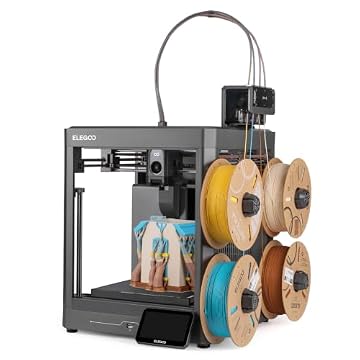



Photographs published on the Amazon listing.
The package brings together a rigid CoreXY platform and automated multi-material delivery hardware designed to streamline multi-shade models without aftermarket add-ons. Every included element focuses on eliminating guesswork during assembly, daily calibration, and nozzle upkeep.
- Elegoo Centauri 2 CoreXY metal 3D printer chassis
- CANVAS 4-color printing module with independent feed motors
- Integrated RFID filament recognition system
- Automatic filament runout refill handling
- Full auto-calibration system backed by 22 intelligent monitoring sensors
- Smart pre-print diagnostic routine
- Rigid aluminum structural frame equipped with precision linear guides
- High-flow printhead supporting active vibration compensation
- Precise extrusion control assembly with quick-release magnetic cover
- Semi-automatic belt tensioning hardware
- Dedicated automated nozzle wiper
- 5-inch high-resolution touchscreen interface
- Software connectivity for laptop, PC, smartphone, and tablet control
Key Specifications
Specification Attribute
Manufacturer Detail
- Item Model Number
- Centauri 2 Combo
- Kinematic Architecture
- High-Speed CoreXY
- Maximum Print Speed
- Up to 500 mm/s
- Maximum Acceleration
- 20,000 mm/s²
- Multicolor Capability
- CANVAS 4-color printing with independent motors
- Filament Automation
- RFID material recognition and auto refill
- Structural Material
- Metal chassis with rigid aluminum frame and linear guides
- Machine Dimensions
- 19.69 inches D x 18.9 inches W x 23.23 inches H
- Item Weight
- 15 kg (approx. 33 lbs)
- Sensor Suite
- 22 real-time intelligent monitoring sensors
- User Interface
- 5-inch integrated touchscreen
- Device Compatibility
- Laptop, Personal Computer, Smartphone, Tablet
Copied from the Amazon listing. These figures were not measured here.
CoreXY Motion Architecture and High-Speed Execution
The mechanical core of this machine relies on an engineered CoreXY drive configuration mounted inside a rigid aluminum frame. Traditional Cartesian printers push a heavy heated bed back and forth along the Y-axis, creating mechanical momentum that can lead to visible ringing artifacts at elevated velocities. In contrast, this CoreXY design locks the build platform into a vertical Z-axis movement path while twin coordinated belts maneuver a lightweight toolhead across the X and Y coordinates. Paired with precision linear guides, the structural rigidity minimizes frame flex under aggressive direction changes, allowing the printhead to reach acceleration values up to 20,000 mm/s² and top travel speeds of 500 mm/s.
Velocity without dynamic compensation often produces severe surface imperfections, such as corner bulging and ghosting across flat panels. To preserve fine geometry, the system utilizes active vibration compensation alongside precise extrusion management algorithms. The controller monitors kinematic resonance and dynamically adjusts stepper micro-stepping to cancel harmonic disturbances before they deform molten filament. Makers familiar with manual gantry adjustments on open-bed platforms like the Neptune 4 Plus will appreciate how enclosed rigidity and rigid linear guides maintain structural squareness over extended high-velocity print jobs.
Sustaining 500 mm/s operational rates also demands rapid heat transfer and reliable feeding kinematics. The extruder drive utilizes tight gear meshing to eliminate slippage during rapid retractions, which occur continuously when completing intricate infill patterns or fine surface texturing. Because the rigid metal chassis dampens motor resonance, the machine avoids the wandering belt track issues that plague lightweight aluminum extrusion builds, delivering sharp edges, uniform external perimeters, and accurate vertical dimension tolerances.
Automated Four-Color Filament Management With CANVAS
Multi-color FDM printing has traditionally required complex manual interventions, third-party filament splicing equipment, or custom firmware hacking. The CANVAS 4-color printing module streamlines this workflow by employing four independent drive motors to guide different filaments through a centralized feed manifold directly into the hotend. Each spool channel operates on dedicated gearing, allowing immediate retraction of inactive filament and swift insertion of the active color during layer transitions. This motorized architecture drastically reduces transition latency compared to single-motor multi-filament selector switches.
Material identification and tracking are managed through an integrated RFID filament recognition module. When compatible spools are placed into the CANVAS bays, the system reads embedded filament telemetry, immediately passing optimal extrusion temperatures, flow rates, and density settings to the controller. Additionally, the system incorporates an automatic filament refill feature. When a primary spool runs out during a lengthy project, the controller automatically switches the feed line to a matching reserve spool in an adjacent slot without terminating the print job. This continuous feeding capability protects multi-day prints against runout failures.
Color change reliability also hinges on waste management and nozzle purity. Whenever colors swap, residual melted plastic from the previous hue must be cleared to prevent cross-color bleeding. The machine utilizes a mechanical nozzle wiper mounted inside the build envelope to strip away purge residue and ooze curls before the printhead returns to the primary model path. While makers once built custom tool changers or multi-switchers using an external Elegoo Mega 2560 controller board, the integrated CANVAS framework delivers a fully synchronized, factory-engineered multi-color process.
Sensory Automation and Daily Calibration Workflow
Achieving a reliable first layer is critical in modern 3D printing, and this machine addresses bed adhesion through an array of 22 intelligent sensors placed throughout the platform and toolhead. These sensors continuously track bed alignment, thermal uniformity, movement tolerances, and filament flow dynamics. Prior to starting a job, the system executes an automated diagnostic routine that verifies axis clearances, verifies heater cartridge responsiveness, and builds a comprehensive topographic mesh of the build plate to compensate for minute bed height variances.
The automated leveling routine operates without manual adjustment knobs or manual z-offset paper friction tests. The sensor array registers the contact distance across multiple reference coordinates, calculating an active compensation matrix that the Z-axis leadscrews follow during the initial layer pass. This continuous monitoring ensures that the first layer achieves proper squish across the entire print bed, preventing corner warping and premature part detachment without user intervention.
Routine hardware upkeep has also been simplified through modular mechanical design. The printhead features a magnetic snap-on cover, allowing immediate access to the extruder assembly, heater block, and cooling fans without loosening microscopic machine screws. Furthermore, maintaining optimal belt tightness across the CoreXY drive paths is handled by semi-automatic belt tensioners. Rather than guessing belt deflection frequencies with an external acoustic gauge, operators loosen a locking fastener, allowing spring-calibrated tensioning blocks to establish correct belt tension before re-securing the mechanism.
Software Ecosystem and Remote Workspace Control
Connecting digital design files to physical hardware is managed via the unified manufacturer ecosystem, which links the Nexprint model repository, the dedicated ELEGOOSlicer software, and the ELEGOO Matrix mobile application. Nexprint offers a curated platform of pre-tested, slice-ready 3D models configured with optimal orientation and support structures. For users who prefer tailoring their own CAD geometries, ELEGOOSlicer provides precise control over multi-material painting tools, support interface parameters, wall counts, and internal infill structures.
Remote hardware monitoring allows operators to manage print queues without remaining physically seated next to the machine. Through the ELEGOO Matrix application, compatible with smartphones and tablets, users can initiate pre-heating routines, monitor progress bars, adjust feed rates, and receive diagnostic notifications if an error occurs. Computer and laptop users retain identical oversight using networked desktop connectivity. This network infrastructure represents a major ergonomic shift from older generation printers like the Longer LK5 Pro, which required carrying physical SD cards back and forth between a desktop workstation and the workshop floor.
Direct machine control is operated through an integrated 5-inch full-color touchscreen mounted on the front chassis. The graphic interface provides intuitive visual previews of loaded G-code files, displays remaining filament approximations reported by the RFID sensors, and offers one-touch calibration toggles. Whether launching a quick mechanical bracket from a mobile device or slicing a complex multi-tone character model on a high-end workstation, the unified software stack reduces operational friction across all supported client devices.
Workspace Requirements and Acoustic Footprint
Integrating a high-speed enclosed CoreXY machine into a home office, workshop, or classroom demands an evaluation of physical dimensions, mass, and workspace clearance. The machine measures 19.69 inches deep, 18.9 inches wide, and 23.23 inches tall, with an overall weight of 15 kilograms. Unlike open-bed machines that require expansive front-to-back clearance to accommodate a sliding build platform, this unit maintains a fixed exterior perimeter, making it easier to position on standard modular shelving or sturdy workbenches.
However, the mass of 15 kg reflects a dense metal chassis built to withstand the kinetic forces of 20,000 mm/s² acceleration. When the printhead changes direction at peak operational velocity, those reactive forces translate directly into the supporting surface. Placing the printer on a flimsy desk or unstable table can induce mechanical resonance, causing the furniture to wobble and potentially degrading print surface quality. A solid, level workbench or dedicated heavy utility stand is strongly recommended to ensure stable operation.
The enclosed design also provides thermal consistency and noise dampening compared to open gantry machines. Enclosing the build area shields the molten polymer from ambient cross-drafts, preventing rapid edge contraction when working with warp-prone filaments. While rapid toolhead movements and active cooling fans generate audible airflow, the rigid metal frame and vibration compensation algorithms keep mechanical motor whine well contained, rendering the machine suitable for everyday home studios or educational maker spaces.
Elegoo Centauri 2 Combo Pros and Cons
Pros
- CANVAS four-color printing with RFID recognition
- High-speed CoreXY motion reaching 500mm/s
- Rigid aluminum frame with precision linear guides
- Full auto calibration using 22 sensors
- Semi-automatic belt tensioner and magnetic printhead cover
Cons
- Substantial 15-kilogram metal chassis weight
- Multi-color purging generates plastic waste
- Demands a sturdy desk to handle acceleration forces
Check Elegoo Centauri 2 Combo on Amazon
Is the Elegoo Centauri 2 Combo Worth It
The platform delivers clear value for hobbyists, digital artists, and small-batch fabricators who want multi-color functional components without assembling third-party accessories. Its combination of 500 mm/s CoreXY speed, full pre-print sensor checks, and an automated 4-color feed system eliminates the primary stumbling blocks of home 3D printing: inconsistent bed leveling, manual filament spool changes, and slow build speeds. Beginners will find the automated pre-flight checks and RFID recognition especially reassuring, while experienced makers will appreciate the precision linear guides, rigid aluminum chassis, and active vibration compensation.
However, prospective buyers must consider the practical trade-offs of multi-color FDM printing. Color changes require purging molten filament between transitions, which generates scrap plastic and inevitably lengthens print times compared to single-color production runs. Furthermore, those who require an expansive build envelope for oversized single-piece theatrical props or large architectural mockups might find open-format bedslingers more suitable for raw volume. If your priority is automated multi-tone prints, reliable first layers, and enclosed CoreXY motion, this machine provides an exceptionally polished, production-ready system.
Ultimately, if you want an enclosed, modern machine that balances automated setup routines with fast, dependable multi-material execution, the platform stands as an excellent investment for your creative workspace. For creators looking at advanced additive systems like the Elegoo Carbon 2 or transitioning from basic single-extruder tools, this combo package provides an accessible on-ramp to modern multicolor fabrication.
Other Options to Consider
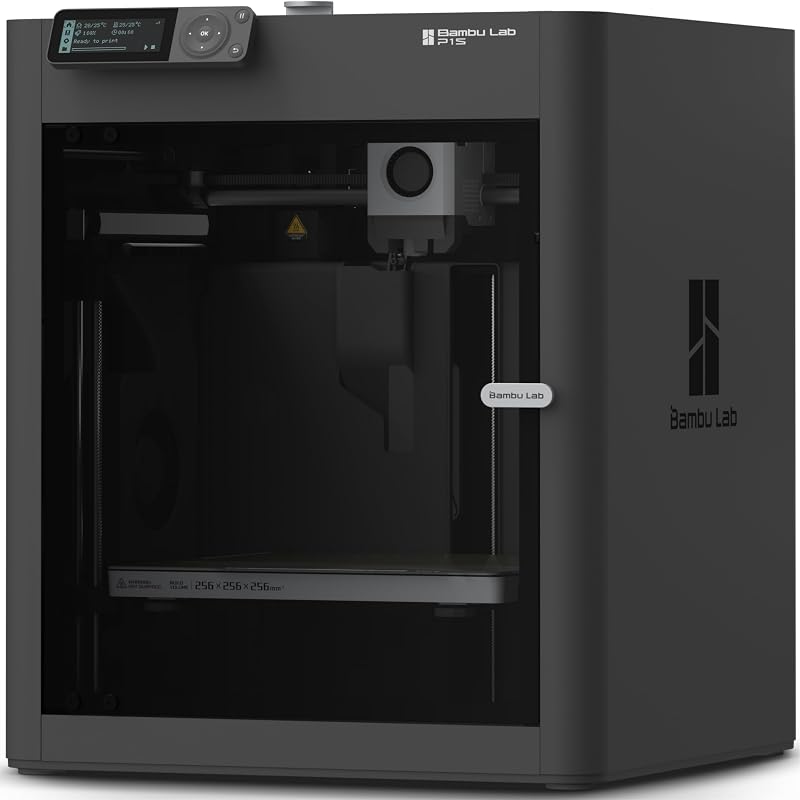
MakerWorld Model Library (Bambu Lab P1S Combo with AMS) provides an alternative enclosed CoreXY ecosystem featuring an integrated multi-material filament switcher and high-speed motion, making it a viable consideration for makers heavily invested in that brand’s existing slicing and model-sharing network.

FLASHFORGE Adventurer 5M 3D Printer caters to makers who prioritize high-speed single-material fabrication, offering a 600 mm/s maximum print speed, an all-metal CoreXY frame, a 280-degree direct extruder, and a 3-second detachable nozzle over multicolor capabilities.
Beginner-Friendly Ecosystem with MakerWorld Model (Bambu Lab P1S Standalone) suits print enthusiasts who desire an enclosed high-precision CoreXY setup right away but prefer to defer purchasing an automated multi-filament feeding unit until their production workflow specifically demands it.
FAQ
How does the CANVAS 4-color printing system switch filaments
The CANVAS system utilizes four independent motorized feeders to advance and retract up to four filament lines into a centralized hotend manifold. When a layer requires a different shade, the active filament retracts, the new strand inserts automatically, and the nozzle wiper removes residual purge material before printing resumes.
Can the machine automatically switch to a new spool when filament runs out
Yes. The automated refill system detects when a primary spool has expired and seamlessly transitions feed operations to an identical filament loaded into another bay of the CANVAS unit, preventing unfinished prints due to empty spools.
What devices can be used to monitor and control the printer
The printer offers cross-platform software integration, supporting network control through personal computers and laptops via ELEGOOSlicer, as well as remote mobile management on smartphones and tablets using the ELEGOO Matrix application.
What does the 22-sensor monitoring system do during operation
The 22 intelligent sensors monitor essential mechanical parameters, including automated bed leveling coordinates, printhead clearances, thermal stability, and pre-print structural checks to maintain print quality from the first layer through final completion.
How are the drive belts tensioned on this machine
The platform features a semi-automatic belt tensioner mechanism that eliminates manual guesswork. Operators loosen the integrated tensioner fasteners, enabling internal spring assemblies to set the appropriate belt tension across the linear guide system before re-securing.


