
As Amazon Associates, we earn from qualifying purchases. This means we may receive a small commission at no extra cost to you if you click through and make a purchase.
When shopping for a modern desktop 3D printer, the toolhead mechanism determines whether your prints succeed smoothly or turn into a mess of tangled plastic. The Bambu Lab A1 direct drive extruder is engineered to eliminate the feeding inconsistencies, flexible filament binding, and tedious calibration steps that plagued earlier generations of desktop machines. For makers looking to explore multi-material models without dealing with endless mechanical troubleshooting, understanding how this specific assembly manages filament tension, rapid flow rates, and multi-line retraction is the key to deciding if it matches your workshop needs.
This comprehensive breakdown examines the mechanical architecture of the direct drive assembly, how it communicates with multi-spool feeding hardware, and what to expect during day-to-day operation. We will evaluate setup times, routine maintenance tasks, software integration through the Bambu ecosystem, and direct comparisons against standalone replacement feeders on the market today.
What You Get With the Bambu Lab A1
Bambu Lab A1


Photographs published on the Amazon listing.
The system arrives configured as an integrated unit designed to minimize assembly friction right out of the shipping carton. Rather than forcing you to align belts, calibrate drive gears, and mount standalone hotends piece by piece, the manufacturer supplies a cohesive hardware package built around automated calibration routines and modular feeding components.
- Integrated direct extruder drive toolhead mechanism
- Multi-colour printing with AMS Lite combo support
- Rapid printing speed system architecture
- Quick 15-minute setup modular frame
- Bambu Studio and Bambu Handy app ecosystem compatibility
- Wi-Fi connectivity through Bambu-Bus communication
- High-temperature 3D printer functionality designed for plastic filament
Key Specifications
Feature
Specification
- Brand
- BambuLab
- Model Number
- A1
- Extruder Architecture
- Direct Extruder Drive
- Setup Time
- Quick 15-Minute Setup
- Material Compatibility
- Plastic Filament
- Color Support
- Multi-Colour Printing with AMS Lite combo
- Connectivity
- Wi-Fi via Bambu-Bus
- Software
- Bambu Studio & Bambu Handy App
- Package Dimensions
- 24.17 x 20.47 x 12.91 inches
- Item Weight
- 8.3 kg
Copied from the Amazon listing. These figures were not measured here.
Direct Drive Extruder Mechanics and Feeding Precision
The core advantage of the bambu lab a1 direct drive extruder lies in the physical proximity between the feed motor and the melting zone. In traditional Bowden setups, filament must travel through a long, flexible PTFE tube before reaching the nozzle, creating mechanical slack that complicates retraction and degrades fine surface details. By positioning the drive gears directly above the melt zone, the toolhead maintains immediate, tactile grip over the plastic filament, translating motor steps into exact material deposition without hysteresis.
This immediate traction is critical when taking advantage of the bambu lab a1 rapid print speed capabilities. Fast print heads require rapid acceleration and sudden volumetric flow transitions. When moving around sharp corners or infill boundaries, the extruder must instantly stop the flow of melted plastic to prevent oozing and stringing. The direct drive setup provides the necessary mechanical leverage to retract material fractions of a millimeter instantly, ensuring clean surface seams even during aggressive print profiles. Those considering enclosed alternatives like the bambu lab p1s will note that this responsive direct feeding approach remains consistent across the brand’s performance-oriented toolheads.
Examining the bambu lab a1 extruder specs highlights its role in eliminating common user errors. Because the drive mechanism is factory-tuned and integrated into the toolhead housing, users avoid the trial-and-error tensioning adjustments required by third-party aftermarket feeders. The listing notes that the unit is built as a high-temperature 3D printer compatible with plastic filament, meaning the internal drive components are paired with thermal management systems that resist heat creep during extended print runs.
Multi-Color Feeding and AMS Lite Integration
Multi-material fabrication introduces severe demands on an extrusion system, requiring repeated cuts, retractions, and re-feeds across hundreds of layer transitions. The bambu lab a1 ams lite setup addresses this challenge by pairing a motorized multi-spool feeder with the direct drive toolhead through an automated switching sequence. Instead of requiring manual filament swaps or complicated purge-block hacks, the system coordinates material changes electronically.
During bambu lab a1 multi color printing tasks, communication flows continuously between the spool holder and the toolhead using the proprietary Bambu-Bus Wi-Fi and cable interface. When a color change occurs, the toolhead severs the current strand, retracts it back toward the AMS unit, and welcomes the next line of plastic filament into the drive gears. This seamless interplay prevents the jams and ground filament shavings that frequently occur when retrofitting multi-material accessories onto generic extrusion hardware. Those exploring multi-material workflows can examine our dedicated guide to the bambu lab a1 ams for deeper operational context.
The mechanical reliability of this interface relies heavily on the toolhead entry pathway. Because multiple feed lines converge into a compact direct drive assembly, the internal alignment must be extraordinarily precise. The direct drive gears grip each freshly fed strand automatically without requiring user intervention to feed the material into the hotend zone. This automated handshake transforms multi-hue modeling from a frustrating calibration puzzle into an everyday utility suitable for functional tags, decorative art, and color-coded prototypes.
Routine Care and Extruder Maintenance Workflows
Even the most advanced toolhead designs require occasional inspection to maintain baseline extrusion accuracy. Consistent bambu lab a1 extruder maintenance involves monitoring the drive gears for plastic dust build-up, verifying that the filament cutting lever moves smoothly, and keeping the feed path clear of debris. Over time, abrasive or brittle filaments can shed micro-particles inside the gear teeth, which gradually decreases grip friction and leads to under-extrusion during high-speed runs.
Access to the drive path is engineered for simplicity. When a user experiences a feeding obstruction or requires a bambu lab a1 extruder replacement, the modular architecture minimizes teardown complexity. Rather than unspooling complex wiring harnesses and disassembling the entire motion gantry, the extruder assembly utilizes discrete mounting points and quick-connect interfaces that allow owners to service or swap the feeding components in minutes. The listing does not specify whether extra replacement gears are bundled in the package, meaning replacement modules should be sourced as official accessories when wear occurs.
Preventative care also extends to maintaining smooth communication between the toolhead sensors and the mainboard. Keeping the Wi-Fi connectivity and Bambu-Bus connections firmly seated ensures that real-time feed errors or runout warnings register instantly on your management dashboard. Taking five minutes every few weeks to brush out the gear chamber and inspect the nozzle interface protects print quality and prevents unexpected downtime on lengthy print jobs.
Setup Simplicity and Software Workflow
For individuals stepping into 3D fabrication for the first time, complex initial assembly presents the largest barrier to entry. The bambu lab a1 for beginners experience is centered around a quick 15-minute setup process that eliminates the hours of squaring frames and wiring terminal blocks common to older kit printers. Because the direct drive toolhead arrives pre-assembled and aligned to the motion system, newcomers bypass the most error-prone stage of hardware installation.
Software orchestration plays an equally critical role in how the extruder operates. Through Bambu Studio on desktop computers and the Bambu Handy app on mobile devices, print parameters are automatically tailored to the direct drive mechanism’s mechanical limits. Acceleration curves, volumetric speed caps, and retraction distances are configured out of the box for standard plastic filament types, removing the need for manual slicer tuning. You can manage multi-part assemblies, slice intricate geometry, or monitor community projects like the bambu lab led lamp kit directly through your connected mobile device over the local Wi-Fi connection.
This closed software-hardware loop also safeguards the toolhead during operation. If the extruder encounters abnormal feeding resistance or runs out of plastic filament mid-print, the system pauses execution and relays an immediate alert to the user’s phone via the Bambu Handy application. This operational safety net gives beginners the confidence to initiate multi-hour print files without standing over the machine to watch the toolhead deposit every layer.
Bambu Lab A1 Pros and Cons
Pros
- Direct extruder drive mechanism
- Quick 15-minute setup time
- Multi-colour printing with AMS Lite
- Rapid printing speed capability
- Bambu Studio and Bambu Handy compatibility
- Built-in Wi-Fi connectivity
Cons
- Weight is relatively heavy at 8.3 kg
- Listing does not specify build volume
- Requires AMS Lite combo for multi-color feeds
Is the Bambu Lab A1 Worth It
Determining whether the question is bambu lab a1 worth it yields a positive answer depends primarily on how much value you place on time savings and automation. If you are a creator who views a 3D printer as a tool to realize physical objects rather than a project machine requiring constant mechanical tinkering, the integrated direct drive extruder and automated multi-color handling provide immense practical value. The rapid 15-minute setup and turnkey software ecosystem eliminate nearly all the traditional setup headaches.
For hobbyists focused strictly on large-format single-color parts who enjoy manually calibrating guide wheels and upgrading drive gears, the integrated ecosystem might feel more locked-down than open-source kit machines. However, the sheer mechanical reliability of the direct extruder drive, combined with its high printing speed capabilities and hands-off multi-color feeding, makes it an exceptional productivity asset for makers, small businesses, and classrooms alike.
Ultimately, the machine excels because its individual components are designed to work together from day one. Instead of troubleshooting third-party direct drive adapters or fighting Bowden tube friction, owners receive an optimized extrusion platform that delivers clean surfaces and accurate color transitions with minimal routine intervention.
Other Options to Consider
Creality Official Ender 3 Extruder is an aluminum metal drive feeder upgrade designed for machines like the Ender-3 Pro, V2, and CR-10 series, making it the ideal choice for tinkerers who want an inexpensive metal replacement part to repair a broken plastic arm on an existing Bowden printer rather than buying a complete modern machine.
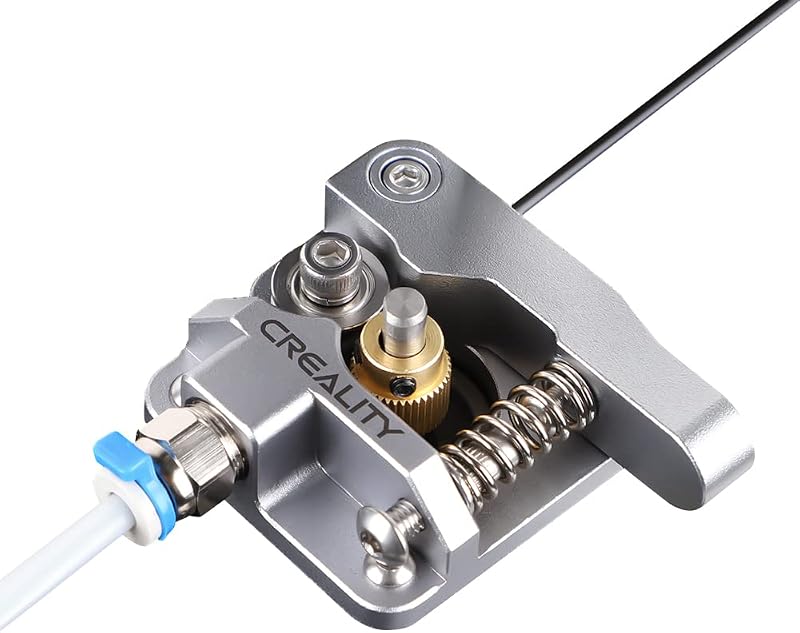
for Creality Ender 3 Pro offers an all-metal MK8 Bowden aluminum extruder kit featuring a 40-teeth drive gear, which suits DIY hobbyists looking to upgrade older Ender 3 or CR-10 setups to improve filament grip while preserving their existing Bowden tube motion architecture.
ELEGOO 3D Printer Extruder provides a fully assembled dual-gear direct drive replacement unit specifically engineered for the Neptune 3 Pro, Plus, and Max 3D printers, catering directly to Neptune owners who need an official drop-in direct drive toolhead replacement.

FAQ
Does the Bambu Lab A1 feature a direct drive or Bowden extruder?
The Bambu Lab A1 utilizes an integrated direct extruder drive located directly above the hotend, which ensures precise filament control, rapid retractions, and consistent feeding performance.
Can the extruder handle multi-color prints out of the box?
The listing states that the machine supports multi-colour printing when paired with the AMS Lite combo, utilizing an automated feeding and retraction sequence managed over Wi-Fi and Bambu-Bus communication.
How long does the initial setup take before printing?
The manufacturer highlights a quick 15-minute setup process, arriving ready to use with minimal assembly required compared to traditional kit-style desktop printers.
What filament types can the Bambu Lab A1 extruder feed?
The product listing specifies compatibility with plastic filament and describes the machine as a high-temperature 3D printer, though specific composite filament limitations are not detailed in the listing data.
What software is used to control the Bambu Lab A1 extruder?
The machine is fully compatible with the Bambu Studio desktop slicer and the Bambu Handy mobile application, allowing users to send print files and manage extrusion profiles over Wi-Fi.


