As Amazon Associates, we earn from qualifying purchases. This means we may receive a small commission at no extra cost to you if you click through and make a purchase.
Finding the right smartthings home hub setup often means figuring out how to connect specialized sensors, switches, and controllers without cluttering your living space with redundant hardware. The Aqara Hub M3 enters this ecosystem as an advanced multi-protocol coordinator built to unify disparate communication standards. For homeowners asking whether this device can successfully anchor or expand an existing SmartThings environment, the answer lies in its implementation of Matter bridging and Thread networking. Rather than forcing you to abandon your established routines, it acts as a translation layer that pulls Zigbee accessories, infrared appliances, and local automation rules together into a unified platform.
In this guide, we evaluate what the Aqara Hub M3 brings to a connected residence, how its dual-band wireless and wired networking function, and how effectively it serves as an aqara hub m3 smartthings bridge. We will break down the hardware specifications provided by the manufacturer, analyze edge computing capabilities, examine installation options including Power over Ethernet, and look at realistic alternatives. By reviewing the device architecture, storage provisions, and integration methods, you can decide whether this coordinator represents the right upgrade path for your smart home setup.
What You Get With the Aqara Hub M3
Aqara Hub M3
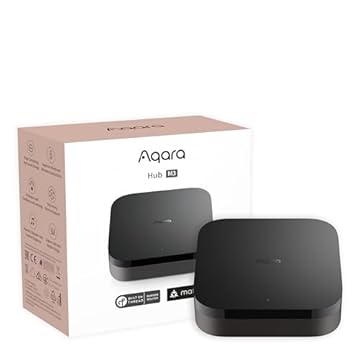


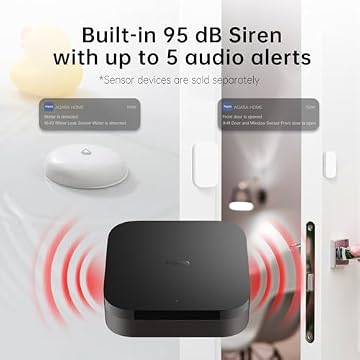
Photographs published on the Amazon listing.
The Aqara Hub M3 is packaged as a compact central controller engineered to handle local operations, cross-platform bridging, and legacy equipment communication. Built by Lumi United Technology Co., Ltd, the unit combines multiple radios and physical connection options within a lightweight square enclosure designed for discrete mounting or tabletop placement.
- Aqara Hub M3 multi-protocol edge coordinator (Model HM-G01E)
- Integrated 360-degree infrared blaster with remote signal learning and feedback detection
- Thread border router and Matter controller networking radios
- Aqara Zigbee device coordination for local sub-device networks
- Dual-band Wi-Fi transceiver supporting 2.4 GHz and 5 GHz bands with WPA3 encryption
- Power over Ethernet (PoE) enabled RJ45 Ethernet network port
- USB-C power connection port compatible with backup power banks and mini-UPS hardware
- 8GB of secure, end-to-end encrypted onboard local storage
- Manufacturer documentation and 12-month warranty coverage
Key Specifications
The technical parameters detailed in the official listing outline the physical build, protocol support, and power capabilities of the coordinator.
Specification
Manufacturer Detail
- Brand
- Aqara
- Model / Part Number
- HM-G01E
- Manufacturer
- Lumi United Technology Co., Ltd
- UPC
- 192784001165
- Product Dimensions
- 4.13 x 4.13 x 1.41 inches
- Item Weight
- 0.17 kg
- Color
- Black
- Network Radios
- Thread, Zigbee, Bluetooth, Dual-Band Wi-Fi (2.4 GHz / 5 GHz)
- Security & Storage
- WPA3 Wi-Fi Security, 8GB Encrypted Local Storage
- Power Interfaces
- Power over Ethernet (PoE), USB-C
- Ecosystem Compatibility
- SmartThings, Apple HomeKit, Amazon Alexa, Home Assistant
- Hardware Warranty
- 12 Month Warranty
Copied from the Amazon listing. These figures were not measured here.
Matter Bridging and SmartThings Compatibility
Integrating third-party accessories into an established automation platform has traditionally required individual cloud skills or dedicated software drivers. Operating as an aqara hub m3 matter controller, this hardware solves that issue by functioning as a certified Matter bridge. When paired into the SmartThings app using Matter onboarding, the unit exposes supported Aqara Zigbee and Thread sub-devices directly to your SmartThings device list. This setup allows you to take advantage of Aqara sensors, contact monitors, and specialized wireless switches without needing a separate bespoke driver for every single peripheral.
Beyond functioning as a bridge, the unit is equipped with Thread border routing capabilities. Acting as an aqara hub m3 thread border router, it joins your local mesh network and shares Thread-based devices across compatible Matter controllers on the same home network. For an environment centered around a smartthings compatible hub, this protocol bridging prevents network fragmentation. Devices that communicate over Thread can route signals efficiently, while Zigbee child devices linked to the M3 appear seamlessly alongside your standard SmartThings hardware.
It is important to understand the boundary conditions of this integration model. While the hub exposes Aqara-exclusive scenes and sub-devices across the Matter fabric, advanced manufacturer-specific configuration settings remain managed inside the proprietary Aqara Home mobile application. Everyday automations, group triggers, and routine scheduling can be handled directly within SmartThings, but initial firmware updates, sensor sensitivity thresholds, and specialized operating modes still route through the native Aqara utility. This split structure ensures standard functionality remains accessible in your main dashboard while keeping deeper diagnostic controls available when needed.
Local Automation and Edge Processing Reliability
One of the primary structural strengths of the hardware is its role as an edge coordinator designed to prioritize local execution. In standard consumer smart setups, simple commands such as a door sensor triggering an overhead light often bounce off a remote cloud server before completing the action. The aqara m3 local automation engine eliminates this vulnerability by executing rules internally across connected hardware. Upon integration into an existing system with multiple Aqara hubs, the M3 can supersede earlier hubs, migrating existing automations between them to run locally rather than through external servers.
To support persistent edge computing, the manufacturer equips the unit with 8GB of end-to-end encrypted onboard storage. This non-volatile memory stores system parameters, device lists, schedule rules, and automation logic locally on the device itself. Even if your wide area internet connection experiences downtime, automated routines linking sensors to switches continue to fire without disruption. While certain outbound alerts and remote push notifications still require an active internet connection according to the listing data, the core logic governing your home infrastructure remains operational.
Privacy is reinforced through physical hardware choices. The M3 explicitly excludes microphone arrays and optical camera lenses, ensuring no audio or visual surveillance data is processed or recorded in your living space. For privacy-conscious homeowners coordinating complex hardware environments—such as blending home automation bridges with specialized local appliances like the home assistant green smart home hub—this local-first, closed-hardware design provides dependable data isolation.
Power Options and Network Installation
Network reliability is critical for any device serving as a smart home backbone, and the M3 accommodates varied physical environments through flexible power and communication ports. An aqara hub m3 poe setup leverages the integrated RJ45 Ethernet port, drawing both low-voltage electrical power and high-speed local data through a single network cable connected to a PoE-enabled network switch or power injector. PoE wiring eliminates wall warts, simplifies placement inside equipment racks or ceiling locations, and ensures uninterrupted data transmission free from radio frequency congestion.
For installations where running Ethernet cabling is impractical, the coordinator includes dual-band Wi-Fi transceivers operating on both 2.4 GHz and 5 GHz frequencies. The integration of 5 GHz connectivity helps bypass crowded 2.4 GHz channels commonly saturated by older smart devices, baby monitors, and microwave interference. Furthermore, the unit supports modern WPA3 wireless security protocols, ensuring that wireless data exchanges meet current encryption standards. The listing does not specify whether a standalone wall power brick is supplied in the box, but it highlights that power can be supplied via a standard USB-C port.
The USB-C input also introduces valuable resilience for installations requiring continuous uptime. Because the port accepts standard 5-volt power delivery, users can connect small portable power banks or mini-UPS battery backup accessories. If your residence experiences a localized electrical brownout or brief power failure, the hub remains active, keeping your local sensor network and battery-operated safety triggers armed. When combined with hardwired panels like the konnected alarm panel pro, maintaining clean, uninterrupted low-voltage power across all monitoring hubs ensures your home automation infrastructure does not drop offline unexpectedly.
Integrated Infrared Control and Climate Management
Bridging traditional consumer electronics with modern Matter environments is notoriously challenging, but the M3 addresses this with an integrated 360-degree infrared blaster. Traditional IR blasters operate blindly by transmitting an activation pulse without verifying whether the target appliance received it or altered its operational state. The M3 incorporates IR feedback and signal learning, allowing it to detect traditional handheld remote usage in the room and update device status indicators accurately inside your connected dashboards.
This infrared functionality extends directly into smart climate automation. When coordinated with an Aqara temperature and humidity sensor, the M3 can translate room climate metrics into automated IR commands directed at conventional mini-split systems, portable air conditioners, or window units. Through its Matter bridge, the M3 exposes these connected IR cooling units as native thermostats to Matter platforms like SmartThings. This bridge allows you to set target temperatures, adjust modes, and schedule heating or cooling intervals alongside your smart plugs, blinds, and exterior sensors.
Incorporating infrared learning within a single physical enclosure avoids the clutter of external USB blasters and separate power leads. By positioning the unit in an open space with line-of-sight to wall-mounted split units or entertainment media consoles, you gain remote and automated management over legacy gear. This unified bridge makes it easier to link household climate rules with broader environmental management, whether you are managing indoor comfort or coordinating with outdoor security hardware like the reolink argus 4 pro.
Aqara Hub M3 Pros and Cons
Pros
- Power over Ethernet and dual-band Wi-Fi
- Matter controller and Thread border router
- 8GB encrypted local edge automation storage
- 360-degree infrared blaster with remote feedback
- Zero built-in cameras or microphones
Cons
- Some alert notifications require internet access
- Listing does not specify included power adapter
- Third-party Zigbee devices not natively supported
Is the Aqara Hub M3 Worth It
Determining whether the aqara hub m3 for smart home use is worth adding to your setup depends heavily on your existing device ecosystem and communication standards. If you already manage a collection of Aqara Zigbee door, window, motion, and climate sensors, the M3 represents a major architectural upgrade. By taking over coordination from legacy hubs, moving automations to local edge execution, and exposing those accessories cleanly to SmartThings via Matter, it simplifies multi-platform management without sacrificing stability.
For users who rely exclusively on native SmartThings-branded Z-Wave devices or standard Wi-Fi switches, the M3 offers fewer immediate advantages. Because the unit does not include a Z-Wave radio, it cannot manage or route signals for Z-Wave products. Shoppers seeking a primary hub strictly for Z-Wave equipment will not find that capability here. However, if your long-term plan involves expanding into Thread-based hardware and Matter accessories, the unit’s Thread border routing and dual-band networking provide future-proof infrastructure that works smoothly alongside an existing smartthings home hub.
Ultimately, the Aqara Hub M3 earns its place in homes that demand local reliability, Power over Ethernet flexibility, and seamless bridge capability across multiple smart home ecosystems. The addition of an infrared learning transceiver that converts standard air conditioning units into Matter-controllable thermostats makes it a versatile device rather than a simple radio bridge. For anyone bridging the gap between Aqara hardware and a unified SmartThings interface, the M3 offers a dependable, privacy-focused foundation.
Other Options to Consider
Amazon Echo Hub suits users who prefer an interactive 8-inch wall-mounted touch display with hands-free voice assistance rather than a discrete headless controller. While the M3 focuses on local background edge execution without cameras or microphones, the Echo Hub provides customizable on-screen widget controls, Alexa voice interactions, and visual device monitoring for homes centered on the Amazon Alexa ecosystem.

AqaraThread Border Router (Smart Hub M100) provides an entry-level alternative for homeowners who require Thread border router functions, Matter controller capabilities, and basic Aqara Zigbee sub-device management over Wi-Fi without needing advanced Power over Ethernet hardware or an integrated 360-degree infrared climate blaster.
FAQ
Does the Aqara Hub M3 work directly with SmartThings?
Yes, the M3 connects with SmartThings via Matter. It operates as a Matter controller and bridge, enabling supported Aqara Zigbee and Thread sub-devices to sync into the SmartThings app for unified control and cross-platform routine building.
Can the Aqara Hub M3 operate my automations without internet?
Yes, the M3 acts as an edge coordinator with 8GB of encrypted onboard storage dedicated to executing automations locally. Basic device-to-device rules will continue to run even if your internet goes down, although remote app access and cloud-based push notifications still require active internet connectivity.
Does the Aqara Hub M3 support Power over Ethernet?
Yes, the unit features an RJ45 Ethernet port compatible with Power over Ethernet (PoE). This allows a single Ethernet cable to supply both local network connectivity and operating power when connected to a compatible PoE switch or injector.
Can the M3 control traditional air conditioners?
Yes, the hub includes an integrated 360-degree infrared blaster with feedback detection. When paired with an Aqara temperature and humidity sensor, it can function as a thermostat by sending learned IR commands to compatible air conditioning units, exposing them to Matter ecosystems.
Does the Aqara Hub M3 include built-in microphones or cameras?
No, the manufacturer specifically designed the hardware without microphones or optical camera sensors to prioritize user privacy. System configuration parameters and device tables remain stored locally using end-to-end encryption.