
As Amazon Associates, we earn from qualifying purchases. This means we may receive a small commission at no extra cost to you if you click through and make a purchase.
As an Amazon Associate we earn from qualifying purchases. Links on this page are affiliate links.
If you are evaluating universal audio volt 4 max USB alternatives, comparing published specifications will clarify your options. The Universal Audio Volt 4 Max provides 32-bit audio resolution, onboard DSP compressor presets, and digital input expansion through ADAT. It also features standard MIDI I/O, a reliable USB host connection, and a visual smart display in a desktop chassis measuring 9.45 by 5.91 by 4.72 inches and weighing 2.2 pounds.
You might still need different hardware features for your specific recording setup. You may require dual USB-C ports for streaming across two computers, a larger 19-inch rackmount chassis, or alternative preamp gain levels from another brand. The 6 alternatives on this list were chosen because their specifications overlap with the original unit. Each audio interface shares key capabilities, including onboard DSP processing, multi-channel USB connectivity, MIDI routing, or digital ADAT expansion options.
How Each Alternative Compares
Elgato Wave XLR Pro Dual USB-C Audio Interface
Elgato Wave XLR Pro gives you dual USB-C ports to connect two computers at once, along with 80 dB of preamp gain. It is lighter and more compact than the Volt 4 Max, weighing 13.4 ounces with a 1.5-inch height. However, you give up the Volt 4 Max’s ADAT optical expansion, 32-bit audio resolution, and dedicated MIDI connections. Elgato also includes onboard DSP for processing. You should choose this interface if you run a dual-PC streaming or podcasting setup and do not require external ADAT preamps or synth hardware connectivity.
Yamaha 6×4 USB-C Audio Interface
Yamaha URX44C matches the Volt 4 Max with 32-bit recording and onboard DSP, but it includes four microphone preamps directly on the chassis. It also features USB-MIDI connectivity alongside line and Hi-Z instrument inputs. In exchange, you lose the ADAT optical input that allows the Volt 4 Max to add external digital channels. The URX44C also demands more desk space, measuring 15 inches long and 8.11 inches wide. You should pick this model if you need to track four microphones or hardware synthesizers simultaneously without buying a separate digital expansion unit.
Antelope Audio Zen Quadro Dual USB-C Audio Interface
Antelope Audio Zen Quadro matches the Volt 4 Max’s ADAT digital expansion and onboard DSP while adding dual USB-C host connections. This allows you to link two computers simultaneously. It provides 75 dB of preamp gain and 14×10 channel routing in a 1.98-pound chassis that sits 2.29 inches high. Unlike the Volt 4 Max, its specifications do not list 32-bit recording or dedicated MIDI ports. Choose the Zen Quadro if you manage two workstations or live-streaming systems and still want optical ADAT expansion for external multi-channel hardware.
Focusrite Scarlett 4i4 4th Gen USB-C Interface
Focusrite Scarlett 4i4 4th Gen delivers a published 120 dB dynamic range and full MIDI connectivity in a compact red enclosure. At 7.09 inches long and 5.08 inches wide, it occupies less desktop area than the Volt 4 Max. What you give up is the Volt 4 Max’s 32-bit recording, onboard DSP compressor processing, and ADAT digital expansion. Choose the Scarlett 4i4 if you produce electronic music, need clean line routing for stereo synthesizers, and rely strictly on computer software rather than hardware DSP or optical inputs.
Universal Audio Volt 4-In/4-Out USB Interface
Universal Audio Volt 476 shares the brand’s desktop styling but substitutes digital DSP for built-in analog 1176 compression circuits. This gives you physical analog tone control before your signal reaches recording software. Compared to the Volt 4 Max, it lacks ADAT digital expansion ports and does not offer 32-bit audio resolution. It is also heavier at 2.65 pounds and wider at 6.89 inches. You should pick the Volt 476 if you prefer classic analog dynamics processing and do not plan to expand your input count through external optical gear.
Fender Quantum LT 16 USB-C Audio Interface
Fender Quantum LT 16 provides a full 19-inch rackmount chassis designed for high analog channel capacity and multi-mic recording. It gives you extensive direct inputs for tracking live ensembles and hardware synthesizers. Compared to the Volt 4 Max, it is significantly larger and heavier at 4.8 pounds. It also does not list onboard DSP effects, 32-bit audio resolution, or ADAT optical expansion ports. Select the Fender Quantum LT 16 if your priority is rack-mounted analog connectivity for studio tracking and you do not require desktop form factors or onboard compressor presets.
| # | Product | Best for | Price |
|---|---|---|---|
| 1 | Universal Audio Volt 4 Max USB Interface Best overall | studio tracking with DSP and ADAT expansion | |
| 2 | Elgato Wave XLR Pro Dual USB-C Audio Interface Also great | dual-PC streamers needing high preamp gain | |
| 3 | Yamaha 6×4 USB-C Audio Interface Best budget | Multi-mic project studios and synth setups | |
| 4 | Antelope Audio Zen Quadro Dual USB-C Audio Interface Best premium | Dual-computer setups needing DSP and digital expansion | |
| 5 | Focusrite Scarlett 4i4 4th Gen USB-C Interface Best red | home producers tracking synths and stereo gear | |
| 6 | Universal Audio Volt 4-In/4-Out USB Interface Best not available | desktop recording with onboard analog compression | |
| 7 | Fender Quantum LT 16 USB-C Audio Interface Best music production | multi-mic tracking and hardware synth studios |

Universal Audio Volt 4 Max USB Interface
Best for: studio tracking with DSP and ADAT expansion
- Host Connection
- USB
- Audio Resolution
- 32-Bit
- Digital Expansion
- ADAT
- MIDI I/O
- MIDI
- Features
- DSP
- Dimensions
- 9.45 × 5.91 × 4.72 inches
The Universal Audio Volt 4 Max Audio Interface provides 32-bit audio resolution and integrated DSP for vocal, guitar, and bass compression presets. You get MIDI connectivity, a built-in display for channel levels, and ADAT digital expansion to add more inputs. At 2.2 pounds, this USB unit suits you if you need hardware-based dynamics processing and digital expandability on your desk.
- 32-bit audio capture resolution
- Built-in DSP compressor presets for vocals, guitar, and bass
- ADAT input expansion support
- Dedicated MIDI input and output ports
- Integrated display for channel selection and metering feedback
- Enclosure height of 4.72 inches and length of 9.45 inches require substantial desktop space
- Digital expansion is limited to ADAT with no S/PDIF connections listed
- You want 32-bit recording resolution combined with onboard DSP compression presets.
- You require ADAT digital expansion to connect additional preamp channels.
- You work with MIDI hardware alongside your vocal and instrument tracks.
- You need a compact, low-profile interface that fits into narrow desk shelving.
- You prioritize a lightweight setup designed purely for mobile bag transport.
Verdict: Universal Audio Volt 4 Max Audio Interface is built for home-studio engineers and musicians who want 32-bit tracking, hardware-level DSP compression, and room to grow via ADAT.
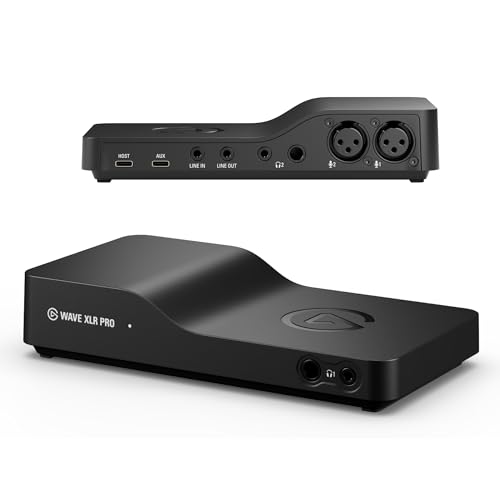
Elgato Wave XLR Pro Dual USB-C Audio Interface
Best for: dual-PC streamers needing high preamp gain
- Mic Preamps
- 2
- Host Connection
- Dual USB-C
- Preamp Gain
- 80 dB
- Features
- DSP
- Dimensions
- 3.82 × 7.28 × 1.5 inches
- Weight
- 13.4 ounces
The Elgato Wave XLR Pro is a dual-input audio interface and hardware mixer designed for multi-device setups. You get two XLR mic preamps with 80 dB of gain, dual USB-C host connections, and an onboard Wave FX DSP processor for low-latency effects. It suits you if you route audio across two systems, such as a streaming PC and a gaming console.
- 80 dB of preamp gain for driving low-output microphones
- Dual USB-C ports to link two host systems simultaneously
- Onboard Wave FX DSP processor with Clipguard 2.0
- Support for up to five independent hardware mixes
- Offers only two XLR microphone preamps
- Does not include standard 5-pin MIDI ports
- You need to route audio between two computers, a phone, or a console.
- You use dynamic microphones that demand high gain without external boosters.
- You want onboard hardware DSP to manage multiple independent sub-mixes.
- You need more than two XLR inputs for multi-mic studio tracking.
- You rely on traditional DIN MIDI connections for hardware synthesizers.
Verdict: Elgato Wave XLR Pro Dual USB-C Audio Interface gives dual-PC streamers and podcasters substantial 80 dB preamp gain alongside direct two-host connectivity. It streamlines matrix routing and hardware monitoring for creators operating multi-device broadcast setups.

Yamaha 6×4 USB-C Audio Interface
Best for: Multi-mic project studios and synth setups
- Total I/O
- 6 x 4
- Mic Preamps
- 4
- Host Connection
- USB-C, USB 3.0
- Audio Resolution
- 32-bit / 192 kHz
- MIDI I/O
- MIDI I/O
- Connectivity
- USB-MIDI, USB, USB-C
This Yamaha unit is a 6-in, 4-out USB-C audio interface designed for multi-source recording. It provides four Class-A D-PRE microphone preamps, built-in MIDI connections, and 32-bit integer conversion up to 192 kHz. Built-in DSP hardware handles latency-free monitor effects, including reverb and channel strips. You get versatile tracking capacity for small ensembles or multi-mic sessions without requiring outboard gear.
- Four XLR/TRS combo inputs with Class-A D-PRE mic preamps and +48V phantom power
- 32-bit integer audio resolution with sample rates up to 192 kHz
- Onboard DSP monitoring with REV-X reverb, Channel Strip, and Guitar Amp Classics
- Dedicated 5-pin MIDI input and output ports
- Chassis measures 15 inches long, occupying substantial desk space
- No ADAT or optical digital inputs for adding extra preamp channels
- You need four microphone inputs with phantom power for multi-mic acoustic tracking.
- You want zero-latency hardware DSP effects like reverb and amp modeling while monitoring.
- You integrate external hardware synthesizers using dedicated 5-pin MIDI ports.
- You have a compact workspace that cannot accommodate a 15-inch-deep interface footprint.
- You plan to expand your input channel count via optical ADAT connections.
Verdict: Yamaha 6×4 USB-C Audio Interface delivers four preamps, onboard DSP processing, and 32-bit audio resolution for musicians tracking multi-mic acoustic sessions or small bands. Its combination of line, Hi-Z, and MIDI inputs serves project studios that record both acoustic instruments and hardware synthesizers.

Antelope Audio Zen Quadro Dual USB-C Audio Interface
Best for: Dual-computer setups needing DSP and digital expansion
- Total I/O
- 14-In/10-Out
- Mic Preamps
- 4
- Host Connection
- Dual USB-C
- Dynamic Range
- up to 130 dB
- Preamp Gain
- up to 75 dB
- Digital Expansion
- ADAT, S/PDIF
This portable desktop interface provides 14 inputs and 10 outputs, anchored by four discrete mic preamps delivering up to 75 dB of gain. Dual USB-C ports let you connect two hosts simultaneously, while onboard DSP handles 37 included real-time effects without CPU load. It suits producers and streamers needing multi-channel expansion through ADAT and dual headphone mixes.
- Four discrete mic preamps with up to 75 dB of gain
- Dual USB-C connections for simultaneous two-host routing
- Onboard DSP and FPGA hardware running 37 real-time effects
- ADAT and S/PDIF digital expansion up to 14 inputs and 10 outputs
- Only two of the four inputs support direct Hi-Z instrument signals
- No traditional 5-pin MIDI DIN ports listed in specifications
- You need up to 75 dB of clean preamp gain for low-output microphones.
- You run simultaneous audio between two computers or a computer and tablet.
- You want onboard DSP processing to track with zero host CPU load.
- You require hardware 5-pin MIDI DIN ports to integrate outboard synthesizers.
- You need more than two direct Hi-Z instrument inputs simultaneously.
Verdict: Antelope Audio Zen Quadro 14×10 USB-C Interface gives multi-device streamers and studio tracking engineers 75 dB of preamp gain, digital ADAT expansion, and onboard hardware DSP in a portable bus-powered unit.

Focusrite Scarlett 4i4 4th Gen USB-C Interface
Best for: home producers tracking synths and stereo gear
- Total I/O
- 4-In 4-Out
- Mic Preamps
- 2
- Host Connection
- USB-C
- Audio Resolution
- 24-Bit/192kHz
- Dynamic Range
- 120dB
- MIDI I/O
- MIDI In/Out
The Focusrite Scarlett 4i4 4th Gen is a desktop USB-C audio interface with four inputs, four outputs, and dedicated MIDI connections. It features two mic preamps, 120dB of dynamic range, and 24-bit/192kHz conversion. Built-in Auto Gain and Clip Safe handle input levels automatically. This interface suits you if you track vocals, synths, and outboard gear.
- 120dB dynamic range conversion
- Two mic preamps with Auto Gain and Clip Safe
- Four balanced line inputs and four line outputs
- Standard 5-pin MIDI input and output ports
- Only two XLR microphone preamps despite four total inputs
- Audio resolution caps at 24-bit rather than 32-bit
- No integrated digital display screen for metering
- You need dedicated MIDI ports to sequence external synthesizers.
- You want automated level calibration through Auto Gain and Clip Safe.
- You connect stereo hardware along with up to two microphones.
- You need more than two XLR microphone inputs at once.
- You require 32-bit audio resolution for your recordings.
Verdict: Focusrite Scarlett 4i4 4th Gen USB-C Interface delivers 120dB dynamic range, dual mic preamps, and MIDI I/O in a compact 2.23-pound chassis. It gives electronic producers and small-studio musicians dependable level management and flexible line routing.

Universal Audio Volt 4-In/4-Out USB Interface
Best for: desktop recording with onboard analog compression
- Total I/O
- 4×4
- Host Connection
- USB-C
- MIDI I/O
- MIDI
- Connectivity
- USB-MIDI, USB, USB-C
- Color
- Not Available
- Dimensions
- 9.49 × 6.89 × 5.24 inches
The Universal Audio Volt 476 is a desktop USB audio interface designed for recording and mixing. It features built-in analog compression inspired by the 1176, a vintage UA 610 preamp emulation mode, and multi-platform compatibility across macOS, Windows, and iOS. This unit suits you if you need hardware-based dynamic control and analog preamp coloration directly on your desktop.
- Built-in analog compressor based on the 1176
- Vintage mode emulation of UA 610 tube preamps
- Includes LUNA Digital Audio Workstation and UAD plug-ins
- Supports macOS, Windows, iPad, and iPhone
- Requires an external power supply for mobile recording
- Requires a separate camera adapter for Lightning-equipped iOS devices
- You want onboard 1176-style analog compression during recording.
- You plan to track and mix using the included LUNA DAW software.
- You need multi-device compatibility across desktop computers and mobile tablets.
- You require a bus-powered mobile interface that runs without an external power supply.
- You need a compact pocket-sized device lighter than 2.65 pounds.
Verdict: Universal Audio Volt 476 USB Audio Interface suits musicians and audio producers who want dedicated analog tone shaping with built-in 1176 compression on their desktop. It provides direct hardware dynamic control before audio reaches your recording software.

Fender Quantum LT 16 USB-C Audio Interface
Best for: multi-mic tracking and hardware synth studios
- Total I/O
- 16-in, 8-out
- Mic Preamps
- 8
- Host Connection
- USB-C
- Preamp Gain
- +75 dB
- MIDI I/O
- 5-pin MIDI I/O
- Suitable For
- Music Production
The Fender Quantum LT 16 is a rack-sized USB-C audio interface designed for hardware-heavy studios. You get 16 inputs and 8 outputs, including eight MAX-HD mic preamps with +75 dB of gain and 14 line inputs. DC-coupled outputs and built-in 5-pin MIDI support modular gear. It fits multi-mic setups and tracking full bands without extra hardware.
- 16 inputs and 8 outputs with 14 total line inputs
- Eight MAX-HD mic preamps with +75 dB gain
- DC-coupled outputs and 5-pin MIDI I/O
- Standalone Mixer Mode and Mic Pre Mode operation
- 19-inch width requires dedicated rack or desk space
- 4.8-pound weight is significantly bulkier than compact desktop interfaces
- You need to mic drum kits or full ensembles using eight preamps.
- You route control voltage signals to modular synthesizers.
- You run outboard gear through standalone mixer or preamp modes.
- You need a lightweight, portable interface for mobile recording.
- You only record one or two inputs simultaneously.
Verdict: Fender Quantum LT 16 USB-C Audio Interface delivers expanded analog channel counts and high-gain preamps for multi-instrument tracking. It fits home and project studio producers who require rack-scale connectivity for external hardware.
Specifications side by side
Spec Universal Audio Volt 4 Max USB Interface Elgato Wave XLR Pro Dual USB-C Audio Interface Yamaha 6×4 USB-C Audio Interface Antelope Audio Zen Quadro Dual USB-C Audio Interface Focusrite Scarlett 4i4 4th Gen USB-C Interface Universal Audio Volt 4-In/4-Out USB Interface Fender Quantum LT 16 USB-C Audio Interface
- Total I/O
- –
- Mic Preamps
- –
- Host Connection
- USB
- Audio Resolution
- 32-Bit
- Dynamic Range
- –
- Preamp Gain
- –
- Digital Expansion
- ADAT
- MIDI I/O
- MIDI
- Connectivity
- USB
- Suitable For
- –
- Color
- –
- Features
- DSP
- Dimensions
- 9.45 × 5.91 × 4.72 inches
- Weight
- 2.2 pounds
- Model
- VOLT4MAX
- Size
- –
Copied from the Amazon listing. These figures were not measured here.
Frequently asked questions
Which alternative interface offers ADAT expansion like the Volt 4 Max?
The Antelope Audio Zen Quadro Synergy Core provides digital ADAT expansion alongside onboard hardware DSP. You also get 75 dB of preamp gain, bus-powered operation, and dual USB-C ports. These features let you expand your digital channel count while connecting two separate host computers simultaneously in home or mobile tracking setups.
Which Volt 4 Max alternatives include dedicated MIDI connections?
Both the Yamaha URX44C and Focusrite Scarlett 4i4 4th Gen include dedicated MIDI connectivity. The Yamaha interface also provides 32-bit resolution, four preamps, and onboard DSP processing. Focusrite provides 120 dB dynamic range with two mic preamps in a 2.23-pound chassis, letting you sequence external hardware synthesizers without extra adapters.
How does the Universal Audio Volt 476 differ from the Volt 4 Max?
The Volt 476 relies on built-in analog 1176 compression for hardware tone shaping instead of digital DSP presets. It features a desktop chassis measuring 6.89 by 5.24 by 9.49 inches and weighs 2.65 pounds. You get direct dynamic control over incoming signals before they reach your digital audio workstation software.
Which alternative interface supports 32-bit audio resolution?
The Yamaha URX44C supports 32-bit audio resolution alongside onboard DSP processing. It also features four microphone preamps, Hi-Z instrument inputs, line connections, and USB-MIDI support. This specification allows project studio engineers to record wide dynamic signals cleanly when tracking small bands, acoustic instruments, or hardware synthesizers without clipping your converters.
Which alternative interface is built for studio rack mounting?
The Fender Quantum LT 16 fits standard studio racks with its 19-inch width and 1.75-inch height. It weighs 4.8 pounds and connects via USB or USB-C. This unit provides expanded analog channels and high-gain preamps, making it suitable for multi-instrument tracking and routing outboard hardware synthesizers in larger studios.
What styles of gear are featured among the 6 alternatives to the Volt 4 Max?
The 6 alternatives span compact desktop units, dual-computer devices, and rackmount production hardware. You can select bus-powered desktop units like the Antelope Audio Zen Quadro, four-preamp options like the Yamaha URX44C, or full 19-inch rack gear like the Fender Quantum LT 16 based on your tracking requirements.


