
As Amazon Associates, we earn from qualifying purchases. This means we may receive a small commission at no extra cost to you if you click through and make a purchase.
For 3D printing enthusiasts running multi-color setups or hygroscopic filaments, managing moisture across several spools is a persistent challenge. The SUNLU FilaDryer S4 tackles this issue by providing a high-capacity drying station capable of handling four 1-kilogram spools at once. Frequently referred to as the sunlu s4 pro, this upgraded drying box introduces independent dual-chamber heating, an expanded thermal ceiling up to 85 degrees Celsius, and specialized material conditioning functions directly to your workspace. If you run multiple printers or an automated filament switching system, it is designed to remove the bottleneck of drying spools one by one.
Investing in a dedicated multi-spool dry box means balancing desk space against heating performance and material flexibility. In this review, we examine how the unit manages heat distribution, automated humidity cycles, spool feeding pathways, and high-temperature technical filaments like nylon. We also evaluate the physical footprint and dual-zone architecture to help you decide whether this upgraded four-spool station earns a permanent spot next to your 3D printers.
What You Get With the SUNLU FilaDryer S4
SUNLU FilaDryer S4
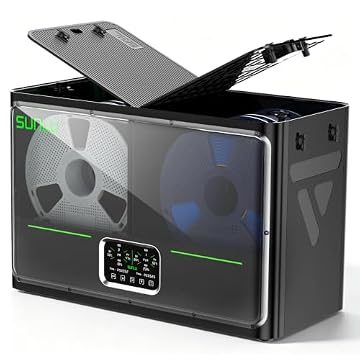


Photographs published on the Amazon listing.
The package includes a comprehensive set of accessories designed to help you integrate the drying station into your current printing workflow without purchasing extra hardware.
- One SUNLU FilaDryer S4 filament drying box in black
- Four 8-centimeter PTFE tubing segments for direct desktop feeding
- Four 1-meter PTFE tubing segments for extended routing to print heads
- One AC power cable
- One user manual detailing setup and program controls
- Two independent internal drying chambers
- Built-in digital control display with real-time temperature and humidity tracking
Key Specifications
Specification
Manufacturer Detail
- Spool Capacity
- Holds up to 4 spools of 1 kg filament simultaneously
- Maximum Temperature
- Up to 85°C (185°F) with upgraded rapid heating
- Chamber Design
- Dual-chamber independent control for separate heating zones
- External Dimensions
- 458 mm (L) x 218 mm (W) x 310 mm (H)
- Internal Dimensions
- 220 mm (L) x 210 mm (W) x 211 mm (H) per chamber section
- Unit Weight
- 4.7 kg net weight (4.8 kg listed item weight)
- Humidity Regulation
- Adjustable preset target from 30% to 50%; auto shuts off at 25%
- Compatible Materials
- PLA, PETG, TPU, ABS, ASA, PA, PC, Nylon, Carbon Fiber, Glass Fiber
- Special Operating Modes
- Integrated annealing mode and intelligent temperature regulation
Copied from the Amazon listing. These figures were not measured here.
Dual-Chamber Temperature Management and Independent Controls
The defining operational feature of this machine is the sunlu filadryer s4 dual chamber layout. Rather than forcing all loaded spools into a single shared thermal environment, the interior is split into two separately controlled zones. Each zone runs its own heating parameters, timers, and cycle modes. This means you can condition moisture-sensitive high-temperature materials in one compartment while gently drying lower-temperature filaments like standard PLA or sunlu pla + in the other without overheating the spool carousels.
Thermal delivery is supported by an upgraded heating element and revised airflow circulation. The sunlu filadryer s4 temperature range reaches up to 85 degrees Celsius (185 degrees Fahrenheit), giving it an advantage over standard filament dryers that typically peak at 50 to 65 degrees. Internal fan circulation continuously moves hot air around both spool positions in each chamber, helping to eliminate localized heat pockets and ensuring that moisture trapped within tightly wound inner layers evaporates evenly.
For print shops and makers who switch materials regularly, dual-zone control eliminates long staging delays. Instead of waiting several hours for one material to dry before swapping in another, both chambers can operate at their respective optimal temperatures at the same time. The front display allows you to toggle between chambers quickly to check active temperatures and set individual runtimes, making the sunlu s4 pro filament dryer an efficient centerpiece for multi-material printing.
High-Temperature Materials and the Dedicated Annealing Mode
Working with advanced engineering filaments requires consistent, elevated heat that basic drying boxes cannot produce. Testing the capabilities of the sunlu filadryer s4 for nylon, polycarbonate, and composite filaments highlights the practical value of the 85-degree thermal ceiling. Polyamide filaments absorb atmospheric moisture rapidly, leading to steam pockets, poor layer adhesion, and surface stringing during extrusion. Reaching sustained higher temperatures ensures deep-seated water molecules are driven out before the filament reaches your nozzle.
In addition to standard drying functions, the integrated sunlu filadryer s4 annealing mode provides a valuable post-processing capability. Annealing is a controlled heat-treatment process that relieves internal mechanical stresses induced during extrusion, allowing polymer crystalline structures to align. This treatment improves tensile strength, dimensional stability, and temperature resistance in finished parts made from technical materials like PA, PC, PA6-CF, and PA12-CF.
Having an annealing program built directly into a drying enclosure simplifies your workflow. Instead of using an uncalibrated domestic kitchen oven with broad thermal swings, you can place freshly printed engineering parts directly into the chamber. The stable, circulating convective heat ensures controlled thermal conditioning, allowing makers working with carbon-fiber or glass-fiber composites to handle pre-print drying and post-print stabilization in a single device.
Four-Spool Capacity and Physical Desktop Footprint
Batch capacity is the core reason to choose this model, and the sunlu filadryer s4 4 spool capacity allows four full 1-kilogram spools to rest side by side. Each spool sits on smooth internal rollers that rotate freely, enabling the unit to feed filament directly into your 3D printers while remaining completely closed. This continuous dry-feed capability is particularly useful for multi-color material systems or multi-head printers where filaments sit exposed for days during long print runs.
A four-spool capacity naturally demands substantial desk space. Measuring 458 mm in length, 218 mm in width, and 310 mm in height, the enclosure takes up considerable room on any workbench. Weighing 4.7 kg empty, and nearly 9 kg when loaded with four full spools, it requires a stable, dedicated surface adjacent to your 3D printer setup.
Filament routing is flexible thanks to the included tubing configurations. SUNLU provides four short 8-centimeter PTFE tubes and four longer 1-meter PTFE tubes. This combination gives you the freedom to position the dryer right next to your machine for short, direct feeding or place it on a nearby shelving unit while feeding filament smoothly through the longer low-friction tubes.
Automated Humidity Regulation and Long-Term Storage
Keeping filament dry is as much about long-term maintenance as it is about pre-print heating. The automated humidity management system lets you set a target relative humidity threshold between 30% and 50%. Integrated internal sensors continuously track environmental conditions inside the chambers and automatically activate the heating elements whenever the relative humidity rises above your preset limit.
The system operates on an efficient hysteresis cycle to manage energy use. Once the dryer activates, it continues circulating heated air until chamber humidity drops down to 25%, at which point it automatically suspends heating. This automated loop transforms the enclosure into an active storage vault, ensuring hygroscopic materials like TPU, PETG, and nylon remain dry and ready to print even in humid shop environments.
Examining the sunlu filadryer s4 specs confirms that this automated cycle runs reliably across both internal compartments. You do not need to monitor the unit constantly or remember to switch it on manually before a project. By maintaining a stable, dry environment around the clock, the system prevents brittle filament breakage and extrusion issues during extended, unattended printing sessions.
SUNLU FilaDryer S4 Pros and Cons
Pros
- Independent dual-chamber temperature controls
- Heats up to 85°C for engineering materials
- Four 1 kg spool capacity for multi-material setups
- Dedicated annealing mode for printed parts
- Automatic humidity regulation with auto shut-off
- Includes both short and long PTFE tubes
Cons
- Large physical footprint requires significant bench space
- Weighs 4.7 kg before loading spools
- Excessive capacity for occasional single-spool PLA users
Check SUNLU FilaDryer S4 on Amazon
Is the SUNLU FilaDryer S4 Worth It
Determining whether is sunlu filadryer s4 worth it depends largely on your material choices and printing volume. If you only print occasionally with standard PLA and rarely use more than one spool at a time, a four-spool station with dual independent heating zones offers more capacity than you need. A smaller, single-spool drying unit will be easier to store and simpler to fit onto a crowded desk.
For makers running multi-material systems, print farms, or engineering filaments, this station solves significant workflow challenges. Being able to independently bake hygroscopic nylon in one chamber up to 85°C while keeping standard filaments safe in the second chamber eliminates drying backlogs. Keeping four spools conditioned and ready to feed simultaneously saves time and prevents print failures caused by moist filament.
The reliable heating performance, built-in annealing functionality, and generous PTFE tube assortment make this unit a capable production tool for dedicated hobbyists and professionals. If your workspace can accommodate its 458 mm footprint, the efficiency gains and material versatility make it a worthwhile upgrade to your 3D printing setup.
Other Options to Consider
Enables Simultaneous Printing & Drying suits Bambu Lab AMS Gen 1 owners who want a dedicated internal 4-spool heater that reaches 70°C to dry filament directly within their existing automated material system without adding a separate standalone box.

Upgraded 65° PTC Heating suits makers with limited bench space who only need to dry one spool at a time, making the sunlu filadryer s4 vs creality space pi comparison relevant for users who work primarily with PLA, PETG, and ABS up to 65°C.
Creality Filament Dryer Box 4 suits users seeking an alternative 4-spool station featuring a 200W PTC heater that reaches 85°C across dual heating chambers, which we examine further in our creality space pi x4 breakdown.

FAQ
Can the SUNLU FilaDryer S4 dry two different filament types at different temperatures simultaneously?
Yes. The dryer is equipped with two independently controlled chambers, allowing you to set different temperatures, drying durations, and operating profiles in each section at the same time.
What is the maximum temperature reached by the SUNLU FilaDryer S4?
The unit can reach up to 85 degrees Celsius (185 degrees Fahrenheit), providing sufficient heat for drying and annealing engineering filaments like nylon, polycarbonate, and carbon-fiber blends.
How does the automatic humidity control function?
You set a target humidity level between 30% and 50%. The dryer monitors chamber conditions, starts heating automatically when humidity exceeds that preset value, and stops heating once humidity drops to 25%.
What PTFE tube accessories come included in the box?
The package contains four 8-centimeter PTFE tubes for short-distance feeding and four 1-meter PTFE tubes for longer routing setups directly to your 3D printers.
Can you anneal 3D printed parts inside this filament dryer?
Yes. The unit features a dedicated annealing mode designed to relieve internal stresses and enhance the mechanical strength and temperature resistance of printed parts made from PA, PC, PA6-CF, and PA12-CF.


