
As Amazon Associates, we earn from qualifying purchases. This means we may receive a small commission at no extra cost to you if you click through and make a purchase.
Shoppers searching for a micro-sized microcontroller often find standard development boards too bulky for wearable gadgets, miniature robotics, or space-constrained enclosures. The Seeed Studio XIAO RP2040 provides a compelling solution by packing a dual-core Raspberry RP2040 processor into a board roughly the size of a postage stamp. If you need a capable 32-bit controller that slips into tiny spaces without sacrificing core processing speed, this model is generally the right buy for compact electronics builds. It delivers responsive execution for custom macro pads, smart wearables, and small sensor hubs, though you should expect a limited pin count compared to full-sized boards.
This review examines everything you need to know before buying this tiny development board. We cover the physical layout, pinout functionality, programming framework compatibility across multiple software environments, and real-world considerations for power and integration. By exploring the detailed hardware specifications, practical trade-offs, and alternative microcontroller options, this guide ensures you choose the right board for your next DIY build.
What You Get With the Seeed Studio XIAO RP2040
Seeed Studio XIAO RP2040

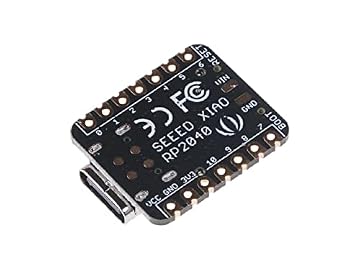


Photographs published on the Amazon listing.
The Seeed Studio XIAO RP2040 arrives as a single, ultra-compact microcontroller board engineered specifically for surface-mount installation and rapid prototyping. The retail package provides the core board featuring a smooth backside free of active components, allowing it to sit completely flat against carrier PCBs or inside low-profile enclosures. Depending on the exact vendor packaging, pin headers may need to be sourced separately, as the listing emphasizes the bare board design tailored for both soldering onto custom circuits and insertion into standard breadboards.
- One Seeed Studio XIAO RP2040 microcontroller board powered by the Raspberry RP2040 chip
- Dual-core ARM Cortex M0+ processor capable of running at clock speeds up to 133MHz
- Onboard memory configuration featuring 264KB of SRAM and 2MB of flash storage
- Comprehensive interface support including 11 digital pins, 4 analog pins, and 11 PWM channels
- Dedicated communication lines for 1 I2C interface, 1 UART interface, and 1 SPI interface
- One SWD bonding pad interface for low-level debugging and hardware programming
- Single onboard USB port for direct programming, data transfer, and power delivery
- Fully flat rear surface with no components on the back for easy surface-mount assembly
- Pin-to-pin hardware compatibility with the Seeeduino XIAO family and Seeeduino XIAO expansion board
Key Specifications
Specification Attribute
Specification Detail
- Processor Brand and Model
- Raspberry RP2040 (Dual-Core ARM Cortex M0+)
- Processor Speed
- Up to 133 MHz
- SRAM Capacity
- 264 KB
- Onboard Flash Storage
- 2 MB
- Physical Dimensions
- 0.79"L x 0.67"W x 0.14"H (20 x 17.5 mm)
- Digital I/O Pins
- 11 pins (all support PWM)
- Analog Input Pins
- 4 pins
- Hardware Interfaces
- 1 I2C, 1 UART, 1 SPI, 1 SWD Bonding Pad
- Supported Operating Systems / Frameworks
- Arduino, MicroPython, CircuitPython
- Model Number
- 500230492
Copied from the Amazon listing. These figures were not measured here.
Physical Design and Wearable Build Potential
The primary appeal of this tiny RP2040 development board lies in its exceptionally compact footprint. Measuring only 0.79 inches long by 0.67 inches wide (20 by 17.5 millimeters), the board is roughly the size of an adult human thumb. This miniature profile makes the hardware exceptionally well suited for seeed xiao rp2040 wearable projects where every millimeter of clearance matters. Whether you are embedding a microcontroller into clothing, crafting an illuminated costume piece, or assembling an ultra-low-profile handheld gaming device, the physical dimensions remove the bulk commonly associated with standard development platforms.

Another critical design advantage is the completely flat back of the circuit board. Seeed Studio engineered the board with all surface-mount components placed strictly on the top side. Because there are no capacitors, resistors, or integrated circuits protruding from the bottom, makers can solder the board directly onto a custom printed circuit board as a surface-mount module (SMD). This flat layout also simplifies attachment inside narrow cavities, such as custom 3D-printed enclosures or precision-cut housings designed using a cameo 5 pro cutter.
Despite the miniature dimensions, the board maintains standard 2.54mm pin spacing along its outer edges. This design choice ensures that you can solder traditional male headers onto the board to use it immediately with standard solderless breadboards. You do not need specialized adapters or awkward breakout shims to begin prototyping. Everyday makers who transition from a breadboard prototype to a final soldered device will appreciate how smoothly the hardware adapts between temporary test wiring and permanent embedded installations.
Programming Support and Development Setup
A microcontroller board is only as useful as its software ecosystem, and the Seeed Studio XIAO RP2040 provides remarkable flexibility across modern programming environments. For traditional makers who have built projects around C and C++, configuring the xiao rp2040 arduino core requires only adding the appropriate board manager URL inside the Arduino IDE. Once installed, developers gain access to familiar sketches, peripheral libraries, and community codebases, allowing established maker projects to migrate to the faster RP2040 silicon without needing a ground-up software rewrite.
If you prefer Python-based workflows, the board functions seamlessly with xiao rp2040 micropython and xiao rp2040 circuitpython. Flashing either firmware environment is straightforward: holding the boot button while plugging the board into your computer presents the device as a standard mass-storage drive. Dragging and dropping the appropriate UF2 firmware file onto the drive completes the setup in seconds. Using CircuitPython or MicroPython allows rapid prototyping because you can edit script files directly on the board without waiting for lengthy compilation cycles, making it ideal for testing sensor readouts or tuning animation speeds.
The dual-core architecture also opens up advanced programming techniques regardless of your chosen environment. The Raspberry RP2040 silicon allows developers to assign time-critical tasks, such as driving addressable LED strips or monitoring hardware interrupts, to one core while dedicating the second core to sensor polling or user interface logic. This architectural separation prevents stuttering or input lag, elevating project responsiveness well beyond what older 8-bit microcontrollers could achieve.
Pinout Flexibility and Peripheral Expansion
Understanding the seeed studio xiao rp2040 pinout is essential for deciding whether this board can accommodate your specific wiring requirements. The hardware exposes 11 digital I/O pins, all 11 of which can function as PWM (pulse-width modulation) outputs for controlling motor speed, servo positions, or LED brightness levels. In addition, 4 of these pins double as analog-to-digital converter (ADC) inputs, allowing you to sample voltages from potentiometers, light sensors, temperature probes, and other analog hardware without requiring an external converter chip.
For communication with digital sensors and displays, the board provides dedicated lines for 1 I2C bus, 1 UART serial connection, and 1 SPI interface. These standard buses allow you to daisy-chain multiple digital components, such as OLED displays, environmental sensors, and real-time clock modules, using a minimal number of physical pins. For advanced hardware developers, the inclusion of SWD bonding pads on the underside provides a direct debugging interface, enabling hardware-level breakpoints and in-depth stepping when troubleshooting complex firmware.
While the board features broad compatibility with the Seeeduino XIAO expansion board ecosystem, the physical pin limit of 11 pins represents a practical trade-off. If your DIY design demands dozens of individual input buttons, multiple parallel displays, or expansive sensor arrays, 11 GPIO pins will quickly become a bottleneck. Makers tackling high-pin-count builds must either rely on I2C port expanders or consider a larger development platform that exposes a broader selection of physical headers.
Everyday Processing Speed and Architectural Limits
When reviewing the seeed studio xiao rp2040 performance, the technical jump over traditional hobbyist boards is immediately noticeable. Running at clock speeds up to 133MHz with 264KB of onboard SRAM and 2MB of flash storage, the dual-core RP2040 chip handles intensive mathematical routines, buffer management, and display rendering with ease. The seeed studio xiao rp2040 specs ensure that memory-heavy operations, such as holding full-color display frame buffers or processing audio signals, do not exhaust your available RAM.
Makers frequently weigh the rp2040 vs esp32 when selecting a compact brain for portable electronics. The ESP32 platform often provides built-in wireless networking such as standard Wi-Fi and Bluetooth, whereas the RP2040 is fundamentally a dedicated processing microcontroller. Although the listing mentions 802.11b wireless compatibility, the base XIAO RP2040 board does not include an onboard wireless radio module or RF antenna. Makers who need robust native wireless communication right out of the box will need external modules, whereas those who prioritize ultra-compact dimensions, low sleep currents, and straightforward USB mass-storage programming will find the RP2040 architecture superior.
For remote and off-grid builds, the board can easily be powered through its onboard USB port using portable energy sources. When operating away from a desk, connecting your circuit to a jackery explorer 240d portable power station or a larger bluetti apex 300 power station on a field workbench provides steady 5V power for extended data-logging sessions or outdoor sensor testing.
Seeed Studio XIAO RP2040 Pros and Cons
Pros
- Dual-core 133MHz ARM Cortex M0+ processor
- Thumb-sized 20×17.5mm compact footprint
- Generous 264KB SRAM and 2MB flash
- Flat rear surface with no bottom components
- Supports Arduino MicroPython and CircuitPython
Cons
- Limited to 11 digital I/O pins
- Requires soldering for breadboard pin headers
- Single USB port for power and data
Check Seeed Studio XIAO RP2040 on Amazon
Is the Seeed Studio XIAO RP2040 Worth It
Determining whether is seeed studio xiao rp2040 worth it depends primarily on the physical constraints and computational demands of your project. If you are building miniature gadgets, wearable controllers, custom mechanical keyboard macropads, or concealed sensor pods, this board offers exceptional value. It packs the processing speed of a modern 32-bit dual-core processor into a format small enough to fit inside almost any enclosure, backed by extensive support for Arduino, MicroPython, and CircuitPython.
However, this tiny board is not the ideal match for every maker. Beginners who want a plug-and-play board with pre-soldered headers, abundant GPIO pins, and built-in wireless connectivity may find the XIAO RP2040 restrictive. Soldering is almost always required to connect peripherals, and with only 11 GPIO pins available, complex builds that require dozens of individual sensor wires will outgrow the board very quickly.
Ultimately, if you need a reliable, thumb-sized computing engine that combines strong community support, dual-core speed, and a breadboard-friendly layout, the Seeed Studio XIAO RP2040 is one of the most capable tiny microcontroller boards on the market today.
Other Options to Consider
ESP-WROOM-32 ESP32 ESP-32S Development Board suits makers who require native dual-mode 2.4GHz Wi-Fi and Bluetooth connectivity alongside dual-core processing power, making it a better option for wireless IoT projects where board size is less critical.

Development Board provides an expansive starter package featuring a USB-C dual-core microcontroller with Wi-Fi, Bluetooth, and over 200 included parts, which suits beginners seeking a complete tutorial kit over a standalone micro board.
Arduino Uno REV3 offers standard full-sized pin headers, 14 digital I/O pins, and unmatched physical prototyping convenience, making it better suited for introductory electronics education and workbench experiments where miniature size is unnecessary.

FAQ
Does the Seeed Studio XIAO RP2040 come with pre-soldered pin headers?
The listing does not specify whether pin headers are included in the package. The board itself features castellated pads and through-holes, allowing it to be soldered directly to custom surface-mount circuits or paired with standard 2.54mm male header pins for breadboard use.
Can I program the Seeed Studio XIAO RP2040 using CircuitPython?
Yes, the board fully supports CircuitPython, MicroPython, and the Arduino IDE. Entering the onboard bootloader mode allows you to drag and drop standard UF2 firmware files directly onto the board over USB without requiring specialized hardware programmers.
What are the exact dimensions of the board?
According to the product specifications, the board measures 0.79 inches in length, 0.67 inches in width, and 0.14 inches in height (approximately 20 by 17.5 millimeters), making it roughly the size of a human thumb.
How many analog inputs are available on the XIAO RP2040?
The board provides 4 dedicated analog input pins connected to the internal analog-to-digital converter, allowing you to read variable signals from analog sensors, sliders, and potentiometers.
Does the board support expansion accessories from Seeed Studio?
Yes, the pinout is designed to be compatible with the Seeeduino XIAO family, and the board officially supports the Seeeduino XIAO expansion board for added connectivity and peripheral breakout options.


