
As Amazon Associates, we earn from qualifying purchases. This means we may receive a small commission at no extra cost to you if you click through and make a purchase.
If you are evaluating whether the LaserPecker LP4 is the right desktop engraving tool for your workspace, the primary appeal comes down to its hybrid dual-laser engine. Most desktop machines force creators to choose between a blue diode laser suited for wood, leather, and dark acrylics, or an infrared source intended strictly for reflective metals and engineering plastics. By combining a 10W blue diode beam and a 2W infrared beam into a single galvanometer optical head, this machine targets makers who need to switch between organic goods and bare metal items like custom jewelry without juggling multiple machines or performing manual laser head swaps.
Choosing the right engraver requires balancing functional output against physical workspace limits, as well as understanding how galvanometer optical systems compare to traditional gantry setups. In this detailed LaserPecker LP4 review, we break down what you actually get, examine the dual-source mechanics, assess speed and accuracy claims, evaluate software compatibility, and compare it against alternative desktop machines to help you determine if this platform fits your specific creative workflow.
What You Get With the LaserPecker LP4
LaserPecker LP4


Photographs published on the Amazon listing.
The LaserPecker LP4 is packaged as a compact desktop marking system centered around an adjustable motorized stand, a dual-laser optical assembly, and integrated hardware controls designed to reduce friction during multi-material jobs. The listing highlights several dedicated components and hardware features built into the core system:
- Dual-laser optical assembly housing both a 10W 450nm diode laser and a 2W 1064nm infrared laser in one head.
- High-definition LED touchscreen mounted directly on the chassis for project file management, setting adjustments, and laser switching.
- Galvanometer scanning mirror mechanism capable of rapid beam movement across an expanded 160 by 120 millimeter field.
- Dual infrared positioning system providing rapid visual framing and target alignment directly on your work surface.
- Motorized vertical stand allowing smooth focal distance calibration.
- Direct software connection support for both the proprietary LaserPecker Design Space application and LightBurn.
Key Specifications
To help evaluate the hardware against your project requirements, the essential LaserPecker LP4 specs gathered from the manufacturer data are compiled below.
Specification
Detail
- Laser Sources
- 10W Diode (450nm) + 2W Infrared (1064nm)
- Precision and Resolution
- 8K resolution, detail rendering down to 0.003mm
- Engraving Speed
- Up to 2000 mm/s (listing highlights high-speed scanning up to 4000 mm/s)
- Working Area
- 160 x 120 mm
- Control Interface
- High-definition LED touchscreen
- Software Compatibility
- LaserPecker Design Space and LightBurn
- Product Dimensions
- 11.22 x 13.19 x 14.96 inches
- Item Weight
- 16.29 pounds
- Item Model Number
- LaserPecker 4
- Compatible Material Types
- 300+ materials including metals, stainless steel, wood, leather, acrylic, and glazed ceramics
Copied from the Amazon listing. These figures were not measured here.
Dual-Laser Versatility and Switching Performance
The standout characteristic of the LaserPecker LP4 dual laser configuration is the inclusion of two distinct laser wavelengths inside a single housing. The 10W 450nm blue diode is tuned for organic materials, handling hardwoods, plywood, leather, coated glass, and specific opaque plastics. Meanwhile, the 2W 1064nm infrared beam is formulated specifically for bare metals, stainless steel, brass, titanium, and various dense polymers. Having both available allows users to mark different substrates without unbolting laser modules, recalibrating optical focal lengths, or swapping wiring harnesses between runs.
This dual-wavelength design is especially practical if you plan on using the LaserPecker LP4 for metal engraving alongside craft gifts. Traditional diode lasers often struggle or fail entirely on reflective raw metals without messy chemical marking sprays. The dedicated 2W IR wavelength interacts directly with the surface structure of metallic materials, creating crisp, dark marks or surface engravings. For custom rings, pendants, and watch cases, using the LaserPecker LP4 for jewelry production offers an immediate workflow advantage because you can engrave an intricate metal charm and its wooden presentation box sequentially from the same desktop station.
Transitioning between the two optical paths is managed directly through software toggles or the top-mounted LED touchscreen. Rather than physically touching the lens assembly, the internal system alters the active beam path electronically. This significantly reduces setup friction during mixed-material production, letting you focus on layout design rather than mechanical recalibration.
Galvanometer Scanning Speed and Precision Detailing
Unlike standard gantry laser engravers that move an entire heavy optical carriage along X and Y aluminum rails, the LP4 utilizes a galvanometer scanning mirror head. By deflecting the laser beam across ultra-lightweight mirrors, the LaserPecker LP4 speed reaches baseline marking rates of up to 2000 mm/s, with listing references citing high-speed scans up to 4000 mm/s. This allows intricate raster engraving jobs, photographic reproductions, and vector text passes to finish in a fraction of the time required by traditional mechanical gantry setups.
Speed does not come at the expense of fidelity on this platform. The optical system delivers 8K resolution, capable of generating microscopic details down to 0.003mm. Such tight tolerances make it possible to produce legible serial numbers, miniature barcodes, and photo-realistic portraits on surfaces where larger laser spots produce blurry or muddy results. For makers creating fine art miniatures, commemorative tokens, or serialized industrial tags, this level of focus ensures high pattern density without noticeable line stepping.
The physical trade-off for this galvanometer setup is the working envelope. The system provides a standard field of 160 by 120 millimeters, which is noticeably smaller than broad-bed shop cutters. While perfectly suited for small items, phone cases, and personal accessories, larger signage or wide cutting jobs will quickly outgrow this boundary unless you invest in modular expansion accessories.
Cutting Power and Material Limitations
When assessing the LaserPecker LP4 cutting power, expectations must be aligned with the machine’s intended role as a precision marking and light fabrication station. The primary cutting muscle stems from the 10W blue diode module. A 10W rating provides adequate capability for slicing through thin craft plywood, balsa, genuine leather, and thin dark acrylic sheets. However, users seeking deep, single-pass cut-through operations on thick building stock or dense structural hardwoods may find this power level restrictive.
For extensive sheet processing or heavier workshop fabrication, full-sized gantry equipment like the laser engraver creality 22w offers double the raw optical wattage along with larger framing dimensions. The 2W infrared laser on the LP4 is not intended for cutting operations at all; its primary role is surface-level ablation and color annealing on metals and plastics. Attempting to use the IR source for parting metal stock will not work, as that task requires dedicated fiber or plasma industrial cutting systems.
Consequently, the LP4 functions best as a high-detail surface etcher that can perform auxiliary cutting duties on light materials. If your projects involve assembling small layered wooden gifts, leather patches, or intricate paper models, the cutting capacity is more than sufficient. For major furniture making, heavy board slicing, or large structural parts, a dedicated large-bed cutting machine remains a necessary counterpart.
Software Integration and Touchscreen Operation
Operational flexibility depends heavily on how smoothly a machine connects to your design environment. The LP4 supports two distinct workflow pathways: the native LaserPecker Design Space platform and industry-standard third-party control software. Utilizing the LaserPecker LP4 LightBurn connection allows experienced makers to tap into advanced vector manipulation, precise layer control, offset paths, and established material parameter libraries right from their computers.
For beginners or rapid standalone tasks, the proprietary LaserPecker Design Space app delivers an intuitive mobile and desktop environment. The built-in dual infrared positioning system projects an accurate framing boundary over your physical workpiece before firing. This preview functionality shows the exact scale and placement of your graphic, cutting down on wasted test blanks and misaligned runs.
Additionally, the integrated LED touchscreen provides a level of autonomy rarely seen on open-frame laser kits. The interface permits direct file selection from stored memory, displays real-time progress percentages, allows source swapping between diode and IR beams, and includes a single-tap sleep mode. This makes short batch operations convenient, as you can run consecutive items directly from the display without tethering a dedicated laptop to the workstation all day.
LaserPecker LP4 Pros and Cons
Pros
- Dual 10W diode and 2W IR laser sources
- Fast galvo scanning up to 2000 mm/s
- Ultra-fine 8K precision down to 0.003mm
- High-definition LED touchscreen controls
- Direct LightBurn and mobile app support
Cons
- Compact 160 x 120 mm working area
- 10W diode limits heavy cutting depth
- Weight exceeds 16 pounds
Check LaserPecker LP4 on Amazon
Is the LaserPecker LP4 Worth It
Deciding if the machine delivers sufficient value depends entirely on what materials you handle and how you organize your production. If you run a custom gift business, make boutique jewelry, or need a compact desktop tool that switches between stainless steel tumblers and leather wallets instantly, the versatility of the dual-laser head saves space, setup time, and equipment expense. Having both diode and infrared wavelengths in an 8K galvo assembly eliminates the need to maintain separate machines for wood and metal.
However, if your primary objective is cutting thick sheet goods, building architectural scale models, or processing large wooden signs, the 160 by 120 mm workspace and 10W diode power will present real bottlenecks. Creators working exclusively with large-format wooden panels would be better served by exploring larger enclosed production centers like the xtool p3 laser or setups utilizing an xtool p2 laser riser system, where high-wattage CO2 or expanded beds provide room for substantial stock.
Ultimately, is the LaserPecker LP4 worth it for your desktop? If your focus is high-speed engraving, fine-line detailing, serialized metal tags, and portable convenience, the LP4 represents a uniquely capable all-in-one system. It bridges the gap between bulky industrial marking lasers and entry-level diode craft machines with impressive refinement.
Other Options to Consider
xTool M2 10W Laser Engraver is an enclosed desktop alternative equipped with built-in dual cameras and Class 1 laser safety shielding, making it a stronger choice for school environments, shared family spaces, or hobbyists prioritizing a fully enclosed workspace over high-speed galvo metal marking.

130 x 130mm Working Area ACMER S1 Laser Engraver Machine uses a compact desktop footprint and a 2500mW laser source, serving casual hobbyists who want a simple, smaller platform specifically for light wood and acrylic crafts without paying for dual-laser infrared metal capabilities.
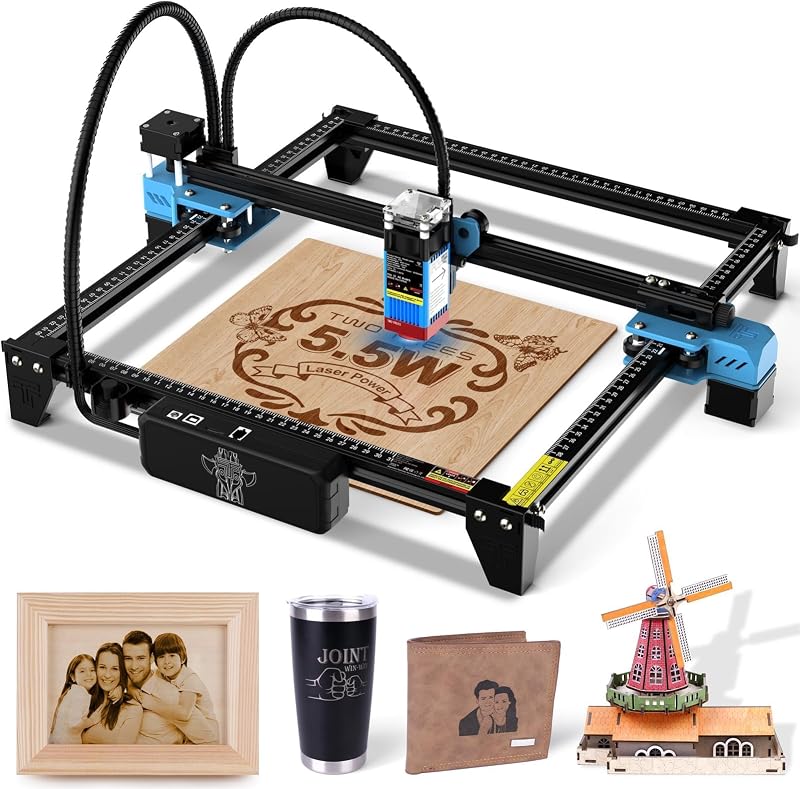
Laser Cutter Twotrees TTS-55 Pro features an open-frame 300 x 300 mm work area powered by a 5500mW laser module, providing more physical space for larger wood, glass, and surface metal DIY engraving projects on a standard gantry frame.
FAQ
Can the LaserPecker LP4 engrave on bare metals like stainless steel?
Yes, the LP4 incorporates a dedicated 2W 1064nm infrared laser specifically developed for marking bare metals, stainless steel, brass, aluminum, and dense plastics without requiring pre-treatment sprays or chemical coatings.
What is the size of the standard working area on the LP4?
The standard working area measures 160 by 120 millimeters, which is optimized for small desktop items, jewelry blanks, leather patches, and pocket gear rather than wide wooden boards.
Can I use LightBurn software with the LaserPecker LP4?
Yes, the LaserPecker LP4 supports LightBurn in addition to its proprietary LaserPecker Design Space application, giving users access to advanced parameter controls and professional design workflows.
Does the LaserPecker LP4 cut metal sheets?
No, the listing specifies that the LP4 is designed for metal engraving and surface marking. The 2W infrared laser lacks the optical intensity required to cut through sheets of metal.
How does the galvanometer head differ from a traditional gantry engraver?
A galvanometer head directs the laser beam using high-speed rotating internal mirrors rather than dragging the entire laser module along mechanical metal rails, resulting in significantly faster engraving speeds and ultra-fine detail rendering.


