
As Amazon Associates, we earn from qualifying purchases. This means we may receive a small commission at no extra cost to you if you click through and make a purchase.
Power outages can halt daily routines in seconds, leaving critical household gear without power when you need it most. If you want an indoor-safe, emissions-free alternative to a noisy gas generator, the Jackery HomePower 3600 Plus provides high-capacity emergency energy right out of the box. Designed specifically for residential backup, this unit delivers substantial running wattage to handle heavy electrical demands while avoiding the fumes, fuel storage, and maintenance headaches that come with combustion engines.
Deciding on a high-capacity power station requires looking closely at real-world capabilities, including how long your essential equipment will run, how the unit handles extreme temperatures, and how easily it maneuvers around your home. This review examines the complete technical profile of the system, detailing its output thresholds, expansion potential, recharge methods, and daily usability so you can determine if it fits your household emergency preparedness strategy.
What You Get With the Jackery HomePower 3600 Plus
Jackery HomePower 3600 Plus



Photographs published on the Amazon listing.
The bundle provides everything required to deploy backup power immediately during a blackout or emergency situation, combining the primary battery station with solar recharging hardware and connecting cables.
- Jackery HomePower 3600 Plus power station (Model JHP-3600A)
- Two 200W solar panels for outdoor renewable recharging
- AC charging cable
- Built-in connecting cables for system operation
- Detailed user manual covering residential setup and safety instructions
- Integrated luggage-style transport system featuring rear wheels and an extendable telescopic handle
Key Specifications
Reviewing the published technical specifications helps clarify how the system handles demanding residential energy needs during sustained power failures.
Feature
Manufacturer Specification
- Continuous AC Output
- 3600 watts (expandable to 7200 watts in parallel)
- Base Battery Capacity
- 3584Wh
- System Voltage
- 120V (supports 240V when paired in parallel)
- Battery Cell Lifespan
- 6,000 cycles (10-year design life)
- Hybrid AC+DC Fast Charge Time
- 2 hours (0 to 100 percent)
- Standard AC Wall Charge Time
- 2.5 hours
- Solar Recharging Time
- 4 hours
- Gas Generator Recharging Time
- 2.5 hours
- Total Unit Weight
- 77.2 pounds
- Exterior Dimensions
- 15.2 x 12.2 x 19.3 inches
- Number of AC Outlets
- 2 outlets
Copied from the Amazon listing. These figures were not measured here.
Home Backup Capabilities and Power Delivery
The core appeal of the system centers on its ability to support essential household loads without tripping internal breakers. With a continuous 3600W output rating, the unit can support demanding appliances such as sump pumps, full-size refrigerators, portable space heaters, and microwave ovens. The 3584Wh battery capacity provides the reserve needed to keep critical circuits active through overnight disruptions or multi-day grid failures.
When connected to high-draw appliances, the unit supplies pure 120V power for residential gear. For households requiring heavy 240V equipment like water heaters or clothes dryers, the system supports dual-voltage operation by linking two units in parallel to achieve 7200W total output. If you are comparing dedicated kitchen backup solutions, checking out the jackery fridge guard battery backup helps show how targeted capacity compares against a full-house generator.
Runtime calculations depend directly on the wattage of connected devices. A standard full-size refrigerator drawing an intermittent 150W average can operate for roughly 20 to 24 hours on the single 3584Wh base pack alone, accounting for natural inverter efficiency losses. Continuous high-draw items like a 1500W space heater will deplete the base battery in approximately two hours, underscoring the importance of power management during extended grid blackouts.
Battery Safety and Thermal Resilience
Emergency power hardware must remain reliable in harsh weather conditions, from summer heatwaves to freezing winter blizzards. The system uses high-temperature resistant ceramic membrane battery cells that have undergone testing up to 302 degrees Fahrenheit. This design provides structural stability against thermal runaway caused by extreme ambient heat, continuous high-load discharging, or prolonged charging cycles.
Low-temperature reliability is equally critical when winter storms take down utility poles. The internal power station architecture remains operational in conditions down to -4 degrees Fahrenheit, ensuring you can run space heaters or medical devices during severe winter freezes. This cold-weather capability eliminates the cold-crank failures common to traditional gas engines in freezing weather.
Longevity is another major benefit of the battery design. The cells are rated for 6,000 cycles while retaining usable service capacity, which translates to a projected 10-year lifespan under frequent use. This extensive cycle count ensures the station can serve as both an emergency backup reservoir and an everyday power hub without rapid capacity degradation.
Charging Options and Recharging Speed
Keeping a large 3584Wh battery bank charged requires flexible input methods, particularly when utility power remains offline for several days. This model offers four distinct recharging paths. The fastest method combines AC grid power with solar input in a hybrid mode, taking the battery from empty to 100 percent in just 2 hours. When relying strictly on a standard 120V household wall outlet, the system reaches a complete charge in 2.5 hours.
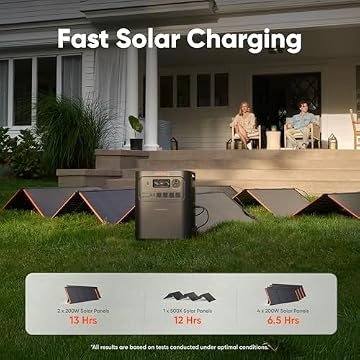
Off-grid replenishment is supported by dedicated solar input ports. Using the included pair of 200W solar panels or additional arrays under optimal sunlight conditions, the power station can fully recharge in as little as 4 hours. Those interested in balanced portable setups can look into the jackery 1500 with solar panels to understand how different solar arrays align with daily energy use.
For hybrid emergency scenarios where an auxiliary combustion engine is available, the station also charges directly from a gas generator in 2.5 hours. This allows homeowners to run a gas generator briefly during the day to fill the battery, then switch the generator off at night to enjoy silent, emission-free power indoors while sleeping.
Portability and Physical Handling
High-capacity battery systems inevitably carry significant weight, and this unit weighs 77.2 pounds. To manage that mass, the manufacturer uses automotive-grade cell-to-body (CTB) engineering. This construction reduces internal empty space, making the enclosure 34 percent smaller and 29.3 percent lighter than traditional multi-kilowatt power stations in the same performance bracket.
Moving a 77-pound machine between rooms requires proper ergonomics. The chassis incorporates a luggage-style telescopic handle paired with heavy-duty rolling wheels. This allows users to tilt and wheel the unit across flat surfaces, such as moving it from a garage charging station to a kitchen refrigerator or living area without lifting the entire weight.
The physical interface keeps home integration straightforward. The plug-and-play architecture is compatible with a manual transfer switch (MTS), allowing direct connection to your home electrical panel. Users flip the transfer switch, plug in the output cable, and press the primary power button to energize pre-selected household circuits without complex wire splicing or electrical modifications.
Expansion Potential for Extended Outages
While the base unit packs 3584Wh of storage, multi-day winter storms or extended regional blackouts may demand significantly more energy. The system features modular expansion capabilities, allowing users to connect external battery packs to scale capacity up to 21kWh on a single station. For larger family dwellings, linking multiple stations in parallel expands total available storage up to 43kWh.
This level of modular growth enables the system to support a three-person household for several days of essential living, maintaining lights, refrigeration, water pumps, and communication electronics. For homeowners deciding between modular high-output platforms and self-contained units, reviewing the jackery explorer 3000 pro provides clear perspective on fixed versus expandable battery capacities.
The expandable architecture means you do not have to purchase maximum capacity immediately. You can start with the primary 3584Wh station to secure basic household security, and later add expansion batteries if your backup needs grow or if you prepare for longer off-grid power requirements.
Jackery HomePower 3600 Plus Pros and Cons
Pros
- High 3600W output handles heavy household appliances
- Massive 3584Wh base capacity expandable to 21kWh
- Durable cells rated for 6,000 cycles
- Rapid two-hour recharge using hybrid AC and DC
- Operates reliably in extreme temperatures down to -4 °F
- Built-in wheels and telescopic handle simplify transport
Cons
- Heavy physical footprint at 77.2 pounds
- Listing specifies only two built-in AC outlets
- Full 240V output requires linking units in parallel
Check Jackery HomePower 3600 Plus on Amazon
Is the Jackery HomePower 3600 Plus Worth It
The system is an outstanding match for suburban and urban homeowners who need dependable emergency power but cannot store gas, manage oil changes, or deal with loud engine exhaust. With 3600W of clean continuous power and an ultra-safe ceramic membrane battery design, it provides peace of mind indoors during critical outages. The built-in wheels and telescopic handle make it manageable for a single adult to reposition despite its 77.2-pound heft.
However, it may not suit buyers looking for a lightweight camping power box or an inexpensive charging pack for personal devices. At over 77 pounds, it is not built for casual backpackers, and the listing specifies only two onboard AC outlets, which means running multiple household items simultaneously often requires heavy-duty power strips or an integrated transfer switch panel.
If your primary goal is clean, residential emergency preparedness with rapid recharge options and expandable battery reserves, this system delivers the heavy-duty specifications required to protect your home through prolonged power disruptions.
Other Options to Consider
Backup LiFePO4 Battery suits campers and outdoor travelers who need a compact 292Wh portable battery station for small electronics, hunting trips, and minimal blackout support rather than running full-size residential appliances.

Pure Sine Wave AC Outlet fits individuals who need lightweight 300W power delivery with 256Wh capacity, MPPT safety, and PD 60W charging specifically for emergency CPAP machines and small mobile devices.
GRECELL Portable Power Station 500W provides a balanced 519Wh capacity with two AC outlets and USB-C power delivery, making it a better match for RV weekenders and casual camping setups that require modest energy reserves without the bulk of a heavy residential unit.

FAQ
What household appliances can the Jackery HomePower 3600 Plus run during an outage?
With its 3600W continuous output, the unit runs high-draw household equipment including full-size refrigerators, sump pumps, space heaters, microwave ovens, and electric power tools. When paired in parallel with a second unit, it achieves 7200W output and dual 120V/240V delivery capable of running heavier residential gear like clothes dryers.
How long does the battery last before losing capacity?
The ceramic membrane battery cells are rated for 6,000 cycles, providing an estimated 10-year lifespan under typical residential usage patterns. The cells are designed to resist thermal degradation and maintain steady capacity across years of routine maintenance charging and blackout deployments.
How long does it take to fully recharge the power station?
Recharging time varies by input method. Using hybrid AC and DC charging, the unit recharges from zero to 100 percent in 2 hours. Standard AC wall charging takes 2.5 hours, a gas generator recharges it in 2.5 hours, and direct solar charging completes in approximately 4 hours under optimal sun conditions.
Does the station operate safely in freezing winter temperatures?
Yes, the system is engineered to function down to -4 degrees Fahrenheit. This allows homeowners to keep heaters, medical gear, and emergency lighting operational during winter blizzards and extreme cold snaps when electrical utilities fail.
Can I expand the storage capacity of the unit later on?
Yes, the 3584Wh base battery is fully expandable. You can add expansion packs to reach up to 21kWh on a single station, or connect multiple units in parallel to expand total system capacity up to 43kWh for extended household backup.


