As Amazon Associates, we earn from qualifying purchases. This means we may receive a small commission at no extra cost to you if you click through and make a purchase.
As an Amazon Associate we earn from qualifying purchases. Links on this page are affiliate links.
When evaluating a hammer action vs semi weighted midi controller, both options provide USB-MIDI connectivity, velocity response, pitch and modulation wheels, and bundled DAW software. Their key differences center on keybed resistance and control layouts. Hammer action provides acoustic-style resistance across a full 88-note range. In contrast, semi-weighted keybeds offer lighter action across 61 keys with aftertouch, alongside extra hardware controls such as faders and modular CV connections.
Key action
Fully-weighted hammer action
Semi-weighted
Number of keys
88
61
Aftertouch
not listed
Aftertouch-enabled
Hardware controls
Pitch bend, modulation, volume, and octave controls
9 faders, performance pads, pitch bend, and modulation wheels
Weight
38.5 pounds
18.1 pounds
Connectivity
USB, sustain, expression, and soft pedal inputs
MIDI In/Out, 4 CV Out, CV In, and 5 pedal inputs
Choose the first if
- You need a full 88-key layout with weighted hammer action to replicate acoustic piano key resistance.
- You require dedicated inputs for sustain, expression, and soft pedals.
Choose the second if
- You want a lighter 61-key controller equipped with aftertouch, performance pads, and 9 faders.
- You route signals to modular hardware via dedicated CV inputs and outputs.
Verdict
The M-Audio Hammer 88 fits players who prioritize full piano range and weighted key resistance. The Arturia KeyLab 61 MkII suits producers needing aftertouch, physical faders, and modular CV routing in a portable build. Your choice depends entirely on whether your workflow demands weighted piano keys or synthesizer control.
Hammer Action and Semi-Weighted Comparison
Number of keys
Edge: M-Audio Hammer 88 Weighted MIDI Controller
If your playing repertoire demands the complete compass of an acoustic grand, the M-Audio Hammer 88 Weighted MIDI Controller delivers a full 88-key layout. This broad register allows you to perform two-handed classical literature, complex jazz voicings, and wide bass-to-treble lines without transposing octaves mid-piece. The Arturia KeyLab 61 MkII Semi-Weighted Controller provides 61 keys, giving you a five-octave span. While 61 keys accommodate synth lines, pop chord progressions, and standard studio track creation within a compact footprint, you must rely on octave switching buttons to access registers beyond that boundary. For complete keyboard coverage, the 88-key layout holds the advantage.
Key action mechanics
Edge: Tie
Your decision between these models comes down to mechanical key resistance and personal playing style. The M-Audio Hammer 88 Weighted MIDI Controller features fully-weighted, hammer-action velocity-sensitive keys designed to reproduce the resistance and dynamic response of an acoustic piano. This makes it well suited for players focused on piano technique and fine velocity layers. Conversely, the Arturia KeyLab 61 MkII Semi-Weighted Controller features semi-weighted keys with aftertouch. The lighter spring resistance enables faster synth runs and rapid organ sweeps, while aftertouch lets you modulate filters and vibrato by applying pressure after striking a key. Each design serves distinct performance priorities.
Hardware control layout
Edge: Arturia KeyLab 61 MkII Semi-Weighted Controller
Control options on the top panel dictate how you interact with software and virtual instruments. The Arturia KeyLab 61 MkII Semi-Weighted Controller provides nine physical faders to adjust mixer channels or organ drawbars, alongside velocity-sensitive performance pads that can trigger chords in chord mode. It also includes machined pitch bend and modulation wheels. In contrast, the M-Audio Hammer 88 Weighted MIDI Controller prioritizes simplicity. Its interface contains only wheels for pitch bend and modulation, dedicated octave shift buttons, and a single master volume fader. For mixing tasks and real-time parameter tweaking, the KeyLab 61 MkII offers significantly more surface control.
Hardware connectivity
Edge: Arturia KeyLab 61 MkII Semi-Weighted Controller
Your external gear requirements determine which rear panel fits your studio setup. The Arturia KeyLab 61 MkII Semi-Weighted Controller includes standard 5-pin MIDI In and Out ports, four CV outputs, one CV input, and five pedal inputs. These analog connections let you route pitch, gate, and modulation signals directly to Eurorack modules and vintage hardware synths. The M-Audio Hammer 88 Weighted MIDI Controller provides class-compliant USB-MIDI and three pedal inputs designated for sustain, expression, and soft pedals. It lacks analog CV jacks and dedicated 5-pin MIDI DIN sockets in its published data. For hybrid hardware and modular rigs, the Arturia unit is more versatile.
Form factor and weight
Edge: Arturia KeyLab 61 MkII Semi-Weighted Controller
Physical dimensions and overall weight affect desk placement and gigging transport. The M-Audio Hammer 88 Weighted MIDI Controller measures 56 inches in width, 11.1 inches in length, and 5 inches in height, weighing 38.5 pounds. Its heavy build reflects the internal hammer mechanism and full 88-key span, demanding a sturdy keyboard stand and a large desk. The Arturia KeyLab 61 MkII Semi-Weighted Controller measures 37.6 inches in length, 11.7 inches in width, and 2.09 inches in height, with a weight of 18.1 pounds. Because it is under half the weight and much shorter, the Arturia unit is easier to reposition and fit into tight production spaces.
Choosing Your MIDI Controller
Modular synth and Eurorack hardware producers
Our pick: Arturia KeyLab 61 MkII Semi-Weighted Controller
You get four CV outputs and one CV input to integrate modular equipment directly without extra converters. Its keybed features aftertouch for dynamic performance modulation, and nine physical faders map to software parameters or drawbars. Five pedal inputs provide continuous physical control across live sets.
Students seeking structured lessons with pedal support
Our pick: M-Audio Hammer 88 Weighted MIDI Controller
You receive a three-month Skoove subscription for interactive lessons alongside bundled piano instruments like Mini Grand and Velvet. Dedicated inputs for sustain, expression, and soft pedals match standard acoustic configurations. The class-compliant USB connection works without driver installations, letting you focus directly on practice sessions.
Touring musicians prioritizing lighter hardware
Our pick: Arturia KeyLab 61 MkII Semi-Weighted Controller
At 18.1 pounds, this unit weighs less than half the alternative, making transport between venues straightforward. It features an aluminum chassis, wood side panels, and performance pads that trigger stored chord modes. A two-year warranty provides extended coverage for traveling setups.
| # | Product | Best for | Price |
|---|---|---|---|
| 1 | M-Audio Hammer 88 Weighted MIDI Controller | studio pianists wanting authentic hammer-action resistance | |
| 2 | Arturia KeyLab 61 MkII Semi-Weighted Controller | hybrid studio setups and modular synth control |

M-Audio Hammer 88 Weighted MIDI Controller
Best for: studio pianists wanting authentic hammer-action resistance
- Key Action
- Hammer Action
- Number of Keys
- 88
- Connectivity
- USB, sustain, expression, soft pedals
- Color
- Black
- Features
- MIDI
- Dimensions
- 11.1 × 56 × 5 inches
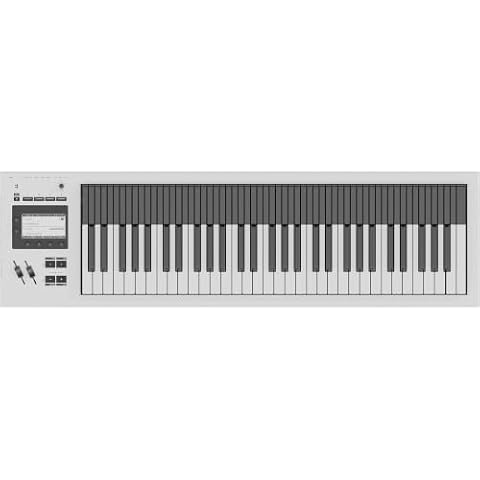
The M-Audio Hammer 88 is an 88-key USB MIDI controller built with fully-weighted hammer-action keys. You get acoustic piano resistance along with pitch bend, modulation, and inputs for sustain, expression, and soft pedals. At 38.5 pounds, it suits you if you need authentic piano feel at a permanent studio desk rather than portable synth keys.
- 88 fully-weighted, hammer-action velocity-sensitive keys
- Dedicated inputs for sustain, expression, and soft pedals
- Class-compliant USB-MIDI connectivity with USB bus power
- Hardware controls for pitch bend, modulation, volume, and octaves
- Heavy 38.5-pound weight limits portable use
- Wide 56-inch footprint requires substantial desk space
- You want an 88-key layout with fully-weighted hammer action.
- You need dedicated inputs for sustain, expression, and soft pedals.
- You have a permanent studio desk setup that supports a 56-inch controller.
- You need a lightweight keyboard controller for frequent travel.
- You have a compact workspace unable to fit a 56-inch chassis.
Verdict: M-Audio Hammer 88 Hammer Action MIDI Controller delivers authentic piano key resistance for composers and keyboardists working from a permanent studio desk.

Arturia KeyLab 61 MkII Semi-Weighted Controller
Best for: hybrid studio setups and modular synth control
- Key Action
- Semi-Weighted
- Number of Keys
- 61
- Aftertouch
- Aftertouch-enabled
- Faders and Knobs
- 9 faders
- Connectivity
- MIDI In/Out, 4 CV Out, CV In, 5 Pedal In
- Creative Modes
- Chord mode
The Arturia KeyLab 61 Semi-Weighted Controller is a 61-key USB MIDI keyboard equipped with semi-weighted keys and aftertouch. It features 9 faders, performance pads, and analog connectivity including 4 CV outputs, a CV input, and 5 pedal inputs. This layout suits you if you run hybrid music setups with software DAWs alongside external modular synthesizers.
- Semi-weighted 61-key bed with aftertouch support
- 4 CV outputs and 1 CV input for modular synthesizer integration
- 5 expression and sustain pedal inputs
- 9 physical faders for mixing and organ parameter adjustment
- 61-key layout provides less octave range than an 88-key board
- Semi-weighted keys do not provide weighted hammer-action resistance
- You want aftertouch response on a semi-weighted keybed
- You connect directly to modular synth gear via CV and gate jacks
- You mix and control software instruments with dedicated faders
- You require a full 88-key piano range
- You want the heavier key resistance of a dedicated hammer-action board
Verdict: Arturia KeyLab 61 Semi-Weighted Controller fits synthesizer players and electronic music producers who require deep DAW integration alongside CV connectivity for modular gear.
Specifications side by side
Spec M-Audio Hammer 88 Weighted MIDI Controller Arturia KeyLab 61 MkII Semi-Weighted Controller
- Number of Keys
- 88
- Key Action
- Fully-weighted hammer action
- Aftertouch
- –
- Faders and Knobs
- –
- Connectivity
- USB, sustain, expression, soft pedals
- Creative Modes
- –
- Color
- Black
- Features
- MIDI
- Dimensions
- 11.1 × 56 × 5 inches
- Weight
- 38.5 pounds
- Size
- Hammer 88
- Model
- HAMMER88
Copied from the Amazon listing. These figures were not measured here.
Frequently asked questions
What is the main physical difference between hammer action and semi-weighted keys?
Hammer action keys use mechanical levers to mimic the inertia of acoustic piano hammers. Semi-weighted keys use light spring mechanisms paired with small weights attached to each key. This design provides lighter resistance that rebounds faster, making it suitable for fast synth lines rather than classical piano technique.
Are hammer action MIDI controllers heavier than semi-weighted models?
Yes, hammer action controllers weigh substantially more due to their internal lever assemblies. For instance, the M-Audio Hammer 88 weighs 38.5 pounds with its hammer-action mechanism. In contrast, the 61-key semi-weighted Arturia KeyLab 61 MkII weighs 18.1 pounds, making spring-tensioned keyboards significantly more portable for traveling setups.
Can you produce synthesizer music with a hammer action controller?
You can play synthesizers with hammer action, but rapid lead playing and quick synth trills feel sluggish on heavy keys. Hammer mechanisms require deeper physical travel to reset each note. Synthesizer performers typically prefer semi-weighted keybeds because the lighter spring resistance allows quicker key return and faster repetitive keystrokes.
Do semi-weighted controllers support standard USB connectivity?
Yes, modern semi-weighted and hammer-action controllers connect directly through standard USB. Both the Arturia KeyLab 61 MkII and the M-Audio Hammer 88 feature USB and USB-MIDI connections. You can plug either unit straight into your computer to send standard MIDI messages directly into your recording software without separate hardware interfaces.
How much desk space do hammer action and semi-weighted controllers require?
Hammer action units usually require much larger desk surfaces. The 88-key M-Audio Hammer 88 spans 56 inches in width, 11.1 inches in length, and 5 inches in height. The semi-weighted Arturia KeyLab 61 MkII measures 37.6 inches wide, 11.7 inches long, and only 2.09 inches high, saving valuable studio space.
Which keybed action is better for learning traditional piano?
Hammer action is necessary if you want your practice to translate to an acoustic piano. It trains your finger muscles to manage natural key resistance and momentum. Semi-weighted keys lack true dynamic lever inertia, meaning your fingers will not develop the specific strength required for acoustic grand or upright pianos.