
As Amazon Associates, we earn from qualifying purchases. This means we may receive a small commission at no extra cost to you if you click through and make a purchase.
As an Amazon Associate we earn from qualifying purchases. Links on this page are affiliate links.
If you want flexible control over software and hardware instruments, exploring expressive e osmose ce 61 key alternatives helps you find the right tool for your setup. The Expressive E Osmose CE 61-Key MPE Controller excels at per-note acoustic articulation with a specialized keybed that responds to tap, press, vibrato, and shake motions. It also includes three controller modes, Press Glide, an expressive arpeggiator, and a 4.3-inch color display.
You might still look for a different model if your workflow demands specific hardware features, keybed actions, sizes, or brands. For instance, you may prefer an 88-key compass, semi-weighted key action, performance pads, or an integrated hardware sequencer from brands like Arturia, M-Audio, or Novation. These 6 alternatives were chosen because their specifications overlap with the original. Every option provides USB-MIDI connectivity and responsive controls to guide your playing in 2026.
How Each Osmose Alternative Compares
Arturia KeyLab mk3 61-Key Aftertouch Controller
The Arturia KeyLab mk3 gives you 12 pressure-sensitive pads alongside standard channel aftertouch across 61 keys. This hardware layout provides dedicated pad triggering that the Osmose CE lacks. However, you give up per-note continuous multidimensional control, such as horizontal vibrato and individual note pitch bends within chords, as well as the 4.3-inch color screen and Press Glide features. Weighing 18.7 pounds with a 38.8-inch frame, it also takes up significant desk depth. Choose the KeyLab mk3 if you want integrated drum pads and traditional aftertouch for general DAW production rather than polyphonic acoustic expression.
Arturia KeyLab 61 MkII Semi-Weighted Controller
The Arturia KeyLab 61 MkII features semi-weighted key action and analog CV connectivity built into an aluminum chassis. This interface lets you control modular Eurorack hardware directly from your keyboard, which the Osmose CE cannot do without external converters. In exchange, you lose the Osmose keybed's per-note MPE capabilities, including lateral vibrato, note shaking, and release shaping, along with its 900 Ctrl-E presets. Weighing 18.1 pounds, it is a sturdy desktop unit. You should select the KeyLab 61 MkII if you run analog CV synths alongside DAW software and prefer semi-weighted key resistance over polyphonic physical expression.
Arturia KeyLab Essential Mk3 61-Key MIDI Controller
The Arturia KeyLab Essential Mk3 provides physical DAW controls, aftertouch, and integrated chord and scale modes in a 6.8-pound chassis. At 35 inches wide and under 3 inches tall, it is far easier to transport than the Osmose CE. However, you sacrifice per-note pitch bending, polyphonic pressure glides, lateral vibrato, and the standalone sound engine containing 900 presets. You also give up the 4.3-inch display and dedicated DIN MIDI routing. Choose the KeyLab Essential Mk3 if you need a lightweight, straightforward 61-key controller for transport controls and assisted scale playing on a portable desk setup.
Arturia KeyLab Essential 88-Key MIDI Controller
The Arturia KeyLab Essential 88 expands your playing range to a full 88-note keybed, offering dedicated chord, scale, and arpeggiator tools. This extra octave range accommodates two-handed piano arrangements that exceed the Osmose CE's 61-key limit. To gain these extra 27 keys across a 54.3-inch frame, you surrender per-note MPE sensing, multidimensional finger articulation, individual note bending, and the 4.3-inch visual display. It also omits the Osmose software sound bank. Pick the KeyLab Essential 88 if your playing demands full piano compass and chord tools rather than deep acoustic and electronic note modulation.
M-Audio Oxygen Pro 61-Key MIDI Controller
The M-Audio Oxygen Pro 61 includes 16 performance pads, nine assignable faders, semi-weighted keys, and integrated NKS mapping. These physical controls give you direct tactile authority over mixer faders and drum racks during studio production. Compared to the Osmose CE, it lacks per-note MPE gesture detection, lateral vibrato, Press Glide pressure transitions, and the 4.3-inch color screen. It also features a black finish instead of white. Choose the Oxygen Pro 61 if you focus on mixing tracks with physical faders and programming beats on pads instead of shaping acoustic nuances across individual keys.
Novation 61SL MkIII 61-Key Sequencer Keyboard
The Novation 61SL MkIII features an internal eight-track sequencer, CV/Gate outputs, weighted key action, and five color LCD screens. These tools let you sequence hardware synths, modular gear, and software tracks simultaneously without relying entirely on a computer screen. By choosing this model, you give up the Osmose CE's continuous per-note MPE key mechanics, including note shaking, lateral vibrato, and strumming articulation, as well as the 900 bundled presets. Opt for the 61SL MkIII if you need a comprehensive hardware command center to sequence external synthesizers and manage hybrid studio routing.
| # | Product | Best for | Price |
|---|---|---|---|
| 1 | Expressive E Osmose CE 61-Key MPE Controller Best overall | expressive per-note MIDI control and synthesis | |
| 2 | Arturia KeyLab mk3 61-Key Aftertouch Controller Best aftertouch | expressive aftertouch and pad performance | |
| 3 | Arturia KeyLab 61 MkII Semi-Weighted Controller Best premium | hybrid modular synth and studio DAW setups | |
| 4 | Arturia KeyLab Essential Mk3 61-Key MIDI Controller Best budget | Lightweight 61-key studio and DAW control | |
| 5 | Arturia KeyLab Essential 88-Key MIDI Controller Best 88-key | full-range piano playing and DAW production | |
| 6 | M-Audio Oxygen Pro 61-Key MIDI Controller Best music production | DAW automation and drum pad production | |
| 7 | Novation 61SL MkIII 61-Key Sequencer Keyboard Best weighted | hardware sequencing and hybrid synth setups |
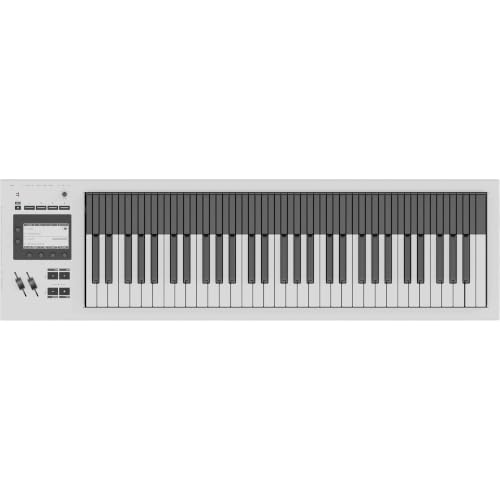
Expressive E Osmose CE 61-Key MPE Controller
Best for: expressive per-note MIDI control and synthesis
- Number of Keys
- 61
- Creative Modes
- Expressive arpeggiator, Press Glide
- Connectivity
- USB-MIDI
- Color
- White
The Expressive E Osmose CE 61-Key MPE Controller provides multi-dimensional per-note control across 61 keys. You can bend pitch, add vibrato, and use Press Glide directly on each key. Hardware controls include a 4.3-inch color display, seven encoders, and pitch and modulation sliders. With USB-C, DIN MIDI connections, and included Ctrl-E software, it suits musicians focused on nuanced phrasing.
- Per-note pitch bend, vibrato, and pressure control on every key
- 4.3-inch color display with seven rotary encoders
- Full DIN MIDI In and Out/Thru alongside USB-C connectivity
- Included Ctrl-E software with over 900 expressive presets
- No integrated drum pads for percussion triggering
- Limited to two pedal inputs for foot control
- You need independent per-note expression and pitch bending on every key.
- You want visual feedback and navigation via a 4.3-inch color screen.
- You connect to both modern USB-C and standard DIN MIDI hardware.
- You require an 88-key range for traditional piano pieces.
- You rely on dedicated velocity pads for finger drumming.
Verdict: Expressive E Osmose CE 61-Key MPE Controller delivers advanced per-note acoustic articulation for electronic musicians and sound designers who require polyphonic physical expression.

Arturia KeyLab mk3 61-Key Aftertouch Controller
Best for: expressive aftertouch and pad performance
- Number of Keys
- 61
- Performance Pads
- 12 pressure-sensitive pads
- Aftertouch
- Aftertouch
- Connectivity
- USB, sustain/auxiliary pedal inputs
- Color
- White
- Features
- MIDI
The Arturia KeyLab mk3 is a 61-key USB MIDI controller built for expressive playing. You get keybed aftertouch, 12 pressure-sensitive pads, and inputs for sustain and auxiliary pedals. At 18.7 pounds and 38.8 inches long, it occupies dedicated desk space. It suits you if you want physical aftertouch alongside assignable pad triggers.
- 61-key keybed equipped with aftertouch
- 12 pressure-sensitive performance pads
- Dedicated sustain and auxiliary pedal inputs
- USB-MIDI connectivity
- Footprint of 38.8 by 16 inches demands substantial desk room
- Weight of 18.7 pounds limits portable use
- You want physical aftertouch across 61 keys.
- You need 12 pressure-sensitive pads for drum programming or clips.
- You plan to connect both sustain and auxiliary pedals.
- You work on a shallow desk unable to fit a 16-inch depth.
- You need a portable controller weighing under 15 pounds.
Verdict: Arturia KeyLab mk3 61-Key with Aftertouch serves musicians seeking physical key aftertouch paired with 12 pressure-sensitive pads. It fits workstation setups where desk space accommodates its 38.8-inch frame.

Arturia KeyLab 61 MkII Semi-Weighted Controller
Best for: hybrid modular synth and studio DAW setups
- Number of Keys
- 61
- Key Action
- Semi-weighted
- Aftertouch
- Aftertouch-enabled
- Faders and Knobs
- 9 faders
- Connectivity
- MIDI In/Out, 4 CV Out, CV In, 5 Pedal In
- Creative Modes
- Chord mode
The Arturia KeyLab 61 MkII is a 61-key semi-weighted MIDI controller built with an aluminum chassis and wood panels. It features four CV outputs, one CV input, five pedal inputs, and aftertouch. You get direct tactile manipulation of modular synthesizers and DAWs through nine faders and chord-capable performance pads, making it suitable for hybrid electronic production desks.
- Extensive modular connectivity with 4 CV outputs and 1 CV input
- Aluminum chassis with machined metal pitch and modulation wheels
- 5 expression pedal inputs for multi-pedal performance control
- Semi-weighted 61-key keybed with aftertouch
- Weighs 18.1 pounds, making it heavier to transport than all-plastic alternatives
- Uses standard channel aftertouch rather than per-key multidimensional MPE control
- You control Eurorack or vintage analog synthesizers using dedicated CV and gate connections.
- You need up to five pedal inputs for foot control during complex live or studio playing.
- You want a heavy-duty aluminum chassis designed for a permanent studio desk.
- You need a lightweight keyboard under 18 pounds for frequent travel.
- You require continuous multi-axis MPE finger modulation on individual keys.
Verdict: Arturia KeyLab 61 MkII MIDI Keyboard serves producers who need robust aluminum construction and deep analog CV connectivity to run Eurorack rigs and software instruments together.

Arturia KeyLab Essential Mk3 61-Key MIDI Controller
Best for: Lightweight 61-key studio and DAW control
- Number of Keys
- 61
- Key Action
- Hybrid synth-piano
- Performance Pads
- RGB velocity/pressure pads
- Aftertouch
- Keybed aftertouch
- Faders and Knobs
- Faders, rotary encoders
- Connectivity
- USB-C, MIDI out, pedal inputs
The Arturia KeyLab Essential Mk3 61-Key MIDI Controller is a 6.8-pound keyboard for studio and stage use. You get 61 velocity-sensitive keys with aftertouch, RGB pressure pads, faders, and rotary encoders. With USB-C, MIDI Out, and built-in scale, chord, and arpeggiator modes, it suits musicians who need core MIDI controls and software integration without excess bulk.
- Weighs 6.8 pounds for easy portability
- Keybed includes velocity sensitivity and aftertouch
- Hardware connectivity provides USB-C, MIDI Out, and three pedal inputs
- Built-in creative tools include arpeggiator, chord play, and scale mode
- Hybrid synth-piano keybed lacks weighted hammer-action resistance
- Keybed aftertouch does not offer multi-dimensional MPE per-key control
- You want a 61-key controller under 7 pounds for portable studio or stage use.
- You need tactile control via faders, rotary encoders, and velocity-sensitive RGB pads.
- You require MIDI Out connectivity alongside USB-C for external instruments.
- You need multi-dimensional continuous MPE expression across each individual key.
- You require fully weighted hammer action for traditional acoustic piano practice.
Verdict: Arturia KeyLab Essential Mk3 61-Key MIDI Controller delivers core physical DAW controls, built-in chord and scale modes, and aftertouch in a portable 6.8-pound frame. It directly serves producers who want comprehensive software integration and hybrid key action without added desk weight.

Arturia KeyLab Essential 88-Key MIDI Controller
Best for: full-range piano playing and DAW production
- Number of Keys
- 88
- Key Action
- Hybrid synth-piano feel, waterfall
- Performance Pads
- RGB-backlit velocity and pressure pads
- Connectivity
- USB
- Creative Modes
- Scale Mode, Chord Mode, Arpeggiator
- Color
- White
The Arturia KeyLab Essential 88-Key Keyboard provides a full 88-note range if you want broader reach than standard 61-key controllers. It features hybrid waterfall keys, a 2.5-inch LCD screen, and velocity-sensitive pads. With built-in Chord, Scale, and Arpeggiator modes, it suits producers and songwriters who prioritize piano range alongside direct DAW integration over specialized multi-dimensional gesture control.
- Full 88-key waterfall keybed with hybrid synth-piano feel
- Built-in Scale Mode, Chord Mode, and Arpeggiator
- RGB-backlit pads with velocity and pressure sensitivity
- Real-time feedback via a 2.5-inch LCD screen
- Dedicated DAW integration scripts for Ableton Live, Logic Pro X, and FL Studio
- Hybrid waterfall keybed lacks weighted hammer action
- Wide 54.3-inch footprint requires substantial desk space
- No multidimensional per-key MPE expression listed in specifications
- You need a full 88-key range for two-handed piano playing and wide arrangements.
- You want built-in creative aids like Scale Mode, Chord Mode, and an Arpeggiator.
- You use DAWs like Ableton Live, Logic Pro X, or FL Studio and want dedicated control scripts.
- You require fully weighted hammer-action keys for traditional acoustic piano practice.
- You have a small workspace that cannot accommodate a 54.3-inch frame.
- You need per-key multidimensional MPE expression.
Verdict: Arturia KeyLab Essential 88-Key Keyboard fits musicians who need the full compass of an 88-note keybed with dedicated chord and scale tools in a lightweight package. It delivers practical DAW navigation for studio production without the bulk of heavy stage pianos.

M-Audio Oxygen Pro 61-Key MIDI Controller
Best for: DAW automation and drum pad production
- Number of Keys
- 61
- Key Action
- Semi-weighted
- Performance Pads
- 16 RGB velocity-sensitive pads
- Aftertouch
- Aftertouch
- Faders and Knobs
- 8 knobs, 9 faders
- Connectivity
- USB
The M-Audio Oxygen Pro 61 is a USB MIDI controller with 61 semi-weighted keys, aftertouch, and assignable zones. You get 16 RGB velocity-sensitive pads with Note Repeat alongside nine faders and eight knobs for direct DAW automation. Built-in NKS integration, Smart Chord, and Smart Scale modes suit producers sequencing complex virtual instruments in home studios.
- 16 RGB backlit velocity-sensitive pads with Note Repeat
- 61 semi-weighted keys with aftertouch and zone assignment
- 9 assignable faders and 8 assignable rotary knobs
- Native Kontrol Standard support for software preset management
- Hardware 5-pin MIDI output and sustain pedal port
- Offers only a sustain pedal input without an expression pedal port
- Semi-weighted keys provide less resistance than hammer-action keybeds
- You produce beats and trigger clips using 16 dedicated drum pads.
- You rely on Native Instruments software and want direct NKS integration.
- You need assignable faders and knobs to map DAW mixer channels.
- You require an expression pedal input for dynamic parameter sweeps.
- You prefer fully weighted hammer-action piano keys.
Verdict: M-Audio Oxygen Pro 61 Semi-Weighted Keyboard gives DAW-based music producers tactile control over arrangements through 16 performance pads, nine faders, and integrated NKS mapping.

Novation 61SL MkIII 61-Key Sequencer Keyboard
Best for: hardware sequencing and hybrid synth setups
- Number of Keys
- 61
- Key Action
- Synth-style semi-weighted
- Connectivity
- USB, MIDI I/O, CV/Gate out, clock out
- Creative Modes
- 8-track polyphonic sequencer
- Color
- Black
- Dimensions
- 11.8 × 38.6 × 3.94 inches
The Novation 61SL MkIII is a 61-key MIDI controller keyboard designed for complex studio routing. You get semi-weighted synth-action keys, an internal eight-track polyphonic sequencer, and dedicated CV/Gate outputs for analog gear alongside standard MIDI and USB ports. Five color LCD screens give parameter feedback across DAWs and external synths. It suits you if you control hardware and software rigs together.
- Internal eight-track polyphonic pattern-based sequencer
- Dedicated CV/Gate, analogue clock, and standard MIDI I/O connections
- Five color LCD screens provide continuous parameter feedback
- Pre-mapped DAW control for Ableton Live, Logic, and Reason
- Synth-style semi-weighted keybed lacks hammer-action resistance
- Larger chassis measuring 38.6 inches wide and weighing 14.4 pounds
- Does not include continuous multidimensional MPE key sensors
- You want an internal eight-track sequencer to command hardware and software without relying on a computer screen.
- You connect modular or analog synths using direct CV/Gate and clock connections.
- You use Ableton Live, Logic, or Reason and require dedicated screen feedback for controls.
- You require fully weighted hammer action for acoustic piano performance.
- You need multidimensional polyphonic expression keys similar to the Osmose keybed.
- You need a compact, lightweight controller keyboard for mobile travel setups.
Verdict: Novation 61SL MkIII 61-Key MIDI Keyboard coordinates hybrid hardware and software setups through its built-in 8-track sequencer and CV/Gate connections. It serves producers who need multi-device routing and visual parameter feedback from five color LCD screens.
Specifications side by side
Spec Expressive E Osmose CE 61-Key MPE Controller Arturia KeyLab mk3 61-Key Aftertouch Controller Arturia KeyLab 61 MkII Semi-Weighted Controller Arturia KeyLab Essential Mk3 61-Key MIDI Controller Arturia KeyLab Essential 88-Key MIDI Controller M-Audio Oxygen Pro 61-Key MIDI Controller Novation 61SL MkIII 61-Key Sequencer Keyboard
- Number of Keys
- 61
- Key Action
- –
- Performance Pads
- –
- Aftertouch
- –
- Faders and Knobs
- –
- Connectivity
- –
- Creative Modes
- Expressive arpeggiator, Press Glide
- Suitable For
- –
- Color
- White
- Built-In Features
- –
- Features
- MIDI
- Dimensions
- –
- Weight
- –
- Size
- 61-Key
- Model
- XPEOSM61CE-1
Copied from the Amazon listing. These figures were not measured here.
Frequently asked questions
Which Osmose alternative works best for controlling analog Eurorack gear?
You should look at the Arturia KeyLab 61 MkII or the Novation 61SL MkIII. The KeyLab 61 MkII provides dedicated analog CV connectivity in an aluminum chassis. The Novation 61SL MkIII also features CV and Gate connections alongside an integrated eight-track sequencer and five color LCD screens.
Which alternatives offer weighted or semi-weighted key action instead of MPE?
You can choose between semi-weighted and weighted keybeds depending on your playing style. The Arturia KeyLab 61 MkII and M-Audio Oxygen Pro 61 feature semi-weighted keys. If you want a weighted feel, the Novation 61SL MkIII provides a weighted 61-key bed alongside hardware sequencing tools.
What is the most lightweight 61-key alternative to the Expressive E Osmose?
The Arturia KeyLab Essential Mk3 61-Key is the lightest option on the list. It weighs 6.8 pounds and measures 35 inches by 9.4 inches. This makes it substantially lighter than alternatives like the KeyLab mk3 at 18.7 pounds and the KeyLab 61 MkII at 18.1 pounds.
Is there an 88-key alternative available on this list?
Yes, the Arturia KeyLab Essential 88-Key provides a full 88-note keybed. It offers built-in chord and scale features along with an integrated arpeggiator. It weighs 17.6 pounds and measures 54.3 inches wide, giving you standard piano range while remaining lighter than many conventional 88-key instruments.
Which keyboard provides the highest number of physical pads and faders?
The M-Audio Oxygen Pro 61 offers the most trigger pads and faders among these alternatives. It features 16 performance pads, nine faders, and integrated NKS mapping. It connects over USB-MIDI, weighs 10.6 pounds, and includes a semi-weighted 61-note layout for arranging tracks in your DAW.
Does any alternative feature an onboard hardware sequencer?
Yes, the Novation 61SL MkIII includes a built-in eight-track hardware sequencer. You can use it to coordinate external synthesizers and software instruments simultaneously. It also features five color LCD screens for visual parameter monitoring and weighted keys with USB-MIDI and CV/Gate connections.
