
As Amazon Associates, we earn from qualifying purchases. This means we may receive a small commission at no extra cost to you if you click through and make a purchase.
Shoppers searching for the Bambu Lab P1S Combo often want to know if an enclosed, multi-material machine can truly eliminate the tedious calibration rituals of older desktop hardware. Those searching for terms like bambu ps2 combo are almost always tracking down this specific machine or researching how it compares to other hardware in the ecosystem, such as the bambu lab p2s combo. For creators tired of failed first layers, agonizingly slow print speeds, and fragile open-frame setups, this unit pairs an enclosed CoreXY motion platform with an automated material system to deliver reliable, high-velocity output straight from the factory crate.
In this detailed bambu p1s combo review, we break down what daily ownership looks like without relying on marketing jargon or inflated promises. We cover the core physical specifications, verify real-world material compatibility, explore the multi-spool automated feeder, and evaluate whether the enclosed chamber delivers meaningful stability for advanced technical filaments. By examining how this printer behaves during continuous operation and comparing it directly against popular alternatives, this guide helps you decide if this all-in-one package fits your creative ambitions and workshop space.
What You Get With the Bambu Lab P1S Combo
Bambu Lab P1S Combo




Photographs published on the Amazon listing.
The Bambu Lab P1S Combo arrives as an integrated manufacturing setup designed to remove the guesswork from multi-material fabrication. Rather than requiring users to purchase aftermarket enclosures, third-party Bowden splitters, and auxiliary leveling sensors separately, the manufacturer delivers a unified bundle ready for immediate assembly.
- Bambu Lab P1S enclosed 3D printer featuring a rigid metal structural body
- Bambu Lab AMS unit engineered for automated multi-material routing
- Direct-drive print assembly capable of 500mm/s velocity and 20000 mm/s² acceleration
- Integrated automatic bed leveling sensor array
- Enclosed side and roof panels designed to manage internal chamber conditions
- Pre-configured material feed tubing and electronic bus cables
- Accessory toolkit and manufacturer documentation for setup
Key Specifications
Specification
Manufacturer Listing Detail
- Item Model Number
- P1S Combo
- Brand / Manufacturer
- BAMBULAB
- Chassis Material
- Metal
- Machine Color
- Black
- Product Dimensions
- 18.72"D x 23.01"W x 18.72"H
- Item Weight
- 47.5 pounds
- Maximum Print Speed
- 500mm/s
- Maximum Acceleration
- 20000 mm/s²
- Multi-Color Support
- Up to 16 colors (requires connecting Bambu Lab AMS)
- Bed Leveling Type
- Automatic Bed Leveling
- Assembly Claim
- Set up in 15 minutes
Copied from the Amazon listing. These figures were not measured here.
Multi-Color Printing and the AMS Workflow
Relying on the bambu p1s combo for multi color printing fundamentally reshapes the typical workflow of home fabrication. Instead of manually pausing jobs to swap spools, purge residual color, and re-prime hotends, the automated module manages feeding mechanics autonomously. The bundled hardware holds up to four active spools in parallel, switching between accent colors, interface materials, or primary build plastics on demand. According to the manufacturer listing, creators who need expansive palettes can connect additional modules to achieve up to 16 distinct colors across a single project.
The physical routing executed by the bambu labs ams system relies on active motorized feeders, an integrated filament cutter near the hotend, and a reverse Bowden guide tube. When a layer requires a new hue, the printer cleanly severs the current filament strand, rewinds it into the staging dry box, loads the next spool forward, and flushes the nozzle cavity to eliminate pigment cross-contamination. While this automated purge process does generate small amounts of sacrificial waste, it completely eliminates layer shifts and cold-pull errors common to manual mid-print pauses.
This automated feeder also excels when handling soluble support materials like PVA alongside standard rigid filaments. Creating intricate overhangs, hollow enclosures, or interlocking internal gears becomes vastly easier when the printer can lay down dedicated breakaway or water-soluble interface layers. By isolating spools within an enclosed lid, the system keeps moisture-absorbing plastics protected throughout lengthy, multi-day print runs.
Print Speed and Mechanical Acceleration
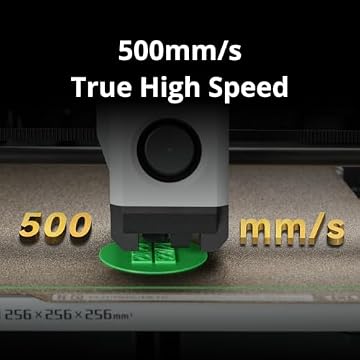
A central pillar of the bambu lab p1s combo specs is its high-velocity motion system, which pairs a top travel speed of 500mm/s with 20000 mm/s² acceleration. While many conventional 3D printers advertise high top speeds, they rarely reach them because their heavy beds and lax stepper drivers take too long to accelerate across short distances. The P1S overcomes this through an optimized CoreXY layout, meaning the printhead remains nimble while moving across stationary drive belts.
Rapid acceleration transforms practical turnaround times for daily projects. Mechanical prototypes, organizational bins, and architectural models that traditionally require ten to twelve hours on older bedslinger machines frequently complete in less than half that time on this platform. The steady velocity curve minimizes heat creep issues and ensures consistent extrusion dynamics across broad flat surfaces and tight perimeter curves alike.
Maintaining pinpoint precision at extreme bambu p1s combo speed requires a stiff, vibration-resistant frame. The all-metal construction specified in the listing provides the mass necessary to counteract rapid changes in kinetic momentum. Built-in dynamic compensation routines actively measure belt resonance during initial calibration, allowing the firmware to anticipate micro-vibrations and prevent visual artifacts like ghosting or ringing on finished exterior surfaces.
Enclosure Benefits and Filament Compatibility
The bambu p1s enclosed 3d printer design delivers critical thermal isolation that open-air machines simply cannot replicate. Ambient room drafts, cool air conditioning currents, and fluctuating workshop temperatures are notorious for causing plastic layers to contract unevenly. By enclosing the entire build area with solid panels and a top glass cover, the chamber traps heat radiating from the build plate, maintaining a warm and stable environment that prevents warping and layer separation.
Filament versatility is clearly defined in the official listing data. The system is marked as ideal for standard and technical filaments, including PLA, PETG, TPU, PVA, PET, ABS, and ASA. For materials like ABS and ASA, an enclosed chamber is practically mandatory; without warm ambient air, these materials inevitably curl off the print surface or crack along layer seams. The listing also notes that the printer is capable of processing advanced engineering plastics such as PA (nylon) and PC (polycarbonate), expanding your options for functional end-use mechanical components.
However, prospective buyers must note the explicit material boundaries specified by the manufacturer. The listing states that carbon fiber and glass fiber reinforced polymers are not recommended for this stock configuration. Abrasive fiber additives quickly grind down standard nozzles and feeder gears. When considering the bambu p1s vs a1, this enclosed chamber and wide thermal envelope give the P1S a distinct edge for technical engineering filaments over open-frame alternatives, even while composite filaments remain off-limits out of the box.
Setup Process and Workspace Demands
Getting started with this machine is remarkably straightforward, with manufacturer documentation highlighting a fast bambu p1s combo setup that takes roughly 15 minutes. Traditional DIY kit printers often consume an entire weekend of sorting loose bolts, routing exposed wiring looms, and squaring structural extrusions. Because the P1S arrives pre-assembled inside its metal cabinet, initial setup mostly entails removing shipping foam, releasing transit retention screws, and snapping the material feed lines into position.
Automated calibration routines eliminate the most frustrating hurdle in desktop 3D printing: bed leveling. The integrated automatic bed leveling sensors test the print surface across a dense coordinate grid before every critical job, calculating an exact spatial mesh of the plate. This software-driven compensation guarantees that the initial plastic extrusion bonds firmly across the entire bed, preventing print detachment without requiring manual adjustments with paper strips or feeler gauges.
Finding the right home for the printer requires careful consideration of its physical footprint. Measuring 18.72 inches deep, 23.01 inches wide, and 18.72 inches tall, and tipping the scales at 47.5 pounds, this machine requires a deep, dedicated workstation. Furthermore, because the carriage moves with extreme velocity, placing the unit on a flimsy desk will result in heavy wobbling and audible resonance. Makers exploring smaller alternatives can compare these dimensions with our bambu lab a1 combo 3d printer overview to see how footprint demands shift across different model classes.
Bambu Lab P1S Combo Pros and Cons
Pros
- Prints up to 16 colors with AMS
- Fast 500mm/s speed and 20000 mm/s² acceleration
- Enclosed metal body stabilizes technical filaments
- Automated bed leveling eliminates manual adjustments
- Quick 15-minute initial setup experience
Cons
- Not recommended for carbon or glass fiber filaments
- Heavy 47.5-pound workspace footprint
- Requires additional AMS modules to reach 16 colors
Check Bambu Lab P1S Combo on Amazon
Is the Bambu Lab P1S Combo Worth It
Deciding whether to bring home this machine comes down to how much you value your time and creative momentum. If you are asking whether is bambu p1s combo worth it, the answer is a resounding yes for anyone who views 3D printing as a practical fabrication tool rather than an ongoing mechanical repair hobby. The seamless union of high speed, automated material swapping, and factory-tuned enclosure panels removes virtually all of the friction points that cause beginners to abandon the craft.
For small business operators, Etsy crafters, and rapid prototypers, the return on investment is immediate. The ability to load four different spools simultaneously allows you to produce multi-colored signage, decorative household items, or support-dense functional parts overnight without babysitting the machine. The time saved by not having to manually calibrate bed leveling wheels or monitor sensitive ABS prints against room drafts easily justifies choosing this platform over cheaper, open-frame alternatives.
On the other hand, hobbyists who exclusively produce small, single-color PLA trinkets and have strict desktop space constraints might find the heavy 47.5-pound enclosed footprint excessive for their modest goals. But if your roadmap includes structural engineering plastics, high-throughput manufacturing, and vibrant multi-colored designs, this machine stands out as one of the most cohesive, dependable, and capable desktop systems available today.
Other Options to Consider
FLASHFORGE Adventurer 5M 3D Printer caters to makers who prioritize maximum single-material extrusion velocity over integrated multi-color feeding. Featuring a top speed of 600mm/s, fully auto leveling, a 280°C direct extruder with a 3-second detachable nozzle, an all-metal CoreXY structure, and a 220x220x220mm build area, it provides an agile alternative for rapid functional prototyping.

Beginner-Friendly Ecosystem with MakerWorld Model is designed for newcomers who want an exceptionally quiet, open-bed experience. Built on an open-frame chassis featuring full-auto calibration, active flow rate compensation, an ultra-quiet noise profile under 48 dB, and direct MakerWorld model integration, this setup suits shared classrooms and living rooms where silent operation outweighs the need for high-temperature enclosure panels.
Dual-Color Printing serves hobbyists seeking an integrated enclosed chamber with multi-material capability in a compact footprint. Offering a built-in touchscreen display, wireless WiFi connectivity, and an enclosed build environment, it delivers straightforward two-color fabrication for users who do not require a separate four-spool external feeding module.

FAQ
Can the Bambu Lab P1S Combo print flexible TPU filament?
Yes, the manufacturer listing explicitly identifies TPU as an ideal filament for the P1S printer. However, flexible filaments generally need to be loaded from a standalone external spool holder rather than fed through the automated multi-material system to avoid feeding jams.
How many colors can you print at one time with this system?
The standard combo setup includes one automated material module that holds and switches between four spools. By connecting additional companion units, the listing notes that the system can scale up to handle a total of 16 colors in a single job.
Does this printer support carbon fiber reinforced filaments?
No, the product listing specifically states that carbon fiber and glass fiber reinforced polymers are not recommended. Using abrasive composite filaments on the stock setup will accelerate wear on the nozzle and internal feeder drive components.
How fast does the Bambu Lab P1S Combo print?
The listing rates the printer for a maximum travel and extrusion speed of up to 500mm/s, supported by an acceleration rate of 20000 mm/s². This combination drastically cuts total print duration compared to traditional desktop machines.
How difficult is the physical assembly for a beginner?
The listing states that setup takes approximately 15 minutes. Because the metal chassis arrives fully enclosed and pre-assembled, you only need to remove the internal transit brackets, mount the spool management system, attach the feed tubes, and run the automated calibration routines.


