
As Amazon Associates, we earn from qualifying purchases. This means we may receive a small commission at no extra cost to you if you click through and make a purchase.
Finding an off-grid charging solution that balances compact packability with reliable energy production often leads campers and preparedness planners to 100-watt folding arrays. The Anker SOLIX PS100 bifacial portable solar panel addresses this balance directly by combining high-efficiency N-type photovoltaic material with dual-sided light capture in a package that weighs just 7 pounds including its built-in kickstand. If you want a dependable, grab-and-go panel for weekend camping trips, tailgate setups, or emergency blackout readiness, this unit offers one of the most streamlined forms currently available in the 100-watt category. Rather than dealing with heavy, awkward folding suitcases, outdoor travelers get a weather-sealed array designed to deploy in seconds and harvest energy from both ambient overhead light and ground reflection.
While standard portable panels rely exclusively on direct front-facing sunlight, this bifacial design extracts extra power from surrounding surfaces such as light-colored soil, sand, concrete, or snow. In this comprehensive anker ps100 solar panel review, we examine the structural build quality, electrical conversion claims, cable integration, and weatherproofing standards detailed in the official product specifications. We also analyze how the panel pairs with contemporary portable power stations, how its physical dimensions translate to real-world vehicle packing, and how it compares to larger capacity alternatives so you can determine if a 100W bifacial configuration matches your specific travel demands.
What You Get With the Anker SOLIX PS100
Anker SOLIX PS100



Photographs published on the Amazon listing.
Opening the package reveals a complete mobile charging kit engineered for straightforward deployment without requiring third-party adapters for most standard solar inputs. The panel arrives fully assembled with its integrated support structure and dedicated wiring sets to connect straight to compatible portable power generators.
- Anker SOLIX PS100 bifacial portable solar panel with integrated kickstand support
- Two 8.2-foot (2.5-meter) solar charging cables
- One 1.6-foot (0.5-meter) XT60i solar charging cable
- Quick start guide for deployment and positioning
- Safety instruction card and compliance documentation
- Integrated reinforced aluminium frame with pre-attached impact-resistant protective materials
Key Specifications
The technical specifications demonstrate a clear emphasis on component density, elevated conversion efficiency, and extreme weather resilience compared to typical folding outdoor panels.
Attribute
Specification Detail
- Model Number
- AS310
- Maximum Rated Power
- 100 Watts
- Cell Architecture
- Next-generation N-type solar cells
- Conversion Efficiency
- 25% or higher conversion efficiency
- Bifacial Yield Gain
- Up to 10% additional power from rear surface capture
- Weight
- 7 lb (including built-in kickstand)
- Expanded Dimensions
- 23.62 inches Long x 0.67 inches Wide x 40.55 inches High
- Ingress Protection Rating
- IP68 water and dust resistance
- Structural Frame
- Reinforced aluminium frame with impact-resistant layering
- Design Lifespan & Warranty
- 10-year lifespan rating with a 5-year (60-month) manufacturer warranty
Copied from the Amazon listing. These figures were not measured here.
Portability and Field Weight for Outdoor Travel
Portability represents the single greatest mechanical hurdle for folding solar equipment. Traditional 100-watt solar blankets or aluminum-framed briefcases frequently tip the scales at 10 to 12 pounds once kickstands, hinges, and heavy-gauge handles are factored into the assembly. The Anker SOLIX PS100 weighs just 7 pounds with its kickstand system included, making it roughly 10 percent lighter than previous Anker iterations and over 30 percent lighter than typical 100W panels across the market. This weight reduction simplifies loading into car trunks, van storage cubbies, or rooftop cargo boxes where space and payload capacities remain strictly budgeted.
When selecting the anker solix c300 dc portable power station for an ultra-compact weekend camping footprint, carrying an excessively heavy solar collector negates the advantage of having a lightweight power hub. The slim 0.67-inch profile of the PS100 allows it to slide flat behind vehicle seats or rest cleanly atop storage totes. Because the kickstand is integrated directly into the structural backing, you do not need to wrestle with loose support legs, detachable brackets, or separate tripod hardware when pitching camp on uneven ground.
For lone travelers and camp cooks managing multiple pieces of gear simultaneously, the single-unit handling of the panel reduces setup fatigue. You simply unlatch the folding sections, extend the rear kickstand, angle the face toward the southern sky, and route the wiring to your charging station. The reinforced frame provides enough torsional rigidity that the panel resists twisting or sagging while carried in one hand, even in blustery campsite environments.
Bifacial Cell Technology and Real Power Generation
The defining technical feature of this anker 100w bifacial solar panel is its dual-sided photovoltaic reception. Standard mono-crystalline panels feature an opaque rear sheet that absorbs zero light, meaning any solar radiation that reflects off surrounding terrain is completely wasted. The PS100 incorporates transparent layers that allow the back of the panel to convert ambient ground reflections into usable electricity, yielding up to 10 percent more total power under favorable surface conditions.
Real-world energy generation from the rear side depends heavily on the surface beneath your setup. If you prop the panel up on light-toned gravel, white sand, light concrete pads, or late-season snowpack, the ground albedo reflects significant ambient light back onto the rear N-type cells. Conversely, placing the panel over thick, dark grass or damp forest loam will produce minimal rear gain. Understanding this operational dynamic helps users position the panel intentionally to maximize total watt-hour yield throughout peak sunlight hours.
Thermal stability provides another key advantage. Photovoltaic cells naturally experience voltage drop-off as surface temperatures climb during midsummer afternoons. The anker ps100 n-type cells engineered into this array resist thermal degradation significantly better than older cell formulations, maintaining a rated conversion efficiency of over 25 percent. This higher baseline efficiency ensures that even in hot desert or lakeshore environments, energy transmission remains steady rather than cratering under direct overhead heat.
Weather Protection and Build Durability
Outdoor power equipment routinely encounters sudden downpours, blowing dirt, and morning condensation. The anker solix ps100 waterproof rating reaches an exceptional IP68 standard, indicating complete sealing against fine dust penetration and the ability to withstand continuous immersion in water under specified conditions. While you should never submerge an operating electrical generator deliberately, an IP68 certification means you do not need to panic and scramble across camp to pack away your solar setup the moment storm clouds roll overhead.
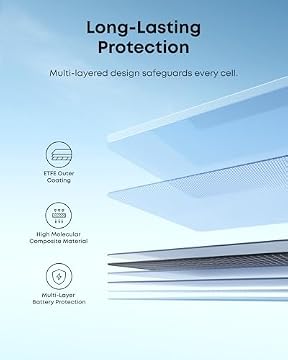
Structural longevity is reinforced through an aluminium perimeter frame combined with impact-resistant exterior composites. Many budget folding solar blankets utilize soft fabric backing that frays, absorbs moisture, and allows cell micro-cracking when folded repeatedly over time. Anker builds the PS100 around a rigid structural spine that resists flexing during wind gusts, protecting the delicate internal busbars and silicon wafers from stress fractures.
This heavy-duty construction underpins the manufacturer’s stated 10-year lifespan rating and included 5-year warranty coverage. By eliminating vulnerable fabric hinge points and sealing the internal wiring junction boxes against water ingress, the panel functions as a permanent fixture for recurring seasonal travel rather than a delicate electronic accessory that degrades after one summer in the field.
Cable Compatibility and Power Station Setup
Wiring flexibility often dictates how practical a solar panel is on a crowded campsite picnic table or vehicle tailgate. Anker includes two 8.2-foot (2.5-meter) solar charging cables along with a 1.6-foot (0.5-meter) XT60i connector cable straight out of the box. Having nearly ten feet of combined cable reach enables you to leave your portable power station inside a shaded tent, vehicle cabin, or awning area while placing the solar panel directly under blistering midday sun.
The inclusion of the XT60i standard ensures seamless plug-and-play operation with a broad variety of modern solar generators. For owners running mid-tier systems like the anker solix c1000 portable power station, the panel connects directly without hunting for third-party barrel plug adapters or terminal splitters. The cabling insulation features heavy outdoor-rated shielding to resist abrasion from sharp rocks, vehicle tailgates, and repeated tight coiling during teardown.
While the panel delivers up to 100 watts of peak direct-current energy, larger storage batteries naturally require multiple hours of direct sunlight to replenish completely from a single 100W source. For smaller 200Wh to 400Wh power hubs running camping fridges, camera batteries, and smartphones, this single panel replenishes daily electrical draw comfortably within standard four-to-six-hour solar windows. If your energy demands expand, the modular cabling design allows integration into multi-panel arrays according to your power station’s maximum solar voltage and amperage thresholds.
Anker SOLIX PS100 Pros and Cons
Pros
- Ultra-light 7 lb weight including integrated stand
- High 25%+ conversion efficiency N-type cells
- Dual-sided design captures up to 10% more power
- IP68 dust and water resistance rating
- Reinforced aluminium frame with 10-year lifespan
- Includes 8.2 ft solar and XT60i cables
Cons
- Maximum rated power output capped at 100W
- Bifacial power gains require reflective terrain
- Single panel recharges large power stations slowly
Check Anker SOLIX PS100 on Amazon
Is the Anker SOLIX PS100 Worth It
Determining whether this panel fits your operational needs comes down to your space constraints, weight limits, and typical travel destinations. If you prioritize minimal weight, rapid physical deployment, and industrial-grade weather protection, the Anker SOLIX PS100 represents a well-engineered option. The combination of a 7-pound total weight, IP68 full submersion sealing, and 25% cell efficiency solves the common pain points of bulky, fragile portable solar gear.
However, travelers operating power-hungry overland rigs featuring induction cooktops or portable air conditioners may find a 100-watt maximum generation ceiling limiting. Users seeking faster charging times on larger storage banks might look toward higher-output setups like the anker solix ps200, which doubles the potential input rate at the expense of a larger footprint and added weight. But for weekend campers, remote field workers running laptops, and emergency preppers seeking a resilient panel that stores flat in a closet, the PS100 provides dependable energy collection without unnecessary bulk.
The added bifacial energy production provides genuine value if your outdoor activities frequently put you on reflective surfaces like snowfields, river sandbanks, or paved parking areas. When evaluated as a lightweight, highly durable charging platform backed by a 5-year warranty, the engineering quality of the PS100 justifies serious consideration for anyone building a dependable off-grid kit.
Other Options to Consider
The N-Type 200 Watt Foldable Solar panel suits campers who require double the rated wattage capacity for mid-sized power stations, featuring integrated USB-A and USB-C direct output ports alongside its 25% efficiency N-type cells.

The 200W Portable Solar Panel suits vehicle campers seeking flexible device charging straight from the array, offering dedicated Quick Charge 3.0, 60W Type-C power delivery, MC4 outputs, and an IP65 waterproof housing.
The 200 watt Foldable solar panel suits users who juggle multiple power station brands and require broad plug versatility, packaging a multi-connector 1-to-4 adapter harness covering MC4, XT60, Anderson, DC5521, and DC7909 connections.

FAQ
What makes the N-type solar cells on the Anker SOLIX PS100 different from older panels?
The N-type solar cells utilized in the PS100 provide conversion efficiency ratings of 25 percent or higher, exceeding standard monocrystalline cells. They are specifically engineered to minimize internal resistance and energy loss while maintaining higher energy output in elevated outdoor temperatures where older panels typically suffer reduced performance.
How does dual-sided bifacial power generation actually work on this panel?
The PS100 features transparent internal layers that allow photovoltaic cells on the rear surface to capture ambient and reflected light bouncing off the ground. In environments with highly reflective terrain like snow, white sand, or concrete pads, this secondary capture can increase total energy production by up to 10 percent compared to single-sided panels.
What does the IP68 waterproof rating mean for campsite use?
An IP68 rating indicates complete protection against the ingress of dust and airborne grit, alongside verified water resistance against continuous immersion. While the panel is designed for outdoor solar harvesting rather than underwater operation, this rating guarantees that sudden rainstorms, mud splashes, and wet campsite ground will not damage the internal circuitry.
What charging cables come included in the box?
The packaging includes two 8.2-foot (2.5-meter) solar charging cables and one 1.6-foot (0.5-meter) XT60i solar charging cable. This wiring assortment provides extended reach to connect directly into compatible power stations while keeping your power storage unit sheltered from direct heat.
Can the Anker SOLIX PS100 charge a portable power station on cloudy days?
The panel continues to generate electricity during overcast conditions by capturing diffuse daylight through its high-efficiency N-type cells. However, overall wattage output will decrease noticeably compared to direct, unshaded sunlight, resulting in longer recharge times for connected batteries.


