As Amazon Associates, we earn from qualifying purchases. This means we may receive a small commission at no extra cost to you if you click through and make a purchase.
As an Amazon Associate we earn from qualifying purchases. Links on this page are affiliate links.
Choosing between a 61-Key vs 37-Key midi controller comes down to playing range and studio footprint. Both instruments feature USB-C connectivity, integrated performance pads, and hardware controls for music production. The primary difference centers on key count and system independence. The Arturia KeyLab mk3 provides a five-octave layout with aftertouch for DAW control, whereas the Akai MPC Key 37 delivers a compact three-octave format with onboard standalone processing.
Number of keys
61 keys
37 keys
Key features
Keys with aftertouch
Synth-action keybed
Performance pads
12 pressure-sensitive pads
16 MPC pads
Standalone operation
not listed
Standalone with MPC3 OS and 8-core processor
Weight
18.7 pounds
9.7 pounds
Choose the first if
- You want a wider 61-key range with aftertouch for two-handed playing and software instruments.
- You need nine assignable encoders and auxiliary pedal inputs for dedicated computer DAW control.
Choose the second if
- You want standalone production capability to sample, arrange, and finish tracks without a computer.
- You prefer a lighter 9.7-pound chassis equipped with 16 MPC pads and an onboard 7-inch touchscreen.
Verdict
The Arturia KeyLab mk3 fits musicians who need a full five-octave keybed with aftertouch to control virtual instruments inside a computer. The Akai MPC Key 37 suits producers who want an integrated standalone workstation with sampling and internal sound engines in a portable frame. Your decision depends on whether you require broader keyboard range or fully independent hardware production.
Comparing 61-Key and 37-Key Midi Controllers
Number of keys
Edge: Arturia KeyLab mk3 61-Key MIDI Controller
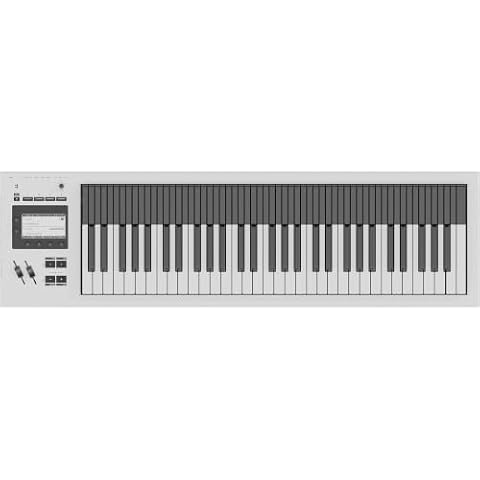
The Arturia KeyLab mk3 provides 61 keys with aftertouch, giving you a full five-octave spread for two-handed playing and expressive dynamic modulation. In contrast, the Akai Professional MPC Key 37 Standalone Keyboard features 37 synth-action keys with pitch and mod wheels. You get three octaves on the Akai model, which saves desk room but restricts complex chord inversions and wide acoustic arrangements. The Arturia model also specifies built-in aftertouch, allowing you to modulate sound parameters by applying continuous pressure after striking a key. If you require standard piano-style range and key pressure response, the Arturia KeyLab mk3 offers a clear advantage.
Performance pads
Edge: Akai Professional MPC Key 37 Standalone Keyboard
Pads allow you to tap out drum sequences, launch audio clips, and trigger sound samples. The Akai Professional MPC Key 37 Standalone Keyboard provides 16 legendary MPC pads arranged in a standard 4×4 grid. This layout matches conventional beatmaking and finger drumming setups. The Arturia KeyLab mk3 includes 12 pressure-sensitive performance pads. While 12 pads handle basic sample triggering and DAW transport controls, the 16-pad configuration on the Akai keyboard offers four additional trigger points. That extra capacity lets you map complete 16-pad drum kits directly to the surface. For rhythm programming, the Akai Professional MPC Key 37 gives you more pad options.
Form factor and weight
Edge: Akai Professional MPC Key 37 Standalone Keyboard
Physical footprint determines how easily these keyboards integrate into a cramped studio or mobile setup. The Akai Professional MPC Key 37 Standalone Keyboard measures 22.9 inches wide, 12.3 inches long, and 4.09 inches high, weighing 9.7 pounds. The Arturia KeyLab mk3 measures 34.4 inches wide, 11 inches long, and 2.9 inches high, with a total weight of 18.7 pounds. The Akai unit is 11.5 inches narrower and nine pounds lighter, making it much easier to transport or place on smaller workspaces. While the Arturia keyboard has a slimmer profile at 2.9 inches high, its 34.4-inch width requires substantial table space.
Rotary encoders
Edge: Arturia KeyLab mk3 61-Key MIDI Controller
Rotary encoders let you adjust software parameters, filter sweeps, and mixer levels directly from your keyboard. The Arturia KeyLab mk3 includes 9 assignable encoders alongside its keybed and pads, allowing direct physical adjustments for virtual instruments and DAW tracks. In comparison, the Akai Professional MPC Key 37 Standalone Keyboard relies primarily on its 7-inch touchscreen, pitch wheel, and modulation wheel, with no dedicated assignable rotary knobs specified in its published data. If you prefer physical rotary controls for fine-tuning synth parameters and software faders without relying exclusively on a screen, the Arturia KeyLab mk3 provides dedicated hardware for that task.
Standalone music production
Edge: Akai Professional MPC Key 37 Standalone Keyboard
The core architectures of these instruments serve different production workflows. The Akai Professional MPC Key 37 Standalone Keyboard operates as a fully standalone production workstation powered by an 8-core processor and the MPC3 OS. It includes a 7-inch touchscreen, over 20GB of factory content, and supports up to 16 stereo audio tracks and 32 plugin instruments without requiring a computer. The Arturia KeyLab mk3 functions purely as a USB MIDI controller, needing a connected computer or external sound module to generate audio. For standalone composition and sequencing without an attached computer, the Akai model provides complete independence.
Choosing the Right Keyboard Setup
Beatmakers wanting an all-in-one standalone production unit
Our pick: Akai Professional MPC Key 37 Standalone Keyboard
You can produce full tracks without connecting a computer. This unit features an internal 8-core processor running MPC3 OS, a 7-inch touchscreen, and 16 MPC pads. You get 20GB of factory content, built-in sampling capabilities over USB-C, and support for up to 32 plugin instruments per project.
Musicians who need hardware controls and foot pedal support
Our pick: Arturia KeyLab mk3 61-Key MIDI Controller
This controller gives you nine assignable encoders to adjust software parameters alongside 12 pressure-sensitive performance pads. Dedicated sustain and auxiliary pedal inputs let you connect standard foot hardware directly. It connects and powers over USB-C, giving you an external hardware interface across a 34.4-inch chassis without internal sound generation.
Producers working in tight spaces with limited desk room
Our pick: Akai Professional MPC Key 37 Standalone Keyboard
At 22.9 inches wide and 9.7 pounds, this keyboard fits easily into constrained workstations. It weighs roughly half of larger 61-key units. A single USB-C connection handles 24×24 multichannel audio streaming alongside 32 MIDI channels, eliminating the need for extra audio interface boxes on your studio desk.
| # | Product | Best for | Price |
|---|---|---|---|
| 1 | Arturia KeyLab mk3 61-Key MIDI Controller | dedicated studio setups needing 61 keys | |
| 2 | Akai Professional MPC Key 37 Standalone Keyboard | standalone beatmaking and compact studio sampling |

Arturia KeyLab mk3 61-Key MIDI Controller
Best for: dedicated studio setups needing 61 keys
- Number of Keys
- 61-Key
- Performance Pads
- 12 pressure-sensitive pads
- Aftertouch
- Aftertouch
- Faders and Knobs
- 9 assignable encoders
- Connectivity
- USB-C, sustain/auxiliary pedal inputs
- Color
- Black
The Arturia KeyLab mk3 is a 61-key USB MIDI keyboard controller built for two-handed playing and studio production. You get 61 keys equipped with aftertouch, 12 pressure-sensitive performance pads, and 9 assignable encoders for software parameters. Powered via USB-C with sustain and auxiliary pedal inputs, it suits you if you need full-range key access at your desk.
- 61 keys equipped with aftertouch
- 12 pressure-sensitive performance pads
- 9 assignable rotary encoders
- USB-C connectivity with sustain and auxiliary pedal inputs
- Weighs 18.7 pounds, making it heavy for portable setups
- Measures 34.4 inches wide, requiring significant desk space
- You need a 61-key range for two-handed playing
- You want tactile control via 12 pads and 9 encoders
- You use expression techniques that require aftertouch
- You need a compact controller for tight workspaces
- You want a lightweight keyboard under 18 pounds
Verdict: Arturia KeyLab mk3 61-Key MIDI Controller fits studio producers who want a full five-octave playing surface with aftertouch and direct parameter control. Its 34.4-inch footprint and 18.7-pound weight suit fixed desktop workstations rather than mobile travel bags.

Akai Professional MPC Key 37 Standalone Keyboard
Best for: standalone beatmaking and compact studio sampling
- Number of Keys
- 37-Key
- Key Action
- Synth-action
- Performance Pads
- 16 MPC pads
- Connectivity
- USB-C
- Standalone Operation
- Standalone
- Skill Level
- Professionals
The Akai Professional MPC Key 37 Standalone Keyboard gives you a complete production workstation built around 37 synth-action keys. Powered by an 8-core processor, it operates standalone without a computer. You get 16 MPC pads, a 7-inch touchscreen, and USB-C connectivity that handles multichannel audio and MIDI. It suits producers wanting an all-in-one beatmaking instrument.
- Runs standalone projects via onboard 8-core processor and MPC3 OS
- 16 integrated MPC pads alongside 37 synth-action keys
- 7-inch touchscreen for track arrangement and editing
- USB-C port supplies 24×24 audio streaming and 32 MIDI channels
- 37-key range limits two-handed playing compared to 61-key options
- Weighs 9.7 pounds, making it bulkier than standard MIDI-only controllers
- You want to produce music standalone without connecting a computer
- You need both MPC drum pads and keys in a single desktop unit
- You sample directly from phones or external hardware over USB-C
- You need a 61-key range for wide two-handed keyboard parts
- You only require a simple, lightweight MIDI controller for a computer DAW
Verdict: Akai Professional MPC Key 37 Standalone Keyboard delivers a self-contained production environment for beatmakers who want pads, keys, and onboard processing in one footprint. It replaces a laptop setup for producers who prioritize sampling workflows over broad keyboard range.
Specifications side by side
Spec Arturia KeyLab mk3 61-Key MIDI Controller Akai Professional MPC Key 37 Standalone Keyboard
- Number of Keys
- 61
- Key Action
- –
- Performance Pads
- 12 pressure-sensitive pads
- Aftertouch
- Aftertouch
- Faders and Knobs
- 9 assignable encoders
- Connectivity
- USB-C, sustain/auxiliary pedal inputs
- Standalone Operation
- –
- Skill Level
- –
- Color
- Black
- Built-In Features
- Aftertouch
- Features
- MIDI
- Dimensions
- 11 × 34.4 × 2.9 inches
- Weight
- 18.7 pounds
- Size
- 61 Key
- Model
- 231632
Copied from the Amazon listing. These figures were not measured here.
Frequently asked questions
How much desk space do you need for a 61-key controller versus a 37-key model?
A 61-key unit requires roughly a foot more horizontal desk width than a 37-key controller. The Arturia KeyLab mk3 spans 34.4 inches wide and 11 inches deep. In comparison, the Akai Professional MPC Key 37 measures 22.9 inches wide and 12.3 inches deep. You clear significant surface space with the 37-key format.
Can you easily travel with a 61-key MIDI controller?
Carrying a 61-key controller for travel is difficult due to its length and bulk. The Arturia KeyLab mk3 weighs 18.7 pounds and extends across 34.4 inches, making it suited for fixed desks. Meanwhile, the 37-key Akai MPC Key 37 weighs 9.7 pounds, offering a more portable option for moving between locations.
What connectivity options do 61-key and 37-key controllers offer?
Both keyboard formats connect to music gear using standard USB configurations. The Arturia KeyLab mk3 provides USB and USB-MIDI connections. The Akai Professional MPC Key 37 features both USB and USB-C connectivity. These ports let you route data into your computer or connect peripheral hardware instruments.
Is aftertouch available on compact 37-key controllers?
Aftertouch provides dynamic control when you press down on keys after striking them. In this comparison, the Arturia KeyLab mk3 includes aftertouch across its 61-key layout. If you need expressive acoustic or synth modulation through key pressure, the 61-key Arturia model provides that built-in specification.
How many octaves do 61-key and 37-key keyboards cover?
A 61-key model covers five octaves, while a 37-key model spans three octaves. The extra two octaves on keyboards like the 61-key Arturia KeyLab mk3 allow full two-handed chord voicing and bass parts simultaneously. A 37-key layout works well for lead lines, basslines, and basic chord stabs without taking up room.
Which size fits professional music production better?
Both sizes suit professional workflows depending on whether you play complex arrangements or program beats. The Akai Professional MPC Key 37 is designed for professionals seeking a compact 37-key hardware workflow. The 61-key Arturia KeyLab mk3 serves producers who require a broad physical range and direct MIDI control across studio instruments.