
As Amazon Associates, we earn from qualifying purchases. This means we may receive a small commission at no extra cost to you if you click through and make a purchase.
As an Amazon Associate we earn from qualifying purchases. Links on this page are affiliate links.
This comparison of the universal audio apollo twin x duo vs volt 876 24×28 USB highlights two distinct studio hardware setups from Universal Audio. Both interfaces share proprietary software integration, auto-gain features, and bundled UAD plug-ins for music production. The primary difference lies in their form factor and connectivity. The Apollo Twin X DUO Gen 2 uses Thunderbolt 3 in a compact profile, whereas the Volt 876 provides a rack-mount build with USB connectivity and 24×28 input-output capacity.
Host connection
Thunderbolt 3
USB
Audio resolution
Not listed
32-bit / 192 kHz
Digital expansion
Not listed
ADAT
Weight
1 pound
13.9 pounds
Choose the first if
- You want a lightweight 1-pound interface equipped with a Thunderbolt 3 connection.
- You need Unison preamps for real-time tracking through emulations of Neve, API, and Manley hardware.
- You plan to use Apollo Monitor Correction powered by Sonarworks and integrated bass management.
Choose the second if
- You need extensive connectivity with a 24×28 total input-output layout and ADAT digital expansion.
- You prefer a rack-mount style chassis with eight onboard Vintage preamps and classic compressors.
- You require 32-bit / 192 kHz audio conversion compatible with Mac, PC, iPad, and iPhone.
Verdict
The Apollo Twin X DUO Gen 2 suits producers seeking a compact Thunderbolt 3 interface featuring Unison preamps and Sonarworks monitor correction. The Volt 876 24×28 USB interface fits multi-channel recording setups that require rack mounting, ADAT expansion, and high I/O counts. Select the Apollo for portable DSP tracking or the Volt for comprehensive studio connectivity.
Apollo Twin X DUO vs Volt 876
Form factor and portability
Edge: Universal Audio Apollo Twin X DUO Gen 2
Universal Audio Apollo Twin X DUO Gen 2 is built for desktop workspaces. It measures 8 inches long, 8 inches wide, and 6 inches high, weighing 1 pound. This compact footprint lets you reposition the unit easily on crowded desks or pack it into mobile bags. Universal Audio Volt 876 24×28 USB Interface uses a rack-mount style chassis. It measures 22 inches long, 17 inches wide, and 5 inches high, with a weight of 13.9 pounds. The Volt 876 is designed to occupy permanent rack enclosures rather than move between locations. For portable setups and compact desks, Apollo Twin X DUO Gen 2 offers the smaller physical build.
Input output count and expansion
Edge: Universal Audio Volt 876 24×28 USB Interface
Universal Audio Volt 876 24×28 USB Interface supplies 24×28 total I/O for tracking larger ensembles and routing outboard hardware. It features eight onboard Vintage preamps paired with 76-style compressors, plus ADAT digital expansion. You can link up to three Volt 876 units or interface directly with ADAT gear and Apollo hardware. Universal Audio Apollo Twin X DUO Gen 2 does not list total channel numbers or ADAT connectivity in its technical data. It features multi-input Auto-Gain to set recording levels quickly. If you run multichannel tracking sessions requiring high physical input counts and modular digital expansion, Volt 876 delivers clear advantages.
Host connectivity and platform compatibility
Edge: Universal Audio Volt 876 24×28 USB Interface
Universal Audio Volt 876 24×28 USB Interface uses a standard USB host connection. Its specifications confirm compatibility across Mac, PC, iPad, and iPhone devices, allowing you to track on mobile hardware or desktop computers. Universal Audio Apollo Twin X DUO Gen 2 utilizes a Thunderbolt 3 connection. Its specifications do not list operating system compatibility or support for mobile iOS devices. Thunderbolt 3 provides high-bandwidth data transfer for desktop computing environments, but USB gives you broader hardware flexibility. If your workflow requires plugging into mobile Apple devices or standard USB ports without needing dedicated Thunderbolt hardware, Volt 876 provides the more versatile host connection.
Preamp emulation and DSP processing
Edge: Universal Audio Apollo Twin X DUO Gen 2
Universal Audio Apollo Twin X DUO Gen 2 features Unison preamps. This technology lets you track in realtime through authentic emulations of Neve, API, Avalon, Manley, and Fender hardware. It also provides access to the full library of over 200 UAD DSP and Native plug-ins, including Capitol Chambers and Sound City Studios. Universal Audio Volt 876 24×28 USB Interface includes eight onboard Vintage preamps inspired by the 610 tube console and 1176 limiter. It includes native UAD plug-ins and instruments like PolyMAX Synth and Showtime 64. For DSP processing and Unison realtime modeling, Apollo Twin X DUO Gen 2 offers greater preamp versatility.
Audio resolution and conversion
Edge: Universal Audio Volt 876 24×28 USB Interface
Universal Audio Volt 876 24×28 USB Interface states a 32-bit / 192 kHz audio resolution. High bit depth helps preserve dynamic range during recording and prevents digital clipping before post-production processing. The specifications for Universal Audio Apollo Twin X DUO Gen 2 do not list audio resolution, bit depth, or maximum sampling rate figures. Both interfaces are built for professional recording environments, but only the Volt 876 documents its conversion specifications directly. If your studio requirements mandate confirmed 32-bit capture and 192 kHz conversion capability, Volt 876 is the interface that clearly publishes these numbers.
Monitoring tools and room correction
Edge: Universal Audio Apollo Twin X DUO Gen 2
Universal Audio Apollo Twin X DUO Gen 2 incorporates Apollo Monitor Correction powered by Sonarworks. This tool lets you calibrate your output for your specific room acoustic response or monitor headphones. It also features built-in bass management to integrate a subwoofer into your monitor setup. Universal Audio Volt 876 24×28 USB Interface includes the UAD Console app, which delivers two low-latency cue mixes with talkback and full session recall of front-panel settings. While Volt 876 aids tracking workflows with dedicated cue mixes, Apollo Twin X DUO Gen 2 provides specialized room calibration and subwoofer management for precise acoustic monitoring.
Choosing Between Apollo Twin and Volt 876
Large ensemble engineers needing high input counts
Our pick: Universal Audio Volt 876 24×28 USB Interface
Select this unit if you track full bands. You get 24×28 total I/O, eight onboard Vintage preamps, and built-in analog compressors. You can expand your setup using ADAT digital connections or link up to three Volt 876 units. It connects via standard USB and captures 32-bit, 192 kHz audio resolution.
Producers prioritizing realtime DSP tracking and monitor tuning
Our pick: Universal Audio Apollo Twin X DUO Gen 2
Choose this interface if you need DSP plug-in power. You record in realtime through Unison preamps with emulations of Neve, API, and Manley. It provides access to over 200 UAD DSP and Native plug-ins over Thunderbolt 3. Built-in Apollo Monitor Correction powered by Sonarworks and bass management assist your room calibration.
Engineers needing multi-device recording and dedicated cue mixes
Our pick: Universal Audio Volt 876 24×28 USB Interface
Pick this interface if you record on mobile platforms. It supports 32-bit / 192 kHz conversion across Mac, PC, iPad, and iPhone via USB. The UAD Console app provides Assistive Auto-Gain and two low-latency cue mixes with talkback. You also get LUNA recording software with Voice Control and Instrument Detection tools.

Universal Audio Apollo Twin X DUO Gen 2
Best for: desktop tracking with real-time UAD processing
- Host Connection
- Thunderbolt 3
- Color
- Not Available
- Dimensions
- 8 × 8 × 6 inches
- Weight
- 1 pounds
The Universal Audio Apollo Twin X DUO is a desktop Thunderbolt 3 audio interface built for tracking and mixing. You get Unison preamps for realtime modeling, onboard DSP for UAD plug-ins, and built-in Auto-Gain. It measures 8 by 8 inches, making it a compact pick if you want studio processing on a desk rather than a rack setup.
- Thunderbolt 3 host connection
- Unison preamps for real-time analog modeling
- Access to over 200 UAD DSP and native plug-ins
- Apollo Monitor Correction powered by Sonarworks
- Requires a dedicated Thunderbolt 3 port instead of standard USB
- Desktop chassis lacks a rack-mount form factor
- You use a computer equipped with Thunderbolt 3.
- You want real-time DSP tracking with Unison preamp emulations.
- You prefer a compact desktop footprint measuring 8 by 8 inches.
- You require a standard USB connection for your computer.
- You need a multi-channel rack-mount configuration.
Verdict: Universal Audio Apollo Twin X DUO Thunderbolt 3 suits desktop creators who need low-latency DSP processing and Unison preamps over a fast connection. It provides a compact two-preamp configuration rather than a multi-channel rack setup.
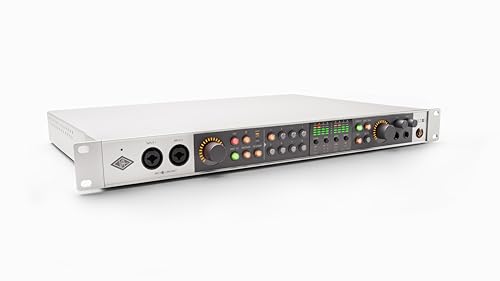
Universal Audio Volt 876 24×28 USB Interface
Best for: multi-channel band tracking and studio rack setups
- Total I/O
- 24×28
- Host Connection
- USB
- Audio Resolution
- 32-bit / 192 kHz
- Digital Expansion
- ADAT
- Color
- Not Available
- Dimensions
- 22 × 17 × 5 inches
The Universal Audio Volt 876 is a 24×28 rack-mount USB audio interface designed for tracking larger sessions. You get 32-bit / 192 kHz audio conversion, eight analog preamps with built-in compressors, and ADAT digital expansion for connecting external gear. This setup gives you extensive physical inputs and outputs to record full bands across Mac, PC, iPad, or iPhone systems.
- 24×28 total I/O with ADAT digital expansion
- Eight preamps with built-in analog compressors
- 32-bit / 192 kHz audio conversion resolution
- Works across Mac, Windows PC, iPad, and iPhone
- Heavy 13.9-pound rack-mount chassis requires dedicated studio furniture
- Uses USB connection rather than high-bandwidth Thunderbolt
- You need 24×28 total channels to track full drum kits or live bands simultaneously.
- You want eight physical preamps with analog compression controls built in.
- You record across desktop operating systems and iOS mobile devices.
- You want a portable, compact desktop interface instead of a heavy rack unit.
- You require a native Thunderbolt host interface connection.
Verdict: Universal Audio Volt 876 24×28 USB Interface suits multi-instrument tracking setups that require eight preamps, wide ADAT routing, and cross-platform USB support. It delivers high-density I/O for project studios tracking full ensembles in a single chassis.
Specifications side by side
| Spec | Universal Audio Apollo Twin X DUO Gen 2 | Universal Audio Volt 876 24×28 USB Interface |
|---|---|---|
| Total I/O | – | 24×28 |
| Host Connection | Thunderbolt 3 | USB |
| Audio Resolution | – | 32-bit / 192 kHz |
| Digital Expansion | – | ADAT |
| Connectivity | – | USB |
| Color | Not Available | Not Available |
| Dimensions | 8 × 8 × 6 inches | 22 × 17 × 5 inches |
| Weight | 1 pounds | 13.9 pounds |
| Size | 5.00 | 5.10 |
| Model | UA-APTXDG2-ESS | VOT876 |
Frequently asked questions
Which interface uses Thunderbolt connectivity?
Universal Audio Apollo Twin X DUO Gen 2 uses a Thunderbolt 3 connection. This protocol supports fast data transfer and low-latency operation for your desktop tracking needs. In contrast, Universal Audio Volt 876 connects to your host computer via standard USB, giving you broad cross-platform device compatibility.
How many onboard preamps do these two Universal Audio interfaces offer?
Apollo Twin X DUO Gen 2 provides two Unison preamps, while Volt 876 features eight onboard preamps. If you record solo vocals or single instruments, two preamps suffice. For tracking full ensembles simultaneously in a single chassis, the eight preamps on the Volt model handle the higher channel count.
What are the physical dimensions and weight differences between these models?
Apollo Twin X DUO Gen 2 measures 8 by 8 by 6 inches and weighs 1 pound. Volt 876 is much larger at 22 inches long, 17 inches wide, and 5 inches high, weighing 13.9 pounds. You can place the Apollo easily on a small desk, whereas the Volt fits rack environments.
Which interface supports real-time DSP processing?
Apollo Twin X DUO Gen 2 features onboard DSP processing. This hardware lets you run real-time UAD plug-ins with minimal latency directly through its Unison preamps while tracking. Volt 876 focuses on multi-channel analog and digital connectivity across USB rather than onboard real-time DSP calculation.
Can you expand the channel count using digital routing on these units?
Volt 876 provides wide ADAT routing to reach its total 24×28 input and output capacity. This layout allows you to connect external multi-channel converters for band tracking sessions. Apollo Twin X DUO Gen 2 relies on a compact two-preamp configuration optimized for direct desktop recording sessions.
Which model is better suited for a studio rack setup?
Volt 876 is built specifically for studio rack setups and multi-instrument tracking. Its 22-inch length, 17-inch width, and 13.9-pound build suit stationary installations. Apollo Twin X DUO Gen 2 is designed strictly as a desktop interface, offering an 8-inch chassis that sits comfortably next to your computer monitor.

