
As Amazon Associates, we earn from qualifying purchases. This means we may receive a small commission at no extra cost to you if you click through and make a purchase.
Shoppers looking to upgrade their wireless network often ask whether an entry-level access point can deliver stable, high-performance connectivity without complex enterprise gear. The Ubiquiti UniFi U6+ addresses this need directly by bringing dual-band WiFi 6 technology to a compact form factor designed for homes and small business environments. If your goal is to eliminate dead zones, manage dozens of connected devices, and gain centralized network oversight, this access point offers a practical starting point within the broader UniFi ecosystem.
This particular US model listing represents an Amazon Renewed unit, giving buyers a way to deploy UniFi hardware without paying brand-new equipment premiums. Before deploying it, shoppers need to understand its physical requirements, including its Power over Ethernet demands and controller management architecture. In this review, we examine the ubiquiti unifi u6+ specs, physical installation, wireless performance capabilities, coverage limits, and how it measures up against alternative networking options.
What You Get With the Ubiquiti UniFi U6+
Ubiquiti UniFi U6+
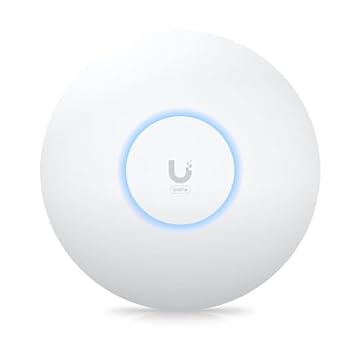


Photographs published on the Amazon listing.
The Ubiquiti UniFi U6+ package provides the core hardware required to mount and connect a high-efficiency wireless access point, though buyers should note that powering accessories are sold separately. Based on the product listing, here are the primary features and inclusions associated with this unit:
- Dual-band WiFi 6 connectivity supporting IEEE 802.11 a/b/g/n/ac/ax wireless standards
- Single Gigabit Ethernet RJ45 port supporting 1000 Mbps wired network speeds
- Integrated four-antenna internal array optimized for home and small business coverage
- Power over Ethernet Plus support operating between 44 and 57 volts direct current
- Wall mountable form factor for clean, elevated installation
- UniFi OS and UniFi Network Application integration for centralized network bridging
- Broad wireless data encryption support including WPA-PSK, WPA-Enterprise, WPA, WPA2, WPA3, and WPS
- Renewed US model hardware packaging with the PoE adapter omitted
Key Specifications
Specification
Detail
- Wireless Standard
- WiFi 6 (802.11ax, backwards compatible with a/b/g/n/ac)
- Frequency Band
- Dual-Band (2.4 GHz and 5 GHz with 2×2 MIMO)
- Maximum Data Transfer Rate
- 2975.5 Mbps (3 Gbit/s aggregate)
- Maximum Upstream Rate
- 1487.5 Mbps
- Ethernet Ports
- 1 x 1000 Mbps Gigabit Ethernet (RJ45)
- Coverage Area
- Up to 140 m² (1,500 ft²)
- Device Capacity
- 300+ connected devices
- Operating Voltage
- 44 to 57V DC (57 volts DC nominal, up to 25.5W)
- Antenna Configuration
- 4 internal antennas
- Security Protocols
- WPA, WPA2, WPA3, WPA-PSK, WPA-Enterprise, WPS
Copied from the Amazon listing. These figures were not measured here.
WiFi 6 Speeds and Real-World Throughput
Evaluating unifi u6+ wifi 6 speeds starts with looking at how data travels over its dual-band radios. The access point utilizes 2×2 MIMO on both the 2.4 GHz and 5 GHz frequency ranges, delivering a combined maximum data transfer rate of 2975.5 Mbps alongside a maximum upstream rate of 1487.5 Mbps. These wireless transmission rates allow modern client devices, including laptops, smartphones, and smart televisions, to exchange data quickly across busy airwaves. While high-density enterprise environments might require multi-gigabit hardware like the unifi u7 pro, the U6+ focuses on solid, practical throughput for standard network backbones.
Shoppers must also understand the relationship between wireless signaling rates and the physical uplink port. The unit includes a single Gigabit Ethernet LAN port rated for 1000 Mbps bandwidth. This means that while local wireless devices can exchange data with each other at rates approaching the theoretical 3 Gbit/s maximum, any traffic traveling out to your local gateway or the wider internet is constrained by the 1000 Mbps Ethernet connection. For typical gigabit home internet plans and standard office connections, this wired throughput remains completely adequate and matches the bandwidth provided by standard service tiers.
In practice, the inclusion of modern 802.11ax standards ensures that data encryption and channel utilization function without bogging down the processor. The hardware manages simultaneous transmissions cleanly, minimizing latency spikes during video conferencing, large file transfers, and continuous cloud backups. Everyday shoppers who want responsive local network traffic will find that the throughput profile easily handles household media demands without requiring constant manual channel adjustments.
Coverage Range and Multi-Device Handling
When planning an installation, understanding the unifi u6+ range is vital to ensure you do not encounter dead spots in your living or working quarters. Ubiquiti rates this compact model to cover an area of up to 140 square meters, which translates to roughly 1,500 square feet. This coverage footprint makes the ubiquiti access point u6+ well suited for apartments, single-story ranch homes, open-plan storefronts, or targeted office zones. Wireless energy is distributed via four internal antennas engineered specifically for indoor ceiling or wall mounting.
Device density is another major strength highlighted in the ubiquiti unifi u6+ specs. The access point is rated to support 300+ connected devices simultaneously. In contemporary households packed with smart lights, smart speakers, streaming dongles, and personal computers, router congestion can quickly degrade connection quality. The U6+ handles high client volumes by leveraging WiFi 6 efficiency, distributing traffic across its dual-band spectrum without dropping lower-priority background gadgets.
Deploying the ubiquiti u6+ for home network setups often solves the issue of unstable consumer all-in-one router combos. By offloading wireless client handling to a dedicated access point, the rest of your network hardware runs more smoothly. If your living space exceeds 1,500 square feet or features thick masonry walls, you can seamlessly adopt additional access points within the same software controller, allowing your devices to roam without dropping active connections.
Power over Ethernet Demands and Powering Options
One critical detail that everyday shoppers must note before purchasing is the ubiquiti unifi u6+ poe requirements. This model does not feature a traditional AC barrel plug or an included wall power adapter in the package. Instead, it relies entirely on Power over Ethernet Plus (PoE+) technology to receive both power and operational data through a single RJ45 network cable. The hardware requires an operating voltage between 44 and 57 volts direct current and can draw up to 25.5 watts.
Because the listing explicitly states that a PoE adapter is not included, buyers must ensure they have compatible powering equipment ready prior to installation. You will need either a dedicated PoE+ network switch or a standalone PoE power injector capable of supplying 44 to 57V DC. For users who already maintain managed network switches or power security peripherals like the ubiquiti g6 turret, adding another PoE device into the existing infrastructure is straightforward. However, if you are transitioning from a consumer mesh system, you must budget for a power injector.

The single-cable installation provides substantial advantages once power is sorted. Being able to run a single Ethernet drop allows you to position the access point on ceilings or high on walls where standard electrical outlets are unavailable. This elevated placement maximizes line-of-sight propagation for the four internal antennas, keeping visible cabling tidy while delivering consistent performance.
Setup and UniFi OS Management
The ubiquiti unifi u6+ setup process differs distinctly from standalone retail routers. Because it is designed to operate within the UniFi ecosystem, the access point integrates directly with the UniFi Network Application running on UniFi OS. Network administrators can adopt the unit via a local controller or a software instance on a personal computer. Once adopted, configuration changes—such as setting up separate guest networks, adjusting channel bandwidths, or configuring VLANs—propagate across your hardware automatically.
Shoppers often evaluate the unifi u6 plus vs u6 lite when deciding on an entry-level UniFi access point. Both units share compact form factors and wall mountable convenience, but the U6+ updates the hardware lineup with expanded throughput capabilities and dual-band WiFi 6 support across both radios. If your installation demands a specialized architectural profile, such as an in-wall faceplate mounting style, you might look at specialized models like the u7 pro wall, but the standard disc shape of the U6+ remains the benchmark for ceiling deployments.
Security is thoroughly addressed within the management console. The U6+ supports the latest WPA3 protocol alongside enterprise options like WPA-Enterprise, standard WPA2, and WPS for rapid client associations. Its integrated data encryption safeguards wireless traffic from unauthorized intercept, which is particularly valuable for small offices handling customer data or homes running sensitive smart home hardware.
Ubiquiti UniFi U6+ Pros and Cons
Pros
- Maximum throughput rate up to 2975.5 Mbps
- Supports over 300 connected devices simultaneously
- Covers up to 1,500 square feet
- Dual-band WiFi 6 with 2×2 MIMO
- Centralized management via UniFi OS
Cons
- PoE adapter not included in package
- Uplink capped by 1000 Mbps Ethernet port
- Amazon Renewed condition model
Check Ubiquiti UniFi U6+ on Amazon
Is the Ubiquiti UniFi U6+ Worth It
Determining whether the ubiquiti unifi u6+ worth it comes down to what you expect from your networking infrastructure. If you are seeking an inexpensive, plug-and-forget router replacement that plugs into a standard power outlet out of the box, this access point might present unnecessary setup friction due to its PoE+ power needs and controller-based management. It is engineered specifically for users who value structured cabling, centralized software monitoring, and discrete ceiling mounting.
For smart homes, small businesses, and enthusiasts who already utilize UniFi switches or controllers, the U6+ represents one of the most cost-effective and sensible upgrades to WiFi 6. It provides dependable 2×2 MIMO connectivity, supports over 300 active devices, and covers 1,500 square feet without generating excessive heat or clutter. As an Amazon Renewed option, it allows network builders to expand coverage zones affordably while keeping full compatibility with UniFi OS features.
Ultimately, the Ubiquiti UniFi U6+ delivers enterprise-grade management, robust data encryption, and solid gigabit-limited wireless speeds in a delightfully small chassis. Provided you have a PoE+ power source available, it offers a dependable backbone that outperforms consumer-grade wireless extenders and entry-level mesh nodes in multi-client stability.
Other Options to Consider
WiFi 6 Dual Band suits buyers who want an AX3000 wireless access point that includes a DC power adapter right in the box, giving you Omada management, mesh capabilities, and an included five-year warranty if you prefer not to buy a separate PoE injector.

Desktop WiFi Bridge works best for users who need a desktop-friendly unit with four external antennas, AC1200 speeds, and flexible client range extender modes without mounting equipment to their walls or ceilings.
Mesh is an ultra-slim AX3000 alternative for shoppers seeking free cloud management and self-organizing mesh roaming without joining either the Omada or UniFi ecosystems.
FAQ
Does the Ubiquiti UniFi U6+ include a power adapter?
No, the listing explicitly notes that the PoE adapter is not included with this model. You will need to supply power using a PoE+ compatible network switch or a standalone PoE power injector that operates between 44 and 57 volts direct current.
What coverage area does the UniFi U6+ support?
The access point covers an area of up to 140 square meters, which is roughly equivalent to 1,500 square feet. This makes it suitable for individual floors, small retail spaces, or open-layout residential areas.
How many devices can connect to the Ubiquiti UniFi U6+ simultaneously?
The U6+ is rated to support more than 300 connected devices at the same time. Its dual-band 2×2 MIMO architecture and WiFi 6 efficiency ensure high stability even when numerous mobile clients, IoT gadgets, and smart appliances are online.
Can the Ubiquiti UniFi U6+ be wall mounted?
Yes, the hardware features a wall mountable form factor. This enables clean, elevated placement on walls or ceilings to help optimize wireless propagation across your living or working environment.
What wireless security protocols are supported on this access point?
The unit supports modern security protocols including WPA3, WPA2, WPA, WPA-PSK, and WPA-Enterprise, as well as WPS. These standards protect transmitted data against unauthorized access across all active networks.


