
As Amazon Associates, we earn from qualifying purchases. This means we may receive a small commission at no extra cost to you if you click through and make a purchase.
As an Amazon Associate we earn from qualifying purchases. Links on this page are affiliate links.
Choosing between a roland vs arturia keyboard depends on your performance and sound design goals. Both instruments provide standalone digital sound engines and USB-MIDI connections for studio work. However, they serve very different workflows. Roland delivers a full-range 61-key songwriting station with built-in stereo speakers, auto-accompaniment styles, and standard touch sensitivity. Arturia provides a compact 25-key experimental hybrid synthesizer featuring a touch-plate PCB keybed with polyphonic aftertouch and analog CV outputs.
Number of keys
61 keys
25 keys
Key action
Touch-sensitive
Flat PCB with poly-aftertouch
Sound engine
ZEN-Core with over 1000 presets
Hybrid paraphonic with 17 oscillator modes
Built-in speakers
Stereo speakers
not listed
Connectivity
Bluetooth Audio/MIDI, USB-MIDI
CV outputs, USB, MIDI
Weight
15.5 pounds
2.3 pounds
Choose the first if
- You want a 61-key layout with built-in stereo speakers for standalone playing.
- You require auto-accompaniment styles and over 1,000 preset sounds.
- You need wireless connectivity via Bluetooth Audio and MIDI.
Choose the second if
- You need CV outputs to interface directly with modular hardware synths.
- You want expressive polyphonic aftertouch on a lightweight 2.3-pound PCB keybed.
- You prefer hybrid sound synthesis with 17 digital oscillator modes and analog filtering.
Verdict
The Roland GO:KEYS 3 suits creators who need a self-contained 61-note keyboard with built-in speakers and ready-to-play accompaniment presets. The Arturia MicroFreak suits synthesists seeking deep sound design, modular CV connectivity, and per-note pressure modulation in a compact format. Your choice depends on whether you prioritize traditional two-handed keyboard practice or experimental hardware patch creation.
Roland or Arturia: Keyboards Compared
Number of keys
Edge: Roland GO:KEYS 3 61-Key Music Creation Keyboard
The Roland GO:KEYS 3 gives you 61 touch-sensitive keys. This layout spans five octaves, which lets you play two-handed piano parts, chords, and bass lines simultaneously. In contrast, the Arturia MicroFreak provides 25 keys, covering a compact two-octave range suited for monophonic leads, arpeggios, and compact bass patterns. Because 25 keys restrict hand movement, you must shift octaves to access wider intervals. If you want a full keyboard layout for learning songs or playing standard keyboard repertoire without running out of notes, the Roland GO:KEYS 3 provides more playing surface.
Key action
Edge: Arturia MicroFreak 25-Key Synth
Key response alters how you interact with sounds. The Roland GO:KEYS 3 uses a traditional touch-sensitive action that alters note volume depending on how hard you strike the keys. The Arturia MicroFreak uses an unconventional printed circuit board keybed with zero moving parts. This flat touch plate detects rapid note triggers along with polyphonic aftertouch and individual key pressure. You can modulate synth parameters per note by pressing deeper into the circuit board surface. While Roland offers familiar piano-style travel, Arturia gives you expressive polyphonic aftertouch modulation that traditional budget keyboards lack.
Form factor and weight
Edge: Arturia MicroFreak 25-Key Synth
Physical size determines where and how you can position each instrument. The Arturia MicroFreak measures 12.2 inches long, 9.2 inches wide, and 2.2 inches high, weighing only 2.3 pounds. This footprint fits into standard backpacks and leaves ample desk space for laptops or audio interfaces. The Roland GO:KEYS 3 measures 37.4 inches wide, 11.3 inches long, and 3.43 inches high, with a total weight of 15.5 pounds. The Roland requires dedicated desk room or a separate keyboard stand to operate comfortably. For mobile workflows and tight studio spaces, the Arturia MicroFreak is significantly lighter and easier to carry.
Built-in sound monitoring
Edge: Roland GO:KEYS 3 61-Key Music Creation Keyboard
Immediate sound playback simplifies quick practice sessions. The Roland GO:KEYS 3 includes onboard stereo speakers, allowing you to turn on the instrument and start playing immediately without connecting external sound hardware. You can practice in any room without setting up monitors or plugging in headphones. In contrast, the Arturia MicroFreak has no built-in speakers listed in its specifications. To hear the Arturia, you must connect it to external studio monitors, an amplifier, or headphones via its audio outputs. If you prioritize standalone playability with self-contained sound, the Roland GO:KEYS 3 has an integrated speaker system.
Hardware and wireless connectivity
Edge: Tie
Connectivity defines how an instrument links to other gear. The Roland GO:KEYS 3 provides USB-MIDI and Bluetooth Audio/MIDI support, allowing wireless connections to mobile devices and wired links to recording software. The Arturia MicroFreak supports USB-MIDI and includes MIDI break-out cables, but it also adds dedicated CV outputs for pitch, gate, and pressure. These analog CV connections let you control modular gear and outboard synthesizers directly without a digital computer interface. If you need wireless Bluetooth convenience, Roland works well, but Arturia gives you direct hardware CV integration alongside standard MIDI.
Choosing the Right Keyboard for You
Modular synth players integrating external hardware rigs
Our pick: Arturia MicroFreak 25-Key Synth
You get dedicated CV outputs to route pitch, gate, and pressure to external hardware. Its digital engine features 17 paraphonic oscillator modes, combined with an analog filter. The 5×7 modulation matrix lets you rewire routing freely, while the sequencer records up to four automations for complex analog integration.
Songwriters looking for diverse sounds and rhythm backing
Our pick: Roland GO:KEYS 3 61-Key Music Creation Keyboard
You get Roland's ZEN-Core sound engine with over 1000 onboard presets. It provides over 200 backing styles to build tracks across genres. The built-in chord sequencer offers more than 300 presets with user editing. Wireless Bluetooth Audio and MIDI support allows simple connection to mobile devices for fast drafting.
Traveling musicians needing maximum portability and expressive control
Our pick: Arturia MicroFreak 25-Key Synth
You get a compact unit weighing only 2.3 pounds with a 2.2-inch height profile. The 25-key flat printed circuit board has no moving parts and tracks individual polyphonic aftertouch pressure per note. For randomized pattern generation, the onboard sequencer includes dedicated Spice and Dice parameters.

Roland GO:KEYS 3 61-Key Music Creation Keyboard
Best for: songwriters needing standalone accompaniment and sound variety
- Number of Keys
- 61
- Key Action
- Touch-sensitive
- Sound Engine
- ZEN-Core
- Preset Count
- over 1000
- Built-In Speakers
- Stereo
- Connectivity
- Bluetooth Audio/MIDI
The Roland GO:KEYS 3 is a 61-key music creation keyboard equipped with the ZEN-Core sound engine. You get over 1,000 preset sounds, over 200 accompaniment styles, and built-in stereo speakers. It connects wirelessly using Bluetooth Audio and MIDI, alongside USB-MIDI support. This setup suits you if you want an all-in-one portable songwriting keyboard with expressive touch-sensitive keys.
- ZEN-Core sound engine with over 1,000 presets
- Chord sequencer with user editing and 300 presets
- Bluetooth Audio/MIDI and USB-MIDI connectivity
- Built-in stereo speaker system
- Touch-sensitive synth action lacks hammer-weighted resistance
- 61-key limit restricts full two-handed piano literature
- You want over 1,000 sounds powered by the ZEN-Core sound engine.
- You use onboard chord sequencers and accompaniment styles for songwriting.
- You need cable-free audio playback and MIDI via Bluetooth.
- You require a full 88-key layout for classical pieces.
- You demand weighted hammer-action keys instead of touch sensitivity.
Verdict: Roland GO:KEYS 3 61-Key Music Keyboard provides a complete standalone songwriting station for creators who need accompaniment styles and sound variety in a 61-key format.
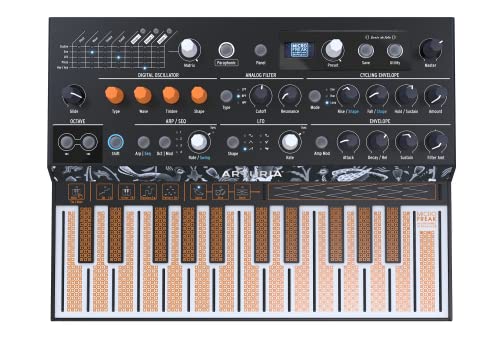
Arturia MicroFreak 25-Key Synth
Best for: modular synth routing and portable sound design
- Number of Keys
- 25
- Key Action
- Poly-aftertouch
- Sound Engine
- Physical modeling to wavetable
- Polyphony
- Paraphonic
- Connectivity
- CV outputs, USB, MIDI
- Color
- Black
The Arturia MicroFreak is a compact hybrid synthesizer designed for experimental sound design. You get 25 flat PCB keys with polyphonic aftertouch, 17 digital oscillator modes, and an analog filter. Its CV outputs let you route pitch, gate, and pressure to modular gear alongside standard USB and MIDI. This setup suits electronic musicians who want versatile modulation in a 2.3-pound unit.
- PCB keybed supports polyphonic aftertouch
- 17 paraphonic digital oscillator modes with an analog filter
- CV outputs provide pitch, gate, and pressure connectivity
- Weighs 2.3 pounds with a compact 12.2-inch footprint
- Flat touch plate lacks traditional moving mechanical keys
- Limited to 25 keys and paraphonic voice allocation
- No built-in speakers listed in specifications
- You want modular integration via dedicated CV outputs
- You need polyphonic aftertouch modulation in a portable unit
- You design sounds using wavetable and physical modeling engines
- You need standard moving piano keys with mechanical travel
- You require more than 25 keys for two-handed playing
- You want true polyphony rather than paraphonic architecture
Verdict: Arturia MicroFreak 25-Key Hybrid Synthesizer delivers deep modulation and modular CV control for sound designers who prioritize compact digital synthesis over traditional keyboard action.
Specifications side by side
| Spec | Roland GO:KEYS 3 61-Key Music Creation Keyboard | Arturia MicroFreak 25-Key Synth |
|---|---|---|
| Number of Keys | 61 | 25 |
| Key Action | Touch-sensitive | Poly-aftertouch |
| Sound Engine | ZEN-Core | Physical modeling to wavetable |
| Polyphony | – | Paraphonic |
| Preset Count | over 1000 | – |
| Built-In Speakers | Stereo | – |
| Connectivity | Bluetooth Audio/MIDI | CV outputs, USB, MIDI |
| Sequencer | Chord sequencer | – |
| Color | Dark Red | Black |
| Built-In Features | Built-In Speakers | Aftertouch |
| Features | MIDI | – |
| Dimensions | 11.3 × 37.4 × 3.43 inches | 12.2 × 9.2 × 2.2 inches |
| Weight | 15.5 pounds | 2.3 pounds |
| Size | 95 cm (W) x 28.6 cm (L) x 8.7 cm (H) | 12.2 inches (L) x 9.2 inches (W) x 2.2 inches (H) |
| Model | GOKEYS3-RD | 570101 |
Frequently asked questions
Can you connect the Roland GO:KEYS 3 wirelessly?
Yes. The Roland GO:KEYS 3 includes built-in Bluetooth connectivity alongside standard USB-MIDI and MIDI ports. This hardware spec lets you send wireless data to compatible mobile devices or computers. In contrast, the Arturia MicroFreak relies strictly on physical wired connections for your production environment.
Which keyboard is easier to carry in a backpack?
The Arturia MicroFreak is much easier to carry. It measures 12.2 inches long, 9.2 inches wide, 2.2 inches tall, and weighs only 2.3 pounds. The Roland GO:KEYS 3 measures 37.4 inches wide and weighs 15.5 pounds, requiring a dedicated full-size keyboard case instead.
Do you need external speakers to play these keyboards?
You do not need external speakers for the Roland GO:KEYS 3. It includes integrated stereo speakers for immediate playback. The Arturia MicroFreak does not list built-in speakers in its hardware specifications, so you must connect headphones or an external sound system to monitor your output.
Does either keyboard feature aftertouch for expressive performance?
Yes. The Arturia MicroFreak features built-in aftertouch on its 25-key bed. This responsive attribute allows you to modulate dynamic sound parameters by applying pressure after striking a key. The Roland GO:KEYS 3 specifications do not list aftertouch support on its 61-key playing surface.
Can you use the Roland GO:KEYS 3 as a MIDI controller?
Yes. You can use the Roland GO:KEYS 3 as a MIDI controller. It features USB-MIDI connectivity and traditional MIDI support. These specs allow you to send note data directly to digital audio workstations, virtual instrument software, or external sound modules in your studio.
What colors are available for the Roland and Arturia keyboards?
The Roland GO:KEYS 3 model GOKEYS3-RD comes in a Dark Red finish. Meanwhile, the Arturia MicroFreak model 570101 comes in a solid Black finish. Each keyboard provides a distinct color profile to fit your desktop production desk or live performance stage rig.


