
As Amazon Associates, we earn from qualifying purchases. This means we may receive a small commission at no extra cost to you if you click through and make a purchase.
As an Amazon Associate we earn from qualifying purchases. Links on this page are affiliate links.
Finding roland gaia 2 synthesizer alternatives depends on which specs matter most for your production setup. The Roland GAIA 2 excels with a hybrid sound engine combining wavetable and virtual analog synthesis, packed into a 10-pound chassis with an aluminum panel and full-size keys. It gives you dedicated physical knobs and sliders, 53 multi-effect types, freely assignable modulation routings, a Motional Pad for sound expression, and a sequencer with real-time and step recording.
You might look for something else if you need a different form factor, brand, or feature set. For instance, you may want 61 keys, integrated speakers, analog semi-modular patch points, a dedicated drum machine, or a compact pad-based sampler. The 6 alternatives below were chosen because their specs overlap with the original, providing similar sequencing, sound design capabilities, and physical controls to compare directly against the GAIA 2.
How Each Alternative Compares
Yamaha CK Series 61-Key Stage Keyboard
The Yamaha CK61 gives you a larger 61-key layout and built-in stereo speakers that the Roland GAIA 2 does not offer. At 35.8 inches long and 12.3 pounds, it is wider and heavier than the 26-inch, 10-pound GAIA 2. You give up the GAIA 2's hybrid wavetable engine, 53 MFX types, aluminum control panel, and Motional Pad. In return, you gain dedicated organ controls and quick multi-part sound splits. You should pick the CK61 if you need an all-in-one stage keyboard for live gigging instead of a specialized sound design synthesizer.
Roland AIRA Rhythm Performer
The Roland AIRA TR-8 focuses entirely on dedicated rhythm creation, featuring a 32-step sequencer and classic drum patterns. At 4.2 pounds and 15.7 inches wide, it takes up less space and weighs less than half of the 10-pound GAIA 2. However, it gives up the full-size keybed, wavetable synthesis, Motional Pad, and 53 onboard effects found on the GAIA 2. You cannot play melodic chords or shape evolving synth patches on it. You should pick the TR-8 if you need dedicated hardware drum sequencing and parallel USB streaming alongside your melodic gear.
Moog Grandmother 32-Key Analog Synthesizer
The Moog Grandmother offers a purely analog sound path with 41 modular patch points, an arpeggiator, and a 256-note sequencer. It weighs 16 pounds, making it noticeably heavier than the 10-pound GAIA 2. You give up the GAIA 2's digital wavetable engine, 53 multi-effects section, Motional Pad, and polyphonic capability, as the Grandmother is strictly monophonic with 32 keys. You should pick the Grandmother if your priority is patching modular analog sounds, raw basslines, and lead sequencing rather than building layered polyphonic digital textures.
Yamaha MX61 Music Production Synthesizer
The Yamaha MX61 provides an extended 61-key range, a 128-note Motif sound engine, and bi-directional USB audio interfacing. Measuring 44.7 inches long and weighing 14.9 pounds, it requires more desk space than the 26-inch, 10-pound GAIA 2. You give up the GAIA 2's aluminum panel sliders, hybrid wavetable synthesis, Motional Pad, and 53 multi-effects types. You also trade real-time synth modulation for acoustic instrument presets. Choose the MX61 if you need full keyboard range and computer music integration for composing multitrack arrangements.
Roland JUNO-D 61-Key Synthesizer
The Roland JUNO-D provides 61 keys, USB-C bus power capability, and sound library presets powered by the ZEN-Core engine. At 39.6 inches long and 12.8 pounds, it is wider and slightly heavier than the 26-inch GAIA 2. You give up the GAIA 2's aluminum surface sliders, wavetable sound generation, 53 MFX types, and expressive Motional Pad. In return, you gain flexible stage performance presets, USB-MIDI, and mobile power options. You should pick the JUNO-D if you need a standard 61-key format with modern USB-C power for gigging and rehearsals.
Polyend Play+ Synthesizer and Sampler
The Polyend Play+ is a standalone groovebox featuring 16 stereo tracks and grid-pad sample sequencing in an ultra-compact chassis. At under 4 inches long and 0.5 inches thick, it fits into spaces where the 26-inch GAIA 2 cannot go. You give up physical piano keys, 53 onboard multi-effects, the Motional Pad, and the GAIA 2's aluminum slider panel. It does not provide traditional keyboard playability. You should choose the Play+ if you create electronic tracks using grid sequencing, sample manipulation, and compact groovebox workflows rather than playing chords on full-size synthesizer keys.
| # | Product | Best for | Price |
|---|---|---|---|
| 1 | Roland GAIA Hybrid Synthesizer Best overall | hybrid sound design and real-time sequencing | |
| 2 | Yamaha CK Series 61-Key Stage Keyboard Best premium | gigging performers wanting integrated speakers and splits | |
| 3 | Roland AIRA Rhythm Performer Best budget | hardware rhythm sequencing and classic drum kits | |
| 4 | Moog Grandmother 32-Key Analog Synthesizer Best sequencer | Monophonic analog sequencing and modular patching | |
| 5 | Yamaha MX61 Music Production Synthesizer Best music production | DAW-integrated studio music production | |
| 6 | Roland JUNO-D 61-Key Synthesizer Best usb | performers needing USB-C power and extensive presets | |
| 7 | Polyend Play+ Synthesizer and Sampler Also great | pad-based sample sequencing and groovebox production |

Roland GAIA Hybrid Synthesizer
Best for: hybrid sound design and real-time sequencing
- Sound Engine
- Wavetable & virtual analog
- Sequencer
- Real-time and step-recording
- Color
- Black
- Dimensions
- 13 × 26 × 4 inches
- Weight
- 10 pounds
The Roland GAIA 2 is a hybrid synthesizer featuring wavetable and virtual analog sound engines alongside full-size keys. You get an aluminum control panel with dedicated knobs, sliders, and a Motional Pad for real-time expression. It also integrates an onboard sequencer with step and real-time recording, plus an MFX section housing 53 effect types for sound design.
- Hybrid sound engine combining wavetable and virtual analog synthesis
- Onboard sequencer supporting real-time and step recording
- MFX section equipped with 53 unique effect types
- Motional Pad and freely assignable modulation routings
- Lacks built-in speakers for standalone playback
- Total key count is not specified in the published data
- You need both wavetable and virtual analog synthesis in one instrument.
- You want real-time expressive modulation using a dedicated Motional Pad.
- You use step and real-time sequencing alongside integrated effects.
- You need built-in speakers for direct monitoring without external gear.
- You require an explicit 61-key playing surface for two-handed performance.
Verdict: Roland GAIA 2 Wavetable Synthesizer delivers hybrid sound generation, physical panel sliders, and a flexible sequencer for electronic musicians seeking deep sound shaping.

Yamaha CK Series 61-Key Stage Keyboard
Best for: gigging performers wanting integrated speakers and splits
- Number of Keys
- 61
- Form Factor
- Stage
- Color
- Black
- Built-In Features
- Built-In Speakers
- Dimensions
- 35.8 × 11.4 × 4.3 inches
- Weight
- 12.3 pounds
This 61-key stage keyboard combines organ, piano, and synth engines with onboard speakers in a 12.3-pound chassis. You can set two split points across the keybed to trigger three sounds simultaneously during performances. It suits gigging players who need acoustic keys, drawbar organs, and real-time synth controls in a single portable instrument without external monitors.
- Built-in speakers provide immediate audio without extra amplification
- Two split points allow three different sounds across the keyboard
- Lightweight build at 12.3 pounds for simple transport
- Includes vintage drawbar and transistor organ sounds from Reface YC
- Stage-oriented layout rather than deep modular synthesizer architecture
- Offers fewer octaves than the 88-key variation
- You need built-in speakers for rehearsals without plugging into an amp.
- You want to split three sounds simultaneously across a 61-key range.
- You play vintage organ, acoustic piano, and live synth tones in performance.
- You need an 88-key layout for standard full-range piano literature.
- You want deep synth patch modulation rather than performance presets.
Verdict: Yamaha 61-Key Stage Keyboard with Speakers serves live performers who prioritize multi-part sound splitting, organ modeling, and portable all-in-one playback over pure synth sound design.

Roland AIRA Rhythm Performer
Best for: hardware rhythm sequencing and classic drum kits
- Connectivity
- USB
- Sequencer
- Up to 32 steps
- Color
- Black
- Dimensions
- 15.7 × 10.2 × 2.6 inches
- Weight
- 4.2 pounds
The Roland AIRA Drum Machine and Rhythm Sequencer gives you dedicated percussion control instead of a melodic keyboard. It includes 16 kits modeled on classic 808 and 909 instruments, paired with a 32-step sequencer. You get per-step reverb and delay, along with multi-channel USB audio routing. It suits you if you need hardware rhythm tracks to accompany other synthesizers in your setup.
- Built-in 32-step sequencer with dedicated tempo and shuffle knobs
- 16 kits covering 11 instrument types with 808 and 909 sounds
- Parallel audio output routing via USB and two assignable analog outs
- Per-step delay, reverb, and external input side-chain ducking
- Lacks a musical keybed for playing pitched melodies or chords
- Pattern storage capacity limits you to 16 patterns
- You want dedicated 808 and 909 rhythm patterns with per-step effect control.
- You need multi-track drum audio streaming directly into a computer over USB.
- You want a hardware beat sequencer to sync with external gear.
- You require traditional black and white keys to play chords and leads.
- You need internal storage for more than 16 patterns at once.
Verdict: Roland AIRA Drum Machine and Rhythm Sequencer fits producers who want classic drum machine sequencing and parallel USB streaming alongside their melodic instruments. It provides dedicated 32-step rhythm generation without taking up space with a full keyboard.

Moog Grandmother 32-Key Analog Synthesizer
Best for: Monophonic analog sequencing and modular patching
- Number of Keys
- 32
- Key Action
- Velocity-sensitive
- Sound Engine
- Analog
- Polyphony
- Monophonic
- Connectivity
- 5-pin DIN, MIDI over USB
- Sequencer
- 256 Note
The MOOG Grandmother is a monophonic analog synthesizer with 32 velocity-sensitive keys. It features an onboard 256-note sequencer that stores up to three sequence files, a built-in arpeggiator, and an analog spring reverb tank. With 41 modular patch points and full-size keys, it suits you if you want modular patching and hardware sequence creation.
- 256-note sequencer with storage for up to three sequence files
- 41 modular patch points for analog interconnectivity
- Built-in analog hardware spring reverb tank
- 32 full-size velocity-sensitive keys
- Monophonic engine restricts playing to one note at a time
- 32-key keyboard range is smaller than 61-key options
- Weighs 16 pounds in a 23-inch wide chassis
- You want a 256-note sequencer with memory for three distinct sequence files.
- You plan to patch between 41 modular analog patch points or external Eurorack gear.
- You need a monophonic analog engine with a built-in spring reverb tank.
- You need polyphonic playback to perform multi-note chords.
- You require more than 32 keys for wider octave runs.
Verdict: MOOG Grandmother Semi-Modular Analog Synthesizer fits electronic musicians and sound designers who prioritize monophonic analog patching and 256-note sequencing over polyphony. Its combination of 41 modular patch points and full-size velocity-sensitive keys suits studio integration and modular setups.

Yamaha MX61 Music Production Synthesizer
Best for: DAW-integrated studio music production
- Number of Keys
- 61
- Sound Engine
- Motif Sound Engine
- Polyphony
- 128 notes
- Connectivity
- USB Audio/MIDI
- Suitable For
- Music Production
- Color
- Black
This 61-key synthesizer runs on the Motif sound engine with 128 notes of polyphony. You get class-compliant USB audio and MIDI connectivity that transmits stereo sound and 16 MIDI channels over one cable. It includes Virtual Circuit Modeling effects and remote DAW integration. Weighing 14.9 pounds, it suits musicians who need a lightweight production workstation for studio tracking.
- Motif sound engine with up to 8 elements per voice
- 128-note polyphony for complex sequences without dropped notes
- Stereo audio and 16-channel MIDI communication over a single USB cable
- Virtual Circuit Modeling processors for vintage effect emulation
- Substantial 44.7-inch length requires dedicated desk or stand space
- No built-in speakers listed in specifications
- You need 128 notes of polyphony for complex multitrack sequencing.
- You want direct USB audio and MIDI streaming without external hardware interfaces.
- You control DAW software like Cubase, Logic Pro, or Sonar from hardware.
- You work in cramped spaces that cannot accommodate a 44.7-inch frame.
- You require onboard speakers for standalone practice without external monitors.
Verdict: Yamaha MX 61-Key Synthesizer delivers 128-note Motif engine voicing and bi-directional USB audio interfacing for computer-based multitrack music production.

Roland JUNO-D 61-Key Synthesizer
Best for: performers needing USB-C power and extensive presets
- Number of Keys
- 61
- Key Action
- Synth-action
- Sound Engine
- ZEN-Core
- Preset Count
- Over 3800
- Connectivity
- USB-C Audio/MIDI
- Sequencer
- Eight-track
This 61-key instrument gives you Roland's ZEN-Core sound engine with over 3,800 presets and an integrated eight-track sequencer. It weighs 12.8 pounds and supports USB-C mobile battery power alongside USB-C audio and MIDI connectivity. You can also import user WAV samples. It suits gigging players who need deep sound libraries, sample playback, and straightforward mobile integration.
- Over 3,800 onboard presets powered by the ZEN-Core engine
- USB-C connectivity supporting audio, MIDI, and mobile battery power
- Built-in eight-track sequencer for song arranging
- Direct WAV file sample import and editing
- Lightweight 12.8-pound chassis with 61 synth-action keys
- Synth-action keybed lacks semi-weighted or fully weighted resistance
- Width of 39.6 inches requires substantial desk or stand space
- You want a large library of over 3,800 presets covering stage sounds.
- You need USB-C audio, MIDI, and mobile battery power support.
- You build arrangements using an onboard eight-track sequencer.
- You require weighted or hammer-action keys for piano playing.
- You need a compact tabletop module without an attached keyboard.
Verdict: Roland 61-Key ZEN-Core Synthesizer delivers massive preset flexibility and modern USB-C audio integration in a portable package. It fits mobile performers and producers who want sequencing and sample playback without carrying heavy stage gear.
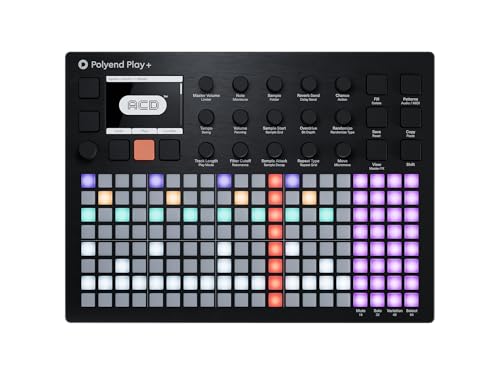
Polyend Play+ Synthesizer and Sampler
Best for: pad-based sample sequencing and groovebox production
- Connectivity
- USB-MIDI
- Color
- Black
- Dimensions
- 3.94 × 1.97 × 0.5 inches
The Polyend Play+ is a standalone synthesizer, sampler, and MIDI workstation. You get 16 stereo tracks, backlit performance pads, and USB-MIDI connectivity. It includes a 16GB microSD card stocked with over 5,000 onboard samples plus a 3.5mm headphone out. This setup suits you if you prioritize pad-based track sequencing and sampling over traditional keyboard playing.
- 16 stereo tracks for sequencing and sampling
- Includes 16GB microSD card with 5000+ onboard samples
- Backlit performance pads for sequencing and trigger control
- USB-MIDI connectivity for controlling external gear
- Uses grid pads rather than a traditional piano keybed
- Audio output limited to a 3.5mm headphone jack
- You want a pad-based groovebox with 16 stereo tracks.
- You need a standalone unit with thousands of onboard samples.
- You sequence external gear via USB-MIDI.
- You require full-size piano keys for live playing.
- You need dedicated quarter-inch stereo outputs.
Verdict: Polyend Play+ Standalone Synthesizer and Sampler delivers 16 stereo tracks and extensive sample sequencing for producers who prefer grid pads over a conventional keybed.
Specifications side by side
Spec Roland GAIA Hybrid Synthesizer Yamaha CK Series 61-Key Stage Keyboard Roland AIRA Rhythm Performer Moog Grandmother 32-Key Analog Synthesizer Yamaha MX61 Music Production Synthesizer Roland JUNO-D 61-Key Synthesizer Polyend Play+ Synthesizer and Sampler
- Number of Keys
- –
- Key Action
- –
- Sound Engine
- Wavetable & virtual analog
- Polyphony
- –
- Preset Count
- –
- Connectivity
- –
- Sequencer
- Real-time and step-recording
- Form Factor
- –
- Suitable For
- –
- Color
- Black
- Built-In Features
- –
- Features
- –
- Dimensions
- 13 × 26 × 4 inches
- Weight
- 10 pounds
- Model
- GAIA-2
- Size
- –
Copied from the Amazon listing. These figures were not measured here.
Frequently asked questions
Which Roland GAIA 2 alternative offers built-in speakers?
The Yamaha CK61 includes built-in speakers for immediate monitoring. This 61-key stage keyboard weighs 12.3 pounds and spans 35.8 inches long. It suits gigging musicians who want multi-part splits and dedicated organ modeling without carrying external amplification to rehearsals.
Is there a semi-modular analog alternative to the GAIA 2?
The Moog Grandmother provides a monophonic analog engine with 41 modular patch points. Unlike digital polyphonic keyboards, this 16-pound instrument features 32 full-size velocity-sensitive keys, an arpeggiator, and an integrated 256-note hardware sequencer for patch-cable sound design in your studio.
Which alternative works best for DAW music production?
The Yamaha MX61 serves computer-based setups with bi-directional USB audio interfacing and a 128-note Motif engine. It features a full 61-key layout within a 44.7-inch frame weighing 14.9 pounds, making it suitable for studio producers needing direct software integration for multitrack music production.
What is a portable alternative with USB-C power?
The Roland JUNO-D features USB-C connectivity for power and audio data alongside standard MIDI connections. It includes 61 keys, weighs 12.8 pounds, and uses the ZEN-Core sound engine. You get extensive preset flexibility, onboard sequencing, and sample playback capabilities for mobile performance setups.
Can you choose a pad-based groovebox instead of a keyboard?
The Polyend Play+ provides an alternative if you prefer grid pads over a traditional keyboard. This compact unit offers 16 stereo tracks for sample sequencing and standalone synthesis. It connects via USB-MIDI, letting you build arrangements without taking up desk space with full-size keys.
Which alternative focuses strictly on rhythm sequencing?
The Roland AIRA TR-8 focuses on dedicated rhythm generation rather than melodic keys. Weighing 4.2 pounds, this compact machine delivers 16 patterns and a 32-step sequencer for classic drum kits. It also provides parallel USB streaming to route individual percussion tracks directly to your setup.


