
As Amazon Associates, we earn from qualifying purchases. This means we may receive a small commission at no extra cost to you if you click through and make a purchase.
As an Amazon Associate we earn from qualifying purchases. Links on this page are affiliate links.
If you produce electronic tracks, exploring roland aira rhythm performer alternatives helps you match your hardware to your workflow. The Roland AIRA Rhythm Performer TR-8 excels at live rhythm creation, recreating classic TR-808 and TR-909 sounds across 16 kits with 11 instrument types. It features a sequencer running up to 32 steps, dedicated knobs for per-step reverb and delay, an external input with rhythmic side-chain ducking, and parallel outputs over USB in a 4.2-pound chassis.
You might still need a different form factor, brand, or feature set for your studio. The TR-8 measures 15.7 inches long and 10.2 inches wide, focusing entirely on drum programming. Depending on your goals, you may want 61 keys for melodic playing, semi-modular analog patch routing, built-in speakers, or portable backlit pads. These 6 alternatives were chosen because their specifications overlap with the original, offering integrated step sequencers, USB connectivity, and direct hardware control for music production.
How Each Alternative Compares
Yamaha CK Series 61-Key Stage Keyboard
Yamaha CK61 shifts the focus from beat programming to keyboard performance. It features a 61-key bed and built-in speakers, allowing standalone play without external monitors. You also get three-way sound splits for live stage work. In exchange, you give up the TR-8 step sequencer, dedicated rhythm controls, per-step sidechaining, and parallel USB audio outs. It is also significantly larger and heavier at 12.3 pounds compared to the 4.2-pound TR-8. Choose the CK61 if you need a portable stage keyboard for pitched chord and melody playing rather than dedicated electronic drum production.
Moog Grandmother 32-Key Analog Synthesizer
The Moog Grandmother offers a 32-key semi-modular analog synth architecture instead of digital drum modeling. It includes a 256-note sequencer, an arpeggiator, dual oscillators, a physical spring reverb, and patch points for signal routing. By choosing it, you trade away the TR-8 multi-track drum kits, dedicated rhythm scatter effects, and USB parallel audio routing. At 16 pounds and 23 inches wide, the Grandmother is bulkier than the 4.2-pound TR-8. You should select the Moog Grandmother if you want patchable analog synthesis, basslines, and leads rather than a dedicated 32-step percussion machine.
Yamaha MX61 Music Production Synthesizer
Yamaha MX61 provides a full music production synthesizer with 61 keys and Motif sound generation. Like the TR-8, it supports multi-channel USB audio streaming directly to a computer, but it serves broader arrangement tasks with pitched instruments. However, you lose the 32-step rhythm sequencer, dedicated per-step delay and reverb knobs, and classic TR drum synthesis. At 14.9 pounds and 44.7 inches long, it requires far more desk space than the 15.7-inch, 4.2-pound TR-8. Pick the MX61 if you need a keyboard workstation for complete DAW compositions rather than a specialized live drum machine.
Roland JUNO-D 61-Key Synthesizer
Roland JUNO-D expands your setup with 61 full-sized keys, multi-track sequencing, and modern USB-C connectivity. While the TR-8 specializes strictly in 11 instrument types across 16 drum kits, the JUNO-D handles full musical arrangements across multiple tracks. To gain keyboard functionality and USB-C audio, you surrender the TR-8 per-step accent controls, hardware rhythm knobs, and dedicated scatter functions. The JUNO-D weighs 12.8 pounds and spans 39.6 inches, making it substantially larger than the 4.2-pound TR-8. Choose the JUNO-D if you prioritize multi-part sequencing and keyboard performance over dedicated TR beat programming.
Roland GAIA Hybrid Synthesizer
The Roland GAIA 2 delivers hybrid wavetable synthesis paired with a built-in step sequencer. It gives you deep melodic sound design tools and a keyboard interface that the drum-focused TR-8 lacks. In contrast, it does not include the TR-8 modeled TR-808 and TR-909 percussion circuits, dedicated rhythm sliders, or external audio ducking sidechain. The GAIA 2 weighs 10 pounds and measures 26 inches wide, requiring more space than the compact 4.2-pound TR-8. Select the GAIA 2 if your productions center on synthesizer sound synthesis and melodic patterns rather than dedicated drum rhythm creation.
Polyend Play+ Synthesizer and Sampler
Polyend Play+ provides a sample-based groovebox workflow featuring 16 stereo tracks, backlit pads, and 5,000 onboard samples. Unlike the TR-8, which focuses on 16 preset kits modeled on analog circuits, the Play+ offers broad sample playback and synthesizer engines in a small footprint. What you give up are the TR-8 dedicated hardware knobs for tempo, shuffle, accent, and per-step delay and reverb. You also lose individual parallel USB outputs for analog drum tracks. Pick the Polyend Play+ if you prefer pad-based sequencing and comprehensive sample manipulation over direct TR-series drum controls.
| # | Product | Best for | Price |
|---|---|---|---|
| 1 | Roland AIRA Rhythm Performer Best overall | live electronic beat creation and studio tracking | |
| 2 | Yamaha CK Series 61-Key Stage Keyboard Best premium | portable multi-sound live keyboard performance | |
| 3 | Moog Grandmother 32-Key Analog Synthesizer Best sequencer | analog modular sequencing and patch routing | |
| 4 | Yamaha MX61 Music Production Synthesizer Best budget | budget studio production with integrated USB connectivity | |
| 5 | Roland JUNO-D 61-Key Synthesizer Best usb | USB-C sequencing with 61 full keys | |
| 6 | Roland GAIA Hybrid Synthesizer Also great | hybrid synthesis and pattern sequencing | |
| 7 | Polyend Play+ Synthesizer and Sampler Also great | sample-based sequencing on backlit pads |

Roland AIRA Rhythm Performer
Best for: live electronic beat creation and studio tracking
- Connectivity
- USB
- Sequencer
- Up to 32 steps
- Color
- Black
- Dimensions
- 15.7 × 10.2 × 2.6 inches
- Weight
- 4.2 pounds
This drum machine recreates classic TR-808 and TR-909 rhythms across 16 drum kits with 11 instrument types. You get a 32-step sequencer, dedicated knobs for accent, reverb, and delay, plus parallel audio output over USB. It suits you if you need direct knob-per-function rhythm sequencing and external audio sidechaining for studio production or live electronic sets.
- Recreates TR-808 and TR-909 sounds across 16 kits and 11 instrument types
- Provides dedicated physical knobs for tempo, shuffle, accent, reverb, and delay
- Includes parallel audio output over USB and two assignable analog outputs
- Features an external audio input with a per-step sidechain ducking function
- Pattern sequencer is limited to 32 steps
- Internal memory stores up to 16 patterns
- You need dedicated hardware controls for tempo, accent, shuffle, and step effects
- You want to stream individual instrument tracks directly over USB into your DAW
- You require external audio input processing with rhythmic sidechain ducking
- You need sequences longer than 32 steps in a single pattern
- You require onboard storage for more than 16 patterns at once
Verdict: Roland AIRA 16-Pattern Rhythm Performer delivers classic TR-series drum synthesis with full per-step knob manipulation and multi-channel USB streaming. It fits electronic music producers who build beats around a 32-step workflow without navigating digital menus.

Yamaha CK Series 61-Key Stage Keyboard
Best for: portable multi-sound live keyboard performance
- Number of Keys
- 61
- Form Factor
- Stage
- Color
- Black
- Built-In Features
- Built-In Speakers
- Dimensions
- 35.8 × 11.4 × 4.3 inches
- Weight
- 12.3 pounds
This stage keyboard gives you a 61-key layout with built-in speakers in a 12.3-pound chassis. You can set two split points to divide the keybed across three distinct sounds simultaneously, including pianos, organs, strings, brass, and real-time synths. It suits you if you need a lightweight live performance keyboard with standalone sound output instead of a tabletop rhythm machine.
- Built-in speakers provide direct onboard sound monitoring
- Lightweight 12.3-pound build allows easy transport
- Two split points let you play three distinct sounds across the keybed
- Organ section includes vintage drawbar and transistor sound engines
- Measures 35.8 inches long, requiring more desk room than compact tabletop gear
- Provides 61 keys instead of a full 88-key piano layout
- You want a 61-key instrument with built-in speakers for immediate monitoring.
- You need to divide your keyboard into three zones using two onboard split points.
- You require a portable live setup that weighs 12.3 pounds.
- You need a compact tabletop device rather than a 35.8-inch wide keyboard frame.
- You prefer a full 88-key piano arrangement for your playing style.
Verdict: Yamaha 61-Key Stage Keyboard with Speakers suits gigging performers who need a 12.3-pound instrument capable of three-way splits with onboard amplification.

Moog Grandmother 32-Key Analog Synthesizer
Best for: analog modular sequencing and patch routing
- Number of Keys
- 32
- Key Action
- Velocity-sensitive
- Sound Engine
- Analog
- Polyphony
- Monophonic
- Connectivity
- 5-pin DIN, MIDI over USB
- Sequencer
- 256 Note
The Moog Grandmother is a monophonic semi-modular analog synthesizer with 32 velocity-sensitive keys. It features an onboard 256-note sequencer with three storage slots, an analog spring reverb tank, and 41 patch points for modular routing. With 5-pin DIN MIDI and USB connectivity, it suits you if you sequence analog basslines and leads alongside external gear.
- Built-in 256-note sequencer with three sequence memory slots
- 41 analog patch points for modular and Eurorack connectivity
- Hardware analog spring reverb tank processes internal and external audio
- 5-pin DIN In, Out, and Thru ports plus MIDI over USB
- Monophonic design restricts playback to one note at a time
- 32-key keyboard offers less pitch range than 61-key options
- You need a dedicated 256-note hardware sequencer for monophonic lines.
- You want 41 patch points to integrate with external Eurorack systems.
- You plan to process instruments through an analog spring reverb tank.
- You need polyphony to play chords or layered harmonies.
- You require more than 32 keys for wide two-handed performances.
Verdict: Moog Grandmother 32-Key Semi-Modular Synthesizer fits musicians who want dedicated 256-note step sequencing and patch-cable routing for analog signal paths. Its combination of dual oscillators, physical spring reverb, and modular jacks delivers direct hardware control for modular setups.

Yamaha MX61 Music Production Synthesizer
Best for: budget studio production with integrated USB connectivity
- Number of Keys
- 61
- Sound Engine
- Motif Sound Engine
- Polyphony
- 128 notes
- Connectivity
- USB Audio/MIDI
- Suitable For
- Music Production
- Color
- Black
The Yamaha MX 61-Key Music Synthesizer is a production keyboard designed for studio and stage use. You get 61 keys backed by the Motif sound engine and 128 notes of polyphony for sequencing full tracks. A class-compliant USB connection handles stereo audio and 16 channels of MIDI, letting you record directly into your DAW without external audio devices.
- 128 notes of polyphony to prevent voice dropout during dense playback
- Bidirectional USB transmits stereo audio and 16 MIDI channels simultaneously
- Motif sound engine allows control of up to 8 elements per single voice
- Lightweight frame weighs 14.9 pounds for easy transport
- Footprint measures 44.7 inches long, requiring dedicated stand space
- Remote DAW control capabilities vary depending on the sequencing software
- You need a 61-key playing surface combined with an integrated audio interface.
- You require 128-note polyphony for complex 16-track sequence playback.
- You want driver-free class-compliant USB connectivity for fast setup.
- You need a compact tabletop drum performer rather than a 44.7-inch keyboard.
- You want dedicated hardware beat-making pads instead of standard keys.
Verdict: Yamaha MX 61-Key Music Synthesizer equips computer-based producers with Motif synthesis and direct multi-channel USB recording in an under-15-pound chassis.

Roland JUNO-D 61-Key Synthesizer
Best for: USB-C sequencing with 61 full keys
- Number of Keys
- 61
- Key Action
- Synth-action
- Sound Engine
- ZEN-Core
- Preset Count
- Over 3800
- Connectivity
- USB-C Audio/MIDI
- Sequencer
- Eight-track
The Roland Juno 61-Key Synthesizer provides a full keyboard layout with an eight-track sequencer and the ZEN-Core sound engine. It gives you over 3,800 onboard presets, sample import for WAV files, and USB-C audio and MIDI connectivity. It suits musicians who need a portable, battery-compatible 61-key workstation to arrange complete tracks alongside external studio gear.
- Over 3800 onboard sounds powered by the ZEN-Core engine
- Built-in eight-track sequencer for song arrangement
- USB-C audio and MIDI connectivity with mobile battery power support
- WAV sample import function for custom sound playback
- Uses synth-action keys rather than weighted piano keys
- Measures 39.6 inches long, requiring more desk space than desktop modules
- You need a 61-key board with USB-C audio and MIDI connectivity.
- You want an onboard eight-track sequencer to compose arrangements.
- You plan to import your own WAV samples into your performances.
- You prefer fully weighted hammer-action keys for piano playing.
- You need a compact desktop module without an attached keyboard.
Verdict: Roland Juno 61-Key Synthesizer suits live performers and home producers who want multi-track sequencing, USB-C connectivity, and 61 keys in a 12.8-pound instrument.

Roland GAIA Hybrid Synthesizer
Best for: hybrid synthesis and pattern sequencing
- Sound Engine
- Wavetable & virtual analog
- Sequencer
- Real-time and step-recording
- Color
- Black
- Dimensions
- 13 × 26 × 4 inches
- Weight
- 10 pounds
The Roland GAIA 2 Hybrid Synthesizer provides a wavetable and virtual analog sound engine paired with full-size keys and an aluminum control panel. You can program patterns using the step and real-time sequencer, route custom modulations, and shape tones with 53 built-in effects. It suits you if you want melodic sound design alongside pattern sequencing.
- Hybrid sound engine combining wavetable and virtual analog synthesis
- Sequencer supporting both step-recording and real-time options
- Effects section with 53 unique effect types
- Motional Pad for expressive control and modulation
- Weighs 10 pounds across a 26-inch footprint
- Uses keyboard keys with no dedicated drum pads
- You want a hybrid wavetable and virtual analog engine with physical controls.
- You need integrated step and real-time sequencing with built-in effects.
- You need dedicated pads designed specifically for finger drumming.
- You want a portable instrument weighing under 10 pounds.
Verdict: Roland GAIA 2 Hybrid Synthesizer fits musicians who prioritize wavetable synthesis and step sequencing over dedicated rhythm-pad hardware.
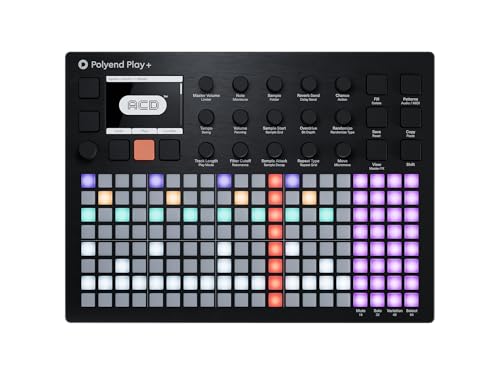
Polyend Play+ Synthesizer and Sampler
Best for: sample-based sequencing on backlit pads
- Connectivity
- USB-MIDI
- Color
- Black
- Dimensions
- 3.94 × 1.97 × 0.5 inches
The Polyend Play+ is a standalone synthesizer, sampler, and groovebox built for track sequencing. You get 16 stereo tracks, backlit performance pads, and over 5,000 onboard samples stored across an included 16GB microSD card. It connects via USB-MIDI and includes a 3.5mm headphone out. This suits you if you need a pad-driven sequencer without a traditional keyboard.
- 16 stereo tracks for sample playback and sequencing
- Over 5,000 onboard samples included
- Backlit performance pads for sequencing and triggering
- Includes 16GB microSD card and dedicated slot
- Uses a 3.5mm headphone output rather than standard 1/4-inch audio jacks
- Uses performance pads instead of a traditional piano-style keyboard
- You produce music using 16 stereo tracks and sample libraries.
- You prefer backlit performance pads over traditional keyboard keys.
- You need external storage via an included 16GB microSD card.
- You want full-size piano or synthesizer keys for live playing.
- You require native 1/4-inch audio connections without using adapters.
Verdict: Polyend Play+ Sampler and Synthesizer provides 16 stereo tracks and 5,000 onboard samples for producers who construct beats with backlit pads rather than a piano keybed.
Specifications side by side
Spec Roland AIRA Rhythm Performer Yamaha CK Series 61-Key Stage Keyboard Moog Grandmother 32-Key Analog Synthesizer Yamaha MX61 Music Production Synthesizer Roland JUNO-D 61-Key Synthesizer Roland GAIA Hybrid Synthesizer Polyend Play+ Synthesizer and Sampler
- Number of Keys
- –
- Key Action
- –
- Sound Engine
- –
- Polyphony
- –
- Preset Count
- –
- Connectivity
- USB
- Sequencer
- Up to 32 steps
- Form Factor
- –
- Suitable For
- –
- Color
- Black
- Built-In Features
- –
- Features
- –
- Dimensions
- 15.7 × 10.2 × 2.6 inches
- Weight
- 4.2 pounds
- Size
- 16 Patterns
- Model
- TR-8
Copied from the Amazon listing. These figures were not measured here.
Frequently asked questions
Which alternative is best for sample-based beat production?
The Polyend Play+ is your best option for sample-based sequencing. It provides 16 stereo tracks and 5,000 onboard samples, letting you trigger and manipulate audio clips directly. You program rhythms using backlit pads instead of traditional drum-machine knobs or a keyboard layout, and it connects to production setups via USB-MIDI.
Can you record multi-channel audio directly to a computer with these instruments?
Yes, specific models like the Yamaha MX61 and Roland AIRA TR-8 handle multi-channel USB audio streaming directly. The Yamaha MX61 lets you record internal Motif synthesis sounds over a single USB cable to your computer. This setup eliminates the need for a separate audio interface when tracking multiple instrument layers in your studio.
How does an analog synthesizer differ from a dedicated rhythm performer?
An analog synthesizer like the Moog Grandmother generates melodic tones, basslines, and sound effects rather than preset percussion sounds. It features a 32-key layout, dual oscillators, a physical spring reverb, and patch-cable routing. While it includes a 256-note step sequencer, you build linear melodic phrases rather than multi-instrument drum patterns.
Which keyboard alternative includes modern USB-C connectivity?
The Roland JUNO-D includes dedicated USB-C connectivity alongside standard USB-MIDI capabilities. It combines a 61-key layout with integrated multi-track sequencing for building full arrangements. Weighing 12.8 pounds, it connects cleanly to modern computers and digital audio workstations with a single cable type, eliminating the need for older legacy USB adapter plugs.
What makes a hybrid synthesizer different from a dedicated drum machine?
A hybrid synthesizer like the Roland GAIA 2 uses wavetable synthesis to create evolving textures, leads, and complex tones rather than drum hits. It features an onboard step sequencer for programming melodic patterns across time. Weighing 10 pounds, it serves musicians who want deep sound design rather than dedicated percussive rhythm grids.
How does pattern sequencing compare across these rhythm and synth alternatives?
Pattern sequencing varies significantly across these devices. The Roland AIRA TR-8 uses a direct 32-step grid tailored for drum loops across 16 patterns. In contrast, the Moog Grandmother provides a 256-note sequencer for analog melodies, while the Polyend Play+ gives you 16 stereo tracks for sequencing samples and synth lines without keybed controls.
Should you choose a 61-key synthesizer or a dedicated tabletop sequencer?
Your choice depends on whether you play full keyboard parts or build sequenced loops. Models like the Yamaha MX61, Yamaha CK61, and Roland JUNO-D feature 61 keys for two-handed playing and studio tracking. If you produce strictly electronic beats and step-based patterns, tabletop units like the Roland TR-8 or Polyend Play+ save substantial desk space.


