
As Amazon Associates, we earn from qualifying purchases. This means we may receive a small commission at no extra cost to you if you click through and make a purchase.
As an Amazon Associate we earn from qualifying purchases. Links on this page are affiliate links.
The Novation Bass Station II is an analog monosynth with 25 full-size keys, aftertouch, two analog oscillators, and a sub-oscillator. If you need different hardware features, exploring novation bass station ii analog alternatives helps you find the right fit. The original excels at sound design through dual filter circuits, an arpeggiator, a step sequencer, and 128 patch storage slots. Even so, you might prefer a larger 61-key or 88-key layout, polyphonic capability, hammer action, or modular patch points.
This guide highlights 6 instruments across different formats. The alternatives were chosen because their specs overlap with the original, including USB connectivity, MIDI support, onboard sequencing, and performance controls. Whether you choose a compact hybrid synth like the Arturia MicroFreak, a semi-modular Moog Grandmother, or a dedicated MIDI controller, you can compare key actions, dimensions, and sound engines to match your space.
How Each Alternative Compares
Novation FLkey 61 MIDI Keyboard Controller
The Novation FLkey 61 expands your physical range with 61 weighted keys, compared to the 25-key layout on the Bass Station II. It connects over USB, USB-MIDI, and USB-C to manage software sequencing in FL Studio. While the Bass Station II generates standalone sound with two analog oscillators and dual analog filters, the FLkey 61 serves strictly as a MIDI controller without an internal analog sound engine. It also weighs 10.6 pounds, roughly double the Bass Station II at 5.38 pounds. Choose this controller if you work inside a DAW and need five octaves for playing.
Arturia MicroFreak 25-Key Synth
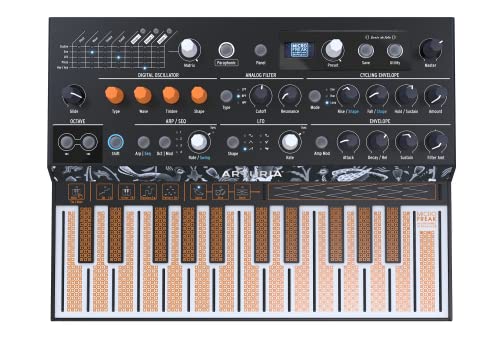
The Arturia MicroFreak matches the 25-key capacity of the Bass Station II but uses a digital hybrid engine with polyphonic aftertouch. It weighs 2.3 pounds and measures 12.2 by 9.2 by 2.2 inches, making it lighter and more compact than the 5.38-pound Bass Station II. You gain digital oscillator modes and touch-sensitive modulation routing. However, you give up the dual analog oscillators, sub-oscillator, and physical moving keys of the Bass Station II. Choose the MicroFreak if you want polyphonic aftertouch and a portable footprint for experimental patch modulation instead of a classic analog monosynth signal path.
Moog Grandmother 32-Key Analog Synthesizer
The Moog Grandmother offers a semi-modular analog architecture with 32 velocity-sensitive keys, seven more than the Bass Station II. It features 41 patch points for Eurorack integration, a built-in spring reverb, an arpeggiator, and a sequencer. In contrast, the Bass Station II includes digital patch storage for 128 sounds, dual switchable filter circuits, and aftertouch, which the Grandmother does not provide. The Grandmother also weighs 16 pounds, compared to the 5.38-pound Bass Station II. Choose the Grandmother if you need physical patch cabling and modular hardware expansion rather than preset recall and compact aftertouch keys.
The ONE 88-Key Hammer-Action Portable Digital Piano
The ONE Digital Piano provides a full 88-key layout with hammer-action keys, built-in speakers, and 691 sounds. This design differs fundamentally from the 25-key Bass Station II analog synthesizer. You gain complete multi-octave range, piano key weighting, and internal speakers for standalone acoustic practice. You give up dedicated analog sound sculpting, including dual analog oscillators, the Acid filter, aftertouch modulation, and the onboard step sequencer. Measuring 52 inches wide, it occupies significantly more space than the 18-inch Novation unit. Select The ONE if you focus on standard keyboard technique across 88 weighted notes instead of electronic monophonic sound synthesis.
Casio Casiotone 61-Key Lighted Keyboard
The Casio Casiotone LK-S450 provides 61 illuminated keys for visual guidance, USB-MIDI connectivity, and a selection of preset instrument tones. It offers more than double the key count of the 25-key Bass Station II. You gain lighted lesson functions and a broader pitch span for two-handed playing. In exchange, you lose the analog signal path of the Bass Station II, including its two tuneable oscillators, sub-oscillator, aftertouch keybed, and dual filter modes. At 9.92 pounds, it is heavier than the 5.38-pound monosynth. Pick the Casiotone if you need key-lighting practice aids and 61 keys instead of analog synth sound design.
Roland JUNO-D 61-Key Synthesizer
The Roland JUNO-D features 61 keys, a multi-track sequencer, and a broad digital sound library with USB-C and USB-MIDI connectivity. It expands your performance range well beyond the 25 keys on the Bass Station II. You gain multi-timbral sequencing and polyphonic coverage for full arrangements. However, you give up the purely analog voice architecture, dual filter circuits, and aftertouch hardware control present on the Novation Bass Station II. The JUNO-D also weighs 12.8 pounds, compared to the 5.38-pound Novation. Choose the JUNO-D if you require complete song arrangement tools and 61 keys rather than a dedicated monophonic analog bass synth.
| # | Product | Best for | Price |
|---|---|---|---|
| 1 | Novation Bass Station II Analog Monosynth Best overall | analog bass and lead sound design | |
| 2 | Novation FLkey 61 MIDI Keyboard Controller Best budget | FL Studio producers wanting 61 keys | |
| 3 | Arturia MicroFreak 25-Key Synth Also great | experimental sound design and compact modular setups | |
| 4 | Moog Grandmother 32-Key Analog Synthesizer Best premium | modular analog synthesis and Eurorack expansion | |
| 5 | The ONE 88-Key Hammer-Action Portable Digital Piano Best 88-key | full-range hammer-action piano practice | |
| 6 | Casio Casiotone 61-Key Lighted Keyboard Best 61-key | beginners wanting 61 illuminated lesson keys | |
| 7 | Roland JUNO-D 61-Key Synthesizer Also great | performers needing extensive digital sounds and sequencing |

Novation Bass Station II Analog Monosynth
Best for: analog bass and lead sound design
- Number of Keys
- 25
- Key Action
- Aftertouch
- Sound Engine
- Analog
- Polyphony
- Monosynth, paraphonic
- Preset Count
- 64
- Connectivity
- USB, 5-pin DIN MIDI
The Novation Bass Station II is a 25-key analog monophonic synthesizer built for dedicated bass and lead sound design. You get two tuneable analog oscillators, a sub-oscillator, two switchable filter circuits, and aftertouch-enabled keys. It features a step sequencer, an arpeggiator, and 128 patch storage slots, making it suitable if you need focused analog lead and bass patching.
- Two tuneable analog oscillators, sub-oscillator, noise generator, and ring modulation
- Two distinct filter sections including Classic multi-mode and 24 dB Acid filters
- 25 full-size keys equipped with aftertouch
- Onboard step sequencer and pattern-based arpeggiator
- Monophonic and paraphonic architecture prevents playing polyphonic chords
- 25-key hardware layout limits playable range to two octaves without transposition
- Internal memory holds a maximum of 128 total patches
- You need a dedicated analog synthesizer with full-size aftertouch keys for basslines and lead sounds.
- You want built-in step sequencing alongside standard 5-pin DIN MIDI and USB connectivity.
- You plan to run external instruments through hardware analog filter circuits.
- You require polyphony to play traditional multi-note chords and piano arrangements.
- You want a keyboard with 61 or more keys for two-handed performance.
Verdict: Novation Bass Station II 25-Key Monosynth gives electronic musicians pure analog signal routing with dual filter circuits, step sequencing, and aftertouch response. It serves producers who prioritize dedicated monophonic synthesis over full polyphonic keyboard range.

Novation FLkey 61 MIDI Keyboard Controller
Best for: FL Studio producers wanting 61 keys
- Number of Keys
- 61
- Key Action
- Semi-weighted
- Connectivity
- USB-C, 5-Pin MIDI Out
- Dimensions
- 10.4 × 35.2 × 3.66 inches
- Weight
- 10.6 pounds
The Novation FLkey 61 is a dedicated USB-MIDI controller designed for FL Studio integration. You get 61 semi-weighted keys, 16 velocity-sensitive pads, nine faders, and eight knobs for direct parameter control. Instead of an internal sound engine, it routes MIDI over USB-C or 5-pin MIDI out, making it suitable if you produce tracks inside your DAW software.
- 61 semi-weighted keys with pitch and modulation wheels
- 16 velocity-sensitive pads for sequencing and finger drumming
- Hardware mixing control with nine faders and eight knobs
- Built-in Scale and Chord modes plus onboard arpeggiator
- USB-C connectivity and 5-pin MIDI Out
- Requires connected software or external modules, lacking an onboard sound engine
- 35.2-inch width demands significantly more desk space than compact 25-key keyboards
- You build tracks primarily in FL Studio and need pre-mapped hardware controls.
- You want a five-octave semi-weighted keybed alongside drum pads and faders.
- You rely on onboard Chord and Scale tools to draft melodies and arrangements.
- You need a standalone analog synthesizer that generates audio without a computer.
- You have limited studio space and require a compact desktop footprint.
Verdict: Novation FLkey 61 MIDI Controller suits computer-based producers who prioritize deep FL Studio workflow navigation across a full 61-key layout. It trades standalone analog sound generation for comprehensive software mixing and sequencing controls.
Arturia MicroFreak 25-Key Synth
Best for: experimental sound design and compact modular setups
- Number of Keys
- 25
- Key Action
- Poly-aftertouch
- Sound Engine
- Physical modeling to wavetable
- Polyphony
- Paraphonic
- Connectivity
- CV outputs, USB, MIDI
- Color
- Black
The Arturia MicroFreak is a compact hybrid synthesizer that pairs a digital oscillator engine with a resonant analog filter. It features a 25-key flat printed circuit board keyboard with polyphonic aftertouch instead of traditional moving keys. With paraphonic voice capability, CV outputs for modular gear, and a 5×7 modulation matrix, it suits sound designers wanting experimental textures in a portable 2.3-pound setup.
- 25-key capacitive touch PCB with polyphonic aftertouch
- Hybrid design with digital oscillator engines and an analog filter
- Pitch, gate, and pressure CV outputs for modular integration
- Built-in 5×7 modulation matrix and sequencer with randomization
- Flat PCB keybed lacks physical key travel
- 25-key span restricts two-handed playing
- Paraphonic voicing rather than full polyphony
- You want polyphonic aftertouch in a compact desktop format.
- You need CV outputs to drive external modular hardware alongside USB MIDI.
- You want diverse digital oscillator modes routed through an analog filter.
- You require traditional mechanical keys with physical travel.
- You need more than 25 keys or dedicated polyphony for standard keyboard playing.
Verdict: Arturia MicroFreak 25-Key Hybrid Synthesizer provides deep digital oscillator options and modular CV routing for producers who want unconventional control without traditional moving keys. It serves electronic musicians prioritizing polyphonic aftertouch and compact patch modulation over standard piano action.

Moog Grandmother 32-Key Analog Synthesizer
Best for: modular analog synthesis and Eurorack expansion
- Number of Keys
- 32
- Key Action
- Velocity-sensitive
- Sound Engine
- Analog
- Polyphony
- Monophonic
- Connectivity
- 5-pin DIN, MIDI over USB
- Sequencer
- 256 Note
The MOOG Grandmother is a monophonic analog synthesizer equipped with 32 velocity-sensing full-size keys. It features 41 modular patch points, two analog oscillators, a built-in spring reverb tank, and a 256-note sequencer. You get standard 5-pin DIN MIDI and USB connectivity. This synthesizer suits musicians seeking pure analog architecture and modular signal routing in a standalone keyboard format.
- 41 patch points for modular interconnectivity and Eurorack integration
- Built-in analog hardware spring reverb tank
- 256-note sequencer with three save files and integrated arpeggiator
- Dual analog oscillators plus a white noise generator
- Monophonic design restricts playback to one note at a time
- Heavier build at 16 pounds compared to standard portable synths
- 32-key layout limits melodic range
- You want 41 patch points for modular patching and Eurorack integration.
- You need a built-in hardware spring reverb and a 256-note sequencer.
- You prefer full-size velocity-sensitive keys with analog synthesis.
- You require polyphony to play chords simultaneously.
- You need a lightweight instrument under 10 pounds for easy travel.
- You want a keyboard with more than 32 notes for two-handed playing.
Verdict: MOOG Grandmother 32-Key Semi-Modular Synthesizer provides genuine analog sound design with 41 patch points for musicians connecting to Eurorack setups. Its 32-key velocity-sensitive layout and built-in spring reverb deliver dedicated signal manipulation in an integrated unit.

The ONE 88-Key Hammer-Action Portable Digital Piano
Best for: full-range hammer-action piano practice
- Number of Keys
- 88
- Key Action
- Hammer action
- Polyphony
- 128-note
- Preset Count
- 691
- Built-In Speakers
- Built-in
- Connectivity
- USB, MIDI, Bluetooth
If you want full acoustic range instead of a compact synth, this 88-key digital piano provides full-sized hammer-action keys with adjustable touch response. It features 128-note polyphony, 691 instrument tones, and built-in speakers. Bluetooth connects to dedicated companion apps for guided lessons and recording, though you need wired headphones for silent practice. It suits players seeking full piano action.
- 88 full-sized hammer-action keys with adjustable touch response
- 128-note maximum polyphony
- 691 built-in instrument tones
- Built-in speakers and USB-MIDI connectivity
- Companion app integration with light-up learning guides
- Bluetooth supports app connection only and cannot stream to Bluetooth headphones
- 52-inch width requires substantial desk or stand space
- You want 88 full-size hammer-action keys for traditional piano practice.
- You prefer an extensive sound bank with 691 tones and 128-note polyphony.
- You plan to practice with interactive learning apps via mobile connection.
- You need a compact instrument for small workspaces or tight travel setups.
- You intend to use wireless Bluetooth headphones for silent monitoring.
Verdict: The ONE 88-Key Hammer Action Digital Piano delivers full-range weighted keys and 691 sounds for players who prioritize traditional piano feel over compact synthesizer controls.

Casio Casiotone 61-Key Lighted Keyboard
Best for: beginners wanting 61 illuminated lesson keys
- Number of Keys
- 61
- Key Action
- Touch-sensitive
- Sound Engine
- AiX
- Preset Count
- 600 tones
- Built-In Speakers
- Stereo speakers
- Connectivity
- USB-MIDI
If you want wider range than a compact monosynth, this 61-key portable keyboard offers full-size touch-sensitive keys with a built-in key lighting system. You get 600 AiX presets, 200 rhythms, and an onboard 6-track recorder. Built-in stereo speakers and a 9.92-pound chassis make it easy to move, while USB-MIDI connects straight to your computer or mobile device.
- 61 full-size touch-sensitive keys with key lighting learning system
- AiX sound engine with 600 tones and 200 rhythms
- Onboard 6-track song recorder and USB-MIDI connectivity
- Lightweight 9.92-pound frame with built-in stereo speakers
- Bluetooth audio and MIDI require an optional WU-BT10 adapter
- Keys are touch-sensitive rather than weighted or semi-weighted
- You need 61 lighted keys to follow step-by-step guided lessons.
- You want a lightweight, under-10-pound keyboard with built-in speakers.
- You want an extensive library of 600 preset sounds and 200 rhythms.
- You need analog synthesis controls and dedicated sound-shaping knobs.
- You want out-of-the-box wireless Bluetooth without buying an extra adapter.
- You require semi-weighted or fully weighted hammer-action keys.
Verdict: Casio Casiotone 61-Key Lighted Keyboard fits learners and mobile players who need a 61-key portable layout with illuminated lesson keys and hundreds of preset tones.

Roland JUNO-D 61-Key Synthesizer
Best for: performers needing extensive digital sounds and sequencing
- Number of Keys
- 61
- Key Action
- Synth-action
- Sound Engine
- ZEN-Core
- Preset Count
- Over 3800
- Connectivity
- USB-C Audio/MIDI
- Sequencer
- Eight-track
The Roland 61-Key Digital Synthesizer is a digital keyboard featuring the ZEN-Core sound engine with over 3,800 presets. You get 61 synth-action keys, an eight-track sequencer, and support for USB-C audio, MIDI, and mobile battery power. It suits you if you need a broad digital sound library and multi-track arranging across five octaves instead of a dedicated analog monosynth.
- ZEN-Core sound engine loaded with over 3,800 presets
- Built-in eight-track sequencer for multi-part song arrangements
- Supports USB-C mobile battery power for portable use
- Sample import function plays and edits user WAV files
- Uses unweighted synth-action keys rather than semi-weighted keys
- Digital sound generation rather than an analog signal path
- Measures 39.6 inches wide, requiring substantial desk space
- You need thousands of digital preset sounds covering synths, pianos, and organs.
- You want an onboard eight-track sequencer to compose full arrangements.
- You need 61 keys to play two-handed parts across five full octaves.
- You want a true analog signal path with dedicated hardware controls.
- You prefer semi-weighted or hammer-action keys over synth action.
- You need an ultra-compact keyboard that fits into a small backpack.
Verdict: Roland 61-Key Digital Synthesizer suits performers and arrangers who want an extensive digital sound library, full-range playing, and multi-track sequencing in one instrument.
Specifications side by side
Spec Novation Bass Station II Analog Monosynth Novation FLkey 61 MIDI Keyboard Controller Arturia MicroFreak 25-Key Synth Moog Grandmother 32-Key Analog Synthesizer The ONE 88-Key Hammer-Action Portable Digital Piano Casio Casiotone 61-Key Lighted Keyboard Roland JUNO-D 61-Key Synthesizer
- Number of Keys
- 25
- Key Action
- Aftertouch
- Sound Engine
- Analog
- Polyphony
- Monosynth, paraphonic
- Preset Count
- 64
- Built-In Speakers
- –
- Connectivity
- USB, 5-pin DIN MIDI
- Sequencer
- Step sequencer
- Form Factor
- –
- Color
- Black/Blue
- Built-In Features
- Aftertouch, Arpeggiator
- Features
- –
- Dimensions
- 10.7 × 18 × 3 inches
- Weight
- 5.38 pounds
- Model
- AMS-BASS-STATION-II
- Size
- –
Copied from the Amazon listing. These figures were not measured here.
Frequently asked questions
Which Bass Station II alternative provides semi-modular patching?
The Moog Grandmother gives you semi-modular analog architecture with 41 patch points for Eurorack gear. You get a 32-key velocity-sensitive layout, an integrated arpeggiator, a hardware sequencer, and onboard spring reverb. At 16 pounds, it provides dedicated physical routing options beyond the fixed signal path of a standard monosynth.
Is there a lightweight alternative with polyphonic aftertouch?
The Arturia MicroFreak includes polyphonic aftertouch in a compact 25-key design. Weighing 2.3 pounds with dimensions of 12.2 by 9.2 by 2.2 inches, it uses digital oscillator models alongside modular CV routing. You get responsive modulation capabilities without the heavier 5.38-pound footprint and purely monophonic analog engine found on the Bass Station II.
What alternative works best for full-range piano playing?
The ONE 88-Key Portable Digital Piano suits players wanting full acoustic range instead of a 25-key synth layout. It features 88 hammer-action weighted keys, built-in speakers, and 691 sounds. Its 52-inch frame connects over USB-MIDI, giving you standard piano action for practice sessions rather than specialized electronic sound shaping.
Which alternative offers lighted keys for keyboard practice?
The Casio Casiotone LK-S450 features 61 illuminated keys designed for lesson guidance and melody tracking. It includes USB-MIDI connectivity, hundreds of preset tones, and a portable 9.92-pound chassis measuring 36.6 inches wide. This layout provides lighted performance cues and extra keyboard octaves compared to compact analog sound design units.
Which synthesizer alternative features multi-track sequencing and digital sound libraries?
The Roland JUNO-D provides multi-track sequencing combined with an extensive digital sound library. It features a 61-key layout, USB-C connectivity, and standard USB-MIDI communication in a 12.8-pound chassis. If you need wide performance arrangements and digital sound flexibility, this model extends well past dedicated two-oscillator monophonic analog synthesizers.
Can you replace the Bass Station II with a dedicated software controller?
The Novation FLkey 61 serves as a dedicated software controller tailored for FL Studio production. It trades standalone internal sound generation for 61 weighted keys, USB-C connectivity, and direct software mixer control. At 10.6 pounds, it lets you arrange DAW tracks across five octaves rather than programming monophonic synthesizer patches.
What makes the Arturia MicroFreak different from traditional analog monosynths?
The Arturia MicroFreak uses hybrid architecture featuring digital oscillator modes and touch-plate keys with polyphonic aftertouch. Unlike standard analog monosynths, it includes modular CV outputs for hardware gear integration while weighing only 2.3 pounds. This setup gives you unconventional sound design and compact portability within a 12.2-inch chassis.


