
As Amazon Associates, we earn from qualifying purchases. This means we may receive a small commission at no extra cost to you if you click through and make a purchase.
As an Amazon Associate we earn from qualifying purchases. Links on this page are affiliate links.
This moog muse 8 voice analog synthesizer review examines the core architecture of Moog's bi-timbral polyphonic instrument. The synthesizer centers on an eight-voice analog engine paired with a 61-key layout. Each voice features two discrete voltage-controlled oscillators, a dedicated modulation oscillator, dual transistor ladder filters, and a stereo voltage-controlled amplifier. A saturating mixer brings these elements together alongside an onboard stereo diffusion delay. With 256 total patch locations and a 64-step sequencer, this hardware unit brings classic analog subtractive architecture to a modern polyphonic format for studio recording and stage performances.
- Eight-voice analog architecture with two VCOs, a modulation VCO, dual ladder filters, and stereo VCAs per voice
- 64-step polyphonic sequencer featuring chord memory and an integrated arpeggiator
- Bi-timbral engine with 256 total patch memory locations, including 224 factory presets
- Stereo Diffusion Delay processor with configurable diffusion, multi-tap, and filter settings
Good fit for
You will appreciate this synthesizer if you need dedicated physical controls for studio composition and live sets. The knob-per-function panel lets you adjust parameters quickly without menu diving. Its 61 keys and bi-timbral sound engine suit keyboardists who layer two distinct sounds across the board. The 64-step polyphonic sequencer and onboard chord memory also fit producers seeking generative sequencing and multi-voice analog pads within a single 32-pound desktop or stand setup.
Who can skip it
You should skip this instrument if you need lightweight gear for frequent travel. Weighing 32 pounds and measuring 39 inches wide, it requires a sturdy stand and substantial desk space. Musicians who rely on high polyphony counts for complex, two-handed piano arrangements may find the eight-voice limit restrictive when playing sustained bi-timbral splits. In addition, players seeking hundreds of empty user preset slots must work within the 32 open locations provided in factory configuration.
Verdict
The MOOG Muse combines an eight-voice analog engine, bi-timbral operation, and a 64-step sequencer into a 61-key instrument designed for deep sound shaping. It provides comprehensive physical controls and discrete ladder filtering for musicians dedicated to subtractive synthesis.
Key Specifications and What They Mean
Polyphony: 8-voice
An 8-voice limit means you can play up to eight distinct notes at the exact same moment before note stealing occurs. This capacity works well for complex chords, bi-timbral splits, and sustained two-handed pads. Studio sound designers and session players benefit from this architecture. When comparing digital pianos and stage synthesizers, contrast this with digital instruments that offer 64 or 128 voices, where long sustain tails rarely cut off notes.
Number of Keys: 61
A 61-key layout spans five octaves. This footprint provides enough physical reach for two-handed playing, lead lines, and split keyboard arrangements while remaining compact. Producers with limited desk space and gigging musicians benefit from the smaller footprint. When shopping across digital pianos and stage keyboards, compare this 61-key arrangement to standard 88-key boards if you plan to perform classical piano literature requiring full bass and treble ranges.
Sequencer: 64-step
A 64-step polyphonic sequencer lets you program or record melodic phrases up to four bars long in standard time. This tool benefits electronic producers, solo performers, and composers who build layered patterns on stage or in the studio without a computer. When comparing instruments in this category, note whether alternative synthesizers offer basic 16-step sequencers or lack onboard phrase recording entirely, which would require an external hardware or software sequencer.
Preset Count: 256
This total capacity includes 224 factory presets across 16 banks, alongside two blank banks reserved for your own custom sound designs. Touring musicians and studio arrangers benefit by quickly recalling dialed-in sounds during sessions without manual patching. When comparing keyboards, evaluate whether you prefer deep preset libraries with hundreds or thousands of general MIDI voices, or an editable hardware pool focused strictly on dedicated synthesizer programs.
Hardware Dimensions and Interface Controls
The MOOG Muse features a black chassis that measures 39 inches wide, 17 inches long, and 4.5 inches high. According to the listing, the instrument weighs 32 pounds. This substantial mass and broad tabletop footprint mean you will need a sturdy, full-sized keyboard stand or a permanent studio desk location rather than a portable folding stand. It houses a 61-key keybed, which gives you five complete octaves to play two-handed arrangements or navigate splits across performance zones.
The control surface uses a knob-per-function layout according to the listing. This hardware choice gives you dedicated physical controls across the panel for real-time sound adjustments without tedious page scrolling. To handle advanced modulation and routing beneath the surface, each module includes a dedicated "More" menu. This hybrid control scheme lets you adjust primary synthesizer parameters immediately while retaining secondary menu access for deeper technical edits.
Physical control extends to built-in performance tools on the deck, including a 64-step polyphonic sequencer, an arpeggiator, and chord memory buttons. The included IEC cable connects to an internal power supply directly. Packaged documentation includes a quick start guide alongside safety and warranty paperwork to assist your initial setup.
Setup and Daily Workflow Integration
Setting up the MOOG Muse requires connecting the instrument to mains power using the included IEC cable. To guide hardware integration, the packaging contains a Quick Start Guide alongside the registration card and a safety and warranty manual. Because the front panel provides a dedicated knob-per-function layout, standard operation gives you direct, tactile control over sound parameters without requiring you to navigate menus to alter basic voice settings.
For deeper sound design, every module features a dedicated "More" menu for adjusting secondary parameters beyond the physical panel controls. When creating musical patterns, you can use the onboard 64-step polyphonic sequencer, the arpeggiator, or the chord memory function. The bi-timbral architecture lets you run two independent patches simultaneously across the 61 keys and eight analog voices.
Daily preset management utilizes 16 banks containing 16 presets each, totaling 256 patch memory locations. The instrument comes preloaded with 224 factory presets, leaving two entire banks reserved for saving your custom user patches. Everyday processing also includes the built-in stereo Diffusion Delay processor, which allows you to apply multi-tap echoes, filtering, and diffused tonal smears directly to your finished patches.
Before Buying the MOOG Muse
The MOOG Muse sits in the Digital Pianos & Keyboards category as a dedicated 61-key polyphonic synthesizer rather than an acoustic piano replacement. The architecture targets sound design and performance with an eight-voice analog engine, dual transistor ladder filters, and a 64-step sequencer. Because the package lists only an IEC cable alongside documentation, you need external amplification to produce sound. Connect an audio system to access the stereo discrete VCAs and the stereo Diffusion Delay processor. You also need a keyboard stand rated for hardware synthesizers. Consider your workflow needs regarding patch capacity. Muse stores 256 patches across 16 banks, with 224 factory sounds and two banks reserved for user patches. Maintenance involves regular dusting to keep the knob-per-function layout and individual module controls debris-free. Verify that your production space suits a dedicated bi-timbral instrument before adding it to your rig.
Check before you buy
- Confirm you have external monitors or headphones, as the package only includes an IEC power cable.
- Check that 32 user patch slots across two banks meet your custom storage requirements.
- Verify your stand and desk can accommodate a 39-inch, 32-pound synthesizer.
- Note that 8 voices and 61 keys serve synthesizer performance rather than full-range piano playing.
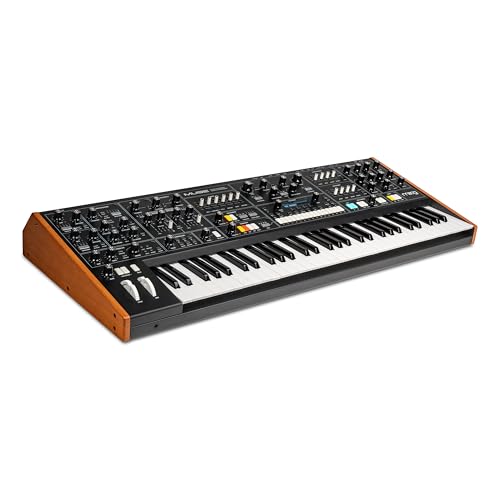
MOOG Muse 8-Voice Analog Synthesizer
Best for: studio producers wanting knob-driven analog polyphony
- Number of Keys
- 61
- Sound Engine
- Analog
- Polyphony
- 8-voice
- Preset Count
- 256
- Sequencer
- 64-step
- Color
- Black
The MOOG Muse is a bi-timbral analog synthesizer featuring 61 full-size keys and an 8-voice polyphonic architecture. You get two discrete VCOs per voice, dual ladder filters, a built-in stereo diffusion delay, and a 64-step polyphonic sequencer. It suits keyboardists and sound designers who need direct knob-per-function panel controls alongside dedicated hardware sequencing for studio production or stage performance.
- 8-voice bi-timbral analog sound engine with two discrete VCOs per voice
- Built-in 64-step polyphonic sequencer, arpeggiator, and chord memory
- Knob-per-function control layout with dedicated More module menus
- Integrated stereo Diffusion Delay processor for multi-tap and modulation effects
- Heavier chassis at 32 pounds makes frequent transport difficult
- Ships with only 32 user-writable preset slots available out of 256 total
- You need a 61-key polyphonic analog synthesizer with bi-timbral layering.
- You prefer dedicated knob-per-function controls for hardware sound programming.
- You want an onboard 64-step sequencer and digital diffusion effects built into the signal chain.
- You need an ultra-portable stage synth that weighs under 30 pounds.
- You require more than 8 voices of analog polyphony for dense split-keyboard playing.
Verdict: MOOG Muse 61-Key 8-Voice Analog Synthesizer delivers deep bi-timbral sound design and multi-step sequencing for studio producers seeking discrete analog circuitry. It gives players extensive physical parameter controls and onboard diffusion effects in a solid 32-pound frame.
Specifications side by side
| Spec | MOOG Muse 8-Voice Analog Synthesizer |
|---|---|
| Number of Keys | 61 |
| Sound Engine | Analog |
| Polyphony | 8-voice |
| Preset Count | 256 |
| Sequencer | 64-step |
| Color | Black |
| Built-In Features | Sequencer |
| Dimensions | 17 × 39 × 4.5 inches |
| Weight | 32 pounds |
| Model | MUSE |
Frequently asked questions
Who is the MOOG Muse designed for?
The MOOG Muse targets studio producers who want knob-driven analog polyphony for advanced sound design. The unit provides direct physical controls across its front panel to adjust synthesis parameters in real time. Combined with its bi-timbral architecture, it suits musicians building layered patches without menu diving during studio tracking sessions.
Does the MOOG Muse include an onboard sequencer?
Yes, the MOOG Muse includes a built-in multi-step sequencer for recording and playing back melodic phrases. This integrated feature lets you program note sequences directly on the instrument without external hardware. You can capture complex polyphonic arrangements and trigger playback alongside real-time panel parameter adjustments to shape your tracks.
What built-in audio effects are available on the MOOG Muse?
The MOOG Muse features onboard diffusion effects integrated into its hardware signal path. These effects allow you to expand your patches with spatial processing directly from the synthesizer. Because the processing occurs internally, you can craft ambient textures, reverberant decays, and wider stereo sounds without routing audio into outboard digital effect racks or computer plugins.
What are the exact dimensions and weight of the MOOG Muse?
The MOOG Muse measures 39 inches wide, 17 inches long, and 4.5 inches high, weighing 32 pounds. Its substantial 32-pound weight and large footprint reflect a rugged black frame containing discrete analog circuitry. You will need a sturdy, deep keyboard stand or dedicated studio desk space capable of holding this heavy 61-key polyphonic instrument securely.
What does bi-timbral capability mean on the MOOG Muse?
Bi-timbral operation allows the synthesizer to run two independent sound patches simultaneously across its eight analog voices. You can split the 61-key bed to play one sound with your left hand and another with your right, or layer both patches together. This lets you construct dense sonic textures by combining distinct timbres across the voice pool in real time.
What type of sound engine does the MOOG Muse use?
The MOOG Muse uses a discrete analog sound engine built with physical circuitry. Rather than digital modeling, the synthesizer generates audio waveforms using hardware electrical circuits. This analog structure produces warm, dynamic tones that respond directly to the front-panel knobs, delivering pure analog behavior across all eight polyphonic voices in your studio production setup.


