
As Amazon Associates, we earn from qualifying purchases. This means we may receive a small commission at no extra cost to you if you click through and make a purchase.
As an Amazon Associate we earn from qualifying purchases. Links on this page are affiliate links.
You might be looking for moog muse 8 voice analog synthesizer alternatives because the original has specific limitations. The Muse offers 8 voices of analog polyphony and a 64-step sequencer in a 61-key format. It weighs 32 pounds and measures 39 inches wide. This makes it a solid studio centerpiece. However, you may need a different size, weight, or sound engine for your workflow.
The 6 alternatives on this list were chosen because their specifications overlap with the Muse. You can find options with fewer keys for portability, like the 25-key Korg Monologue. You can also find heavier workstations like the 73-key Korg Kronos 3. Some picks offer semi-modular connectivity, such as the Moog Grandmother. Others provide similar polyphony at lower weight, like the Behringer PRO-800. Each option shares core analog traits or sequencing features. You can compare these specs to find the right fit for your needs.
How alternatives compare to Muse
Moog Mother-32 Analog Synthesizer
The Moog Mother-32 is a semi-modular monosynth, whereas the Muse provides 8 voices of polyphony. The Mother-32 weighs 3.48 pounds and measures 12.6 inches wide, making it far more portable than the 32-pound Muse. It includes USB-MIDI connectivity and a built-in sequencer for pattern creation. You gain modular flexibility and deep patch cable routing, but you lose polyphonic chord capability. This model suits producers who want a compact expansion for their modular system rather than a standalone polyphonic instrument.
Moog Grandmother 32-Key Analog Synthesizer
The Moog Grandmother features 32 keys, which is fewer than the Muse's 61 keys. It weighs 16 pounds, roughly half the weight of the Muse, and measures 23 inches wide. Like the Muse, it is a semi-modular analog synth with a built-in sequencer and arpeggiator. You get tactile control and modular connectivity, but you sacrifice the wider keyboard range and higher polyphony of the Muse. This option fits players who prioritize hands-on sound design in a smaller footprint over the full range and chordal capabilities of the larger 8-voice instrument.
Korg Kronos 3 73-Key Weighted Workstation
The Korg Kronos 3 is a 73-key workstation with nine sound engines, contrasting with the Muse's single analog engine and 61 keys. It weighs 55.3 pounds and measures 49 inches wide, making it significantly larger and heavier than the Muse. You gain extensive digital sound libraries and workstation features, but you give up the pure analog character and compact form factor of the Muse. This keyboard suits studio musicians who need diverse sound sources and extensive editing capabilities, rather than those seeking a dedicated analog polyphonic synthesizer.
Behringer PRO-800 Analog Polyphonic Synth
The Behringer PRO-800 offers 8 voices of analog polyphony, matching the Muse's voice count. It features two VCOs per voice, a built-in sequencer, and an arpeggiator. Weighing only 3.63 pounds and measuring 16.7 inches wide, it is much lighter and more portable than the 32-pound Muse. You get classic analog detuned leads and sequencing in a compact package, but you lose the specific Moog circuit design and the larger 61-key keyboard. This synth fits players seeking a portable analog polyphonic option with similar voice capacity.
Korg Monologue 25-Key Analog Synthesizer
The Korg Monologue is a monosynth with 25 keys, compared to the Muse's 8-voice polyphony and 61 keys. It weighs 3.75 pounds and measures 14.8 inches wide, making it highly portable. It includes a built-in sequencer for bass and lead lines. You gain extreme compactness and focused monophonic performance, but you give up the ability to play chords and the wider range of the Muse. This model suits players who value portability and hands-on sequencing for single-note lines over the polyphonic capabilities of the larger synthesizer.
Roland V-Stage 88 Stage Keyboard Bundle
The Roland V-Stage 88 is an 88-key stage keyboard, differing from the Muse's 61 keys and analog engine. It weighs 48.1 pounds and measures 52.4 inches wide, making it much larger than the Muse. It features direct XLR connectivity and extensive patch memory for live performance. You gain a full-size weighted keyboard and robust stage connectivity, but you lose the analog sound engine and compact size of the Muse. This keyboard suits professionals who need a permanent stage setup with extensive scene management rather than a portable analog synth.
| # | Product | Best for | Price |
|---|---|---|---|
| 1 | MOOG Muse 8-Voice Analog Synthesizer Best overall | Analog sound design and studio sequencing | |
| 2 | Moog Mother-32 Analog Synthesizer Best budget | Compact analog modular expansion | |
| 3 | Moog Grandmother 32-Key Analog Synthesizer Also great | compact analog sound design and modular integration | |
| 4 | Korg Kronos 3 73-Key Weighted Workstation Best premium | Studio musicians needing nine sound engines | |
| 5 | Behringer PRO-800 Analog Polyphonic Synth Also great | Players seeking classic analog polyphony | |
| 6 | Korg Monologue 25-Key Analog Synthesizer Also great | compact analog bass and lead lines | |
| 7 | Roland V-Stage 88 Stage Keyboard Bundle Best stage | Live performers needing extensive patch memory |
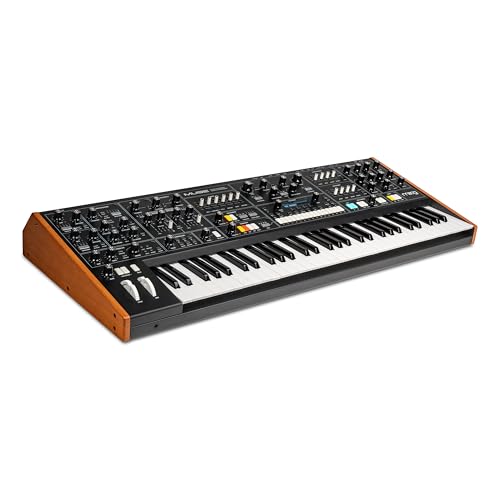
MOOG Muse 8-Voice Analog Synthesizer
Best for: Analog sound design and studio sequencing
- Number of Keys
- 61
- Sound Engine
- Analog
- Polyphony
- 8-voice
- Preset Count
- 256
- Sequencer
- 64-step
- Color
- Black
The MOOG Muse is an 8-voice analog polyphonic synthesizer with 61 keys. It features a 64-step sequencer and 256 patch memories. The instrument uses discrete oscillators and dual ladder filters for classic Moog tone. It suits producers and performers seeking a dedicated analog sound engine with deep modulation options and stereo effects.
- 8-voice analog polyphony with dual VCOs per voice
- 61 keys with intuitive knob-per-function layout
- 64-step sequencer with 16 banks of 16 patches
- 256 total patch memory including 224 presets
- Stereo Diffusion Delay processor for complex echoes
- 61-key keyboard limits range compared to full-size workstations
- 8-voice polyphony restricts complex chord voicings
- 32-pound weight makes it less portable than compact units
- You need dedicated analog polyphony for studio production
- You want a sequencer for generative musical ideas
- You prefer knob-per-function control for sound design
- You require full-size 88-key piano action
- You need more than 8 simultaneous voices
- You prioritize lightweight portability for gigging
Verdict: MOOG Muse 8-Voice Analog Synthesizer delivers classic analog tone in a compact 61-key form. It fits musicians who value hands-on analog sound design over digital versatility.

Moog Mother-32 Analog Synthesizer
Best for: Compact analog modular expansion
- Sound Engine
- Analog
- Connectivity
- MIDI In, CV Jack
- Sequencer
- 32-step
- Color
- Black
- Built-In Features
- Sequencer
- Dimensions
- 4.21 × 12.6 × 5.24 inches
The MOOG Mother-32 is a semi-modular analog synthesizer featuring a 32-step sequencer and a classic ladder filter. It connects via USB-MIDI and CV jack. This compact unit fits on a desk or into a Eurorack case. It suits musicians seeking raw analog tones and modular flexibility without complex cabling for basic use.
- Analog signal path with ladder filter
- Built-in 32-step sequencer
- Eurorack module compatibility
- USB-MIDI connectivity
- Monophonic sound engine limits polyphony
- Heavier build at 3.48 pounds
- Semi-modular design requires cables for full expansion
- You want authentic analog warmth
- You need a compact desktop synth
- You plan to expand into Eurorack
- You require polyphonic chords
- You need a full-sized keyboard
- You prefer digital sound engines
Verdict: MOOG Mother-32 Semi-Modular Synth delivers essential analog character in a small form factor. It fits producers who value modular flexibility and sequencer integration over polyphonic range.

Moog Grandmother 32-Key Analog Synthesizer
Best for: compact analog sound design and modular integration
- Number of Keys
- 32
- Key Action
- Velocity-sensitive
- Sound Engine
- Analog
- Polyphony
- Monophonic
- Connectivity
- 5-pin DIN, MIDI over USB
- Sequencer
- 256 Note
The MOOG Grandmother is a monophonic analog synthesizer with 32 velocity-sensitive keys. It features a built-in 256-note sequencer and arpeggiator. The unit includes 41 modular patch points for sound design. It also has a hardware spring reverb tank. This instrument suits users seeking hands-on analog control and Eurorack compatibility.
- Monophonic analog sound engine
- 32 velocity-sensitive keys
- 256-note built-in sequencer
- 41 modular patch points
- Hardware spring reverb tank
- Monophonic polyphony limits chord playing
- 32-key count is smaller than full-size pianos
- 16-pound weight adds portability effort
- You want hands-on analog sound design
- You need a compact semi-modular synth
- You plan to integrate with Eurorack gear
- You require polyphonic chord playback
- You need a full 88-key piano action
- You prefer digital multi-timbral workstations
Verdict: MOOG Grandmother Semi-Modular Synth offers deep analog sound shaping in a compact 32-key form factor. It fits producers who prioritize tactile control and modular connectivity over polyphonic range.

Korg Kronos 3 73-Key Weighted Workstation
Best for: Studio musicians needing nine sound engines
- Number of Keys
- 73
- Key Action
- RH3 Weighted Hammer Action
- Sound Engine
- 9 Sound Engines
- Color
- Black
- Dimensions
- 14.6 × 49 × 5.83 inches
- Weight
- 55.3 pounds
The Korg Kronos 3 is a 73-key music workstation featuring RH3 weighted hammer action keys and an 8-inch Color TouchView Display. It integrates nine sound engines and a 4-way joystick for performance control. This unit suits musicians needing a comprehensive studio tool with tactile feedback and extensive sound generation capabilities in a mid-sized format.
- 9 Sound Engines for diverse audio generation
- RH3 Weighted Hammer Action keybed
- 8-inch Color TouchView Display for navigation
- 4-way Joystick for real-time modulation
- 73 keys offer less range than 88-key models
- 55.3 pounds weight makes it difficult to transport
- 49 inches width requires significant desk space
- You need nine sound engines for complex production
- You prefer weighted keys for piano-style playing
- You want a dedicated workstation with a large display
- You require a full 88-key keyboard range
- You need a lightweight instrument for frequent travel
- You only need monophonic or polyphonic synth sounds
Verdict: Korg Kronos 3 73-Key Music Workstation fits producers who prioritize sound engine variety and tactile control over portability. It is ideal for studio-based composition where weight and size are secondary to functionality.

Behringer PRO-800 Analog Polyphonic Synth
Best for: Players seeking classic analog polyphony
- Sound Engine
- Analog
- Polyphony
- 8-voice
- Preset Count
- 400 program memories
- Color
- Black
- Built-In Features
- Sequencer, Arpeggiator
- Dimensions
- 22.5 × 16.7 × 8.43 inches
The Behringer PRO-800 is a classic 8-voice polyphonic synthesizer featuring a pure analog signal path. It includes two VCOs per voice for detuned sounds and a unison mode for 16-oscillator leads. With 400 program memories, a built-in arpeggiator, and a sequencer, it offers extensive sound shaping. This black unit weighs 3.63 pounds. It suits players seeking authentic analog warmth and classic polyphonic textures in a compact format.
- 8-voice polyphonic analog sound engine
- Two VCOs per voice for fat tones
- 400 program memories for preset storage
- Built-in arpeggiator and sequencer
- 8-voice polyphony limits chord complexity
- 3.63-pound weight adds bulk for travel
- You want authentic analog polyphonic tones
- You need a built-in arpeggiator and sequencer
- You prefer a compact 8-voice layout
- You require more than 8 voices
- You need a semi-modular Eurorack format
- You prefer digital or hybrid sound engines
Verdict: Behringer PRO-800 8-Voice Analog Synth delivers classic analog polyphony with two VCOs per voice. It fits players who want detuned leads and built-in sequencing in a portable package.

Korg Monologue 25-Key Analog Synthesizer
Best for: compact analog bass and lead lines
- Number of Keys
- 25
- Sound Engine
- Analog
- Polyphony
- Monophonic
- Sequencer
- 16-step
- Color
- Black
- Built-In Features
- Sequencer
The Korg monologue is a monophonic analog synthesizer with 25 keys. It includes a 16-step sequencer and a 2-pole voltage-controlled filter. The drive circuit adds bass and lead presence. Expanded LFO rates allow deeper modulation. This compact unit suits players who want real-time step edits and parameter lock motion sequencing in a small footprint.
- 25-key monophonic analog sound engine
- 16-step sequencer with real-time editing
- 2-pole VCF with drive circuit
- Expanded LFO for deeper modulation
- Parameter lock motion sequencing support
- Monophonic polyphony limits chord playing
- 25 keys restrict range compared to full-size boards
- 3.75-pound weight adds to transport bulk
- You need a portable analog synth for live performance
- You want to experiment with motion sequencing
- You prefer compact gear for limited desk space
- You require polyphonic chord playing
- You need a full 88-key piano range
- You want a semi-modular Eurorack format
Verdict: Korg Monologue 25-Key Analog Synth is a compact tool for bass and lead lines. It fits players who value portability and hands-on sequencing over polyphonic complexity.

Roland V-Stage 88 Stage Keyboard Bundle
Best for: Live performers needing extensive patch memory
- Sound Engine
- V-Piano, ZEN-Core
- Connectivity
- XLR, 1/4-inch, USB-C
- Form Factor
- Stage
- Color
- Black
- Dimensions
- 13.9 × 52.4 × 5.6 inches
- Weight
- 48.1 pounds
The Roland V-STAGE 88 is an 88-key stage keyboard built for live performance. It combines four sound engines, including V-Piano and ZEN-Core, into one unit. You get 512 scenes for organizing patches and balanced XLR outputs for direct mixing. The bundle includes a stand and bench. Its 48.1-pound weight and 52.4-inch width make it a substantial addition to your setup.
- Four independent sound engines including V-Piano and ZEN-Core
- 512 scenes and 128 scene chains for setlist management
- Balanced XLR and 1/4-inch main stereo outputs
- Includes adjustable stand, bench, and sustain pedal in bundle
- Weighs 48.1 pounds, making transport heavier than compact alternatives
- Measures 52.4 inches wide, requiring significant stage space
- Limited to two size options: 88-key and 76-key models
- You need extensive scene memory for complex live sets
- You require balanced XLR outputs for direct PA connection
- You want a bundled package with stand and bench included
- You prioritize portability and minimal weight on stage
- You need a compact keyboard for small venues
- You prefer a standalone synth without bundled accessories
Verdict: Roland V-STAGE 88 88-Key Stage Keyboard suits professionals who need robust scene management and direct XLR connectivity. Its substantial size and weight demand a permanent or semi-permanent stage setup.
Specifications side by side
Spec MOOG Muse 8-Voice Analog Synthesizer Moog Mother-32 Analog Synthesizer Moog Grandmother 32-Key Analog Synthesizer Korg Kronos 3 73-Key Weighted Workstation Behringer PRO-800 Analog Polyphonic Synth Korg Monologue 25-Key Analog Synthesizer Roland V-Stage 88 Stage Keyboard Bundle
- Number of Keys
- 61
- Key Action
- –
- Sound Engine
- Analog
- Polyphony
- 8-voice
- Preset Count
- 256
- Connectivity
- –
- Sequencer
- 64-step
- Form Factor
- –
- Color
- Black
- Built-In Features
- Sequencer
- Features
- –
- Dimensions
- 17 × 39 × 4.5 inches
- Weight
- 32 pounds
- Model
- MUSE
- Size
- –
Copied from the Amazon listing. These figures were not measured here.
Frequently asked questions
What is the best budget alternative to the Moog Muse?
The Moog Mother-32 is the top budget choice. It costs less and weighs only 3.48 pounds. This makes it much lighter than the 32-pound Muse. It includes a built-in sequencer and USB-MIDI connectivity. You get essential analog character in a compact form factor.
Does the Korg Monologue replace the Muse for live playing?
The Korg Monologue is a compact option for bass and lead lines. It weighs just 3.75 pounds and measures 14.8 inches wide. It includes a built-in sequencer for hands-on control. It lacks polyphonic range, so it fits players who prioritize portability over complex chords.
Which synth offers more polyphony than the 8 voices?
The Behringer PRO-800 provides 8 voices of analog polyphony like the Muse. It features two VCOs per voice for detuned leads. It weighs 3.63 pounds and includes a sequencer and arpeggiator. It fits players seeking classic analog sound in a portable package.
Can I use the Grandmother for modular expansion?
Yes, the Moog Grandmother is a semi-modular synth. It offers 32 keys and deep analog sound shaping. It weighs 16 pounds and includes a sequencer and arpeggiator. It fits producers who prioritize tactile control and modular connectivity over wide polyphonic range.
Is the Korg Kronos 3 a good studio alternative?
The Korg Kronos 3 is a premium workstation. It features nine sound engines and 73 weighted keys. It weighs 55.3 pounds and measures 49 inches wide. It fits producers who prioritize sound engine variety and tactile control over portability in a studio setting.
Which option is best for stage performances?
The Roland V-Stage 88 is designed for stage use. It has 88 keys and robust scene management. It weighs 48.1 pounds and measures 52.4 inches wide. It suits professionals needing direct XLR connectivity. Its size demands a permanent or semi-permanent stage setup.


