
As Amazon Associates, we earn from qualifying purchases. This means we may receive a small commission at no extra cost to you if you click through and make a purchase.
As an Amazon Associate we earn from qualifying purchases. Links on this page are affiliate links.
Finding suitable korg 61 key arranger keyboard alternatives depends on how you balance accompaniment tools against physical instrument specs. The original Korg EK-50 arranger workstation excels for solo performers who value built-in production features. It provides 702 sounds, 280 backing styles, a split keyboard function, and an onboard 12-track linear sequencer for one-touch recording. Its hardware also includes 2 x 10W stereo speakers, an input jack, illuminated panel buttons, and a portable 16.5-pound black chassis.
You might still look for alternatives if your playing requires a different size, form factor, or key action. For example, practicing pianists often prefer 88 weighted keys from brands like Yamaha or Roland rather than 61 keys. Alternatively, you may prefer an upright console from Donner, or touchscreen navigation from another arranger model. These 6 selected products earned their place because their published specs overlap directly with the original, matching its portable design, sound variety, or integrated speakers for 2026.
Comparing the Top EK-50 Alternatives
Korg 61-Key Arranger Keyboard with Color TouchView
The Korg PA300 matches the 61-key count of the EK-50 while upgrading performance tools. You get 310 accompaniment styles instead of 280, along with a programmable songbook database. Navigation shifts from the EK-50 LED-backlit buttons to a central Color TouchView display. However, the PA300 is significantly bulkier. It measures 45.9 by 21.3 by 10.6 inches and weighs 26 pounds, compared to the 16.5-pound EK-50. You trade lightweight portability for deeper backing control. Pick the PA300 if you need more accompaniment styles and touchscreen navigation for live stage arrangements.
Yamaha 88-Key Weighted Portable Digital Piano
The Yamaha P45B moves from arranger workstation features to traditional piano hardware. You gain an 88-key weighted layout instead of the 61 keys on the EK-50. It includes USB connectivity and built-in speakers. In exchange, you lose the 702 onboard sounds, 280 backing styles, and the linear 12-track recorder found on the Korg. At 52.3 inches long and 25.4 pounds, the Yamaha takes up more room and adds nearly nine pounds over the 16.5-pound EK-50. Choose the P45B if you prioritize authentic key resistance and full piano range over automated accompaniment rhythms.
Yamaha P71 88-Key Weighted Digital Piano
The Yamaha P71 provides a full 88-key layout with weighted key action, differing directly from the 61-key Korg EK-50. You gain weighted key response for dedicated piano practice. However, you leave behind the creative features of the EK-50, such as its 702 voices, 280 backing styles, split keyboard function, and 12-track recorder. The P71 measures 52.3 inches long and weighs 25 pounds, making it heavier and longer than the 39.1-inch, 16.5-pound Korg. You should choose the P71 if you need weighted keys for practice rather than an arranger workstation with backing tracks.
Donner 88-Key Upright Digital Piano
The Donner DDP-400 changes the format completely by offering an 88-key weighted hammer action console instead of a portable 61-key workstation. It features built-in accompaniment and full hammer resistance designed for an upright home setup. What you surrender is portability. The DDP-400 weighs 108 pounds, whereas the EK-50 weighs just 16.5 pounds. You also lose the compact 39.1-inch footprint, illuminated control buttons, and 12-track sequencing workflow found on the Korg. Pick the Donner DDP-400 if you want an 88-key upright instrument with weighted hammer feel for a permanent room setup instead of a portable gigging arranger keyboard.
Roland FP-10 88-Key Digital Piano
The Roland FP-10 targets beginning players who require an 88-key layout rather than a 61-key arranger workstation. It delivers a full keybed designed for foundational piano practice. In choosing the FP-10, you forego the deep workstation features of the Korg EK-50, including its 702 voices, 280 accompaniment styles, LED-lit navigation buttons, and 12-track linear recording engine. The FP-10 weighs 27 pounds, making it over 10 pounds heavier than the 16.5-pound EK-50. Select the Roland FP-10 if you are a beginner looking to build traditional piano playing habits on 88 keys rather than producing multi-track arrangements with automated backing bands.
Yamaha 88-Key Weighted Digital Piano
The Yamaha P-45B provides an 88-key weighted keybed for players seeking acoustic-style resistance instead of the EK-50 61-key layout. This model prioritizes full key travel and essential grand piano voices over complex electronic menus. By choosing this model, you give up the 702 sounds, 280 arranger styles, and linear 12-track recorder built into the Korg. At 48.5 pounds, this Yamaha package is significantly heavier than the 16.5-pound EK-50, and its 54-inch width takes up considerably more surface space. You should choose this Yamaha P-45B configuration if you want a substantial 88-key weighted practice instrument rather than a lightweight arranger keyboard.
| # | Product | Best for | Price |
|---|---|---|---|
| 1 | Korg 61-Key Arranger Keyboard Best overall | solo performers needing backing styles and sequencing | |
| 2 | Korg 61-Key Arranger Keyboard with Color TouchView Best premium | live performers needing extensive accompaniment styles | |
| 3 | Yamaha 88-Key Weighted Portable Digital Piano Best budget | pianists wanting weighted keys on a budget | |
| 4 | Yamaha P71 88-Key Weighted Digital Piano Also great | pianists wanting full-size weighted keys | |
| 5 | Donner 88-Key Upright Digital Piano Best upright | home practice in a permanent upright format | |
| 6 | Roland FP-10 88-Key Digital Piano Best beginners | Beginners wanting authentic 88-key piano touch | |
| 7 | Yamaha 88-Key Weighted Digital Piano Also great | pianists wanting full-size weighted acoustic feel |

Korg 61-Key Arranger Keyboard
Best for: solo performers needing backing styles and sequencing
- Number of Keys
- 61 keys
- Total Sounds
- 702 sounds
- Form Factor
- Workstation
- Speaker System
- 2 x 10W
- Connectivity
- Input jack
- Color
- Black
This 61-key arranger workstation gives you 702 built-in sounds, 280 accompaniment styles, and an onboard keyboard split function. Built-in 2 x 10W stereo speakers project your performance, while the integrated 12-track linear sequencer lets you record arrangements using one-touch controls. It suits you if you want an all-in-one platform for rapid composition and live solo accompaniment without external gear.
- 702 onboard sounds and 280 accompaniment styles
- Built-in 12-track sequencer with one-touch recording
- 2 x 10W stereo speaker system with an external audio input jack
- Illuminated LED buttons with a high-contrast central display
- Provides 61 keys instead of a full 88-key piano layout
- Display shows text characters without touchscreen interaction
- You need a large library of 702 sounds and 280 auto-accompaniment styles.
- You want to record multi-part arrangements directly to an onboard 12-track sequencer.
- You prefer dedicated LED-backlit buttons for visual feedback during live playback.
- You require a full 88-key weighted keybed for traditional piano repertoire.
- You want a color touch-panel interface to navigate sounds and settings.
Verdict: KORG 61-Key Arranger Workstation delivers extensive sound variety and multi-track sequencing for solo performers and songwriters who prioritize built-in accompaniment styles over a full 88-key weighted action.

Korg 61-Key Arranger Keyboard with Color TouchView
Best for: live performers needing extensive accompaniment styles
- Number of Keys
- 61 keys
- Sound Engine
- Enhanced RX
- Color
- Black
- Dimensions
- 45.9 × 21.3 × 10.6 inches
- Weight
- 26 pounds
This 61-key arranger keyboard features an Enhanced RX sound engine and a Color Touchview display. You get over 310 factory styles, each with dedicated intro, ending, variation, and fill-in settings, alongside a programmable songbook database for instant recall. At 26 pounds and 45.9 inches long, it suits performers seeking deep accompaniment options on a compact synth layout.
- Enhanced RX sound engine with factory PCM memory
- Over 310 factory styles featuring intro, ending, variation, and break controls
- Programmable songbook database for instant preset retrieval
- Color Touchview display built directly into the console
- 61-key range offers fewer octaves than 88-key alternatives
- Cabinet footprint measures 21.3 inches deep and weighs 26 pounds
- You want over 310 interactive accompaniment styles with multiple variations and fills.
- You need a programmable songbook database to quickly pull up performance setups.
- You prefer a 61-key arranger with an integrated Color Touchview display.
- You require a full 88-key layout for traditional piano repertoire.
- You want an ultra-slim keyboard under 20 inches deep for tight desk setups.
Verdict: Korg 61-Key Arranger with Color Touchview Display gives solo performers 310 accompaniment styles and a programmable songbook database. It is built for musicians who prioritize backing orchestration and touchscreen navigation over full-size weighted keys.

Yamaha 88-Key Weighted Portable Digital Piano
Best for: pianists wanting weighted keys on a budget
- Number of Keys
- 88 keys
- Key Action
- Weighted
- Total Sounds
- 10 voices
- Form Factor
- Portable
- Speaker System
- Built-in speakers
- Pedal Setup
- Sustain foot switch
This portable digital piano gives you a full 88-key weighted keyboard instead of the 61 unweighted keys typical of arranger keyboards. It features 10 built-in voices, integrated stereo speakers, and USB connectivity. Weighing 25.4 pounds, it suits you if you want an acoustic piano feel and simple one-button controls rather than hundreds of auto-accompaniment tracks.
- 88 weighted touch-sensitive keys
- Includes sustain foot switch and music rest
- Built-in stereo speaker system
- USB connectivity
- Offers only 10 instrument voices
- No built-in display screen
- Footprint spans 52.3 inches long
- You prioritize full 88-key weighted hammer action over arranger styles.
- You need a portable 25.4-pound instrument with built-in speakers.
- You prefer streamlined one-button sound selection.
- You need hundreds of backing accompaniment tracks and rhythm styles.
- You want a compact 61-key keyboard for limited desk space.
Verdict: Yamaha 88-Key Weighted Portable Digital Piano suits beginner and practicing musicians who need authentic weighted key resistance without the clutter of synthesizer menus.
Yamaha P71 88-Key Weighted Digital Piano
Best for: pianists wanting full-size weighted keys
- Number of Keys
- 88 keys
- Key Action
- Weighted
- Total Sounds
- 10 voices
- Pedal Setup
- Sustain pedal
- Color
- Black
- Dimensions
- 52.3 × 11.5 × 6 inches
If you want full acoustic piano feel instead of a compact 61-key arranger, this digital piano gives you an 88-key weighted layout. You get 10 voices, touch-sensitive keys, and a Dual Mode to layer two sounds together. It includes a sustain pedal and basic one-button controls. It fits players prioritizing standard piano action and full keyboard range.
- 88 touch-sensitive keys with weighted action
- Dual Mode layers two voices simultaneously
- Comes with dedicated sustain pedal and power supply
- Streamlined one-button control layout
- Limited sound selection with only 10 voices
- Bulky 52.3-inch length and 25-pound weight compared to 61-key boards
- You need a full 88-key range with weighted resistance.
- You prefer simple one-button navigation instead of deep menus.
- You want basic voice layering for piano and strings.
- You need hundreds of accompaniment sounds and rhythm tracks.
- You have limited space and require a lightweight 61-key footprint.
Verdict: Yamaha 88-Key Weighted Digital Piano provides full-length weighted action for musicians stepping away from synthesizer-style arranger keyboards. It suits practice-oriented players who require acoustic-style key response and included pedal support over onboard backing bands.

Donner 88-Key Upright Digital Piano
Best for: home practice in a permanent upright format
- Number of Keys
- 88 keys
- Key Action
- Progressive weighted hammer action
- Sound Engine
- French Dream
- Total Sounds
- 138 tones
- Form Factor
- Upright
- Speaker System
- Dual 15W amplifiers
This upright digital piano gives you a full-size 88-key progressive hammer action keyboard set inside a wooden cabinet. It pairs dual 15W amplifiers with a French Dream sound engine, 128-note polyphony, and 138 built-in tones. You get 100 rhythm styles alongside fixed metal pedals, making it suitable if you want dedicated home furniture instead of a portable arranger.
- 88 progressive hammer-action keys with double-contact design
- Upright wooden cabinet with integrated metal pedals
- Dual 15W onboard amplifiers and French Dream sound engine
- 138 tones, 100 rhythm styles, and 128-note polyphony
- Heavy 108-pound cabinet limits room-to-room mobility
- Fewer sound options with 138 tones compared to 700 on dedicated arranger keyboards
- You want an 88-key weighted upright piano with a fixed wooden cabinet.
- You need built-in accompaniment features such as 100 rhythm styles and intro/outro controls.
- You prefer integrated metal pedals over a loose foot switch.
- You need a lightweight, portable keyboard for gigs or rehearsals.
- You want hundreds of arranger voices beyond the 138 included tones.
Verdict: Donner 88-Key Upright Digital Piano provides an 88-key weighted hammer action and built-in accompaniment inside a permanent wooden console for home practice.

Roland FP-10 88-Key Digital Piano
Best for: Beginners wanting authentic 88-key piano touch
- Number of Keys
- 88-note
- Sound Engine
- SuperNATURAL
- Speaker System
- Built-in speakers
- Pedal Setup
- DP-2 Foot Switch
- Connectivity
- Headphones, USB MIDI
- Skill Level
- Beginners
This 88-key digital piano trades arranger accompaniment styles for a full-size acoustic feel keyboard and Roland's SuperNATURAL sound engine. You get built-in speakers, a DP-2 foot switch, and a headphone jack for quiet practice. Twin Piano mode splits the keyboard into identical octave ranges for side-by-side lessons. It suits you if you prioritize piano touch over arranger features.
- SuperNATURAL sound engine delivers acoustic piano tones
- 88-note keyboard with authentic acoustic feel and ivory texture
- Twin Piano mode allows side-by-side student and teacher practice
- Roland Piano App connects to smartphones for metronome and sound selection
- Includes only a basic DP-2 foot switch pedal
- Weighs 27 pounds, making transport heavier than 61-key alternatives
- You want full 88-key acoustic piano key action for beginner practice.
- You take lessons that require two people playing in the same octave range.
- You plan to control instrument settings using a smartphone app.
- You need a lightweight 61-key board designed for quick stage setup.
- You want built-in auto-accompaniment styles and backing tracks.
Verdict: Roland FP 88-Key Compact Digital Piano fits beginning students who need realistic weighted keys and practice tools rather than arranger workstation accompaniment.
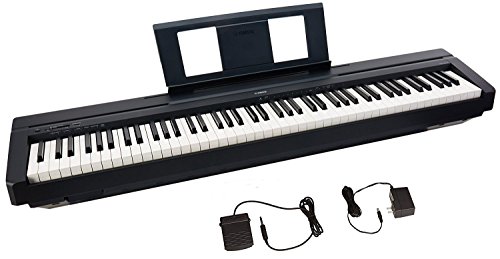
Yamaha 88-Key Weighted Digital Piano
Best for: pianists wanting full-size weighted acoustic feel
- Number of Keys
- 88 keys
- Key Action
- Fully weighted
- Total Sounds
- 10 voices
- Pedal Setup
- Sustain pedal
- Color
- Black
- Dimensions
- 12 × 54 × 6 inches
This digital piano provides a full-size alternative to 61-key arranger keyboards. You get 88 fully weighted keys that simulate acoustic piano resistance, along with 10 built-in voices. Dual Mode lets you layer two sounds simultaneously. It suits you if you prioritize traditional acoustic key action and a full 88-key range over hundreds of auto-accompaniment styles.
- 88 fully weighted keys
- Includes sustain pedal, music rest, and power adapter
- Dual Mode layers two voices together
- 10 built-in instrument voices
- Limited to 10 voices without arranger rhythms or backing tracks
- No built-in display screen
- You want 88 fully weighted keys rather than 61 unweighted keys.
- You need an included sustain pedal and music rest in the box.
- You want to layer two sounds together using Dual Mode.
- You want hundreds of arranger sounds, rhythms, and automatic accompaniments.
- You need a compact 61-key layout for smaller spaces.
Verdict: Yamaha 88-Key Weighted Digital Piano suits players seeking a standard full-size keyboard with hammer resistance instead of automated accompaniment tools. It gives you essential grand piano voices and full key travel without complex arranger menus.
Specifications side by side
Spec Korg 61-Key Arranger Keyboard Korg 61-Key Arranger Keyboard with Color TouchView Yamaha 88-Key Weighted Portable Digital Piano Yamaha P71 88-Key Weighted Digital Piano Donner 88-Key Upright Digital Piano Roland FP-10 88-Key Digital Piano Yamaha 88-Key Weighted Digital Piano
- Number of Keys
- 61 keys
- Key Action
- –
- Sound Engine
- –
- Total Sounds
- 702 sounds
- Form Factor
- Workstation
- Speaker System
- 2 x 10W
- Pedal Setup
- –
- Connectivity
- Input jack
- Skill Level
- –
- Color
- Black
- Built-In Features
- –
- Dimensions
- 39.1 × 15.4 × 5.2 inches
- Weight
- 16.5 pounds
- Size
- EK-50
- Model
- EK50
Copied from the Amazon listing. These figures were not measured here.
Frequently asked questions
What is the difference between an arranger keyboard and a digital piano?
You choose an arranger for accompaniment tools, whereas 88-key digital pianos give you key resistance. Models like the Yamaha P45B and Yamaha P71 provide full-size weighted keys for traditional piano practice. An arranger like the Korg EK-50 offers 61 keys focused on backing tracks and sequencing instead.
Which 88-key alternative is the lightest to transport?
The Yamaha P71 is the lightest 88-key alternative at 25 pounds. The Yamaha P45B is close behind at 25.4 pounds. If you need portable dimensions, both Yamaha units measure 52.3 inches in length and 11.5 inches in width, making them easy to move between practice locations.
Can you connect a digital piano alternative to a computer?
Yes, models equipped with USB support connect directly to your computer. The Yamaha P45B includes USB connectivity to link the instrument with external software. This connection allows you to send MIDI data between the 88 weighted keys and recording applications on your desktop system.
Which keyboard alternative is designed for a permanent home setup?
The Donner DDP-400 is built specifically for a stationary home layout. It features an upright cabinet format and weighs 108 pounds, providing stable placement for dedicated practice spaces. You get full 88-key weighted hammer action along with built-in accompaniment features inside a permanent wooden console.
Which alternative model is best suited for beginners?
The Roland FP-10 is designated specifically for beginners. It provides an 88-key layout designed to build proper finger technique without distracting accompaniment menus. At 27 pounds, it remains compact enough for home practice while giving you acoustic-style piano touch rather than unweighted keys.
How does the size of an 88-key piano compare to a 61-key arranger?
You need noticeably more horizontal room for an 88-key piano than for a 61-key arranger. The Korg EK-50 measures 39.1 inches in length, fitting tighter desk spaces. Full-size alternatives like the Yamaha P45B and Yamaha P71 require 52.3 inches of length to accommodate all 88 weighted keys.


