
As Amazon Associates, we earn from qualifying purchases. This means we may receive a small commission at no extra cost to you if you click through and make a purchase.
As an Amazon Associate we earn from qualifying purchases. Links on this page are affiliate links.
Finding the right instrument requires clear technical data, and this keyboard buying guide helps you evaluate hardware without marketing hype. After reading, you will be able to decide on the best layout, key action, and connectivity options for your music workspace. The guide walks you through essential hardware choices, including key count, weighted actions versus synth touch, standalone sound generation versus dedicated MIDI control, and chassis dimensions for travel.
The 8 featured models were chosen strictly from their published specifications. By comparing physical dimensions, total weight, connector types, and onboard tools like hardware sequencers or built-in speakers, you can identify the exact gear configuration you need. Every specification translates directly to how each unit performs on your desk, on stage, or in your production studio.
Key Specs to Evaluate Before Buying
Number of Keys
The key count determines the pitch range available under your hands without transposing octaves. Standard sizes range from compact 25-key boards up to 76-key layouts. If you compose basslines or simple leads, a 25-key or 37-key model saves space on a desk. Studio producers and stage performers usually prefer 61 keys because that layout covers most two-handed chord arrangements and lead lines. If you play traditional piano repertoire or split the keyboard into separate sound zones, a 76-key model gives you the necessary register width. For example, the Yamaha Piaggero 76-Key Digital Piano provides extended reach for multi-octave parts. The trade-off for higher key counts is a larger footprint that requires more storage space.
Look for
- Full 61-key or 76-key widths for two-handed piano playing and split performance zones
- Compact 25-key or 37-key sizes to fit small production desks and travel bags
Key Action and Touch Response
Key action describes the mechanical resistance and tactile feedback under your fingers. Options range from spring-loaded synth keys to weighted mechanisms and capacitive touch plates. Synth action responds quickly for fast leads and rapid percussion triggers. Weighted keys provide mechanical resistance that helps you control dynamics when playing acoustic piano parts. Specialized sensors like aftertouch capture pressure changes after a key reaches the bottom of its travel, letting you modulate pitch or filter settings. The Novation FLkey 61 MIDI Keyboard Controller features weighted keys to provide controlled velocity input for software instruments. Choosing weighted keys increases playing control, but the added mechanical components raise the overall instrument weight compared to basic spring designs.
Look for
- Weighted key actions for nuanced dynamic control across expressive piano passages
- Aftertouch support to modulate sound parameters using continuous key pressure
Form Factor and Portability
Physical dimensions and total weight determine whether an instrument remains on a studio stand or travels to rehearsals. Tabletop units and compact synths measure under 15 inches across and weigh under five pounds, making them easy to pack into backpacks. Stage keyboards and extended digital pianos often exceed 35 inches in width and weigh over 10 pounds, requiring dedicated gig bags and stable double-braced stands. For example, the Arturia MicroFreak 25-Key Synth weighs 2.3 pounds with a 12.2-inch chassis, fitting tight workspaces easily. While compact form factors excel at mobility, they offer fewer physical octave keys and reduce the space available for large hardware sliders and full-size jacks.
Look for
- Total weight under six pounds for frequent transport and mobile music production
- Chassis width matched to your desk footprint or keyboard stand capacity
Connectivity and Output Options
The ports on your keyboard dictate how it communicates with computers, mobile devices, and audio equipment. USB-MIDI ports transmit note and automation data directly to digital audio workstations without requiring separate audio interfaces. Modern USB-C connections streamline computer hookups, while standard USB-MIDI handles standard computer cables. Wireless protocols like Bluetooth allow cable-free pairing with tablets and phones for practice software and song streaming. For example, the Roland GO:KEYS 3 61-Key Music Creation Keyboard includes both USB-MIDI and Bluetooth connectivity for flexible routing. Choosing wireless or purely digital ports reduces cable clutter, but relying strictly on digital outputs means you cannot route analog audio signals directly into traditional mixing consoles without external converters.
Look for
- USB-MIDI or USB-C ports for direct integration with recording software and computers
- Bluetooth capability for wireless connection to mobile apps and audio devices
Sound Engines and Integrated Speakers
Hardware keyboards divide into standalone sound generators and pure MIDI controllers. Standalone instruments contain onboard sound engines, meaning you can power them on and play without connecting to an external computer or tablet. Units equipped with built-in speakers provide immediate acoustic monitoring for rehearsals, casual practice, or quick songwriting sessions. For instance, the Yamaha CK Series 61-Key Stage Keyboard features built-in speakers alongside its stage performance sound options. Pure MIDI controllers lack sound engines and internal speakers, requiring an active computer connection to generate audio. While instruments with internal speakers and sound libraries offer immediate playability anywhere, they add physical bulk and increase overall unit weight compared to minimalist keyboard controllers.
Look for
- Onboard sound engines for standalone play without connecting to a computer
- Built-in speakers for immediate acoustic output during practice sessions
Sequencing and Hardware Performance Controls
Hardware sequencing and onboard modulation tools let you program repeating musical phrases and sculpt sound textures directly from the front panel. Step sequencers allow you to enter note sequences step by step, which frees your hands to adjust filters, envelopes, and oscillator settings during a performance. This workflow suits electronic musicians who build evolving patterns rather than performing conventional multi-part keyboard arrangements. For example, the Moog Mother-32 Analog Synthesizer includes an integrated sequencer designed for modular analog production and step sequencing. The trade-off with hardware sequencers is interface density. Devices focused on modular sequencing feature smaller keypads or fewer octaves, making them less suitable for traditional two-handed keyboard repertoire.
Look for
- Integrated hardware sequencers for automated pattern creation and step editing
- Dedicated modulation controls like pitch wheels, aftertouch, or CV patching
Types of Digital Pianos and Keyboards
MIDI Keyboard Controllers
MIDI keyboard controllers produce no sound on their own. Instead, they send digital control data over USB or MIDI connections to software instruments on your computer. These units feature keys alongside hardware controls like faders, knobs, and pads for managing virtual instruments. They suit music producers and home studio composers who work inside a digital audio workstation. An example is the Novation FLkey 61. The primary trade-off is the absolute dependence on external hardware; without a connected computer, tablet, or sound module, a MIDI controller cannot make audible sound.
Portable Digital Pianos
Portable digital pianos focus on acoustic piano recreation within a lightweight, transportable frame. These instruments offer extended key ranges, such as 76 or 88 keys, and run on wall power or batteries. They suit traveling musicians, students, and players who require an acoustic-style layout without taking up permanent living space. The Yamaha Piaggero represents this category. The major trade-off lies in key action and sound selection. To keep the weight low, many portable digital pianos use lighter spring-loaded keys rather than heavy graded hammer actions, and they typically include fewer sound options than dedicated synthesizers.
Hardware Synthesizers
Hardware synthesizers generate sounds using internal analog circuits or digital modeling engines. They provide dedicated parameters such as filters, oscillators, envelopes, and built-in step sequencers for shaping original tones. This design suits sound designers and electronic music producers seeking standalone sound generation without a computer screen. Models like the Yamaha Reface CS and Moog Mother-32 belong in this group. The main trade-off is playable range and polyphony. Many hardware synths feature compact 25-key or 37-key layouts or desktop modules without full piano action, making them unsuitable for two-handed classical or standard piano repertoire.
Stage Keyboards
Stage keyboards emphasize real-time sound switching and direct control for live performance. They come equipped with extensive internal preset libraries, including organs, acoustic pianos, and lead synths, alongside multi-zone splits and onboard speakers. This category suits gigging musicians and rehearsal performers who need quick access to diverse sounds on stage without navigating deep digital menus. The Yamaha CK Series 61-Key is an example. The key trade-off is complexity and physical size; stage units offer extensive controls that may overwhelm casual beginners, and their robust construction makes them bulkier than streamlined desktop controllers.
Common Keyboard Specification Mistakes to Avoid
Ignoring maximum polyphony ratings for sustained play
Low polyphony limits note capacity. Playing dense chords with sustain pedals or layered voices cuts off earlier sustained notes prematurely. Check the maximum polyphony spec on the hardware. Aim for at least 64 or 128 notes of polyphony to prevent note stealing during complex passages.
Overlooking dedicated line outputs for external sound systems
Relying solely on a 3.5mm headphone jack creates noise and low signal levels with external speakers. When connecting to an audio interface or PA system, check for dedicated 1/4-inch line outputs. Separate left and right line jacks preserve clean stereo imaging and standard professional signal strength.
Confusing standard switch jacks with continuous pedal inputs
Standard switch jacks only toggle sustain binary states on or off. They cannot register partial pedal positions. If your repertoire requires realistic acoustic piano damping, verify that the specifications list continuous or half-damper pedal support. This allows the instrument to read varying physical pedal depths.
Neglecting power supply requirements and bundled adapter specifications
Certain hardware units run exclusively on USB bus power or require separate batteries. Always check the electrical specifications in the product documentation. If a model requires a proprietary DC adapter that is not bundled, you must source a compatible power supply before using the keyboard.
| # | Product | Best for | Price |
|---|---|---|---|
| 1 | Novation FLkey 61 MIDI Keyboard Controller | FL Studio producers wanting tactile hardware mixing | |
| 2 | Roland GO:KEYS 3 61-Key Music Creation Keyboard | standalone songwriting with expansive sound libraries | |
| 3 | Moog Mother-32 Analog Synthesizer | modular Eurorack patching and analog step sequencing | |
| 4 | Roland JUPITER Boutique Synthesizer | portable desktop sound design and sequencing | |
| 5 | Yamaha Reface CS 37-Key Synthesizer | portable sound design and mobile synthesizer practice | |
| 6 | Yamaha Piaggero 76-Key Digital Piano | mobile practice and battery-powered playing | |
| 7 | Yamaha CK Series 61-Key Stage Keyboard | gigging players needing portable three-zone splits | |
| 8 | Arturia MicroFreak 25-Key Synth | modular routing and experimental desktop sound design |

Novation FLkey 61 MIDI Keyboard Controller
Best for: FL Studio producers wanting tactile hardware mixing
- Number of Keys
- 61
- Key Action
- Semi-weighted
- Connectivity
- USB-C, 5-Pin MIDI Out
- Dimensions
- 10.4 × 35.2 × 3.66 inches
- Weight
- 10.6 pounds
The Novation FLkey 61 is a dedicated USB-C MIDI controller designed for FL Studio workflows. You get 61 semi-weighted keys, 16 velocity-sensitive pads, nine faders, and eight knobs. It includes 5-pin MIDI output alongside Scale and Chord modes. This layout suits FL Studio producers who need direct hardware control over sequencing, mixing, and instrument playback in one 10.6-pound unit.
- 61 semi-weighted keys with pitch and modulation wheels
- 16 velocity-sensitive pads for step sequencing and finger drumming
- Nine physical faders and eight knobs for mixer control
- USB-C and 5-pin MIDI Out connections
- Requires a computer or sound module; contains no onboard audio engine or speakers
- Semi-weighted keybed lacks the hammer weight and 88-key range of acoustic pianos
- You produce music primarily inside FL Studio
- You need physical faders and encoders to control your software mixer
- You want built-in Scale and Chord modes for entering notes
- You need a standalone keyboard that plays sound without a computer
- You require an 88-key weighted hammer action for classical practice
Verdict: Novation FLkey 61 Semi-Weighted MIDI Controller delivers deep hardware integration for FL Studio users who prioritize dedicated mixer faders, sequencing pads, and 61 expressive keys over standalone operation.

Roland GO:KEYS 3 61-Key Music Creation Keyboard
Best for: standalone songwriting with expansive sound libraries
- Number of Keys
- 61
- Key Action
- Touch-sensitive
- Sound Engine
- ZEN-Core
- Preset Count
- over 1000
- Built-In Speakers
- Stereo
- Connectivity
- Bluetooth Audio/MIDI
The Roland GO:KEYS 3 is a 61-key portable keyboard with touch-sensitive keys and built-in stereo speakers. It runs on the ZEN-Core sound engine, giving you over 1,000 sounds alongside 200 auto-accompaniment styles and an onboard chord sequencer. It connects through Bluetooth Audio/MIDI and USB-MIDI, suiting players who produce songs without a computer setup.
- ZEN-Core sound engine with over 1000 presets
- Chord sequencer with over 300 presets and user editing
- Bluetooth Audio/MIDI and USB-MIDI connectivity
- Built-in stereo sound system
- 61-note range limits two-handed classical piano arrangements
- Touch-sensitive key action lacks weighted hammer resistance
- Carries a 15.5-pound weight without external accessories
- You need over 1000 onboard sounds powered by Roland ZEN-Core.
- You want built-in chord sequencing and 200 accompaniment styles.
- You use Bluetooth for wireless audio playback and MIDI transmission.
- You require a full 88-note keyboard for traditional piano repertoire.
- You need weighted hammer action keys for acoustic piano practice.
Verdict: Roland GO:KEYS 3 61-Key Music Creation Keyboard gives songwriters an extensive 1000-sound ZEN-Core library and chord sequencing in a self-contained 61-key format.

Moog Mother-32 Analog Synthesizer
Best for: modular Eurorack patching and analog step sequencing
- Sound Engine
- Analog
- Connectivity
- MIDI In, CV Jack
- Sequencer
- 32-step
- Color
- Black
- Built-In Features
- Sequencer
- Dimensions
- 4.21 × 12.6 × 5.24 inches
The MOOG Mother-32 is an analog synthesizer designed for tabletop use or installation as a 60HP Eurorack module. You get a raw analog signal path featuring a voltage-controlled oscillator, ladder filter, and a built-in 32-step sequencer storing up to 64 sequences. It fits you if you want modular patching flexibility and analog sequencing in a compact desktop unit.
- All-analog signal path with voltage-controlled oscillator and ladder filter
- Integrated 32-step sequencer holding up to 64 memory sequences
- Converts between tabletop housing and a standard 60HP Eurorack case
- Semi-modular design works without patch cables or connects via CV jacks
- Lacks a traditional keyboard layout for standard piano playing
- Single voltage-controlled oscillator limits voice creation to monophonic parts
- Hardware connectivity provides MIDI In without a dedicated 5-pin MIDI Out
- You want an analog desktop module with an onboard 32-step sequencer.
- You plan to mount a 60HP synthesizer voice directly into a Eurorack case.
- You want semi-modular sound design using CV patch points without mandatory patching.
- You need full-sized piano keys for traditional two-handed performance.
- You require polyphonic chords rather than single-oscillator monophonic lines.
Verdict: MOOG Mother-32 Semi-Modular Synthesizer suits electronic musicians who want hardware step-sequencing and modular CV patching in a standalone tabletop format. It gives modular synthesists a self-contained 60HP voice without requiring separate utility modules.

Roland JUPITER Boutique Synthesizer
Best for: portable desktop sound design and sequencing
- Polyphony
- 8 voices, expandable to 32 voices
- Connectivity
- USB-C audio/MIDI, MIDI I/O, clock input
- Sequencer
- Two-part polyphonic sequencer
- Form Factor
- Portable
- Built-In Features
- Built-In Speakers
- Dimensions
- 12.1 × 8.25 × 2.13 inches
The Roland JUPITER Boutique Synthesizer is a portable sound module paired with an included K-25m keyboard dock. It provides eight voices of polyphony that you can expand up to 32 voices, alongside a two-part sequencer with motion recording. With built-in speakers and USB-C audio and MIDI connectivity, it suits producers needing compact synthesis on a desktop.
- Includes K-25m keyboard dock and built-in speakers
- Polyphony expandable from 8 voices up to 32 voices
- Two-part polyphonic sequencer with motion recording and arpeggio
- Integrated USB-C audio and MIDI interface plus hardware MIDI I/O
- Includes only a 25-key dock rather than a full-size keybed
- Defaults to 8-voice polyphony unless adjusted in parameters
- You need a compact synthesizer with integrated speakers and audio over USB-C
- You want two-part step sequencing with motion recording for portable setups
- You need a wide keyboard range with 61 or more keys
- You require more than 32 voices of polyphony
Verdict: Roland JUPITER Boutique Synthesizer suits electronic musicians who want portable sequencing, expanded polyphony, and an all-in-one dockable keyboard footprint.

Yamaha Reface CS 37-Key Synthesizer
Best for: portable sound design and mobile synthesizer practice
- Number of Keys
- 37
- Sound Engine
- Analog Physical Modeling
- Polyphony
- 8-note
- Built-In Speakers
- Built-in speaker system
- Form Factor
- Portable
- Color
- White
The Yamaha Reface CS 37-Key Synthesizer is a compact instrument designed around an analog physical modeling engine. You get 37 mini keys, 8-note polyphony, and an integrated phrase looper for tracking ideas. Weighing 6 pounds and featuring built-in speakers, it gives you a portable synthesis setup for leads, basslines, and pads outside traditional studio environments.
- Analog physical modeling engine with multiple oscillator types
- Integrated phrase looper for capturing ideas on the fly
- Built-in speaker system for standalone use
- Lightweight 6-pound chassis measuring 29.5 inches long
- 37 mini keys restrict two-handed playing range
- 8-note maximum polyphony limits dense chord arrangements
- You need a 6-pound portable synth with onboard speakers
- You want physical modeling controls with switchable mono and poly modes
- You need standard full-sized keys for acoustic piano repertoire
- You require more than 8 notes of polyphony for complex layering
Verdict: Yamaha Reface CS 37-Key Synthesizer gives mobile creators dedicated physical modeling synthesis with onboard speakers and an integrated looper. It suits keyboardists focused on compact synth patch creation rather than multi-octave performance.

Yamaha Piaggero 76-Key Digital Piano
Best for: mobile practice and battery-powered playing
- Number of Keys
- 76
- Key Action
- Graded Soft Touch (GST)
- Sound Engine
- Advanced Wave Memory Stereo Sampling
- Form Factor
- Portable
- Color
- Black
- Dimensions
- 49.6 × 10.2 × 4.09 inches
The Yamaha Piaggero gives you a portable 76-key platform weighing 13.2 pounds. It uses Graded Soft Touch key action and Advanced Wave Memory stereo sampling for acoustic piano tones. You can run it on six AA batteries for up to five hours or plug in the included adapter. It suits mobile players needing extended range without heavy hammer keys.
- Weighs 13.2 pounds for easy transport
- Runs up to five hours on six AA batteries or the included power adapter
- 76-key Graded Soft Touch action provides graded resistance without full hammer weight
- Compatible with the Smart Pianist app for parameter and feature control
- Features 76 keys rather than a standard full-size 88-key layout
- Graded Soft Touch keys lack a fully weighted hammer mechanism
- You want more than 61 keys while keeping carrying weight down to 13.2 pounds.
- You need battery-powered portability for rehearsals away from wall outlets.
- You prefer using the Smart Pianist app to manage settings and instrument functions.
- You require a full 88-key keyboard for traditional piano repertoire.
- You want fully weighted hammer action rather than lighter Graded Soft Touch keys.
Verdict: Yamaha Piaggero 76-Key Digital Piano provides battery-powered portability and extended key range for traveling players who prefer a lightweight key feel over heavy hammer actions.

Yamaha CK Series 61-Key Stage Keyboard
Best for: gigging players needing portable three-zone splits
- Number of Keys
- 61
- Form Factor
- Stage
- Color
- Black
- Built-In Features
- Built-In Speakers
- Dimensions
- 35.8 × 11.4 × 4.3 inches
- Weight
- 12.3 pounds
The Yamaha CK Series 61-Key Stage Keyboard combines live performance tools with portability. Weighing 12.3 pounds and measuring 35.8 inches long, you can transport it easily between rehearsals. It features 61 keys, built-in speakers, and two keyboard split points that let you play three distinct sounds simultaneously. This hardware suits gigging performers who need organs, synths, and pianos without external monitors.
- Weighs 12.3 pounds for portable stage transport
- Two split points allow three sounds across the keys
- Built-in speakers for self-contained sound monitoring
- Real-time controls for onboard synthesizer sounds
- Provides 61 keys instead of a full 88-key piano range
- Does not include hammer-weighted action in its key specifications
- You need a lightweight stage keyboard under 13 pounds.
- You want to split the keyboard across three sounds simultaneously.
- You practice or rehearse using onboard built-in speakers.
- You require a full 88-key layout for classical repertoire.
- You want weighted hammer keys for an acoustic piano feel.
Verdict: Yamaha CK Series 61-Key Stage Keyboard fits touring performers who need organ, synth, and multi-sound splits in a compact build. Its onboard speakers and lightweight frame streamline transport between rehearsals and live gigs.
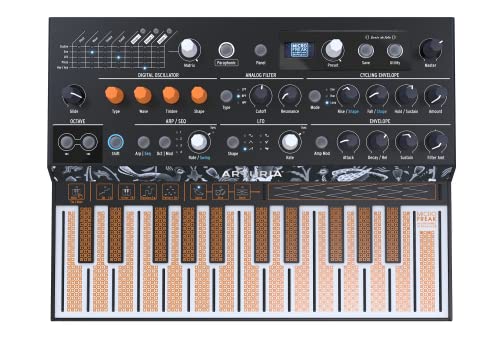
Arturia MicroFreak 25-Key Synth
Best for: modular routing and experimental desktop sound design
- Number of Keys
- 25
- Key Action
- Poly-aftertouch
- Sound Engine
- Physical modeling to wavetable
- Polyphony
- Paraphonic
- Connectivity
- CV outputs, USB, MIDI
- Color
- Black
The Arturia MicroFreak is a compact hybrid synthesizer designed for sound exploration. It features a 25-key flat printed circuit board with individual note pressure tracking and polyphonic aftertouch. Its digital engine supplies 17 paraphonic oscillator modes routed through an analog resonant filter. Weighing 2.3 pounds, it suits musicians who need CV and MIDI connectivity for modular or desktop setups.
- Flat 25-key PCB keyboard with polyphonic aftertouch
- 17 paraphonic digital oscillator modes with an analog filter
- CV outputs for pitch, gate, and pressure routing
- 5×7 modulation matrix and built-in sequencer with four automation lanes
- Flat touch surface lacks moving mechanical keys
- Paraphonic architecture limits voice polyphony
- You want expressive polyphonic aftertouch in a lightweight desktop format.
- You route signals to modular hardware using dedicated CV and gate connections.
- You design sounds using hybrid digital engines and analog filters.
- You need mechanical keys with traditional acoustic or synth travel.
- You need a wider keybed with 61 or more keys for two-hand performance.
Verdict: Arturia MicroFreak 25-Key Hybrid Synthesizer delivers compact, deep sound modulation for electronic producers and modular synth users who want expressive touch-plate performance.
Specifications side by side
| Spec | Novation FLkey 61 MIDI Keyboard Controller | Roland GO:KEYS 3 61-Key Music Creation Keyboard | Moog Mother-32 Analog Synthesizer | Roland JUPITER Boutique Synthesizer | Yamaha Reface CS 37-Key Synthesizer | Yamaha Piaggero 76-Key Digital Piano | Yamaha CK Series 61-Key Stage Keyboard | Arturia MicroFreak 25-Key Synth |
|---|---|---|---|---|---|---|---|---|
| Number of Keys | 61 | 61 | – | – | 37 | 76 | 61 | 25 |
| Key Action | Semi-weighted | Touch-sensitive | – | – | – | Graded Soft Touch (GST) | – | Poly-aftertouch |
| Sound Engine | – | ZEN-Core | Analog | – | Analog Physical Modeling | Advanced Wave Memory Stereo Sampling | – | Physical modeling to wavetable |
| Polyphony | – | – | – | 8 voices, expandable to 32 voices | 8-note | – | – | Paraphonic |
| Preset Count | – | over 1000 | – | – | – | – | – | – |
| Built-In Speakers | – | Stereo | – | – | Built-in speaker system | – | – | – |
| Connectivity | USB-C, 5-Pin MIDI Out | Bluetooth Audio/MIDI | MIDI In, CV Jack | USB-C audio/MIDI, MIDI I/O, clock input | – | – | – | CV outputs, USB, MIDI |
| Sequencer | – | Chord sequencer | 32-step | Two-part polyphonic sequencer | – | – | – | – |
| Form Factor | – | – | – | Portable | Portable | Portable | Stage | – |
| Color | Black/Orange | Dark Red | Black | – | White | Black | Black | Black |
| Built-In Features | – | Built-In Speakers | Sequencer | Built-In Speakers | – | – | Built-In Speakers | Aftertouch |
| Features | MIDI | MIDI | MIDI | – | – | – | – | – |
| Dimensions | 10.4 × 35.2 × 3.66 inches | 11.3 × 37.4 × 3.43 inches | 4.21 × 12.6 × 5.24 inches | 12.1 × 8.25 × 2.13 inches | 29.5 × 9.4 × 3.9 inches | 49.6 × 10.2 × 4.09 inches | 35.8 × 11.4 × 4.3 inches | 12.2 × 9.2 × 2.2 inches |
| Weight | 10.6 pounds | 15.5 pounds | 3.48 pounds | 5.07 pounds | 6 pounds | 13.2 pounds | 12.3 pounds | 2.3 pounds |
| Size | 61 Keys | 95 cm (W) x 28.6 cm (L) x 8.7 cm (H) | Mother-32 | – | Synthesizer | 76-Key | 61-Key | 12.2 inches (L) x 9.2 inches (W) x 2.2 inches (H) |
| Model | AMS-FLKEY-2-61 | GOKEYS3-RD | MOD-MOTHER-32 | JUPITER-08 | reface CS | NP35B | CK61 | 570101 |
If you want foundational spec comparisons before choosing, refer to the electronic keyboard buying guide.
Frequently asked questions
Can a MIDI controller work without a computer connection?
No, a standalone MIDI controller cannot generate audio on its own. Hardware such as the Novation FLkey 61 sends control signals through USB or USB-C ports to external devices. You must connect it to a computer, hardware synthesizer, or mobile sound module to hear any sound output during your sessions.
What is the benefit of Bluetooth connectivity on a keyboard?
Bluetooth lets you stream audio or send wireless MIDI data without running extra cables to your setup. For instance, the Roland GO:KEYS 3 integrates Bluetooth alongside standard USB-MIDI connections. You can pair compatible mobile devices wirelessly to play along with audio tracks through the instrument or interface with production software.
Which keyboard specs matter most for live stage performance?
Physical weight, direct split controls, and integrated amplification matter most for stage use. The Yamaha CK61 stage keyboard weighs 12.3 pounds and provides quick access to organ and synth sounds. Dedicated multi-sound splits let you assign distinct voices to separate zones across its 61 keys during live gigs.
Can you run digital keyboards on battery power for mobile use?
Yes, select portable models operate away from wall outlets using battery power. The Yamaha Piaggero NP35B features a battery-powered design in a 13.2-pound portable chassis. This specification allows you to practice in mobile settings without tethering the 76-key instrument to a permanent electrical power supply.
What does aftertouch provide on a synthesizer?
Aftertouch lets you alter pitch, filter cutoff, or vibrato by applying downward pressure to a key after striking it. On compact instruments like the Arturia MicroFreak, this built-in feature gives you extra expressive modulation from its touch-plate surface without requiring you to move your hand to a separate modulation wheel.
What is the purpose of semi-modular patching on analog synths?
Semi-modular patching lets you re-route control voltages to override the internal pre-wired signal path. The Moog Mother-32 includes modular CV patching alongside its built-in sequencer in a 60HP format. This hardware specification allows you to interconnect the analog voice directly with other Eurorack modules or external analog equipment.


