
As Amazon Associates, we earn from qualifying purchases. This means we may receive a small commission at no extra cost to you if you click through and make a purchase.
As an Amazon Associate we earn from qualifying purchases. Links on this page are affiliate links.
Key Action Explained for Digital Pianos
Key action refers to the mechanical resistance, weight, and physical response of a keyboard when you press down a key. In an acoustic piano, keys lift felt hammers that strike metal strings. Digital instruments lack strings, so manufacturers use internal springs, counterweights, or mechanical hammers beneath each key to simulate that physical touch.
When you evaluate product specifications across listings, you will see key action explained through three standard industry classifications: Semi-Weighted, Weighted, and Hammer Action.
Semi-Weighted actions combine light spring tension with small attached weights. They provide mild resistance, return to position quickly, and keep the overall instrument lightweight for easy transport.
Weighted actions add heavier counterweights to the internal mechanism. This design creates firmer resistance under your fingers and provides a more substantial feel than basic spring-loaded synth keys.
Hammer Action mechanisms use true swinging levers to recreate the natural inertia of acoustic piano hammers. Many models grade this resistance across the keybed, placing heavier resistance in the low bass register and lighter resistance in the high treble.
You should care about this specification because it directly determines your dynamic control, finger technique, and playing comfort. Hammer action helps you develop proper finger strength and expressive volume control for traditional piano pieces. Semi-weighted keys favor fast organ or synthesizer playing and minimize hand fatigue. Reviewing this spec ensures you select the correct mechanical response for your needs in 2026.
Comparing Digital Piano Key Actions
Key Action: Weighted
Weighted key action adds physical resistance across the keyboard to recreate the inertia of an acoustic piano. You encounter firm downward pushback that requires finger strength, which helps you build consistent muscle memory and dynamic control during foundational practice. This action suits students and classical learners who prioritize traditional piano finger technique. The primary trade-off is portability. Weighted keys add internal hardware mass, resulting in instruments like the 25.4-pound Yamaha 88-Key Weighted Portable Digital Piano that require stable stands and are less convenient to pack and move.
Key Action: Hammer Action
Hammer action incorporates internal mechanical levers to replicate the specific swing and release of acoustic hammers. When you press a key, you feel realistic leverage and return resistance rather than simple spring tension. This mechanism suits dedicated pianists and students wanting realistic acoustic response for home practice. UISCOM 88-Key Progressive Hammer Action Desk Piano uses this mechanism alongside progressive weighting. The trade-off centers on physical bulk. Hammer assemblies require deep chassis space and contribute to heavy frames, often keeping these instruments anchored to dedicated home furniture stands rather than portable gig bags.
Key Action: Semi-Weighted
Semi-weighted key action blends light spring tension with minimal added mass. You get faster key rebound and lighter initial resistance than a weighted hammer board. This setup suits gigging musicians, organ players, and synthesizer users who require rapid note repetition, glissandos, and light touch. An example is the Yamaha 76-Key Semi-Weighted Stage Keyboard. The main trade-off is mechanical realism. The lighter touch does not recreate the acoustic resistance needed for developing traditional classical finger strength, making it less suitable if your primary goal is practicing acoustic piano repertoire.
Evaluating Key Action for Your Needs
Who needs it
If you take formal piano lessons, practice classical repertoire, or plan to transition frequently between digital and acoustic instruments, hammer action is essential. You need authentic mechanical resistance to build finger independence, sustain proper hand posture, and control complex dynamics. Without physical counterweights, your fingers adapt to light pushback, which makes playing acoustic upright or grand instruments feel fatiguing and imprecise. Musicians who record nuanced solo parts also gain clear advantages from weighted mechanisms. The mechanical balance allows you to input precise MIDI velocity layers naturally during live performance, reducing the time you spend manually adjusting note velocities in your digital audio workstation software.
Who can skip it
You can skip heavy hammer or weighted actions if you primarily produce electronic music, play synthesizer leads, or perform fast organ passages. Organ and synth techniques rely on rapid key returns without mechanical drag, where semi-weighted or unweighted keys excel. You can also bypass heavy actions if you travel frequently or have limited desk space, as hammer mechanisms add significant bulk and chassis weight. Instead, prioritize lighter portability, total key count, pitch and modulation controls, assignable faders, and robust USB-MIDI connectivity to fit your production workflow.
Key Action Spec Glossary
Escapement
Escapement simulates the subtle click felt near the bottom of an acoustic grand piano key stroke. It lets you replay notes quickly without releasing keys completely.
Graded Hammer Action
This design weights lower bass keys heavier than higher treble keys. It matches acoustic string inertia, training your fingers for traditional pianos where lower strings require thicker, heavier hammers to strike.
Triple Sensor
A triple sensor detects key reset points higher in the stroke than dual sensors. You can trigger repeated notes much faster without cutting off the sounding note, typical on advanced stage pianos.
Polyphony
Polyphony measures the total individual notes or voice samples your instrument plays simultaneously without dropping sounds. Entry models typically offer 64 notes, while advanced digital pianos support 192 to 256 notes.
Touch Sensitivity
Touch sensitivity adjusts sound volume and timbre depending on how fast or hard you strike a key. Most models let you select between light, normal, and heavy response curves to match your technique.
Semi-Weighted Action
Semi-weighted action combines light spring tension with small weights inside plastic keys. This hybrid feel suits portable arranger keyboards and synthesizer players who want moderate resistance without acoustic piano weight.
Synthetic Ivory Keytops
These textured surfaces coat the tops of plastic keys to absorb finger sweat during practice. They provide you with extra grip and tactile stability compared to standard slick plastic finishes.
| # | Product | Best for | Price |
|---|---|---|---|
| 1 | Yamaha 88-Key Weighted Portable Digital Piano | beginners developing core acoustic piano technique | |
| 2 | UISCOM 88-Key Progressive Hammer Action Desk Piano | beginners wanting furniture-style hammer-action home practice | |
| 3 | Artesia PE-88 Arranger Keyboard | gigging musicians needing lightweight battery-powered arranger keys | |
| 4 | Yamaha P71 88-Key Weighted Digital Piano | authentic weighted practice in compact spaces | |
| 5 | KUMENG 88-Key Weighted Desk Digital Piano | Beginners needing dual-function desk and piano space | |
| 6 | Yamaha 76-Key Semi-Weighted Stage Keyboard | Gigging musicians wanting portable semi-weighted keys |

Yamaha 88-Key Weighted Portable Digital Piano
Best for: beginners developing core acoustic piano technique
- Key Action
- Weighted
- Number of Keys
- 88 keys
- Total Sounds
- 10 voices
- Form Factor
- Portable
- Speaker System
- Built-in speakers
- Pedal Setup
- Sustain foot switch
This portable digital piano provides an 88-key weighted keybed designed to replicate acoustic piano touch. You get 10 instrument voices, built-in speakers, and a standard sustain foot switch for dynamic practice. At 25.4 pounds and 52.3 inches long, it suits beginner students who need authentic key resistance without the bulk of a permanent cabinet.
- Full 88-key weighted keyboard action
- Portable build weighing 25.4 pounds
- Included sustain foot switch and music rest
- Built-in stereo speakers and USB connectivity
- Limited sound library with only 10 voices
- Includes a basic foot switch instead of a triple-pedal unit
- No built-in display screen
- You want weighted 88-key resistance for acoustic piano practice.
- You need a portable instrument that weighs around 25 pounds.
- You prefer simple one-button navigation without complex menus.
- You want an extensive library with hundreds of voices and rhythms.
- You need a built-in three-pedal console setup.
Verdict: Yamaha 88-Key Weighted Digital Piano provides the key resistance and compact footprint necessary for core piano practice. Its streamlined controls keep your focus on foundational technique rather than digital sound editing.

UISCOM 88-Key Progressive Hammer Action Desk Piano
Best for: beginners wanting furniture-style hammer-action home practice
- Key Action
- Hammer Action
- Number of Keys
- 88 Key
- Sound Engine
- French sound source
- Total Sounds
- 8 sound profiles
- Form Factor
- Wooden Desk
- Pedal Setup
- Three-pedal system
The UISCOM 88-Key Weighted Desk Digital Piano gives you 88 progressive hammer-action keys built into a wooden desk format. You can adjust the key sensitivity to match your touch, while the integrated three-pedal unit supports sustain, legato, and soft play. It suits home beginners who need acoustic-style hammer weighting combined with dual headphone outputs for quiet practice.
- 88-key progressive hammer action with adjustable key sensitivity
- Three-pedal system supporting sustain, legato, and soft play
- Dual headphone ports for silent practice
- USB and MIDI connections for external devices
- Limited sound selection with only 8 sound profiles
- Fixed desk form factor prevents portable use
- You want an 88-key progressive hammer action in a stationary desk format.
- You need an integrated three-pedal system for traditional piano technique.
- You plan to practice quietly using dual headphone jacks.
- You need a portable stage keyboard rather than a stationary desk unit.
- You want a large library of onboard sounds beyond 8 profiles.
Verdict: UISCOM 88-Key Weighted Desk Digital Piano fits beginner players who want progressive hammer weighting built directly into home furniture. Its three-pedal console and adjustable key sensitivity deliver traditional practice mechanics without mobile clutter.

Artesia PE-88 Arranger Keyboard
Best for: gigging musicians needing lightweight battery-powered arranger keys
- Key Action
- Semi-Weighted
- Number of Keys
- 88 keys
- Total Sounds
- 137 voices
- Form Factor
- Portable
- Pedal Setup
- Pedal
- Color
- Black
The Artesia 88-Key Semi-Weighted Arranger Keyboard gives you a full 88-key layout with semi-weighted spring action and seven touch-sensitivity levels. Weighing 19.8 pounds, it runs on mains or battery power and includes 137 voices and 100 auto-accompaniment styles. You get four built-in speakers delivering 30 watts total output. It suits traveling players who want arranger features without heavy hammer-action keys.
- Semi-weighted spring-action keys with 7 touch-sensitivity options
- Runs on AC mains or battery power at 19.8 pounds
- 137 instrument voices and 100 auto-accompaniment rhythm styles
- Four built-in speakers providing 30 watts of total amplification
- Semi-weighted spring action lacks true weighted hammer resistance
- Large 55.5-inch length requires substantial horizontal space
- You want a lightweight, battery-capable keyboard for travel.
- You want built-in auto-accompaniment styles and 137 sound voices.
- You prefer lighter semi-weighted key resistance over heavy hammer action.
- You require fully weighted hammer-action keys to emulate an acoustic piano.
- You need a compact instrument shorter than 55.5 inches.
Verdict: Artesia 88-Key Semi-Weighted Arranger Keyboard provides mobile gigging musicians and accompaniment players with versatile onboard sounds and battery portability instead of acoustic-style hammer weighting.
Yamaha P71 88-Key Weighted Digital Piano
Best for: authentic weighted practice in compact spaces
- Key Action
- Weighted
- Number of Keys
- 88 keys
- Total Sounds
- 10 voices
- Pedal Setup
- Sustain pedal
- Color
- Black
- Dimensions
- 52.3 × 11.5 × 6 inches
The Yamaha 88-Key Weighted Digital Piano is a full-size instrument designed for practice and performance. You get 88 touch-sensitive, weighted keys that replicate acoustic piano resistance, along with an included sustain pedal for dynamic control. At 25 pounds and 11.5 inches deep, it fits compact rooms easily. It suits players seeking genuine weighted response without excess bulk.
- 88 touch-sensitive keys with weighted acoustic-style action
- Dual Mode layers two voices simultaneously
- Includes standalone sustain pedal and power supply
- Compact 25-pound frame measuring 11.5 inches deep
- Sound selection limited to 10 total voices
- Includes single sustain pedal rather than three-pedal unit
- You want 88 weighted, touch-sensitive keys for acoustic-style practice.
- You need a portable instrument weighing 25 pounds.
- You prefer simple one-button controls over complex display menus.
- You require a large sound library beyond 10 onboard voices.
- You want an integrated three-pedal furniture console.
Verdict: Yamaha 88-Key Weighted Digital Piano provides authentic weighted key resistance and a full 88-key layout for pianists focused on foundational acoustic finger technique. Its 25-pound build and simple voice controls make it ideal for musicians prioritizing key action over synthesizer features.
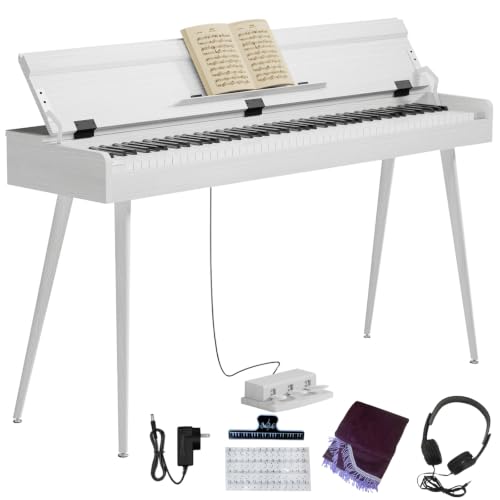
KUMENG 88-Key Weighted Desk Digital Piano
Best for: Beginners needing dual-function desk and piano space
- Key Action
- Hammer Action
- Number of Keys
- 88 keys
- Total Sounds
- 800 tones
- Form Factor
- Desk electric piano
- Pedal Setup
- Pedal
- Connectivity
- USB/MIDI
The KUMENG 88-Key Hammer-Action Desk Piano provides full-size progressive hammer-action keys that simulate acoustic resistance. You get 800 tones, 128-note polyphony, and USB-MIDI connectivity built into a wooden console with a flip key cover. Its flat top converts into a work desk when closed. This setup suits beginners who want weighted acoustic feel inside a compact furniture footprint.
- Progressive hammer-action 88-key weighted keybed
- Cabinet lid converts to flat work desk
- Extensive library of 800 instrument tones
- 128-note maximum polyphony
- Weighs 51 pounds, reducing ease of transport
- Single pedal configuration instead of three-pedal unit
- No Bluetooth connectivity specified
- You want progressive hammer-action keys in a dual-purpose desk cabinet.
- You need a broad variety of built-in sounds, featuring 800 tones.
- You practice in small spaces requiring a protective flip key cover.
- You need a lightweight keyboard under 50 pounds for regular travel.
- You require a traditional triple-pedal lyre for advanced classical pieces.
Verdict: KUMENG 88-Key Hammer-Action Desk Piano gives developing players progressive weighted resistance and dual-purpose desk functionality in a stationary home frame.

Yamaha 76-Key Semi-Weighted Stage Keyboard
Best for: Gigging musicians wanting portable semi-weighted keys
- Key Action
- Semi-Weighted
- Number of Keys
- 76 keys
- Form Factor
- Stage keyboard
- Speaker System
- Built-in speakers
- Connectivity
- Bluetooth audio input, A/D input
- Color
- Black
This stage keyboard features a 76-key semi-weighted action with increased key travel and initial resistance. It includes built-in speakers, battery power capability, and onboard controls for organ, piano, and synth sounds. At 23.7 pounds with Bluetooth audio and an A/D input, it suits mobile players who need versatile performance controls without the bulk of fully weighted keys.
- 76-key semi-weighted action with heavier initial resistance and increased travel
- Dedicated real-time controls for organ, synth, and effects
- Built-in speakers with battery power capability
- Bluetooth audio input and A/D input connectivity
- Semi-weighted key action lacks the mechanical hammer feel of acoustic pianos
- 76 keys provide a narrower range than a standard 88-key piano
- You want lighter semi-weighted keys suitable for organ and synth parts alongside piano
- You need a portable stage keyboard that can run on battery power
- You want dedicated physical controls to adjust effects and sounds quickly
- You require a full 88-key compass for traditional repertoire
- You demand a fully weighted hammer action keybed
Verdict: Yamaha CK Series 76-Key Semi-Weighted Keyboard provides gigging musicians with fast sound-shaping controls and portable battery power, substituting hammer action for lighter semi-weighted responsiveness.
Specifications side by side
Spec Yamaha 88-Key Weighted Portable Digital Piano UISCOM 88-Key Progressive Hammer Action Desk Piano Artesia PE-88 Arranger Keyboard Yamaha P71 88-Key Weighted Digital Piano KUMENG 88-Key Weighted Desk Digital Piano Yamaha 76-Key Semi-Weighted Stage Keyboard
- Number of Keys
- 88 keys
- Key Action
- Weighted
- Sound Engine
- –
- Total Sounds
- 10 voices
- Form Factor
- Portable
- Speaker System
- Built-in speakers
- Pedal Setup
- Sustain foot switch
- Connectivity
- USB
- Skill Level
- –
- Color
- Black
- Built-In Features
- Built-In Speakers
- Features
- –
- Dimensions
- 52.3 × 11.5 × 6 inches
- Weight
- 25.4 pounds
- Size
- 52.25 inches (L) x 11.5 inches (W) x 6 inches (H)
- Model
- P45B
Copied from the Amazon listing. These figures were not measured here.
Frequently asked questions
What is the difference between weighted and semi-weighted key actions?
Weighted keys use mechanical weights to replicate the heavy feel of acoustic instruments, while semi-weighted keys combine light springs with small weights. Semi-weighted models like the Yamaha CK76 allow faster key return and lighter total instrument weight. Weighted actions like that on the Yamaha P45B require more finger effort, which trains finger muscles for acoustic pianos.
Can you learn proper acoustic piano technique on semi-weighted keys?
You cannot build complete acoustic piano technique on semi-weighted keys because they lack authentic hammer inertia. Semi-weighted designs like the 76-key Yamaha CK76 focus on speed and gigging convenience. If you aim to develop traditional acoustic finger strength and control, choose a fully weighted 88-key instrument such as the Yamaha P71.
How does key action affect the total weight of a digital piano?
Key action significantly influences total instrument weight because internal weights and mechanical assemblies add physical mass. Console hammer-action models like the KUMENG KU-1181 weigh 51 pounds due to stationary desk structures and hammer parts. Meanwhile, portable semi-weighted boards like the Yamaha CK76 weigh only 23.7 pounds, making them much easier to carry.
Are hammer-action digital pianos suitable for beginners?
Yes, hammer-action pianos suit beginners who want to build foundational acoustic technique right away. Dedicated console units like the UISCOM 1852 are designed for beginners, combining progressive hammer action with a three-pedal console. This design helps new players develop proper touch sensitivity and finger independence without forming bad technical habits.
Does an 88-key layout mean a keyboard has hammer action?
No, having 88 keys indicates the total musical range, not the internal key action. You can find 88-key keyboards with weighted, hammer, or semi-weighted actions. For example, the Artesia PE-88 features a full 88-key layout with semi-weighted action, whereas the Yamaha P45B provides 88 weighted keys for traditional piano resistance.
Can keyboards with different key actions connect to MIDI software?
Yes, key action does not restrict MIDI recording capabilities. Keyboards with semi-weighted keys, fully weighted keys, and hammer actions all transmit performance data over digital connections. For example, the hammer-action UISCOM 1852 features USB-MIDI connectivity, and the weighted Yamaha P45B includes USB connectivity to communicate note velocity directly to recording software.


