As Amazon Associates, we earn from qualifying purchases. This means we may receive a small commission at no extra cost to you if you click through and make a purchase.
As an Amazon Associate we earn from qualifying purchases. Links on this page are affiliate links.
Digital Piano Form Factor Options Explained
Form factor describes the physical shape, cabinet design, and structural footprint of an instrument. On retail spec sheets, manufacturers label this specification to tell you how the chassis is built, whether it includes furniture-grade cabinetry, and how much floor space it requires. With digital piano form factor explained, you can determine if a model fits your room dimensions, transportation needs, and playing environment.
Listings classify these instruments into four primary categories: portable, stage, console, and upright.
Portable models are lightweight slabs designed for easy transport and storage. They usually feature built-in speakers, weigh under thirty pounds, and pair with folding X-stands or detachable legs. Stage models also use a flat slab body, but manufacturers build them for live performance. They feature heavy-duty metal or reinforced plastic enclosures, omit internal speakers to save weight, and rely on external amplifiers.
Console models integrate the keyboard into an attractive wooden frame. They feature a modesty panel, a fixed stand, and a built-in three-pedal bar. These units serve as permanent home fixtures with balanced sound systems housed inside the base. Upright models take the cabinet concept further. They mimic the vertical height and acoustic mass of a traditional upright piano. Their larger wooden housings accommodate multi-speaker arrays and acoustic tone chambers, delivering fuller sound projection.
You care about this specification because it dictates portability, ergonomics, and placement. A portable slab suits mobile musicians, while console and upright designs provide stable key action, integrated pedals, and permanent furniture styling.
Comparing Digital Piano Form Factor Options
Form Factor: Portable
A portable form factor provides an 88-key instrument in an unattached, compact chassis. These models omit stationary furniture cabinets, letting you position them on temporary folding stands or stow them in closets when not in use. This build suits traveling musicians, students in small rooms, and players with limited floor area. The Yamaha 88-Key Weighted Portable Digital Piano exemplifies this with a 25.4-pound weight and dimensions of 52.25 by 11.5 by 6 inches. The main trade-off is the physical stability. Without a heavy integrated stand, the instrument can wobble during forceful play, and you must supply external support.
Form Factor: Upright
An upright form factor integrates the keyboard directly into a tall, full-panel wooden cabinet. This construction emulates traditional acoustic upright pianos, giving you a dedicated piece of furniture for a fixed room. It suits stationary home practice where the instrument remains in one location permanently. For instance, the Donner 88-Key Upright Digital Piano weighs 108 pounds and measures 54.53 inches long by 35.04 inches wide by 15.75 inches high. The primary trade-off is zero portability. Relocating an upright instrument requires multiple people or disassembly, making it completely impractical for mobile performances or rooms needing flexible floor layouts.
Form Factor: Stage
A stage form factor focuses on rugged construction and live performance utility. These keyboards feature road-ready enclosures engineered for transport between gigs, studios, and rehearsals. They suit touring musicians, band performers, and stage players who connect to external sound systems and stage rigs. As an example, the Roland RD 88-Key Stage Piano weighs 39.5 pounds with a width of 16 inches and length of 54.5 inches. The trade-off is physical bulk compared to lightweight entry slabs. They are considerably heavier than standard portable practice keyboards and require a dedicated, heavy-duty keyboard stand, adding setup time and equipment to transport.
Form Factor: Console
A console form factor offers a slim stationary cabinet with integrated legs and a pedal crossbar. It creates an anchored acoustic look with a slightly lower profile than full upright furniture. This style suits home pianists who desire an attractive living-room fixture without assembling separate metal stands. The Yamaha 88-Key Console Digital Piano illustrates this category, featuring a 123-pound cabinet measuring 57.5 inches long by 18.1 inches wide by 36.5 inches high. The primary downside is weight and immobility. At over one hundred pounds, console units cannot be packed for travel, requiring a dedicated permanent footprint in your home.
Choosing the Right Form Factor
Who needs it
You must evaluate form factor if your room layout, travel needs, or physical setup dictate how the instrument lives. Choose an upright or console model if you want a stationary furniture piece that integrates a full wooden cabinet, a stable keybed, and a built-in three-pedal assembly into a permanent practice area. These designs anchor the instrument in place and protect internal components behind solid panels.
Select a portable or stage design if you transport your gear between rehearsals, gigs, or studios. These enclosures fit into gig bags, mount to folding stands, and pack down quickly. If you share a small room, a portable chassis lets you practice and store it away.
Who can skip it
You can deprioritize form factor if you already own a dedicated workspace desk or studio workstation that holds an 88-key board. In that case, any standard chassis rests on your existing surface without issues.
Focus instead on core electronic and mechanical specifications. Prioritize key action type, sensor count, maximum polyphony, and onboard connectivity. A home producer needs dedicated line outputs and MIDI over USB more than a specific cabinet finish. A player focused on technique benefits more from graded hammer-weighted keys than from a wood cabinet or sliding key cover.
Digital Piano Specifications Glossary
Number of keys
This spec counts the playing keys across the keyboard bed. Standard full-size digital pianos feature 88 keys, while smaller beginner models or compact keyboards often feature 61 or 76 keys.
Hammer action
A mechanical key design that replicates the weighted resistance of acoustic pianos using internal levers and counterweights. You encounter graded hammer actions where lower registers feel heavier than higher treble registers.
Triple-pedal unit
An accessory providing sustain, soft, and sostenuto pedals. Furniture models integrate this unit into the base frame, while portable slabs typically ship with an individual plug-in sustain pedal switch.
USB-MIDI connectivity
A digital interface port that transmits keystroke and velocity data to external computers, tablets, or sound modules. You use standard USB Type-B or Type-C cables to control learning software and virtual instruments.
Audio outputs
Physical ports routing stereo audio signals to headphones or external speakers. Most consumer models feature standard 3.5-millimeter or quarter-inch headphone jacks, while stage keyboards include balanced left and right line outputs.
Slab chassis
A flat, unattached housing that encloses the internal electronics, speakers, and keybed without integrated furniture legs. This build lets you mount the instrument on portable X-stands or tabletop studio desks.
Keybed depth
The front-to-back physical dimension of the instrument chassis. Compact models maintain slim footprints around 11 to 13 inches deep, while upright cabinets usually require 15 to 22 inches of floor depth.
Music rest
A detachable or hinged ledge mounted on the top casing to hold sheet music or tablets. Console builds feature wide wooden desks, while portable keyboards typically include removable slotted plastic inserts.
| # | Product | Best for | Price |
|---|---|---|---|
| 1 | Yamaha 88-Key Weighted Portable Digital Piano | portable practice with full weighted keys | |
| 2 | Donner 88-Key Upright Digital Piano | stationary home practice with traditional upright styling | |
| 3 | Nord Stage 4 88-Key Fully-Weighted Keyboard | performing musicians needing multi-engine stage versatility | |
| 4 | Yamaha 88-Key Console Digital Piano with GH3 Action | dedicated home practice and multi-track recording | |
| 5 | Roland RD 88-Key Stage Piano | gigging players needing built-in stage monitoring | |
| 6 | Casio Privia 88-Key Console Piano | home practice requiring a stationary console setup |

Yamaha 88-Key Weighted Portable Digital Piano
Best for: portable practice with full weighted keys
- Form Factor
- Portable
- Number of Keys
- 88 keys
- Key Action
- Weighted
- Total Sounds
- 10 voices
- Speaker System
- Built-in speakers
- Pedal Setup
- Sustain foot switch
This instrument is a portable digital piano with an 88-key weighted keyboard and built-in speakers. Weighing 25.4 pounds and measuring 6 inches high, it fits into compact practice spaces or transport setups. It features 10 built-in voices, USB connectivity, and an included sustain foot switch, giving you core acoustic-style action without the bulk of a permanent cabinet.
- 88 touch-sensitive weighted keys
- Portable 25.4-pound total weight
- Built-in stereo speaker system
- Direct USB connectivity
- Sound selection limited to 10 voices
- Includes basic single foot switch rather than a three-pedal unit
- You need an 88-key weighted instrument that is easy to move and store.
- You want simple one-button navigation without complex digital menus.
- You practice in tight spaces where an upright or console frame will not fit.
- You need a large variety of sounds beyond 10 core instrument voices.
- You require an integrated furniture-style console with three fixed pedals.
Verdict: Yamaha 88-Key Weighted Portable Piano suits mobile players and small rooms needing full-size weighted keys without furniture bulk.

Donner 88-Key Upright Digital Piano
Best for: stationary home practice with traditional upright styling
- Form Factor
- Upright
- Number of Keys
- 88 keys
- Key Action
- Progressive weighted hammer action
- Sound Engine
- French Dream
- Total Sounds
- 138 tones
- Speaker System
- Dual 15W amplifiers
This upright digital piano pairs a stationary wooden cabinet with an 88-key progressive weighted hammer action. At 108 pounds and 54.5 inches wide, it occupies a fixed footprint in your home. You get dual 15-watt amplifiers, 138 built-in tones, and 128-voice polyphony. It suits players who want permanent acoustic-style furniture with integrated pedals and direct USB MIDI connectivity.
- Progressive weighted hammer action with 88 full-size keys
- Extended cabinet housing dual 15W amplifiers
- Integrated metal pedal system for traditional expression
- 138 tones, 100 rhythm styles, and 128-voice polyphony
- At 108 pounds, the fixed upright cabinet cannot be easily moved
- 128-voice polyphony limits dense multi-track layering
- No integrated Bluetooth connectivity listed in the specifications
- You want a stationary upright cabinet with integrated metal pedals for your home.
- You need progressive weighted hammer-action keys for traditional acoustic practice.
- You plan to connect to learning apps or computers via wired USB MIDI.
- You need a portable stage instrument for rehearsals and gigging.
- You require built-in wireless Bluetooth audio or MIDI streaming.
- You want a higher polyphony ceiling for complex compositional layering.
Verdict: Donner 88-Key Upright Digital Piano serves home pianists who want a permanent piece of musical furniture with progressive hammer action and dual 15-watt amplification. Its heavy 108-pound wooden enclosure and integrated pedal setup fit stationary practice spaces rather than traveling performers.

Nord Stage 4 88-Key Fully-Weighted Keyboard
Best for: performing musicians needing multi-engine stage versatility
- Form Factor
- Stage
- Number of Keys
- 88
- Key Action
- Fully weighted, triple-sensor
- Sound Engine
- Wave 2 Synth Engine
- Color
- Black
- Dimensions
- 59.8 × 10.2 × 19.7 inches
The Nord Stage 4 88-Key Weighted Stage Piano is a stage-format instrument built for live performance and complex sound layering. It gives you an 88-key fully weighted, triple-sensor keybed alongside dedicated piano, organ, and Wave 2 synth engines. At 53 pounds, it provides a stable setup for stage performers who need multi-engine flexibility.
- 88-key fully weighted, triple-sensor keybed
- Wave 2 Synth Engine with 3 independently managed layers
- Dedicated organ section with B3, Vox, Farfisa, and pipe models
- Doubled sample memory for the Nord Piano Library
- Heavy 53-pound weight makes solo transport demanding
- Long 59.8-inch chassis requires substantial stage footprint
- No built-in speakers included in the instrument housing
- You need independent piano, organ, and multi-layer synth engines in one stage piano.
- You prioritize triple-sensor weighted key action for live performance.
- You want a lightweight portable keyboard under 30 pounds for quick transport.
- You need built-in speakers for standalone practice without external amplification.
Verdict: Nord Stage 4 88-Key Weighted Stage Piano delivers extensive multi-engine sound design and triple-sensor action for gigging keyboardists requiring deep live control. Its 53-pound build is built specifically for stage rigs connected to external amplification.

Yamaha 88-Key Console Digital Piano with GH3 Action
Best for: dedicated home practice and multi-track recording
- Form Factor
- Console
- Number of Keys
- 88
- Key Action
- Graded Hammer 3 (GH3)
- Sound Engine
- CFX
- Dimensions
- 57.5 × 18.1 × 36.5 inches
- Weight
- 123 pounds
This is a console digital piano designed as a permanent home fixture. It features an 88-key Graded Hammer 3 action, a CFX grand piano sound engine, and a 123-pound cabinet measuring 57.5 by 18.1 inches. It suits you if you want furniture-style stability, onboard multi-track MIDI recording, and realistic key resistance without needing stage portability.
- Graded Hammer 3 action with synthetic ivory keytops
- Built-in 16-track MIDI recording and playback
- Bundled with padded bench, music stand, and half-damper pedal
- Virtual Resonance Modeling and CFX grand voice
- Maximum polyphony is limited to 128 notes
- Heavy 123-pound weight makes relocation difficult
- You want a stationary console piano with an included bench and pedals.
- You record complex arrangements using up to 16 onboard MIDI tracks.
- You need a lightweight keyboard that you can carry to rehearsals or gigs.
- You require more than 128 notes of polyphony for dense layered arrangements.
Verdict: Yamaha 88-Key Console Digital Piano delivers a stationary acoustic-style setup for dedicated home pianists who need multi-track MIDI recording and hammer-action keys.

Roland RD 88-Key Stage Piano
Best for: gigging players needing built-in stage monitoring
- Form Factor
- Stage
- Number of Keys
- 88-Note
- Key Action
- PHA-4 Ivory Feel
- Sound Engine
- SuperNATURAL, ZEN-Core
- Total Sounds
- Over 3000
- Speaker System
- Stereo Speaker System
This stage piano combines an 88-key PHA-4 weighted keyboard with an onboard stereo speaker system in a self-contained chassis. You get the SuperNATURAL piano engine, the ZEN-Core sound engine with over 3,000 tones, and an interface built for live performance. At 39.5 pounds, it gives you full-size weighted keys and stage-ready sounds without requiring external stage monitors for practice.
- Over 3,000 onboard sounds powered by ZEN-Core
- 88-key PHA-4 weighted keyboard with Ivory Feel
- Built-in stereo speaker system for standalone use
- Sound and feature expansion via Roland Cloud
- Total weight of 39.5 pounds limits single-person portability
- Chassis length of 54.5 inches requires a wide stage footprint
- Additional sound expansions require Roland Cloud access
- You want a stage instrument with built-in speakers for personal monitoring.
- You need an extensive library of over 3,000 sounds for live sets.
- You want weighted hammer action with 88 full-size keys.
- You need an ultra-light portable keyboard under 30 pounds.
- You prefer a fixed furniture-style console cabinet for home decor.
Verdict: Roland RD 88-Key Stage Piano provides performing players with weighted hammer action, deep sound libraries, and onboard speakers in a dedicated stage format.

Casio Privia 88-Key Console Piano
Best for: home practice requiring a stationary console setup
- Form Factor
- Console
- Number of Keys
- 88
- Key Action
- Tri-Sensor II Scaled Hammer Action
- Sound Engine
- AiR Sound Source
- Speaker System
- 40W 4-speaker
- Connectivity
- USB-MIDI, dual headphone jacks
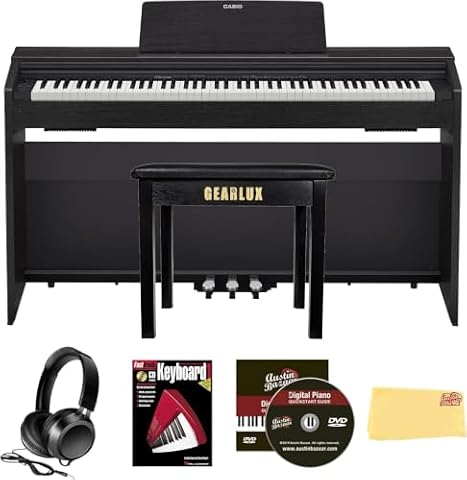
This 88-key console digital piano provides a stationary furniture setup for your home. You get an integrated 40W four-speaker sound system, Tri-Sensor II scaled hammer action keys, and a built-in sliding key cover. Its AiR sound engine includes string and damper resonance simulation. It suits you if you want a dedicated practice instrument with fixed cabinet styling and dual headphone jacks.
- 40W four-speaker sound projection system
- Tri-Sensor II scaled hammer action with textured keys
- Integrated sliding key cover and console cabinet
- Dual headphone outputs for quiet shared practice
- Weighs 75.6 pounds, limiting portability
- No wireless Bluetooth connectivity listed
- You want a stationary console piano with an integrated 40W speaker array.
- You plan to practice with a partner using dual headphone jacks and Duet Mode.
- You need a lightweight keyboard to pack up and transport to gigs.
- You require built-in wireless Bluetooth audio or MIDI.
Verdict: Casio Privia 88-Key Console Piano suits home players who want an integrated 40W four-speaker setup and hammer-action keys in a stationary furniture cabinet. It provides dedicated learning features without the transportability of a stage or portable keyboard.
Specifications side by side
| Spec | Yamaha 88-Key Weighted Portable Digital Piano | Donner 88-Key Upright Digital Piano | Nord Stage 4 88-Key Fully-Weighted Keyboard | Yamaha 88-Key Console Digital Piano with GH3 Action | Roland RD 88-Key Stage Piano | Casio Privia 88-Key Console Piano |
|---|---|---|---|---|---|---|
| Number of Keys | 88 keys | 88 keys | 88 | 88 | 88-Note | 88 |
| Key Action | Weighted | Progressive weighted hammer action | Fully weighted, triple-sensor | Graded Hammer 3 (GH3) | PHA-4 Ivory Feel | Tri-Sensor II Scaled Hammer Action |
| Sound Engine | – | French Dream | Wave 2 Synth Engine | CFX | SuperNATURAL, ZEN-Core | AiR Sound Source |
| Total Sounds | 10 voices | 138 tones | – | – | Over 3000 | – |
| Form Factor | Portable | Upright | Stage piano | Console | Stage Piano | Console |
| Speaker System | Built-in speakers | Dual 15W amplifiers | – | – | Stereo Speaker System | 40W 4-speaker |
| Pedal Setup | Sustain foot switch | Metal pedals | – | – | – | – |
| Connectivity | USB | USB MIDI, iOS, Android, Headphone | – | – | – | USB-MIDI, dual headphone jacks |
| Skill Level | – | Professionals | – | – | – | – |
| Color | Black | Black | Black | Dark Rosewood | Black | Black |
| Built-In Features | Built-In Speakers | – | – | – | – | – |
| Features | – | – | – | – | – | MIDI |
| Dimensions | 52.3 × 11.5 × 6 inches | 15.8 × 35 × 15.8 inches | 59.8 × 10.2 × 19.7 inches | 57.5 × 18.1 × 36.5 inches | 54.5 × 16 × 12 inches | 31.5 × 54.6 × 31.5 inches |
| Weight | 25.4 pounds | 108 pounds | 53 pounds | 123 pounds | 39.5 pounds | 75.6 pounds |
| Size | 52.25 inches (L) x 11.5 inches (W) x 6 inches (H) | 54.53 x 35.04 x 15.75 inches | Keyboard Only | – | 12.00 | Piano Only |
| Model | P45B | DDP-400 | STAGE4-88 | YDP184R | RD-88 | PX-870BK |
Frequently asked questions
What is the main difference between stage and portable digital pianos?
Stage pianos cater to live performance rigs, while portable models target basic mobility. Portable units like the Yamaha P45B weigh 25.4 pounds and feature built-in speakers for simple practice. In contrast, stage models like the Roland RD-08 weigh 39.5 pounds, and the Nord Stage 4 weighs 53 pounds with dedicated control surfaces designed for external sound systems.
How do console and upright digital pianos differ in home spaces?
Console and upright instruments differ mainly in cabinet height and weight. Upright models like the Donner DDP-400 weigh 108 pounds with tall, traditional acoustic styling. Console models like the Yamaha YDP184R weigh 123 pounds, while the Casio PX-870BK weighs 75.6 pounds. Both styles serve as permanent fixtures in your home practice area.
Do stage digital pianos come with built-in speakers?
Some stage pianos include built-in speakers, but others omit them entirely. For example, the Roland RD-08 provides onboard speakers for monitoring your performance on stage. Conversely, instruments like the Nord Stage 4 omit internal amplification and require you to connect external audio hardware, monitors, or headphones to hear your sound.
How heavy is a typical portable digital piano?
A portable digital piano typically weighs under 30 pounds, allowing you to move it easily between rooms. The Yamaha P45B, for instance, weighs 25.4 pounds and measures 52.3 inches long by 11.5 inches wide. This compact specification lets you mount the keyboard on a temporary folding stand or store it flat when not playing.
Can you easily move a console digital piano after assembly?
You cannot easily move a console digital piano once you assemble the frame. Console designs feature integrated wooden furniture panels that build a rigid structure. Instruments like the Yamaha YDP184R weigh 123 pounds, and the Casio PX-870BK weighs 75.6 pounds. Relocating these units usually requires two people to prevent cabinet damage.
Does the form factor determine what key action you get?
No, form factor does not restrict key action quality across digital pianos. You can find weighted or hammer-action keys in every chassis style. For example, the portable Yamaha P45B features weighted keys, the stage-format Roland RD-08 provides weighted action, and console models like the Casio PX-870BK feature dedicated hammer-action mechanisms for your practice.
What connectivity specs should you expect across different piano form factors?
Connectivity varies by the intended use of each chassis design. Portable and console units focus on standard data connections for home practice, such as the USB port on the Yamaha P45B and USB-MIDI on the Casio PX-870BK. Stage models offer broader hardware integration designed for stage mixers and audio interfaces.