
As Amazon Associates, we earn from qualifying purchases. This means we may receive a small commission at no extra cost to you if you click through and make a purchase.
Shoppers evaluating the Dyson 360 Vis Nav usually want to know whether its motor power and extending side duct justify choosing it over rival autonomous cleaners. This robot vacuum is engineered specifically for homes where deep fiber agitation, thorough perimeter pickup, and allergen containment take priority over hands-off conveniences like mopping pads or auto-emptying docks. If your primary goal is pulling fine silt, dust, and stubborn debris out of hard floors and carpets in a single automated sweep, this machine delivers focused, high-grade cleaning capability.
In this detailed dyson 360 vis nav review, we examine whether its physical features match daily household cleaning demands. We analyze the published 360 vis nav specs, explore how the vision-based system maps rooms without saving images, evaluate edge cleaning mechanics, and look at the real-world trade-offs of its battery duration across four operating modes.
What You Get With the Dyson 360 Vis Nav
Dyson 360 Vis Nav


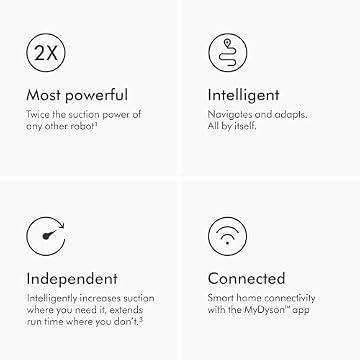

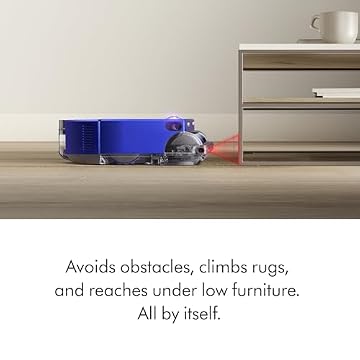
Photographs published on the Amazon listing.
The Dyson 360 Vis Nav arrives with hardware focused purely on dry floor cleaning, high-filtration airflow, and surface agitation across all floor types.
- Dyson 360 Vis Nav robotic vacuum in Blue and Nickel styling
- Wide 11.8-inch brush bar combining three cleaning methods to dislodge dirt
- Mechanical extending side duct that redirects suction directly to room edges
- Lithium-ion battery pack running at 21.6 volts
- Sensor array featuring 26 onboard sensors and a 360-degree vision camera
- Whole-machine sealed HEPA filtration system capturing particles down to 0.1 microns
- Access to the MyDyson smartphone app for scheduling, zoning, and power controls
- Charging dock station with automatic recharge-and-resume capability
- Manufacturer coverage including a 2-year warranty and lifetime support
Key Specifications
Feature
Specification Details
- Surface Recommendation
- All Floors
- Filtration Type
- Fully sealed HEPA (traps 99.99% of particles down to 0.1 microns)
- Maximum Battery Runtime
- Up to 65 minutes
- Battery Cell and Voltage
- Lithium Ion, 21.6 Volts
- Dust Capacity
- 0.13 gallons
- Brush Roller Width
- 11.8 inches
- Sensor Suite
- 26 high-precision sensors with 360-degree optical navigation
- Power Profiles
- 4 levels (Auto, Boost, Quick, Quiet)
- Control Interfaces
- MyDyson App, onboard push buttons, Amazon Echo voice control
- Mobility System
- Dual-link suspension with 2 drive wheels
Copied from the Amazon listing. These figures were not measured here.
Suction Performance Across Different Floor Types
The headline attribute of the dyson robot vacuum 360 vis nav is raw pickup power. Dyson rates this machine as delivering twice the suction of any other robot vacuum based on ASTM F558 testing at the inlet load. Most autonomous vacuums utilize small central brush rollers flanked by wide wheel wells, leaving unbrushed bands along the path. By contrast, the 11.8-inch brush bar on this machine extends across almost the complete width of the chassis. It combines three distinct material actions across its roller to loosen set-in dust, capture loose crumbs, and sweep fine debris out of floorboard crevices in one pass.
Controlling dyson 360 vis nav suction power is handled through four distinct modes: Auto, Boost, Quick, and Quiet. In Auto mode, internal sensors monitor debris levels in real time and automatically modulate motor wattage. When transitioning from smooth tile to thick rugs or encountering heavier concentrations of dirt, the motor ramps up suction instantly, then steps down over cleaner areas to save battery reserve. Managing the machine in homes with pets is straightforward; using the 360 vis nav for pet hair is aided by the wide diameter of the brush core, which is engineered specifically to prevent long pet fur and human hair from tightly wrapping around the axle.
A crucial part of deep cleaning is making sure dirt stays inside the machine. The vacuum features a fully sealed whole-machine HEPA filtration system that traps 99.99% of particulate down to 0.1 microns, including pollen, mold spores, and pet dander. Maintaining clean exhaust airflow is just as vital as room air movement; running this vacuum alongside an efficient home circulator like the woozoo 360 pedestal air circulator helps ensure fine airborne particles are continuously captured rather than recirculated across living spaces.
Edge Cleaning Mechanics and Side Duct Engineering
Perimeter sweeping has long been an Achilles heel for autonomous vacuums. Standard market designs utilize spinning nylon side brushes to whip dirt into the central suction path. In practice, these spinning arms frequently scatter crumbs, cat litter, and dry kibble outward across previously swept zones. The dyson 360 vis nav edge cleaning system eliminates rotating side whiskers entirely. Instead, an automated side duct mechanically deploys outward from the side of the housing whenever perimeter sensors register an adjacent wall or cabinet kickboard.
When the duct extends, internal airflow diverts through the side channel, focusing strong vacuum suction right against the baseboard joint. This allows the machine to pull dirt ribbons and clinging pet fur directly out of perimeter crevices without flinging particles into the middle of the room. Combined with the forward placement of the 11.8-inch brush bar, the robot can clean squarely into corners without leaving the wide uncleaned margins common to circular cleaners.
This duct architecture also avoids common mechanical headaches. Conventional rotating side brushes are prone to wrapping around rug fringe, low curtain hems, and trailing cords, which can halt cleaning runs midway. Because the extending side duct uses smooth mechanical extension and directed airflow rather than rotating bristles, it sweeps tight boundaries without binding onto decorative trims or fragile fabrics.
Vision Navigation, Sensors, and Data Privacy
Spatial pathfinding relies on an advanced 360 vis nav navigation system that combines 26 specialized sensors with an upward-facing 360-degree vision camera. The camera observes ceiling lines, light contrasts, and furniture shapes to build a real-time mental map of your home. It tracks where it has cleaned and methodically calculates remaining uncleaned floor area. The dual-link suspension and two-wheel drive system allow the robot to maintain ground contact across surface transitions, climbing easily over standard thresholds and room dividers without getting beached.
While domestic smart cameras such as the eufy solocam e30 are built to stream and store surveillance video, the optical sensor on this vacuum operates under strict privacy safeguards. Dyson designed the system to process shapes and environmental contrast locally on the device strictly for geometric navigation. The robot never records, stores, or transmits visual images to external servers or cloud repositories, eliminating privacy concerns for users who want vision-guided cleaning in bedrooms and private living areas.
Setting up the MyDyson mobile app unlocks custom controls. Users can review the mapped floor layout, establish no-go zones around fragile items or pet feeding dishes, assign specific cleaning modes on a room-by-room basis, and view clean-time estimates. The machine also integrates with Amazon Echo devices, enabling hands-free voice commands to launch cleaning sessions when heading out the door.
Battery Endurance and Dust Bin Maintenance
Managing cleaning runs requires an understanding of how runtime behaves across different power modes. The official 360 vis nav battery life reaches up to 65 minutes on a full charge of its 21.6-volt lithium-ion battery. This maximum duration applies to lower power settings; running the motor in Boost mode draws heavy current to dislodge stubborn carpet grit, shortening the continuous run time. To handle larger spaces, the robot features an automatic recharge-and-resume function, returning to its charging dock when power dips and automatically heading back out to finish mapped rooms once recharged.
For quicker daily sweeps, switching to Quick mode optimizes the robot’s travel patterns to cover accessible open floor areas rapidly. The onboard dust bin holds 0.13 gallons of debris. Because this model does not use an oversized auto-emptying dock, the dust container requires routine manual emptying. The bin is transparent, allowing you to check fill levels at a glance and empty it directly into the trash before accumulated debris restricts internal airflow.
Upkeep requirements are straightforward and monitored by internal diagnostics. The MyDyson mobile app delivers automated alerts when the washable lifetime HEPA filter requires cleaning or the brush bar needs a check. System updates install automatically over Wi-Fi, allowing Dyson to refine navigation algorithms and performance features over time without requiring physical servicing.
Dyson 360 Vis Nav Pros and Cons
Pros
- Twice the suction of rival robot vacuums
- Full-width 11.8-inch triple-action brush bar
- Extending side duct cleans directly along walls
- Sealed whole-machine HEPA filtration system
- Local vision navigation never records or sends images
- Dynamic Auto mode adapts suction to debris
Cons
- Maximum runtime limited to 65 minutes
- Compact 0.13-gallon dust bin requires frequent emptying
- Requires MyDyson mobile app for room mapping
- No integrated wet mopping attachment
Check Dyson 360 Vis Nav on Amazon
Is the Dyson 360 Vis Nav Worth It
Deciding whether the 360 vis nav is worth it depends on whether your cleaning challenges demand brute physical suction or hands-off automation. If you have carpeted living rooms, heavy shedding pets, or allergy sensitivities that require sealed HEPA filtration, this vacuum provides deep cleaning agitation and wall-to-wall extraction that typical low-suction autonomous sweepers cannot match. Its wide brush roll and extending side duct make it especially capable for homes with extensive baseboards and high dust accumulation.
Conversely, homeowners seeking weeks of completely unattended operation may find the setup restrictive. Because there is no self-emptying base station, the 0.13-gallon dust bin requires regular attention. Furthermore, it does not include mopping features. If your floor plan spans several thousand square feet on a single level and you dislike having the robot pause to recharge midway through, or if you prefer an all-in-one vacuum and mopping system with an automated fluid dock, a traditional hybrid robot may serve you better.
For households that view floor cleaning as an essential hygiene task rather than a quick surface polish, the vacuum justifies its specialized focus. It concentrates engineering resources on genuine suction, edge pickup, and sealed filtration, delivering thorough dry vacuum performance while safeguarding home privacy.
Other Options to Consider
Up to 60 Days Hands-Free is an autonomous robot vacuum and mop offering 8000Pa suction, LiDAR navigation, multi-level mapping, and a self-emptying dock, making it an appealing alternative for buyers seeking combined wet mopping and prolonged hands-free debris storage.

iRobot Roomba 105 Combo Robot delivers intense power-lifting suction, LiDAR navigation, and an AutoEmpty dock that stores debris for up to 75 days while avoiding carpets during mopping cycles, suiting shoppers who prioritize automated bin evacuation over edge-channel suction.
90-Day Hands-Free Cleaning 160-Minute Long features a generous 160-minute runtime, 11500Pa suction, LiDAR navigation, multi-floor room mapping, and a 90-day self-emptying base, serving as a practical alternative for large, multi-story homes requiring extended cleaning sessions without mid-run recharging.

FAQ
How does the Dyson 360 Vis Nav handle pet hair?
The vacuum tackles pet hair by combining twice the suction power of competing robot vacuums with a full-width 11.8-inch brush bar. The roller is engineered with a wide diameter to minimize hair tangling, while the sealed HEPA filter traps 99.99% of microscopic pet dander down to 0.1 microns.
Does the Dyson 360 Vis Nav save pictures of your home?
No, the 360-degree panoramic camera interprets contrast and room shapes strictly for real-time spatial positioning. Dyson states that the vacuum will never record, save, or transmit photographic imagery outside the device, protecting indoor privacy.
What are the four cleaning modes on the 360 Vis Nav?
The machine features Auto, Boost, Quick, and Quiet modes. In Auto mode, onboard sensors continuously monitor dirt levels and adjust suction output automatically, while Boost mode delivers maximum power, Quick mode prioritizes rapid cleaning coverage, and Quiet mode minimizes motor noise.
How long does the 360 Vis Nav battery run on a single charge?
The 21.6-volt lithium-ion battery delivers up to 65 minutes of continuous operation depending on the selected power mode and floor type. If the charge runs low before cleaning is complete, the vacuum automatically returns to its base to recharge and resumes where it left off.
Does the Dyson 360 Vis Nav include an auto-empty dock or mop?
The listing does not specify any mopping attachments or an auto-emptying base station for this model. The vacuum concentrates strictly on dry suction and allergen capture, collecting debris in an onboard 0.13-gallon bin that is emptied manually.


