As Amazon Associates, we earn from qualifying purchases. This means we may receive a small commission at no extra cost to you if you click through and make a purchase.
As an Amazon Associate we earn from qualifying purchases. Links on this page are affiliate links.
This digital piano buying guide breaks down the technical specifications you need to evaluate before selecting an instrument in 2026. You will be able to decide which key action, cabinet format, and connection types match your practice habits. The guide walks you through the practical differences between progressive hammer action and velocity-sensitive keys, lightweight portable frames and stationary furniture consoles, and core sound banks versus expansive multi-tone libraries.
The 8 picks featured below were chosen strictly from their published specifications rather than promotional marketing claims. You can compare standardized measurements for total weight, physical dimensions, pedal capability, and USB-MIDI audio connections across every model. Evaluating these verified manufacturer details ensures you find an instrument that matches your technical skill level, room setup, and musical requirements.
Key Specifications to Compare Before Buying
Key Action Type
Key action determines how closely digital keys simulate the mechanical resistance of an acoustic instrument. Full hammer action and weighted keys recreate the leverage of acoustic hammers. This build provides resistance that helps you develop standard finger strength and proper playing technique. Velocity-sensitive keys without weighting track how hard you strike a note to change volume, but they do not provide acoustic resistance. Progressive hammer action scales the resistance across the keyboard, offering heavier resistance in the lower bass register and lighter response in the high treble. For traditional piano instruction, weighted or hammer-action keys are standard. The UISCOM 88-Key Progressive Hammer Action Desk Piano demonstrates progressive hammer action for foundational practice. Choosing non-weighted velocity keys reduces physical resistance, which suits players who do not need traditional acoustic technique.
Look for
- Hammer-action or weighted keys if you want acoustic piano resistance.
- Progressive weighting if you want heavier bass keys and lighter treble.
- Velocity-sensitive keys if you prefer lighter key response without acoustic-style resistance.
Form Factor and Cabinet Design
The cabinet style dictates where you can place the piano and how easy it is to move. Portable stage pianos feature slim, self-contained chassis that sit on folding stands or tabletops. These units store away easily in smaller spaces and fit mobile players who travel to lessons. Furniture-style desk pianos integrate the keyboard into a wooden console frame with dedicated side legs. These units serve as permanent fixtures in a living room or home office. Desk models also provide an integrated surface for study materials or computers. For example, the KUMENG 88-Key Weighted Desk Digital Piano uses a desk format that measures 53 inches wide and 30.3 inches tall. Furniture styles take up fixed floor space, while portable frames require separate stand purchases.
Look for
- Portable chassis designs if you need to store or transport the piano.
- Integrated furniture desk consoles if you want a stationary home practice setup.
Instrument Weight and Portability
Total weight affects how easily you can set up, relocate, or transport the keyboard. Portable models typically weigh between 25 and 27 pounds. At this weight, an individual can lift the instrument onto a stand, pack it into a gig bag, or move it between rooms without assistance. Furniture-style and console pianos weigh significantly more, often ranging from 40 to 51 pounds. That heavier weight gives the instrument physical stability during energetic playing and prevents the frame from wobbling. However, heavier frames require two people to assemble or reposition safely. The Yamaha P71 88-Key Weighted Digital Piano keeps weight at 25 pounds for easy transport. Decide whether your piano will remain stationary or requires regular transport before selecting a weight class.
Look for
- Weights under 30 pounds if you plan to move the instrument frequently.
- Weights above 40 pounds for stationary stability on dedicated stands or consoles.
Connectivity and Headphone Outputs
Audio and data connections decide how well the digital piano interacts with software, recording equipment, and silent practice gear. USB and USB-MIDI ports connect directly to computers, tablets, or digital audio workstations. This connectivity lets you record MIDI data into sequencing software or practice with interactive learning applications. Output jacks dictate your listening options. A single headphone jack enables silent practice for solo play. Dual headphone jacks allow two people, such as a student and teacher, to monitor audio simultaneously without disturbing others. The Donner 88-Key Velocity-Sensitive Digital Piano includes dual headphone outputs for shared lessons. Standard USB ports handle basic device hookups, while dedicated MIDI protocols ensure low-latency data communication. Verify that the output types match your practice and recording hardware.
Look for
- USB-MIDI or USB ports for connecting to recording software and learning applications.
- Dual headphone jacks if you plan to practice with an instructor or partner.
Tone Library and Sound Variety
The size of the built-in sound bank alters how you use the instrument. Some digital pianos feature compact banks with around 10 core sounds, such as grand pianos, electric pianos, and organs. A focused sound selection reduces distractions, keeps navigation simple, and concentrates hardware resources on authentic acoustic voice sampling. Other models offer extensive sound libraries with hundreds of instrument tones, ranging from 238 to 800 sounds. Large tone counts give beginner players flexibility to explore synth leads, strings, brass, and diverse world instruments directly on the board. The Donner DEP-20 Weighted Portable Digital Piano provides a 238-tone selection for players seeking broad stylistic range. If you prioritize strict acoustic piano practice, huge sound libraries add complexity you might not use.
Look for
- Streamlined sound banks under 20 tones for distraction-free traditional acoustic piano practice.
- Expanded libraries of 200 or more tones for multi-instrument exploration and arrangement.
Built-In Speaker Amplification
Built-in speakers provide immediate sound projection without the need for external amplifiers or tangled cables. Speaker power ratings and driver placement determine sound volume, clarity, and low-frequency resonance. Smaller built-in speaker systems supply adequate volume for personal bedroom practice and quiet home environments. More powerful speaker configurations, such as dual 25W setups, project clear audio across larger living spaces without distortion at high output levels. Higher wattage also reproduces the rich dynamic range of low-register piano notes more accurately. The Yamaha 88-Key Weighted Portable Digital Piano includes built-in speakers for convenient standalone playing anywhere. If you plan to practice primarily through headphones, high-wattage onboard speakers become less essential, but powerful speakers remain critical for acoustic room performance.
Look for
- Built-in stereo speakers for convenient standalone practice without external audio equipment.
- Higher wattage speaker configurations if you need room-filling volume without distortion.
Digital Piano and Keyboard Types Explained
Portable Weighted Digital Pianos
Portable weighted digital pianos pack 88 hammer-action keys into a slab chassis weighing around 25 to 27 pounds. Models like the Yamaha P71 and Donner DEP-20 feature internal speakers and USB connectivity for quick setup anywhere. You get authentic key resistance that builds standard finger technique without occupying permanent floor space. This type suits traveling performers, dorm residents, and students who store their instrument after practice. The main trade-off is the lack of an integrated wooden console and multi-pedal lyre, requiring you to supply an external stand and sustain pedal.
Furniture Desk Digital Pianos
Desk digital pianos integrate a full 88-key hammer-action board directly into a furniture frame. Units like the KUMENG KU-1181 and UISCOM 1852 provide USB-MIDI support, dual headphone outputs for lessons, and flat tops that function as work surfaces. You gain a dedicated practice station that blends into home offices or shared living areas without needing extra keyboard furniture. This design suits home learners and remote workers who want a permanent practice fixture in compact rooms. The trade-off is fixed placement: weighing up to 51 pounds, these desks cannot be packed away or transported to gigs.
Console Velocity-Sensitive Digital Pianos
Console velocity-sensitive pianos mount a full 88-note keyboard into a stationary wooden frame equipped with a traditional three-pedal assembly. Instruments such as the Donner DDP-60 offer dual headphone connections and volume-sensitive keys without the heavy mechanical resistance of acoustic hammers. You receive a traditional cabinet look and standard pedaling technique for home practice at a moderate 40.8-pound chassis weight. This setup suits beginning students and teachers who prioritize shared lessons over classical touch training. The central trade-off is the lighter key action, which will not develop the finger strength required for acoustic grand pianos.
Common Digital Piano Buying Mistakes
Ignoring Maximum Polyphony Ratings for Complex Music
Polyphony limits how many notes and layered voices sound simultaneously. Heavy sustain pedal use on low counts like 32 or 64 causes audible note dropouts. Check spec sheets for at least 128-voice polyphony. This headroom prevents cutoffs during dense arrangements and layered splits.
Overlooking Dedicated Line Outputs for External Sound Systems
Relying strictly on headphone sockets creates problems when connecting external amplifiers or recording interfaces. Headphone jacks can introduce noise or impedance mismatches. Look for dedicated left and right quarter-inch line outputs on the rear panel if you plan to send clean stereo signals into external audio hardware.
Neglecting Half-Pedal and Continuous Damper Compatibility
Basic bundles often include simple on-off footswitches. These prevent you from practicing graduated damper control common on acoustic pianos. Inspect the specifications for continuous detection or half-damper compatibility. Verify whether the pedal input accepts multi-pedal boards or variable resistance pedals before you decide.
Confusing Standard MIDI USB With Bidirectional Audio Interfaces
Many USB-to-Host ports transmit MIDI commands only. They cannot send line audio into recording software or return computer sounds through the internal speakers. Check the connectivity specifications for built-in USB audio support. Without it, you need a separate external audio interface to record instrument sounds.
| # | Product | Best for | Price |
|---|---|---|---|
| 1 | Yamaha 88-Key Weighted Portable Digital Piano | beginners wanting portable weighted acoustic action | |
| 2 | Yamaha P71 88-Key Weighted Digital Piano | portable weighted-key practice on a clean interface | |
| 3 | UISCOM 88-Key Progressive Hammer Action Desk Piano | home learners wanting furniture-style desk design | |
| 4 | Donner DEP-20 Weighted Portable Digital Piano | beginners wanting diverse tones and loud speakers | |
| 5 | Donner 88-Key Velocity-Sensitive Digital Piano | shared home practice and beginner lessons | |
| 6 | Roland FP-10 88-Key Digital Piano | student lessons and home studio MIDI recording | |
| 7 | KUMENG 88-Key Weighted Desk Digital Piano | dual-purpose home office and study practice spaces | |
| 8 | Yamaha 88-Key Weighted Digital Piano | authentic weighted practice in compact spaces |

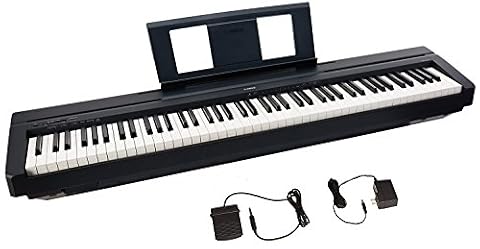
Yamaha 88-Key Weighted Portable Digital Piano
Best for: beginners wanting portable weighted acoustic action
- Number of Keys
- 88 keys
- Key Action
- Weighted
- Total Sounds
- 10 voices
- Form Factor
- Portable
- Speaker System
- Built-in speakers
- Pedal Setup
- Sustain foot switch
You get a full-size digital piano built for practice and travel. It features 88 weighted, touch-sensitive keys designed to mimic acoustic action, along with 10 built-in instrument voices. The unit weighs 25.4 pounds and measures 52.3 inches long by 11.5 inches wide. USB connectivity connects you directly to recording gear. It suits beginners and mobile players needing full keyboard reach without extra clutter.
- 88-key weighted, touch-sensitive action
- Portable 25.4-pound cabinet with built-in speakers
- USB connectivity for computer audio and MIDI
- Includes sustain foot switch and music rest
- Limited sound selection with only 10 voices
- Uses single foot switch rather than multi-pedal unit
- No Bluetooth connectivity listed
- You need a standard 88-key weighted keyboard under 30 pounds.
- You want basic USB connectivity for simple computer setups.
- You prefer streamlined one-button controls over deep sound menus.
- You need an expansive library beyond 10 built-in sounds.
- You require integrated Bluetooth for wireless audio or MIDI.
- You want a permanent furniture-style triple-pedal console setup.
Verdict: Yamaha 88-Key Weighted Portable Digital Piano fits beginning pianists and traveling players who prioritize acoustic-style key action and basic USB connectivity over large sound libraries.
Yamaha P71 88-Key Weighted Digital Piano
Best for: portable weighted-key practice on a clean interface
- Number of Keys
- 88 keys
- Key Action
- Weighted
- Total Sounds
- 10 voices
- Pedal Setup
- Sustain pedal
- Color
- Black
- Dimensions
- 52.3 × 11.5 × 6 inches
This full-size digital piano gives you 88 weighted, touch-sensitive keys designed to recreate acoustic keyboard resistance. It features 10 built-in sounds, a dual-layer voice mode, and an included sustain pedal. At 25 pounds and 11.5 inches deep, the portable frame fits compact rooms and gig bags. It suits you if you need weighted practice keys without complex menu navigation.
- Full 88-key weighted action with touch-sensitive response
- Weighs 25 pounds for straightforward transport
- Dual Mode layers two instrument voices simultaneously
- Includes standalone sustain pedal and dedicated power supply
- Limited sound selection of 10 onboard voices
- Ships with a single sustain pedal rather than a three-pedal board
- You want full 88-key weighted resistance for standard piano technique.
- You need a 25-pound portable keyboard that fits into smaller spaces.
- You prefer direct button controls rather than scrolling through digital menus.
- You require dozens of instrument presets and synthesizer voices.
- You want a fixed console body with three integrated pedals.
Verdict: Yamaha 88-Key Weighted Digital Piano gives students and mobile players an authentic 88-key weighted touch in a 25-pound chassis. Its streamlined 10-sound bank focuses strictly on foundational practice rather than synth production.

UISCOM 88-Key Progressive Hammer Action Desk Piano
Best for: home learners wanting furniture-style desk design
- Number of Keys
- 88 Key
- Key Action
- Progressive Hammer-Action
- Sound Engine
- French sound source
- Total Sounds
- 8 sound profiles
- Form Factor
- Wooden Desk
- Pedal Setup
- Three-pedal system
This 88-key digital piano features a wooden desk-style console with progressive hammer-action weighted keys. It provides eight onboard sound profiles powered by a French sound source, along with a three-pedal setup for sustain, legato, and soft control. With dual headphone outputs and USB-MIDI connectivity, you can practice silently with a partner or link to recording software.
- Progressive hammer-action 88 weighted keys with adjustable sensitivity
- Dedicated three-pedal unit supporting sustain, legato, and soft control
- Dual headphone ports for two-person silent practice
- Integrated USB-MIDI connectivity and MP3 playback input
- Limited sound selection with only eight onboard profiles
- Desk form factor lacks portability compared to stage pianos
- No built-in Bluetooth connectivity listed
- You want a furniture-style desk piano with a full three-pedal unit.
- You plan to practice silently with a teacher using dual headphone jacks.
- You need progressive hammer-action keys for beginner practice.
- You need a wide variety of sounds beyond the eight included tones.
- You require a portable keyboard you can pack and travel with.
Verdict: UISCOM 88-Key Weighted Desk Digital Piano fits beginner players who want an integrated furniture console with progressive hammer-action touch and dual-headphone monitoring.
Donner DEP-20 Weighted Portable Digital Piano
Best for: beginners wanting diverse tones and loud speakers
- Number of Keys
- 88 key
- Key Action
- Hammer action
- Total Sounds
- 238 tones
- Form Factor
- Portable
- Speaker System
- Two 25W amplifiers
- Pedal Setup
- Sustain pedal
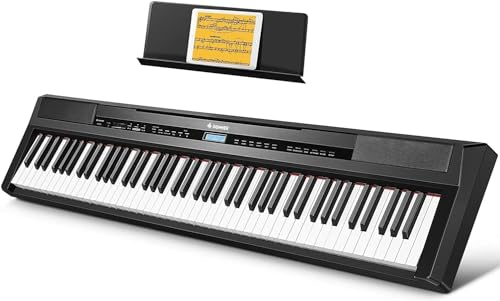
The Donner DEP-20 is a portable 88-key digital piano with full-sized hammer-action keys and adjustable touch response. It offers 238 built-in tones, 128-note max polyphony, and dual 25W onboard speakers. You get a backlit LCD screen showing notation and chords, along with audio inputs, outputs, and MIDI connectivity. It suits beginners who need versatile instrument sounds and high speaker output.
- 88 full-sized hammer-action keys with adjustable touch response
- 238 instrument tones and 128-note maximum polyphony
- Two 25W amplifiers for built-in sound projection
- Backlit LCD screen displaying chord names and notation
- No wireless Bluetooth connectivity included
- Includes only a standard single sustain pedal rather than a fixed three-pedal unit
- You want an 88-key hammer-action keyboard with a large selection of 238 built-in tones.
- You need loud onboard amplification without connecting external speakers.
- You want a visual LCD display to confirm chord names and voice selections.
- You require wireless Bluetooth connectivity for apps or audio streaming.
- You want a stationary cabinet piano with a integrated three-pedal console.
Verdict: Donner DEP-20 88-Key Portable Digital Piano delivers hammer-action keys, robust dual 25W sound, and an expansive 238-tone selection for beginners exploring diverse musical styles. It gives you flexible practice and recording connections without needing external amplification.

Donner 88-Key Velocity-Sensitive Digital Piano
Best for: shared home practice and beginner lessons
- Number of Keys
- 88
- Key Action
- Velocity-sensitive
- Total Sounds
- 128 voices
- Speaker System
- 2x 15W
- Pedal Setup
- 3 piano style pedals
- Connectivity
- USB-MIDI, 3 headphone jacks, AUX IN
This Donner instrument gives you an 88-key velocity-sensitive keyboard paired with a 128-note polyphony engine and dual 15-watt speakers. It includes 128 built-in voices, three piano-style pedals, and three headphone jacks for quiet duets. It suits beginners who want full keyboard coverage and home practice tools without the heavy mechanical resistance of weighted hammer keys.
- Dual 15W onboard speakers
- Three headphone jacks for silent practice and lessons
- 128-note polyphony and 128 instrument voices
- Includes three-pedal unit
- Keys use velocity sensitivity rather than weighted hammer action
- Stand and console build weighs 40.8 pounds
- You want multiple headphone jacks for shared practice or lessons.
- You prefer lighter velocity-sensitive keys over heavier hammer action.
- You need a console setup that includes three pedals.
- You need weighted hammer action to build acoustic finger strength.
- You need a lightweight portable keyboard for travel.
Verdict: Donner 88-Key Velocity-Sensitive Digital Piano fits beginning players and teachers who require dual headphone outputs and a three-pedal setup without acoustic-style key resistance.

Roland FP-10 88-Key Digital Piano
Best for: student lessons and home studio MIDI recording
- Number of Keys
- 88-note
- Sound Engine
- SuperNATURAL
- Speaker System
- Built-in speakers
- Pedal Setup
- DP-2 Foot Switch
- Connectivity
- Headphones, USB MIDI
- Skill Level
- Beginners
The Roland FP-Series 88-Key Digital Piano brings Roland's SuperNATURAL sound engine and 88 ivory-feel keys into a compact 27-pound chassis. You get built-in speakers, USB and MIDI connectivity for recording, and companion app control. Twin Piano mode splits the keyboard into identical octaves, making this an effective tool for home lessons and quiet headphone practice.
- SuperNATURAL sound engine delivers acoustic piano tones
- 88-key keybed with textured ivory feel
- Twin Piano mode splits keybed into identical octaves for lessons
- USB and MIDI connectivity for computer DAWs and recording software
- Includes a basic DP-2 foot switch instead of a half-damper pedal
- No onboard screen for viewing current voice and metronome settings
- You take in-person lessons and need split-octave side-by-side playing
- You practice with headphones and need low-noise key action
- You connect to a computer or mobile device for MIDI recording
- You require a stationary wood console cabinet with three fixed pedals
- You prefer hardware screen menus over smartphone app controls
Verdict: Roland FP-Series 88-Key Digital Piano suits beginner students and DAW producers who prioritize acoustic-style key feel and MIDI integration in a portable format.
KUMENG 88-Key Weighted Desk Digital Piano
Best for: dual-purpose home office and study practice spaces
- Number of Keys
- 88 keys
- Key Action
- Progressive hammer-action
- Total Sounds
- 800 tones
- Form Factor
- Desk electric piano
- Pedal Setup
- Pedal
- Connectivity
- USB/MIDI
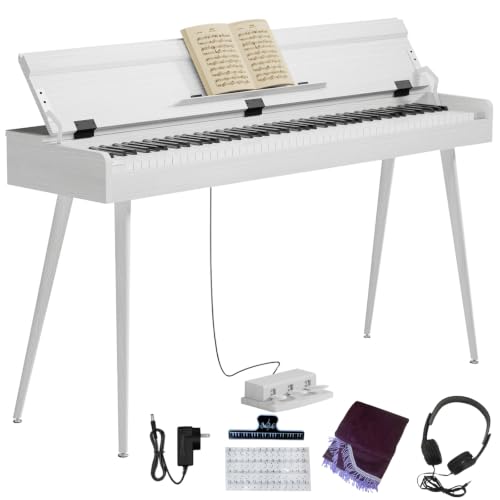
This 88-key desk digital piano combines progressive hammer-action keys with a flip-top wooden cabinet that doubles as a workspace. It features 128-note polyphony, 800 onboard tones, and built-in USB-MIDI connectivity. You get a split-keyboard mode and recording controls directly on the panel. It suits beginners and home players who need a full-size weighted keyboard that fits compact rooms.
- 88 progressive hammer-action weighted keys
- 800 instrument tones and 128-note polyphony
- Cabinet converts between an electric piano and a work desk
- USB-MIDI port and USB MP3 playback support
- Cabinet design weighs 51 pounds, reducing portability
- Includes a single pedal rather than a three-pedal unit
- No Bluetooth support listed in the specifications
- You want a full-size weighted keyboard that doubles as a desk.
- You need a vast sound library with 800 instrument tones.
- You require split-keyboard functions for beginner practice.
- You need a lightweight keyboard that you can transport regularly.
- You require a traditional three-pedal console configuration.
Verdict: KUMENG 88-Key Desk Digital Piano gives beginners full hammer action and 800 sounds in a dual-purpose desk format. It fits players with limited room who need an instrument that integrates directly into a home office.
Yamaha 88-Key Weighted Digital Piano
Best for: authentic weighted practice in compact spaces
- Number of Keys
- 88 keys
- Key Action
- Fully weighted
- Total Sounds
- 10 voices
- Pedal Setup
- Sustain pedal
- Color
- Black
- Dimensions
- 12 × 54 × 6 inches
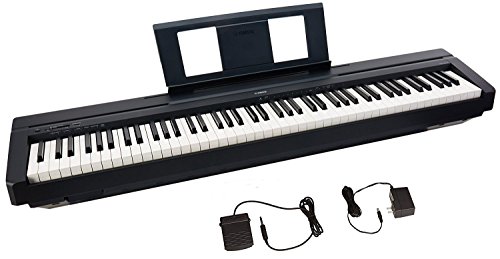
This full-size instrument features 88 fully weighted keys and 10 onboard voices, including acoustic grand piano samples. It measures 54 inches wide by 12 inches deep and includes a sustain pedal and music rest. You get Dual Mode for layering two sounds at once. It suits players who need an acoustic key feel in a slim footprint.
- 88 fully weighted keys simulate acoustic piano action
- Dual Mode layers two voices simultaneously
- Slim 12-inch depth fits compact spaces
- Includes sustain pedal, music rest, and power adapter
- Limited sound library with 10 total voices
- Single sustain pedal included rather than a three-pedal board
- You prioritize acoustic-style key resistance for daily technique practice.
- You have limited space and need a depth under 12 inches.
- You want to blend tones using Dual Mode.
- You need a broad sound library beyond 10 presets.
- You require a traditional three-pedal setup for advanced classical playing.
Verdict: Yamaha 88-Key Weighted Digital Piano provides standard hammer-weighted action and core grand piano samples in a compact build. It serves practice-focused musicians who value authentic key touch over varied sound effects.
Specifications side by side
| Spec | Yamaha 88-Key Weighted Portable Digital Piano | Yamaha P71 88-Key Weighted Digital Piano | UISCOM 88-Key Progressive Hammer Action Desk Piano | Donner DEP-20 Weighted Portable Digital Piano | Donner 88-Key Velocity-Sensitive Digital Piano | Roland FP-10 88-Key Digital Piano | KUMENG 88-Key Weighted Desk Digital Piano | Yamaha 88-Key Weighted Digital Piano |
|---|---|---|---|---|---|---|---|---|
| Number of Keys | 88 keys | 88 keys | 88 Key | 88 key | 88 | 88-note | 88 keys | 88 keys |
| Key Action | Weighted | Weighted | Progressive Hammer-Action | Hammer action | Velocity-sensitive | – | Progressive hammer-action | Fully weighted |
| Sound Engine | – | – | French sound source | – | – | SuperNATURAL | – | – |
| Total Sounds | 10 voices | 10 voices | 8 sound profiles | 238 tones | 128 voices | – | 800 tones | 10 voices |
| Form Factor | Portable | – | Wooden Desk | Portable | – | – | Desk electric piano | – |
| Speaker System | Built-in speakers | – | – | Two 25W amplifiers | 2x 15W | Built-in speakers | – | – |
| Pedal Setup | Sustain foot switch | Sustain pedal | Three-pedal system | Sustain pedal | 3 piano style pedals | DP-2 Foot Switch | Pedal | Sustain pedal |
| Connectivity | USB | – | MIDI, USB, dual headphone ports | Audio inputs & outputs, MIDI, MP3 | USB-MIDI, 3 headphone jacks, AUX IN | Headphones, USB MIDI | USB/MIDI | – |
| Skill Level | – | – | Beginners | Beginners | – | Beginners | Beginners | – |
| Color | Black | Black | White | Dull Black | Classic Gray | Black | Pearl White | Black |
| Built-In Features | Built-In Speakers | – | – | – | – | – | – | – |
| Features | – | – | MIDI | – | – | – | MIDI | – |
| Dimensions | 52.3 × 11.5 × 6 inches | 52.3 × 11.5 × 6 inches | – | 52.2 × 11.6 × 7.6 inches | 52.5 × 12.1 × 28.9 inches | 15.9 × 11.1 × 54.4 inches | 12.4 × 53 × 30.3 inches | 12 × 54 × 6 inches |
| Weight | 25.4 pounds | 25 pounds | – | 25.6 pounds | 40.8 pounds | 27 pounds | 51 pounds | 48.5 pounds |
| Size | 52.25 inches (L) x 11.5 inches (W) x 6 inches (H) | Full | Flip-Top Model | Weighted Piano Only | Full | FP-10 | Compact | 12 x 54 x 6 inches |
| Model | P45B | P71B | 1852 | EC3042 | DDP-60 | FP-10-BK | KU-1181 | P-45B |
For additional technical definitions regarding action types and polyphony ratings, reference the digital piano buying guide.
Frequently asked questions
Do you need a full 88-key digital piano as a beginner?
A full 88-key layout gives you the standard acoustic compass needed for traditional classical literature and modern exercises. All 8 models in this guide feature 88 keys. Choosing a full board prevents you from running out of upper treble or lower bass notes as your practice advances.
What is the difference between velocity sensitivity and weighted hammer action?
Velocity sensitivity alters volume based on how fast you strike a key, which models like the Donner DDP-60 provide. Weighted hammer action physically replicates acoustic resistance beneath your fingers. Instruments like the Yamaha P45B use this mechanical weighting to build proper finger strength and dynamic control.
Why do some digital pianos include dual headphone jacks?
Dual headphone jacks let two people listen to practice sessions simultaneously without disturbing others. Models such as the UISCOM 1852 and Donner DDP-60 include this configuration. It allows you to share private practice with an instructor, lesson partner, or parent without disconnecting your primary headset.
How does a desk console digital piano differ from a portable slab piano?
Desk console pianos include permanent furniture stands designed for stationary rooms. The KUMENG KU-1181 weighs 51 pounds and stands 30.3 inches high. In contrast, portable slab models like the Yamaha P71 weigh 25 pounds, allowing you to store them in a closet or pack them for travel.
How do you connect a digital piano to a computer or tablet?
You connect a digital piano to computers or mobile devices using USB or USB-MIDI connections. Units such as the Roland FP-10 and UISCOM 1852 send MIDI signals over these cables. This setup lets you control digital audio workstations, practice apps, and virtual instruments without extra hardware.
Why does onboard speaker wattage matter on a portable digital piano?
Internal speaker wattage determines how loudly and cleanly a digital piano projects sound without an external amplifier. The Donner DEP-20 includes dual 25W speakers, which provide clear volume for home rooms. Sufficient wattage ensures your low-end bass and dynamic chords project cleanly during regular practice.