As Amazon Associates, we earn from qualifying purchases. This means we may receive a small commission at no extra cost to you if you click through and make a purchase.
Property owners dealing with detached garages, perimeter fence lines, or expansive backyards understand how quickly standard wireless security cameras falter when pushed beyond domestic Wi-Fi boundaries. The Blink Outdoor 4 XR addresses that exact barrier by pairing wire-free outdoor cameras with an extended-range system hub. Recognized as the blink outdoor 4 xr newest model, this four-camera package shifts wireless communication away from standard congested router bands to an extended frequency. If you have spent time troubleshooting dropping video feeds or unreachable corners around a large yard, this platform aims to bridge the physical gap without requiring mesh extenders or trenching network cables to remote buildings.
In this guide, we evaluate what the hardware brings to challenging installation sites, dissecting how the specialized radio signals operate across open air and structural obstacles. We examine the core blink outdoor 4 xr specs, inspect the physical components included in the retail box, review the pairing and app setup, and explore your choices between local MicroSD card saving and cloud subscriptions. Whether you are comparing this package to previous hardware in our blink outdoor 4 breakdown or deciding if the extended coverage solves your property layout needs, this article delivers the verifiable facts required to make an informed choice.
What You Get With the Blink Outdoor 4 XR
Blink Outdoor 4 XR
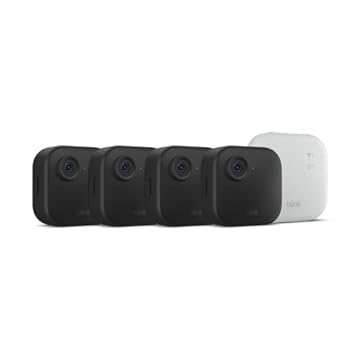
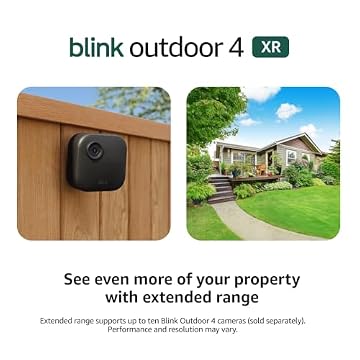


Photographs published on the Amazon listing.
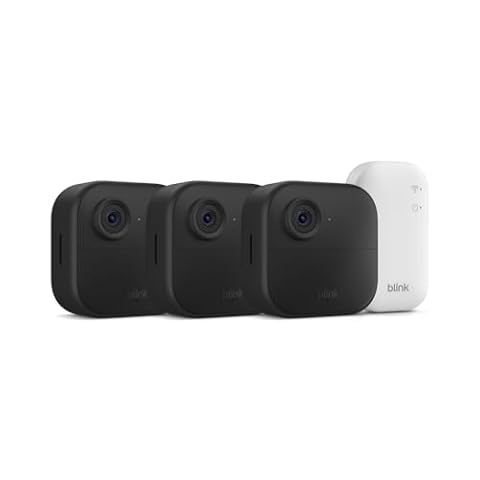
The Blink Outdoor 4 XR system ships as a complete multi-camera security package designed for quick deployment across large properties. Inside the retail packaging, you receive all essential components to establish four perimeter monitoring points right away.
- Four Blink Outdoor 4 wireless smart security cameras
- One Blink Sync Module XR extended-range system hub
- Eight Energizer Lithium AA 1.5V batteries (two per camera)
- Four camera mounting kits with installation hardware
- One USB-C power cable for the Sync Module XR
- One power adapter for the sync module
- Patented chip technology enabling up to two years of battery life
- Local storage slot on the Sync Module XR supporting MicroSD cards up to 256 GB
- Free 30-day trial of the Blink Subscription Plan for cloud video storage
Key Specifications
Attribute
Detail
- System Camera Count
- Four Outdoor 4 wireless cameras
- Included System Hub
- Sync Module XR
- Wireless Operating Band
- 900MHz proprietary band and Wi-Fi
- Maximum Wireless Range
- Up to 1000 feet open-air, up to 400 feet typical use
- Primary Power Source
- Two AA Energizer Lithium batteries per camera
- Battery Longevity Rating
- Up to two years of standard operation
- Local Video Storage
- MicroSD slot supporting up to 256 GB (card sold separately)
- Cloud Video Storage
- Blink Subscription Plan (30-day trial included)
- Voice Assistant Integration
- Works with Alexa
- Total System Capacity
- Controls up to 10 Blink devices per system
Copied from the Amazon listing. These figures were not measured here.
How the 900MHz Radio Architecture Solves Range Limitations
The primary engineering distinction of this system lies in how it moves data from peripheral monitoring zones back to your living space. Standard consumer cameras rely exclusively on 2.4GHz Wi-Fi frequencies, which carry substantial data payloads but struggle when penetrating masonry, brick, dense framing, or thick garden shrubbery. The blink outdoor 4 xr 900mhz range fundamentally alters that propagation equation. By leveraging lower sub-gigahertz frequencies, the Sync Module XR transmits signals that bend around obstacles and pass through solid building materials with significantly less attenuation, giving homeowners the ability to place hardware far beyond standard domestic router boundaries.
When assessing a blink outdoor 4 xr vs standard wifi deployment, the performance metrics reported by the manufacturer highlight marked operational improvements. The dedicated 900MHz link delivers up to a 70% reduction in dropped connections compared to cameras attempting to maintain standard Wi-Fi handshakes at marginal signal strengths. Furthermore, because the sub-GHz spectrum operates free from the heavy congestion of home smartphones, tablets, smart televisions, and neighboring routers, the camera system provides 20% quicker access to live view feeds. That lower latency means you spend less time waiting for feeds to load when an alert triggers from a remote driveway.
These operational gains prove especially decisive when evaluating the blink outdoor 4 xr for large properties where physical distance represents an insurmountable barrier for conventional setups. In open-air line-of-sight conditions, the Sync Module XR maintains communication up to 1000 feet away from the base station. Even in typical suburban or rural configurations with intervening walls, sheds, and trees, the system is rated for up to 400 feet of usable separation, which is four times the effective distance of cameras tethered to Wi-Fi alone. When compared to the placement limits observed in our standard blink outdoor wireless evaluations, the XR platform eliminates the dead zones that routinely plague rural estates.
Battery Longevity and Power Management at Long Range
Wireless convenience often comes with the nagging downside of frequent battery maintenance, an issue magnified when cameras sit mounted on high barn gables, tree trunks, or remote perimeter posts. The blink outdoor 4 xr battery life addresses this challenge through proprietary power management silicon developed specifically for low-overhead cycling. Paired with the included Energizer Lithium AA batteries, the system delivers an operating lifespan of up to two years. This longevity allows property managers to install peripheral cameras in hard-to-reach locations without the constant chore of hauling out ladders every few months to swap power cells.
A crucial factor behind this efficiency is how the 900MHz radio interacts with the camera’s sleep circuitry. In standard Wi-Fi configurations, an outdoor camera consumes substantial power maintaining a beacon connection with a distant home router, especially when the signal drops near threshold levels and demands higher transmission amplification. The Sync Module XR offloads that continuous network overhead. The Outdoor 4 cameras remain in an efficient low-power sleep mode until passive infrared sensors detect movement, waking the radio to transmit video bursts across the sub-GHz channel before dropping back into dormancy.
Prospective buyers should note that real-world battery endurance depends on environmental factors and event frequency. A camera positioned overlooking a busy driveway with dozens of daily vehicle movements or one used frequently for extended live view sessions will deplete its two AA lithium cells faster than a camera guarding a quiet pasture fence. Nevertheless, because the system includes eight genuine Energizer Lithium AA batteries in the box, buyers receive the exact high-capacity chemical formulation required to achieve multi-year longevity right from the start.
Mounting, Setup, and System Management
Setting up the hardware is deliberately straightforward, requiring no specialized background in network engineering or RF management. The blink outdoor 4 xr setup centers on the Sync Module XR, which acts as the physical bridge between your home internet connection and the extended-range cameras. The module connects to household power via the included USB-C cable and adapter, while linking to your home network through guided pairing inside the mobile application. Once the central hub is online, adding each Outdoor 4 camera involves scanning the QR code on the housing and following the pairing prompts on your smartphone.
Physical placement requires practical consideration of how radio waves traverse your property layout. While the system is capable of bridging up to 1000 feet under open-air conditions, structural obstacles like metal barns, dense stucco, or heavy earth berms will reduce the practical operational radius toward the 400-foot typical rating. Conducting an informal sync module xr range test by temporarily carrying a paired camera to your target mounting site before drilling into siding or posts helps verify signal stability. The included mounting brackets allow flexible tilt and swivel adjustments, ensuring you can aim the lenses precisely toward entry gates or driveways.
System coordination is managed entirely through the unified mobile interface, which can accommodate up to 10 Blink devices on a single account. This allows you to arm and disarm entire camera groups concurrently, set customized schedules, and establish automation routines. The system also features native compatibility with Alexa. By enabling the integration, homeowners can review camera feeds directly on smart displays, trigger voice arming commands, or create audible announcements when distant perimeter motion sensors detect activity, seamlessly pairing with other security hardware such as a blink doorbell outdoor camera.
Local Storage Versus Cloud Subscription Options
Understanding ongoing costs and data management is a central consideration when investing in modern security hardware. The blink outdoor 4 xr local storage capabilities provide a notable advantage for shoppers wary of mandatory recurring service fees. The Sync Module XR contains a built-in MicroSD card slot capable of accommodating memory cards up to 256 GB. When a MicroSD card is inserted, recorded motion clips from all four cameras are saved locally to physical flash storage, allowing homeowners to retain and review surveillance footage directly through the mobile application without ongoing monthly bills.
For users who favor off-site redundancy, the package includes a 30-day free trial of the Blink Subscription Plan. The cloud tier automatically uploads motion-activated clips to secure remote servers, preserving footage even if a physical camera or the central hub suffers tampering or environmental damage. Subscription plans also unlock extended video history features and clip-sharing tools that simplify exporting footage to local devices. Once the 30-day trial expires, owners can choose whether to subscribe to a paid cloud tier or transition entirely to local storage on the Sync Module XR.
There are practical trade-offs between both storage avenues that buyers must weigh. Local recording onto a MicroSD card eliminates subscription fees entirely, but accessing clips stored on a physical card can exhibit slightly slower thumbnail loading times compared to high-speed cloud playback. Additionally, the physical MicroSD card is not included in the standard retail bundle and must be purchased separately. Having the freedom to choose between free local recording and cloud backup ensures the system adapts to individual budget preferences.
Blink Outdoor 4 XR Pros and Cons
Pros
- Up to 1000 feet open-air wireless coverage
- Sub-GHz 900MHz band cuts connection dropouts
- Two-year battery life with included lithium cells
- Local storage support up to 256GB MicroSD
- Faster live view connection than standard Wi-Fi
Cons
- MicroSD card sold separately for local video storage
- Cloud video backup requires paid subscription after trial
- System hub capped at ten total Blink devices
Check Blink Outdoor 4 XR on Amazon
Is the Blink Outdoor 4 XR Worth It
When asking whether is blink outdoor 4 xr worth it, the answer depends almost entirely on the physical layout and dimensions of your property. If you manage an expansive residential lot, an equestrian property, a workshop located across an asphalt driveway, or a perimeter fence line that sits deep in a Wi-Fi dead zone, this kit offers tremendous practical utility. By solving the persistent problem of packet loss and dropped connections through dedicated 900MHz wireless technology, the system delivers reliable security monitoring to areas where standard Wi-Fi cameras simply cannot function without expensive commercial mesh hardware.
The overall value proposition is further bolstered by the inclusion of four cameras, the specialized Sync Module XR hub, and the full complement of lithium batteries right in the packaging. With a battery lifespan reaching up to two years, local storage capability up to 256 GB that avoids forced monthly subscription fees, and responsive live view speeds that outperform traditional Wi-Fi connections by 20%, the system addresses the primary pain points that historically plague remote wire-free security cameras. The seamless compatibility with Alexa voice commands also allows existing smart homes to incorporate perimeter security without friction.
Conversely, if you live in a compact suburban home or an urban townhouse where a standard residential Wi-Fi router easily blankets every exterior wall and garden bed, the extended-range capabilities of the XR platform may exceed your functional needs. Standard wireless setups will adequately cover small yards without requiring dedicated sub-GHz transmission hubs. But for acreage owners and rural homeowners tired of unreliable camera connections, the Blink Outdoor 4 XR delivers the extended reach, long-lasting battery life, and operational stability required to secure expansive perimeters reliably.
Other Options to Consider
Motion Detection suits shoppers who need an indoor-focused wired camera rather than an extended-range outdoor perimeter system, offering 1080p resolution, two-way audio, a built-in siren, night vision, and compatibility with both Alexa and Google Home for monitoring baby rooms or pets indoors.

VicoHome Cam provides an alternative four-camera outdoor package for properties within standard wireless range, featuring 2K video resolution, color night vision, IP65 waterproofing, two-way talk, and dual SD/cloud storage over standard 2.4GHz Wi-Fi networks.
Ring Indoor Cam is tailored for users who only require dedicated indoor monitoring in 1080p HD video for their home or business interior, making it a better match for indoor surveillance than perimeter yard security.

FAQ
How far can the Blink Outdoor 4 XR cameras reach from the hub?
The system is rated for up to 1000 feet of range in open-air conditions with a direct line of sight, or up to 400 feet under typical operating conditions where signals must pass through standard exterior walls, foliage, and residential obstacles.
Does the Blink Outdoor 4 XR require a paid monthly subscription?
No, a paid monthly subscription is not required. You can save motion clips locally without recurring fees by inserting a MicroSD card (up to 256 GB, sold separately) directly into the Sync Module XR, though a 30-day free trial of the Blink Subscription Plan is included if you prefer cloud backup.
How does the 900MHz frequency improve connectivity?
The Sync Module XR communicates with the cameras using the 900MHz band rather than standard 2.4GHz Wi-Fi. This lower frequency penetrates physical obstacles more effectively, avoids crowded home Wi-Fi bands, reduces disconnects by up to 70%, and speeds up live view access by 20%.
How long do the batteries last on the Blink Outdoor 4 XR?
The cameras are engineered to achieve up to two years of battery life when powered by the included Energizer Lithium AA batteries and connected to the Sync Module XR, even when operating at extended physical distances.
How many total cameras can be managed on one Sync Module XR?
The Blink app allows you to control up to 10 Blink devices under a single system managed by the module, enabling synchronized arming, disarming, and motion routines across your property.