
As Amazon Associates, we earn from qualifying purchases. This means we may receive a small commission at no extra cost to you if you click through and make a purchase.
As an Amazon Associate we earn from qualifying purchases. Links on this page are affiliate links.
To find the best MOOG keyboards for your setup, you should compare hardware ranging from compact 3.48-pound desktop modules to 32-pound instruments. This guide compares 3 models based strictly on the specifications published on their listings.
MOOG offers black analog synthesizers with built-in sequencers, spanning widths from 12.6 to 39 inches across monophonic and polyphonic designs. The Moog Mother-32 Analog Synthesizer leads as our top pick because it is best for modular synthesis beginners and desktop sequencing.
| # | Product | Best for | Price |
|---|---|---|---|
| 1 | Moog Mother-32 Analog Synthesizer Best overall | modular synthesis beginners and desktop sequencing | |
| 2 | Moog Grandmother 32-Key Analog Synthesizer Best budget | monophonic patching and modular synthesizer setups | |
| 3 | MOOG Muse 8-Voice Analog Synthesizer Also great | polyphonic analog synthesis and studio sequencing |
Comparing the MOOG Synthesizer Lineup
The lineup divides between compact desktop units and keyboard-equipped synthesizers. If you focus on modular synthesis and desktop sequencing with USB-MIDI connectivity, choose the Moog Mother-32. Its compact module format fits setups that rely on external controllers or patchable modular gear.
When you need integrated keys, your choice depends on voice count and footprint. The Moog Grandmother features 32 velocity-sensing keys and an arpeggiator, serving musicians who focus on monophonic patching. For polyphonic playing, the MOOG Muse delivers eight voices across 61 keys for dedicated studio setups.

Moog Mother-32 Analog Synthesizer
Best for: modular synthesis beginners and desktop sequencing
- Sound Engine
- Analog
- Connectivity
- MIDI In, CV Jack
- Sequencer
- 32-step
- Color
- Black
- Built-In Features
- Sequencer
- Dimensions
- 4.21 × 12.6 × 5.24 inches
The MOOG Mother-32 is a semi-modular analog synthesizer designed for standalone desktop use or Eurorack integration. You get an analog signal path with a voltage-controlled oscillator, ladder filter, and a 32-step sequencer storing up to 64 patterns. Measuring 12.6 inches wide and weighing 3.48 pounds, it suits musicians building a modular setup without patching cables.
- Built-in 32-step sequencer stores up to 64 patterns
- Analog signal path with Moog ladder filter and noise generator
- Fits standard 60HP Eurorack enclosures or functions as a tabletop unit
- Semi-modular design works immediately without patch cables
- Lacks traditional piano-style keys
- Single oscillator limits monophonic voice complexity
- You want a compact analog synthesizer for desktop or Eurorack mounting.
- You need hardware step sequencing with onboard pattern memory.
- You plan to interconnect modular gear using standard CV jacks.
- You require traditional velocity-sensitive keyboard keys.
- You need polyphony for playing multi-note chords.
Verdict: MOOG Mother-32 Semi-Modular Analog Synthesizer delivers raw subtractive synthesis and deep step sequencing for producers expanding into Eurorack formats.

Moog Grandmother 32-Key Analog Synthesizer
Best for: monophonic patching and modular synthesizer setups
- Number of Keys
- 32
- Key Action
- Velocity-sensitive
- Sound Engine
- Analog
- Polyphony
- Monophonic
- Connectivity
- 5-pin DIN, MIDI over USB
- Sequencer
- 256 Note
The MOOG Grandmother is a monophonic semi-modular analog synthesizer equipped with 32 velocity-sensing keys. It features 41 patch points, a built-in hardware spring reverb tank, and a 256-note sequencer. You can use it standalone without patch cables or integrate it with Eurorack hardware. It suits players who want dedicated analog synthesis controls and modular expansion.
- Built-in analog hardware spring reverb tank
- 41 modular patch points for Eurorack interconnectivity
- 256-note sequencer with storage for three sequence files
- 32 velocity-sensitive full-size keys
- Monophonic design plays only one note at a time
- Weighs 16 pounds, which is heavy for a 32-key instrument
- Limited 32-key range covers under three octaves
- You want a monophonic analog synth with modular patching options.
- You need a built-in arpeggiator and a 256-note sequencer.
- You plan to route external audio through an analog spring reverb.
- You need polyphony to play chords.
- You want a keyboard with more than 32 keys.
Verdict: MOOG Grandmother 32-Key Semi-Modular Synthesizer delivers classic monophonic sound creation and patching capabilities for musicians expanding into modular gear. Its 32 velocity-sensing keys and built-in sequencer serve solo performers and studio producers who do not require polyphony.
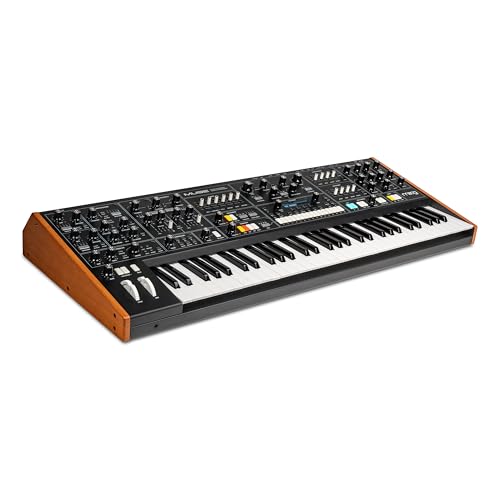
MOOG Muse 8-Voice Analog Synthesizer
Best for: polyphonic analog synthesis and studio sequencing
- Number of Keys
- 61
- Sound Engine
- Analog
- Polyphony
- 8-voice
- Preset Count
- 256
- Sequencer
- 64-step
- Color
- Black
The MOOG Muse is an eight-voice polyphonic analog synthesizer equipped with a 61-key layout, bi-timbral architecture, and a 64-step sequencer. Each voice provides two discrete VCOs, a modulation VCO, dual transistor ladder filters, and a stereo VCA. It gives you 256 patch slots and a stereo diffusion delay, fitting musicians who require multi-voice analog arrangements.
- 8-voice analog polyphony with bi-timbral architecture
- Full-size 61-key playing surface
- Onboard 64-step polyphonic sequencer and arpeggiator
- Integrated stereo diffusion delay processor
- Heavy 32-pound weight limits easy portability
- Large 39-inch by 17-inch footprint requires dedicated desk space
- Ships with 224 factory presets, leaving 32 open user slots across the 16 banks
- You need 8-voice analog polyphony for chords and layered sounds.
- You want a dedicated 61-key board with an integrated 64-step sequencer.
- You plan to design complex patches using dual filters and onboard diffusion delay.
- You need a lightweight instrument for mobile gigs; it weighs 32 pounds.
- You work in a cramped setup that cannot house a 39-inch wide synthesizer.
Verdict: MOOG Muse 61-Key Polyphonic Synthesizer delivers multi-voice analog synthesis and deep sequencing controls for studio musicians needing a full-sized centerpiece. Its 32-pound build and wide frame make it better suited for a permanent stand than a portable rig.
Specifications side by side
Spec Moog Mother-32 Analog Synthesizer Moog Grandmother 32-Key Analog Synthesizer MOOG Muse 8-Voice Analog Synthesizer
- Number of Keys
- –
- Key Action
- –
- Sound Engine
- Analog
- Polyphony
- –
- Preset Count
- –
- Connectivity
- MIDI In, CV Jack
- Sequencer
- 32-step
- Color
- Black
- Built-In Features
- Sequencer
- Features
- MIDI
- Dimensions
- 4.21 × 12.6 × 5.24 inches
- Weight
- 3.48 pounds
- Size
- Mother-32
- Model
- MOD-MOTHER-32
Copied from the Amazon listing. These figures were not measured here.
Who the MOOG Range Suits
This 3-model range suits you if you need analog hardware for studio sequencing or modular patching. Physical builds spread from the compact 12.6-inch, 3.48-pound desktop module up to a 39-inch, 32-pound 61-key instrument. All models come in a black finish, with no alternative lighting options or colors listed in their specifications. The lineup features both desktop box units and traditional keyboard frames. However, you will not find full 88-key sizes, battery power, or Bluetooth connectivity in the published specifications.
How to Choose a MOOG Keyboard
Check the Voice Count
Check whether the synthesizer is monophonic or polyphonic before you decide. Monophonic instruments play one note at a time, making them suitable for lead lines, bass riffs, and modular patching. If you want to play multi-note chords and harmonic progressions, look for multi-voice architecture. The MOOG Muse 8-Voice Analog Synthesizer provides eight voices of polyphony, which suits studio musicians who need to record complex chord structures rather than single-note lines.
Evaluate Keybed Size
Look at the physical key specifications to determine how you will interact with the sound engine. Some hardware instruments include integrated velocity-sensing keybeds, while module formats lack keys entirely and require external controllers. If you perform live solos, choosing integrated keys gives you direct control over dynamics. For instance, the Moog Grandmother 32-Key Analog Synthesizer features 32 velocity-sensing keys, offering a portable playing surface for performers who do not need a full five-octave spread.
Review Built-In Performance Tools
Examine the onboard sequencing and performance tools listed in the instrument specifications. While all models in this selection include built-in step sequencers for programming pitch and gate patterns, some also add arpeggiators. An arpeggiator automatically cycles through held notes, which helps you generate rhythmic ostinatos without manually programming each step. Check the listed features to confirm whether you receive both an arpeggiator and a sequencer for automated melodic control.
Consider Physical Weight
Check the weight and dimensions of each instrument against your studio workspace or gig bag capacity. Compact desktop units weighing under 4 pounds fit easily onto crowded production desks or into modular cases. Larger keyboards that weigh 16 to 32 pounds provide sturdier chassis for permanent stands, but they require dedicated room. Choose an instrument with a footprint that matches your desk surface and whether you intend to transport your setup.
Verify Digital Connectivity
Review the connectivity specifications to ensure smooth communication with your digital audio workstation or master controller. While standard MIDI handles note and clock communication with traditional hardware rigs, direct USB-MIDI enables straightforward integration with computer sequencing software over a single cable. The Moog Mother-32 Analog Synthesizer includes USB-MIDI connectivity, making it easy to sync its internal sequencer directly to your computer without needing a separate hardware MIDI interface.
Frequently asked questions
Does the Moog Mother-32 include a physical keyboard?
The Moog Mother-32 does not feature a physical piano keyboard. It is a tabletop semi-modular unit measuring 12.6 inches wide and weighing 3.48 pounds. Instead of integrated keys, you control it using its onboard step sequencer or through external controllers connected via MIDI or USB-MIDI connections.
Which MOOG synthesizer supports polyphonic playing?
The MOOG Muse provides polyphonic playing across 8 voices. Unlike monophonic instruments restricted to single notes, this model allows you to voice complex chords on its 61-key layout. It measures 39 inches across and weighs 32 pounds, making it an expansive centerpiece designed primarily for permanent studio installations.
What built-in performance tools come on the Moog Grandmother?
The Moog Grandmother includes both a built-in sequencer and an arpeggiator. These performance tools pair directly with its 32 velocity-sensing keys, allowing you to generate automated melodic patterns without external hardware. Its semi-modular design also provides patching options across a chassis that weighs 16 pounds and measures 23 inches wide.
Can you integrate the Moog Mother-32 into a Eurorack setup?
Yes, the Moog Mother-32 is built for Eurorack modular integration. Its compact chassis measures 4.21 inches in length and 5.24 inches in height, fitting standard modular dimensions. It offers semi-modular subtractive synthesis, an internal sequencer, and MIDI connectivity, serving as an accessible entry point for modular synthesis beginners.
How many keys does the Moog Grandmother have?
The Moog Grandmother features a 32-key layout with velocity-sensing response. This key count gives solo performers two and a half octaves of physical reach for playing monophonic leads and basslines. The instrument measures 14.3 inches long and 5.51 inches high, offering portable playability in a 16-pound format.
Which MOOG synthesizers feature USB-MIDI connectivity?
Among these models, the Moog Mother-32 explicitly lists USB-MIDI connectivity in its technical specifications. This interface enables direct communication between the synthesizer's built-in step sequencer and computer-based recording software. The compact module delivers raw subtractive synthesis without requiring standard five-pin DIN converter boxes when connecting to modern USB computer hosts.


