
As Amazon Associates, we earn from qualifying purchases. This means we may receive a small commission at no extra cost to you if you click through and make a purchase.
As an Amazon Associate we earn from qualifying purchases. Links on this page are affiliate links.
Choosing the best midi controllers for music production depends on your studio workflow and hardware requirements. We compared 4 options strictly by the specifications published on their product listings.
The Akai Professional MPC Live III Pad Controller takes the top spot because its built-in speakers, portable form factor, and standalone architecture support hardware synth control without a computer. This guide helps you choose the right key count, form factor, and connectivity for your music production setup.
Key Count Dictates Studio Workflow
Your workspace determines the right hardware format. If you need portable gear for travel, 25-key options like the Novation Launchkey Mini weigh 1.61 pounds. If you compose two-handed parts, 61-key options like the M-Audio Oxygen Pro offer full range at your desk. Check dimensions and key counts before you choose.
| # | Product | Best for | Price |
|---|---|---|---|
| 1 | Akai Professional MPC Live III Pad Controller Best overall | standalone beatmaking and hardware synth control | |
| 2 | M-Audio Oxygen Pro 61-Key MIDI Controller Best budget | producers wanting comprehensive DAW controls and pads | |
| 3 | Novation Launchkey 61 with Bluetooth Monitors Best weighted | producers wanting a full keyboard and monitors | |
| 4 | Novation Launchkey Mini 25-Key MIDI Controller Best arpeggiator | portable music production and arpeggiator-driven workflows |
The best fit for you
- You want built-in speakers for production – Akai Professional MPC Live III Pad Controller – It includes built-in speakers and portable standalone operation.
- You need extensive physical DAW controls – M-Audio Oxygen Pro 61-Key MIDI Controller – It features 61 keys, 16 pads, and 9 faders.
- You prefer weighted keyboard action – Novation Launchkey 61 with Bluetooth Monitors – It features weighted key action and Bluetooth connectivity.
- You need a lightweight arpeggiator controller – Novation Launchkey Mini 25-Key MIDI Controller – It weighs 1.61 pounds with a built-in arpeggiator.

Akai Professional MPC Live III Pad Controller
Best for: standalone beatmaking and hardware synth control
- Suitable For
- Music Production
- Performance Pads
- 3D-sensing MPCe pads
- Aftertouch
- Pad pressure
- Connectivity
- USB-C, MIDI, CV/Gate, Bluetooth, Wi-Fi
- Standalone Operation
- Standalone
- Form Factor
- Portable
This pad-based production center operates fully standalone without a computer. You get an 8-core processor, 8GB of RAM, and 128GB of internal storage alongside 3D-sensing velocity and pressure pads. It features a 7-inch multi-touch display, built-in battery, and CV/Gate outputs. It suits you if you want a complete hardware sequencer and sampler for standalone beat production.
- Standalone operation with 8-core CPU, 8GB RAM, and 128GB storage
- 3D-sensing MPCe pads with velocity, pressure, and X/Y control
- Extensive I/O including CV/Gate, MIDI, and 6 TRS outputs
- Built-in rechargeable battery, speakers, and integrated microphone
- Heavier than dedicated keyboard controllers at 9.48 pounds
- Lacks traditional piano-style keyboard keys
- You produce music without a computer using standalone hardware sequencing.
- You need CV/Gate and multiple audio outputs to control external synthesizers.
- You rely on pad finger-drumming with aftertouch and 3D control.
- You need traditional full-size piano keys for keyboard playing.
- You want a lightweight controller under five pounds for travel.
Verdict: Akai Professional MPC Live Standalone Controller gives you sampling, sequencing, and hardware synthesis control in a single untethered unit. It fits producers who require standalone workflow and deep CV and MIDI connectivity over traditional piano keys.
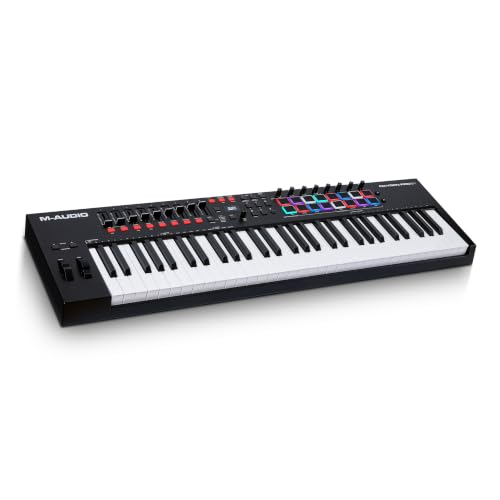
M-Audio Oxygen Pro 61-Key MIDI Controller
Best for: producers wanting comprehensive DAW controls and pads
- Suitable For
- Music Production
- Number of Keys
- 61
- Key Action
- Semi-weighted
- Performance Pads
- 16 RGB velocity-sensitive pads
- Aftertouch
- Aftertouch
- Faders and Knobs
- 8 knobs, 9 faders
The M-Audio Oxygen Pro 61 gives you full desktop production control with 61 velocity-sensitive, semi-weighted keys featuring aftertouch. It equips your studio with 16 RGB backlit pads, 9 faders, and 8 knobs for direct virtual instrument and DAW parameter mapping. You also get built-in Smart Chord and Smart Scale modes, making it suitable for producers seeking extensive hardware controls across five octaves.
- 61 semi-weighted velocity-sensitive keys with aftertouch
- 16 RGB backlit pads with Note Repeat for beat sequencing
- 9 assignable faders and 8 assignable knobs for DAW parameters
- Standard 5-pin MIDI output and sustain pedal jack
- Length of 40.5 inches and weight of 10.6 pounds limit portability
- Semi-weighted key action does not offer fully weighted hammer resistance
- You want 61 semi-weighted keys with aftertouch alongside dedicated faders and pads.
- You need hardware 5-pin MIDI output to control external synthesizers.
- You need a compact controller for tight workspaces or frequent travel.
- You prefer fully weighted hammer-action keys for traditional acoustic piano playing.
Verdict: M-Audio Oxygen Pro 61-Key MIDI Controller delivers a comprehensive control surface with 61 aftertouch-enabled keys, 16 pads, and 9 faders for producers who sequence in DAWs and run external MIDI gear.

Novation Launchkey 61 with Bluetooth Monitors
Best for: producers wanting a full keyboard and monitors
- Suitable For
- Music Production
- Number of Keys
- 61
- Key Action
- Semi-weighted
- Performance Pads
- 16 velocity-sensitive FSR pads
- Aftertouch
- Polyphonic
- Faders and Knobs
- 9 faders, 8 encoders
This bundle provides a 61-key USB-C controller alongside a pair of 50-watt Bluetooth studio monitors. You get a semi-weighted keybed with nine faders, eight encoders, and 16 velocity-sensitive pads featuring polyphonic aftertouch. Built-in scale and chord modes assist your songwriting in major DAWs. It suits producers and beatmakers needing both a full-range keyboard and dedicated desk monitoring in one setup.
- 16 velocity-sensitive pads with polyphonic aftertouch
- Includes 50W powered studio monitors with acoustic isolation pads
- Full mixing section with 9 faders and 8 encoders
- Built-in generative arpeggiator, scale modes, and chord modes
- Semi-weighted action rather than fully hammer-weighted piano action
- Monitor frequency response bottoms out at 55Hz
- You need a 61-key controller with polyphonic aftertouch pads.
- You want included studio monitors and audio cables in the same package.
- You require fully weighted hammer-action keys for classical piano practice.
- You already own studio monitors and only need a standalone MIDI controller.
Verdict: Novation Launchkey 61 Semi-Weighted Bundle delivers complete DAW control and desktop audio monitoring for producers building a multi-octave workstation.

Novation Launchkey Mini 25-Key MIDI Controller
Best for: portable music production and arpeggiator-driven workflows
- Suitable For
- Music Production
- Number of Keys
- 25
- Performance Pads
- 16 velocity-sensitive RGB
- Connectivity
- Sustain input, 3.5mm MIDI out
- Creative Modes
- Fixed chord mode, arpeggiator
- Form Factor
- Portable
The Novation Launchkey Mini MK3 is a compact 25-key USB MIDI keyboard controller designed for mobile music production. You get 16 velocity-sensitive RGB pads, eight rotary knobs, and pitch and modulation touch strips. It features a built-in arpeggiator with rhythm and octave controls alongside deep Ableton Live integration, making it ideal if you produce tracks on the move.
- Built-in arpeggiator with rhythm, pattern, octave, and gate controls
- 16 velocity-sensitive RGB pads for clip launching and finger drumming
- Lightweight 1.61-pound build powered directly over USB
- Hardware connectivity includes a 3.5mm MIDI out and sustain pedal jack
- Two-octave mini-key design limits two-handed playing
- Uses touch strips instead of physical pitch and mod wheels
- Requires a 3.5mm adapter for standard 5-pin DIN MIDI connections
- You need a lightweight MIDI keyboard under two pounds for traveling.
- You want direct hardware control over Ableton Live clips and macros.
- You rely on a customizable arpeggiator and single-finger chord modes.
- You require full-size piano keys or more than 25 keys.
- You prefer dedicated mechanical pitch and modulation wheels.
Verdict: Novation Launchkey Mini MK3 25-Key Controller suits mobile music producers who need deep Ableton Live integration, performance pads, and flexible arpeggiator controls in a 1.61-pound chassis.
Specifications side by side
Spec Akai Professional MPC Live III Pad Controller M-Audio Oxygen Pro 61-Key MIDI Controller Novation Launchkey 61 with Bluetooth Monitors Novation Launchkey Mini 25-Key MIDI Controller
- Number of Keys
- –
- Key Action
- –
- Performance Pads
- 3D-sensing MPCe pads
- Aftertouch
- Pad pressure
- Faders and Knobs
- –
- Connectivity
- USB-C, MIDI, CV/Gate, Bluetooth, Wi-Fi
- Creative Modes
- –
- Standalone Operation
- Standalone
- Form Factor
- Portable
- Skill Level
- Professionals
- Suitable For
- Music Production
- Color
- Black
- Built-In Features
- Built-In Speakers
- Features
- –
- Dimensions
- 10.1 × 17.2 × 2.64 inches
- Weight
- 9.48 pounds
- Model
- MPCLIVE3
- Size
- –
Copied from the Amazon listing. These figures were not measured here.
Key Specs for Choosing MIDI Controllers
Check Connectivity Types
Verify how the hardware links to your setup. Standard USB-MIDI connections provide direct communication with digital audio workstations via cable. Some controllers add Bluetooth connectivity for wireless communication with external gear or computers. The Novation Launchkey 61 bundle lists both USB-MIDI and Bluetooth connections. Match the connectivity specification to your computer ports or wireless studio gear to ensure stable signal transmission without requiring extra adapter hardware.
Evaluate Key Action
Examine key action specifications when choosing a controller. Models with weighted key action provide resistance under each key, which suits traditional piano playing techniques and dynamic velocity input. Other models use unweighted or mini synth keys that focus on compact footprints. If your music production workflow prioritizes formal keyboard performance, verify that the spec sheet lists weighted or semi-weighted keys before deciding on a specific unit size.
Review Surface Controls
Hardware controls determine how you manipulate software parameters during production. Check the control surface specifications for physical faders, knobs, and velocity pads. The M-Audio Oxygen Pro includes 16 pads and 9 physical faders alongside its 61 keys. If you frequently automate volume levels or mix tracks directly from hardware, prioritize units with multiple faders. If you only play melodies, basic keys without secondary control banks are sufficient.
Inspect Weight Dimensions
Physical dimensions and weight dictate where a device fits in your workspace. Check the listed length, width, and height against your studio desk dimensions. Units range from desk-filling frames to compact gear. For example, the Akai Professional MPC Live III measures 17.2 inches wide and weighs 9.48 pounds. Consider total footprint if you have limited desk space or need a portable device that fits easily into a travel bag.
Note Built-In Features
Look for integrated production functions listed under built-in features. Hardware utilities like integrated arpeggiators generate rhythmic patterns automatically without external software programming. The Novation Launchkey Mini lists a built-in arpeggiator directly in its feature specifications. Other units include built-in speakers for direct audio playback. Choose controllers with onboard processing tools if you want to generate musical ideas quickly without relying completely on complex digital audio workstation plugins.
Frequently asked questions
What is the benefit of aftertouch on a MIDI controller keyboard?
Aftertouch lets you modulate sounds by applying extra pressure to keys after striking them. This control alters parameters like vibrato or filter cutoff in compatible virtual instruments. The M-Audio Oxygen Pro includes aftertouch across its 61-key layout, giving you expressive continuous control when sequencing synth lines in your digital audio workstation.
Can you use a MIDI controller without connecting to a computer?
You can operate specific standalone units without a computer. The Akai Professional MPC Live III operates untethered with onboard sampling, sequencing, and hardware synthesis control. It also features built-in speakers and Bluetooth connectivity, letting you produce tracks and manage external MIDI or CV hardware directly from the portable chassis.
How does weighted key action affect music production?
Weighted key action adds mechanical resistance that simulates traditional acoustic pianos. This helps you control dynamics accurately when recording expressive acoustic piano or electric piano tracks. In this lineup, the Novation Launchkey 61 bundle provides weighted key action, pairing a 61-key format with Bluetooth monitoring to support studio recording.
What built-in features help with sequencing patterns on compact controllers?
Integrated arpeggiators allow you to generate automatic melodic sequences from held chords without manual note programming. The Novation Launchkey Mini includes a built-in arpeggiator along with performance pads and dedicated Ableton Live integration. These tools let you produce rhythmic patterns quickly on a 25-key surface designed for music production.
What physical controls should you look for when mixing in a DAW?
Physical faders and velocity-sensitive pads streamline mixing and beat creation compared to mouse input. Faders allow manual volume balancing across active channels, while pads trigger samples and drum hits. For example, the M-Audio Oxygen Pro provides 9 faders and 16 pads alongside its 61 keys for comprehensive software and hardware control.
What connectivity options are available on modern MIDI controllers?
Controllers typically connect to your production setup using standard USB-MIDI ports or wireless Bluetooth protocols. Standard USB-MIDI provides wired communication with computers, found on models like the Novation Launchkey Mini. For wireless setups, units like the Akai Professional MPC Live III and Novation Launchkey 61 bundle include Bluetooth for external hardware routing.
How do you choose between 25-key and 61-key MIDI controllers?
Your production style and studio desk space determine the ideal size. A 25-key model like the Novation Launchkey Mini measures 13 inches wide and suits compact desks or travel setups. A 61-key model like the M-Audio Oxygen Pro measures over 40 inches wide, giving you five full octaves for complex arrangements.


