
As Amazon Associates, we earn from qualifying purchases. This means we may receive a small commission at no extra cost to you if you click through and make a purchase.
As an Amazon Associate we earn from qualifying purchases. Links on this page are affiliate links.
Aftertouch provides dynamic modulation by tracking continuous finger pressure after you strike a key. We compared 5 models to find the best keyboards with aftertouch based on the specifications published on the listings.
The Arturia MicroFreak 25-Key Synth earns the top ranking because its 2.3-pound weight and 12.2-inch length deliver portable polyphonic aftertouch sound design for compact spaces. This guide helps you choose the right key count, physical dimensions, and hardware features for your setup.
Key count determines footprint and mobility
Key count directly determines instrument weight and desk space. If you prioritize portability, 25-key models like the 5.38-pound Novation Bass Station II fit compact setups. If you need an extended range with weighted hammer resistance, 88-key instruments like the Korg Nautilus require room for a 50.9-pound frame and a length of 56.6 inches.
| # | Product | Best for | Price |
|---|---|---|---|
| 1 | Arturia MicroFreak 25-Key Synth Best overall | portable polyphonic aftertouch sound design | |
| 2 | Novation Bass Station II Analog Monosynth Best budget | analog basslines with aftertouch expression | |
| 3 | Korg Keystage 61 Polyphonic Aftertouch Controller Best premium | producers needing polyphonic aftertouch with MIDI 2.0 | |
| 4 | Yamaha Montage 76-Key Synthesizer with Aftertouch Best 76-key | stage synth performers needing extended key range | |
| 5 | KORG Nautilus 88-Key Workstation with Aftertouch Best 88-key | pianists needing weighted action with aftertouch modulation |
The best fit for you
- You need an ultra-portable aftertouch synth. – Arturia MicroFreak 25-Key Synth – It weighs 2.3 pounds with built-in aftertouch.
- You want an analog monosynth with aftertouch. – Novation Bass Station II Analog Monosynth – It includes aftertouch and a built-in arpeggiator.
- You want extended range for stage playing. – Yamaha Montage 76-Key Synthesizer with Aftertouch – It features a 76-key layout with aftertouch.
- You need a full 88-key layout. – KORG Nautilus 88-Key Workstation with Aftertouch – It delivers an 88-key weighted frame with aftertouch.
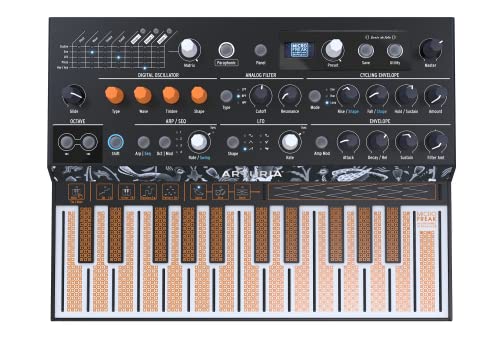
Arturia MicroFreak 25-Key Synth
Best for: portable polyphonic aftertouch sound design
- Built-In Features
- Aftertouch
- Number of Keys
- 25
- Key Action
- Poly-aftertouch
- Sound Engine
- Physical modeling to wavetable
- Polyphony
- Paraphonic
- Connectivity
- CV outputs, USB, MIDI
The Arturia MicroFreak is a compact hybrid synthesizer designed for expressive control. It features a 25-key flat printed circuit board with individual polyphonic aftertouch across every note. You get a paraphonic digital sound engine paired with an analog filter, CV outputs, and MIDI connectivity. It suits you if you want deep, note-by-note pressure modulation in a lightweight 2.3-pound desktop footprint.
- 25-key flat touch keyboard detects individual polyphonic aftertouch per note
- CV outputs route pitch, gate, and pressure signals to external modular gear
- Compact 12.2 by 9.2-inch footprint weighs 2.3 pounds
- 5×7 modulation matrix assigns modulation destinations for dynamic control
- Flat printed circuit board has no moving physical keys
- 25-key layout offers less range than 61-key and 88-key instruments
- Sound engine is paraphonic rather than fully polyphonic
- You want individual per-key polyphonic aftertouch modulation in a desktop format.
- You need CV pressure, gate, and pitch jacks to modulate modular equipment.
- You prefer a lightweight 2.3-pound synthesizer for mobile and space-limited setups.
- You require traditional mechanical moving keys with standard travel.
- You need full polyphony rather than a paraphonic oscillator architecture.
- You play two-handed repertoire requiring a 61-key or larger keybed.
Verdict: Arturia MicroFreak 25-Key Poly-Aftertouch Synth gives electronic producers per-key pressure articulation in an ultra-portable 2.3-pound footprint. It suits modular and desktop sound designers who prioritize polyphonic aftertouch control over conventional moving keys.

Novation Bass Station II Analog Monosynth
Best for: analog basslines with aftertouch expression
- Built-In Features
- Aftertouch, Arpeggiator
- Number of Keys
- 25
- Key Action
- Aftertouch
- Sound Engine
- Analog
- Polyphony
- Monosynth, paraphonic
- Preset Count
- 64
The Novation Bass Station II is an analog monosynth with 25 full-size keys and assignable aftertouch. You get two tunable analog oscillators, a sub-oscillator, dual filter modes, and an onboard step sequencer. Its 5-pin DIN MIDI and USB ports route expressive aftertouch data directly to hardware or DAWs. It suits players seeking a compact analog synth for expressive lead and bass work.
- Full-size 25-key bed with built-in aftertouch
- Pure analog signal path with two oscillators and a sub-oscillator
- Built-in pattern step sequencer and arpeggiator
- Standard 5-pin DIN MIDI input and output plus USB connectivity
- 25-key reach limits two-handed playing
- Monophonic and paraphonic voice architecture restricts chords
- Stores only 128 total patches with 64 factory presets
- You want aftertouch modulation on a compact 25-key analog synth.
- You need 5-pin DIN MIDI ports to control external sound gear.
- You use an integrated step sequencer and arpeggiator for real-time patterns.
- You need polyphony for playing standard multi-note chords.
- You require 61 or 88 keys for wide two-handed performances.
Verdict: Novation Bass Station II 25-Key Synthesizer delivers hardware aftertouch control and analog sound shaping in a compact footprint for producers focused on monosynth basslines and leads.

Korg Keystage 61 Polyphonic Aftertouch Controller
Best for: producers needing polyphonic aftertouch with MIDI 2.0
- Built-In Features
- Aftertouch
- Number of Keys
- 61
- Key Action
- Semi-weighted, Polyphonic Aftertouch
- Connectivity
- MIDI 2.0
- Color
- Black
- Dimensions
- 9.21 × 38.5 × 3.23 inches
This 61-key MIDI controller features semi-weighted keys with polyphonic and channel aftertouch plus MPE support. It provides MIDI 2.0 connectivity, dedicated OLED parameter screens, and an integrated audio interface with direct stereo output. Weighing 11.9 pounds, it suits producers and stage performers who need individual per-key pressure control without carrying a heavier synthesizer.
- Polyphonic and channel aftertouch with MPE compatibility
- MIDI 2.0 connectivity with Property Exchange
- Built-in audio interface with direct stereo outputs
- Parameter-dedicated OLED screens for visual feedback
- Semi-weighted keybed instead of fully weighted hammer action
- 61 keys rather than a full 88-note range
- You need polyphonic aftertouch to modulate individual held notes independently.
- You want MIDI 2.0 support and an integrated stereo audio interface in your controller.
- You prefer an 11.9-pound portable footprint with dedicated OLED readouts.
- You want fully weighted hammer-action keys instead of semi-weighted action.
- You need an 88-key board to cover traditional acoustic piano literature.
Verdict: Korg Keystage 61-Key Aftertouch Controller gives electronic producers and live keyboardists precise per-note dynamic expression through MPE support and MIDI 2.0 integration.

Yamaha Montage 76-Key Synthesizer with Aftertouch
Best for: stage synth performers needing extended key range
- Built-In Features
- Aftertouch
- Number of Keys
- 76
- Key Action
- FSX action with Aftertouch
- Polyphony
- 400-note
- Color
- Black
- Dimensions
- 49 × 15.6 × 5.19 inches
The Yamaha Montage M 76-Key Synthesizer gives you an extended performance platform with FSX action and built-in aftertouch. It features 400-note total polyphony across three sound engines, including the AN-X analog engine. Dedicated Scene and Part controls support real-time sound design. It suits keyboardists needing extended key range and deep modulation without full 88-key bulk.
- 76-key FSX action keybed with aftertouch
- 400-note total polyphony across three sound engines
- Seamless Sound Switching for smooth preset transitions
- Dedicated physical Keyboard, Part, and Scene controls
- Weighs 37.5 pounds, making transport difficult
- 49-inch length requires substantial stand and desk space
- You want a 76-key synth action keybed with expressive aftertouch control.
- You need high polyphony and three distinct synthesis engines for layered performances.
- You work in a DAW and want integration through the Expanded Softsynth Plugin.
- You need a lightweight board under 30 pounds for frequent travel.
- You prefer a full 88-note weighted piano action over semi-weighted synth keys.
Verdict: Yamaha Montage M 76-Key Synthesizer delivers massive 400-note polyphony and aftertouch dynamics for gigging players and studio composers who need extra octave range without hammer-action bulk.

KORG Nautilus 88-Key Workstation with Aftertouch
Best for: pianists needing weighted action with aftertouch modulation
- Built-In Features
- Aftertouch
- Number of Keys
- 88
- Key Action
- Weighted hammer action with Aftertouch
- Sound Engine
- Nine sound engines
- Color
- Black
- Dimensions
- 56.6 × 15.2 × 5.47 inches
The Korg Nautilus 88-Key Workstation pairs full-range piano playing with expressive aftertouch control. You get a four-stage weighted hammer action across 88 keys, nine distinct sound engines, and a dedicated Dynamics knob to tailor keybed sensitivity on the fly. It suits performers and studio composers who need authentic piano resistance alongside comprehensive workstation synthesis and live setlist management.
- 88-key four-stage weighted hammer action with aftertouch
- Nine built-in sound engines for acoustic and synth performance
- Dynamics knob for instant adjustment of keybed velocity sensitivity
- Set List mode with color-coded touch-screen selection
- Heavy 50.9-pound build requires effort to transport
- Large 56.6-inch width demands substantial desk or stage space
- You want an 88-key weighted hammer action combined with aftertouch expressive control.
- You need nine sound engines and touch-screen setlist organization for live shows.
- You want hardware control over keybed velocity response using a dedicated knob.
- You need a lightweight board under 50 pounds for frequent solo gig travel.
- You work in a tight studio setup that cannot fit a 56.6-inch chassis.
Verdict: Korg Nautilus 88-Key Workstation delivers weighted hammer resistance and aftertouch modulation for pianists running complex stage or studio arrangements. Its nine sound engines provide deep sound design if you have the space for its 50.9-pound frame.
Specifications side by side
Spec Arturia MicroFreak 25-Key Synth Novation Bass Station II Analog Monosynth Korg Keystage 61 Polyphonic Aftertouch Controller Yamaha Montage 76-Key Synthesizer with Aftertouch KORG Nautilus 88-Key Workstation with Aftertouch
- Number of Keys
- 25
- Key Action
- Poly-aftertouch
- Sound Engine
- Physical modeling to wavetable
- Polyphony
- Paraphonic
- Preset Count
- –
- Connectivity
- CV outputs, USB, MIDI
- Sequencer
- –
- Color
- Black
- Built-In Features
- Aftertouch
- Features
- –
- Dimensions
- 12.2 × 9.2 × 2.2 inches
- Weight
- 2.3 pounds
- Size
- 12.2 inches (L) x 9.2 inches (W) x 2.2 inches (H)
- Model
- 570101
Copied from the Amazon listing. These figures were not measured here.
How to Choose an Aftertouch Keyboard
Evaluate Aftertouch Type
Aftertouch functions in two distinct formats: channel and polyphonic. Standard channel aftertouch reads the deepest key press and applies that modulation value across all held notes simultaneously. Polyphonic aftertouch tracks pressure independently on each key. This allows you to swell a single melody note while keeping chord accompaniment steady. The Arturia MicroFreak provides polyphonic aftertouch, making it suitable for producers who require independent per-key pressure articulation.
Check Polyphony Limits
Maximum polyphony indicates how many notes an instrument generates at the same time. Monophonic keyboards produce only one note, which works well for basslines and lead riffs. Polyphonic instruments allow complex chords and sustained layers without premature voice cutoff. If you play dense arrangements with long decay times, select a model with high polyphony headroom. The Yamaha Montage provides 400-note polyphony, which prevents note dropouts during multi-layered stage performances.
Consider MIDI Protocols
Digital keyboards communicate with computers and hardware through specific MIDI protocols. Standard USB-MIDI transmits conventional 7-bit control values, which give you 128 discrete pressure steps. Advanced controllers support MIDI 2.0 and MPE, providing higher-resolution communication and per-note articulation channels. Choose advanced protocols if your digital audio workstation supports detailed continuous controller data. The Korg Keystage features MIDI 2.0 integration and MPE support, matching workflows that rely on precise expressive software instruments.
Match Keybed Resistance
Key action defines how the instrument responds under your fingers. Synth-action beds use light springs for rapid synth leads and fast organ runs. In contrast, weighted hammer action replicates the mechanical resistance and inertia of an acoustic grand piano. Engaging aftertouch on hammer action requires deliberate downward pressure past the keybed bottom. The Korg Nautilus features weighted hammer resistance alongside aftertouch, suiting pianists who require authentic touch response for complex studio arrangements.
Review Onboard Performance Tools
Built-in performance utilities expand what you can articulate in real time without extra external gear. Keyboards featuring integrated hardware arpeggiators let you generate rhythmic sequences from held chords, leaving your hands free to modulate filter sweeps and aftertouch parameters. If your workflow focuses on live electronic improvisation, check for integrated pattern tools on the hardware panel. The Novation Bass Station II includes a built-in arpeggiator paired with aftertouch control for rhythmic basslines and lead shaping.
Frequently asked questions
Which keyboard with aftertouch supports MIDI 2.0?
The Korg Keystage 61 features MIDI 2.0 integration alongside MPE support. This 61-key controller uses polyphonic aftertouch to send individual pressure values per note. It connects to external sound gear using USB-MIDI and weighs 11.9 pounds. Its black frame measures 38.5 inches long by 9.21 inches wide.
What is the lightest keyboard with aftertouch on this list?
The Arturia MicroFreak is the lightest model, weighing 2.3 pounds. It measures 12.2 inches long by 9.2 inches wide and 2.2 inches high. You get a 25-key layout featuring polyphonic aftertouch in a compact black chassis designed for desktop sound design and mobile setups.
Can you get an 88-key weighted keyboard with aftertouch?
Yes, the Korg Nautilus 88-Key Workstation provides weighted hammer resistance alongside aftertouch modulation. It features nine sound engines for deep acoustic and synthesizer patch creation. The black chassis measures 56.6 inches long by 15.2 inches wide, making it a dedicated 50.9-pound station for studio and stage performers.
Which aftertouch keyboard offers the highest polyphony for stage performance?
The Yamaha Montage M 76-Key Synthesizer delivers 400-note polyphony for complex live arrangements. It includes built-in aftertouch on an extended 76-key bed. The hardware weighs 37.5 pounds and measures 49 inches in length by 15.6 inches in width, giving you extra octave range without hammer-action bulk.
Which analog synth includes both aftertouch and an arpeggiator?
The Novation Bass Station II includes hardware aftertouch and a built-in arpeggiator. This analog monosynth features USB connectivity and a 25-key surface optimized for basslines and lead performance. Its black and blue body measures 18 inches by 10.7 inches and weighs 5.38 pounds for easy transport.
How do aftertouch keyboards connect to other gear?
Keyboards with aftertouch use standard connection protocols like USB and USB-MIDI. For example, the Novation Bass Station II provides USB connectivity, while the Korg Keystage 61 utilizes USB-MIDI to transmit pressure data and MIDI 2.0 messages. These ports let you send aftertouch signals directly to DAWs or external sound modules.


