
As Amazon Associates, we earn from qualifying purchases. This means we may receive a small commission at no extra cost to you if you click through and make a purchase.
As an Amazon Associate we earn from qualifying purchases. Links on this page are affiliate links.
Finding the best keyboards under $4000 requires comparing key action, sound generation, and overall instrument dimensions. You will find 5 models in this guide, ranked strictly by the specifications published on the listings.
The Korg Kronos 3 73-Key Weighted Workstation takes the top rank because it combines hammer-weighted touch and multi-engine synthesis within a 49-inch wide frame. This spec comparison helps you decide which key count, voice architecture, and physical footprint best match your studio or stage needs.
Match Key Action to Transport Needs
Key count and action directly decide instrument weight. The 73-key weighted Korg Kronos 3 reaches 55.3 pounds, making it best for permanent setups. If you gig frequently, the 76-key Roland V-Stage 76 provides semi-weighted action at 33.6 pounds. Choose 61 or 76 semi-weighted keys for travel, or weighted actions for studio stability.
| # | Product | Best for | Price |
|---|---|---|---|
| 1 | Korg Kronos 3 73-Key Weighted Workstation Best overall | producers needing weighted action and multi-engine synthesis | |
| 2 | Yamaha Montage M6 61-Key Synthesizer Best budget | producers wanting high polyphony and DAW integration | |
| 3 | Roland V-Stage 88 Stage Keyboard Bundle Best premium | performers needing dedicated sound engines and XLR routing | |
| 4 | Roland V-STAGE 76-Key Semi-Weighted Keyboard Best 76-key | gigging players wanting 76 semi-weighted keys | |
| 5 | MOOG Muse 8-Voice Analog Synthesizer Best sequencer | analog sound design and complex step sequencing |
The best fit for you
- You want weighted keys with multi-engine sound design – Korg Kronos 3 73-Key Weighted Workstation – The 73-key hammer-weighted action pairs with multi-engine synthesis across a 49-inch frame.
- You need high polyphony and expressive aftertouch – Yamaha Montage M6 61-Key Synthesizer – This model features 400-note polyphony and built-in aftertouch on a 61-key frame.
- You prefer semi-weighted keys for live performance – Roland V-STAGE 76-Key Semi-Weighted Keyboard – The 76-key semi-weighted format includes four dedicated sound engines and weighs 33.6 pounds.
- You want analog synthesis with integrated step sequencing – MOOG Muse 8-Voice Analog Synthesizer – This 61-key instrument delivers eight-voice analog architecture paired with an onboard sequencer.

Korg Kronos 3 73-Key Weighted Workstation
Best for: producers needing weighted action and multi-engine synthesis
- Number of Keys
- 73
- Key Action
- RH3 Weighted Hammer Action
- Sound Engine
- 9 Sound Engines
- Color
- Black
- Dimensions
- 14.6 × 49 × 5.83 inches
- Weight
- 55.3 pounds
The Korg Kronos 3 73-Key Weighted Workstation pairs a 73-note RH3 weighted hammer-action keybed with 9 dedicated sound engines. You navigate parameters through an 8-inch color TouchView display and shape notes using an integrated ribbon controller and 4-way joystick. It suits gigging musicians and studio producers who need deep sound synthesis alongside weighted piano-style resistance in a 49-inch frame.
- 9 dedicated sound engines
- RH3 weighted hammer-action keybed
- 8-inch color TouchView display
- Built-in ribbon controller and 4-way joystick
- Substantial 55.3-pound weight makes solo transport difficult
- 73-key layout lacks the full 88-key acoustic piano range
- You need multiple synthesis types within a single hardware workstation.
- You want authentic hammer-action resistance in a setup narrower than 88 keys.
- You actively use hardware modulation tools like joysticks and ribbon strips.
- You need a lightweight instrument under 50 pounds for regular travel.
- You require a full 88-note compass for classical piano repertoire.
Verdict: Korg Kronos 3 73-Key Weighted Workstation gives performing keyboardists extensive multi-engine sound design and hammer-weighted touch in a space-saving 49-inch footprint.

Yamaha Montage M6 61-Key Synthesizer
Best for: producers wanting high polyphony and DAW integration
- Number of Keys
- 61
- Key Action
- FSX action with Aftertouch
- Polyphony
- 400-note
- Dimensions
- 40.8 × 15.6 × 5.19 inches
- Weight
- 33.1 pounds
The Yamaha Montage 61-Key Synthesizer with Aftertouch is a digital synthesizer built for studio production and stage performance. You get 400-note polyphony distributed across three sound engines, including the AN-X analog engine. Its 61-key FSX keybed provides aftertouch control for modulation. At 33.1 pounds, it fits musicians who need extensive polyphony and deep DAW integration via the included softsynth plugin.
- 400-note total polyphony across three sound engines
- FSX keybed action with aftertouch control
- AN-X engine for analog synth sound design
- Seamless Sound Switching for smooth preset changes
- Expanded Softsynth Plugin replicates hardware controls in your DAW
- 61-key layout offers fewer octaves than 73-key or 88-key alternatives
- Total weight of 33.1 pounds makes it heavy for a 61-key frame
- You need 400-note polyphony across multiple sound engines for layered patches.
- You want physical aftertouch modulation on a 61-key FSX action keybed.
- You produce in a DAW and want direct softsynth integration.
- You need a wider 73-key or 88-key layout for standard two-handed piano repertoire.
- You require an ultra-portable stage board weighing under 30 pounds.
Verdict: Yamaha Montage 61-Key Synthesizer with Aftertouch delivers 400-note polyphony and flexible sound engines for synth performers. It provides immediate sound switching and aftertouch control inside a compact 61-key chassis.

Roland V-Stage 88 Stage Keyboard Bundle
Best for: performers needing dedicated sound engines and XLR routing
- Sound Engine
- V-Piano, ZEN-Core
- Connectivity
- XLR, 1/4-inch, USB-C
- Form Factor
- Stage
- Color
- Black
- Dimensions
- 13.9 × 52.4 × 5.6 inches
- Weight
- 48.1 pounds
The Roland V-STAGE 88 is an 88-key stage keyboard built for live performance. It features four sound engines, including V-Piano and ZEN-Core, alongside balanced XLR and 1/4-inch outputs with an XLR microphone input. With 512 memory scenes, 128 scene chains, and an included stand and bench, you get a complete setup for multi-instrument stage sets.
- Four sound engines covering acoustic piano, electric piano, organ, and ZEN-Core synthesis
- Comprehensive connectivity including balanced XLR outputs, sub outputs, and an XLR mic input
- Built-in USB-C audio and MIDI interface
- Large internal storage with 512 scenes and 128 scene chains
- Heavy chassis weighing 48.1 pounds before adding accessories
- Taller 5.6-inch profile than the 4.3-inch 76-key variation
- You need balanced XLR line outs and a dedicated XLR vocal mic input on stage.
- You organize complex live sets using custom scene chains.
- You want bundled performance hardware including an adjustable stand, bench, and pedal.
- You need a lightweight board under 40 pounds for frequent solo transport.
- You want a more compact profile and prefer the 4.3-inch height of the 76-key version.
Verdict: Roland V-STAGE 88 Stage Keyboard Bundle provides touring keyboardists with dedicated piano and synth engines, complete stage connectivity, and bundled hardware. It suits performers who need full setlist recall and comprehensive audio routing from a single 88-key stage rig.

Roland V-STAGE 76-Key Semi-Weighted Keyboard
Best for: gigging players wanting 76 semi-weighted keys
- Number of Keys
- 76
- Key Action
- Semi-weighted
- Sound Engine
- V-Piano, SuperNATURAL, VTW, ZEN-Core
- Preset Count
- Over 400
- Form Factor
- Stage
- Dimensions
- 51 × 20 × 9.5 inches
The Roland V-Stage 76-Key Stage Keyboard gives you 76 semi-weighted keys in a 33.6-pound chassis. It runs four discrete sound engines: V-Piano acoustic modeling, SuperNATURAL electric pianos, Virtual Tone Wheel organ, and the ZEN-Core synth with over 400 presets. You get 512 Scene slots and 128 Scene Chains. It suits live performers who need multi-engine synthesis without hammer-action weight.
- Four dedicated sound engines for acoustic piano, electric piano, organ, and synth
- 76 semi-weighted keys keep total weight down to 33.6 pounds
- 512 Scene memories and 128 Scene Chains for live setlists
- ZEN-Core engine includes over 400 presets and Roland Cloud expansion support
- Semi-weighted action lacks the fully weighted hammer resistance of acoustic pianos
- Deep 20-inch front-to-back profile demands ample stand space
- You need separate dedicated engines for organ, piano, and synth sounds.
- You prefer light semi-weighted keys over heavy hammer action for travel.
- You manage complex gigs that rely on 128 preset Scene Chains.
- You require an 88-key layout with weighted hammer action.
- You need a shallow stage footprint under 20 inches deep.
Verdict: Roland V-Stage 76-Key Stage Keyboard delivers four dedicated sound engines and fast setlist switching for performers who prefer semi-weighted key response over hammer action.
MOOG Muse 8-Voice Analog Synthesizer
Best for: analog sound design and complex step sequencing
- Number of Keys
- 61
- Sound Engine
- Analog
- Polyphony
- 8-voice
- Preset Count
- 256
- Sequencer
- 64-step
- Color
- Black
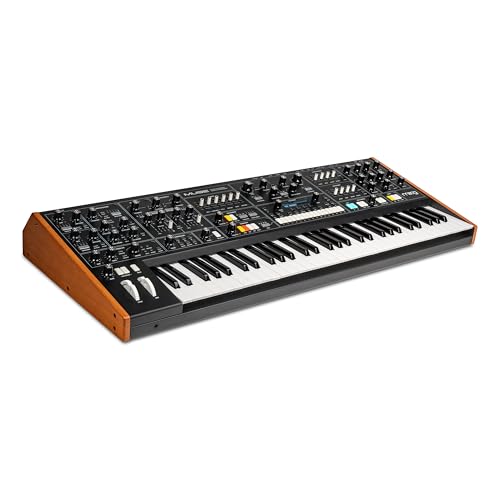
The Moog Muse is a bi-timbral analog synthesizer featuring 61 keys and an 8-voice polyphonic engine. It includes a built-in 64-step polyphonic sequencer, an arpeggiator, and a stereo diffusion delay processor. If you want direct knob-per-function sound design paired with dedicated step sequencing for studio production or stage performance, this hardware synth matches your setup.
- Built-in 64-step polyphonic sequencer with chord memory and generative behaviors
- Eight-voice analog engine with two VCOs, modulation VCO, and dual ladder filters per voice
- Stereo diffusion delay processor with multi-tap and filter controls
- Knob-per-function front panel controls for direct parameter adjustments
- 8-voice polyphony limits dense, sustained chord arrangements compared to digital workstations
- 61-key range offers less reach than 73- or 88-key stage keyboards
- Total patch storage is capped at 256 slots with only two banks open for user sounds
- You want a dedicated 64-step polyphonic sequencer integrated into an analog keyboard.
- You prioritize discrete analog signal paths with knob-per-function controls.
- You require onboard stereo diffusion delay and bi-timbral sound layering.
- You need high polyphony counts for complex multi-layered acoustic arrangements.
- You prefer a full 73-key or 88-key playing range.
- You need more than 32 user patch memory locations out of the box.
Verdict: Moog Muse 61-Key 8-Voice Analog Synthesizer gives electronic musicians and sound designers dedicated analog architecture paired with advanced step sequencing. It serves producers who need bi-timbral analog synthesis over high digital polyphony.
Specifications side by side
Spec Korg Kronos 3 73-Key Weighted Workstation Yamaha Montage M6 61-Key Synthesizer Roland V-Stage 88 Stage Keyboard Bundle Roland V-STAGE 76-Key Semi-Weighted Keyboard MOOG Muse 8-Voice Analog Synthesizer
- Number of Keys
- 73
- Key Action
- RH3 Weighted Hammer Action
- Sound Engine
- 9 Sound Engines
- Polyphony
- –
- Preset Count
- –
- Connectivity
- –
- Sequencer
- –
- Form Factor
- –
- Color
- Black
- Built-In Features
- –
- Dimensions
- 14.6 × 49 × 5.83 inches
- Weight
- 55.3 pounds
- Model
- KRONOS3-73
- Size
- –
Copied from the Amazon listing. These figures were not measured here.
How to Choose the Right Keyboard
Voice Architecture and Polyphony
Evaluate the polyphony specification against your playing style. Synthesizers with analog architectures offer dedicated physical voices, suited for distinct melodic lines, basslines, and focused chords. The MOOG Muse provides an 8-voice analog engine tailored for bi-timbral sound design. If you regularly layer multi-part pads or hold sustained acoustic piano passages, digital engines with higher polyphony prevent premature voice stealing. Check voice specs to ensure your chord arrangements do not exceed the instrument limit.
Total Keybed Note Range
Select a key count that accommodates your musical material. Pianists who perform classical repertoire, split bass arrangements, or expansive two-hand chords require a full 88-key board. The Roland V-Stage 88 Stage Keyboard Bundle provides an 88-key layout for uncompromised acoustic and stage coverage. If you primarily trigger synth leads, brass patches, or organ phrases, 61-key or 76-key options offer smaller footprints. Review your lowest and highest performance notes before selecting your key count.
Expressive Keybed Aftertouch Support
Check whether the keyboard action includes aftertouch sensors. Aftertouch lets you modulate vibrato, filter cutoffs, or volume levels by applying downward pressure after striking a key. The Yamaha Montage M6 features built-in aftertouch control across its 61-key layout. This physical control benefits live soloists and synth performers who need continuous sound shaping without taking their hands off the keys. If you only play traditional acoustic piano parts, standard velocity sensitivity without aftertouch will typically suffice.
Chassis Depth and Footprint
Measure your studio desk and keyboard stand before selecting a model. Instrument dimensions vary significantly beyond key count alone due to rear jack panels and front-panel interfaces. The Korg Kronos 3 73-Key Weighted Workstation measures 49 inches in width, 14.6 inches in length, and 5.83 inches in height. Deep chassis demand sturdy, deep stands and substantial desk clearance. Check published length, width, and height specifications to ensure the instrument fits your physical setup.
Dedicated Stage Form Factor
Consider the form factor to match your gigging routine. Stage keyboards prioritize fast setup, direct sound controls, and durable chassis designs for live touring environments. The Roland V-STAGE 76-Key Semi-Weighted Keyboard features a dedicated stage form factor built for quick sound switching during live sets. If your instrument remains primarily in a home studio, deeper workstation chassis with comprehensive on-screen sequencing may suit your workflow better. Choose your form factor according to your performance environment.
Frequently asked questions
Which stage keyboard includes dedicated XLR connections?
The Roland V-Stage 88 Stage Keyboard Bundle provides dedicated XLR routing for direct stage audio connections. You also get dedicated piano and synth engines alongside full setlist recall. The instrument measures 52.4 inches wide by 13.9 inches long and weighs 48.1 pounds, giving you complete live performance connectivity.
What is aftertouch on a synthesizer keyboard?
Aftertouch senses continuous finger pressure applied after striking a key to modulate sound parameters in real time. You can use it to adjust filters or vibrato dynamically without taking your hands off the keyboard. On this list, the 61-key Yamaha Montage M6 synthesizer includes built-in aftertouch for expressive performance control.
Which keyboard on this list has a built-in step sequencer?
The MOOG Muse 8-Voice Analog Synthesizer includes a built-in step sequencer for automated note and modulation patterns. You get a bi-timbral analog engine across a 61-key layout. The instrument measures 39 inches wide, 17 inches long, and 4.5 inches high while weighing 32 pounds for studio sound design.
What physical dimensions should you expect from a 73-key weighted workstation?
A 73-key weighted workstation balances full-range hammer feel with a footprint smaller than an 88-key frame. For example, the Korg Kronos 3 measures 49 inches wide, 14.6 inches long, and 5.83 inches high. It weighs 55.3 pounds, making it a substantial instrument best suited for permanent studio tables or heavy-duty stage stands.
What are the differences between 61-key and 76-key keyboards for gigging?
Key count determines your playable octave range as well as the chassis width during transport. A 61-key model like the Yamaha Montage M6 measures 40.8 inches long and weighs 33.1 pounds. The 76-key Roland V-STAGE 76 measures 51 inches long and weighs 33.6 pounds, giving you broader two-hand split capability.
How does bi-timbral synthesis work on analog keyboards?
Bi-timbral synthesis lets you split or layer two distinct instrument sounds at the same time across your keybed. You can route separate melodic patches to different keyboard zones or combine them for dense textures. The MOOG Muse synthesizer uses bi-timbral analog architecture across 61 keys alongside an integrated hardware sequencer.


