
As Amazon Associates, we earn from qualifying purchases. This means we may receive a small commission at no extra cost to you if you click through and make a purchase.
As an Amazon Associate we earn from qualifying purchases. Links on this page are affiliate links.
When comparing an arturia vs MOOG keyboard setup, both brands provide compact hardware synthesizers equipped with step sequencers and CV connectivity for external gear. The main distinction lies in interface and sound generation. Arturia MicroFreak includes a 25-key touch plate with polyphonic aftertouch and a hybrid digital-analog engine. Moog Mother-32 uses an all-analog signal path with semi-modular patching and works as a tabletop unit or Eurorack module without standard playing keys.
Number of keys
25 keys
not listed
Key action
Super-flat PCB with polyphonic aftertouch
not listed
Sound engine
Digital hybrid (paraphonic, 17 oscillator modes, analog filter)
Analog (VCO, white noise generator, ladder filter)
Form factor
Desktop synthesizer keyboard
Tabletop synth or 60HP Eurorack module
Sequencer
Sequencer with automation recording and Spice and Dice functions
32-step sequencer with up to 64 on-board sequences
Weight
2.3 pounds
3.48 pounds
Choose the first if
- You want an integrated 25-key touch plate that tracks polyphonic aftertouch.
- You prefer a hybrid engine with 17 paraphonic digital oscillator types paired with an analog filter.
- You require a lightweight 2.3-pound instrument for desktop or portable setups.
Choose the second if
- You prefer an all-analog signal path with semi-modular patching and a ladder filter.
- You intend to mount your instrument into a 60HP Eurorack case.
- You want a 32-step sequencer that stores up to 64 pattern sequences.
Verdict
Choose the Arturia MicroFreak if you want an expressive 25-key touch surface with extensive digital synthesis modes. Select the Moog Mother-32 if you require a dedicated analog signal path with Eurorack integration and patchable CV routing. Your decision depends on whether you need a playable touch keyboard or a semi-modular synth voice.
Arturia MicroFreak vs MOOG Mother-32
Key action and interface
Edge: Arturia MicroFreak 25-Key Synth
When you look at performance controls, the Arturia MicroFreak 25-Key Synth includes a 25-key printed circuit board. This flat touch plate uses no moving parts and detects pressure and polyphonic aftertouch per note. In contrast, the Moog Mother-32 Analog Synthesizer does not list standard keyboard keys in its specifications. Instead, you interact with the instrument using onboard sequencer buttons and knobs. If you need dedicated keys to play melodic lines by hand with expressive finger pressure, the Arturia unit delivers that specific physical control directly out of the box, whereas the MOOG unit relies primarily on step input for musical performance.
Form factor and modular integration
Edge: Moog Mother-32 Analog Synthesizer
Physical installation options differ between these synthesizers. The Moog Mother-32 Analog Synthesizer operates as a standalone tabletop unit or installs directly into an existing Eurorack case as a 60HP module. You can also expand your setup by combining multiple Mother-32 units. The Arturia MicroFreak 25-Key Synth is strictly a desktop unit with fixed enclosure dimensions of 12.2 by 9.2 by 2.2 inches. Its specifications do not mention modular chassis installation or Eurorack faceplate removal. If you already own a modular rack or plan to build one, the MOOG design gives you direct mounting adaptability that the Arturia synthesizer cannot provide.
Sound engine architecture
Edge: Arturia MicroFreak 25-Key Synth
Sound generation defines how each synth shapes tone. The Arturia MicroFreak 25-Key Synth uses a hybrid setup. It combines an analog resonant filter with a digital oscillator offering 17 modes, such as wavetable, physical modeling, vocoder, and noise. It also supports paraphonic playing and internal 5×7 matrix routing. Conversely, the Moog Mother-32 Analog Synthesizer provides a strictly analog signal path. It features a voltage-controlled oscillator, white noise generator, external audio input, and an analog ladder filter. While the MOOG model delivers classic continuous analog filtering, the Arturia model offers far more sonic modes and oscillator algorithms in one compact frame.
Sequencer and pattern memory
Edge: Moog Mother-32 Analog Synthesizer
Both instruments include step sequencers, but their operational parameters vary. The Moog Mother-32 Analog Synthesizer comes with a 32-note step sequencer featuring two distinct modes and internal storage for up to 64 sequences. This allows you to store and recall dozens of patterns for live sets. The Arturia MicroFreak 25-Key Synth provides step editing, four automation lanes, and Spice and Dice randomization tools for real-time variation, but its specifications do not state total pattern memory banks. If your workflow demands saving and recalling dozens of pre-programmed step sequences during live performance, the MOOG synthesizer gives you clear published memory capacity.
Dimensions and weight
Edge: Arturia MicroFreak 25-Key Synth
If desk space and transport weight guide your choice, their measurements reveal measurable differences. The Arturia MicroFreak 25-Key Synth measures 12.2 inches long, 9.2 inches wide, and 2.2 inches high, weighing in at 2.3 pounds. The Moog Mother-32 Analog Synthesizer measures 12.6 inches wide, 4.21 inches long, and 5.24 inches high, with a total weight of 3.48 pounds. While the MOOG unit takes up less depth on a surface, the Arturia model is more than a pound lighter and has a lower vertical profile. That makes the Arturia synthesizer easier to pack flat into a gig bag or standard backpack.
Selecting the Right Synthesizer Model
Eurorack modular synth owners
Our pick: Moog Mother-32 Analog Synthesizer
If you maintain an existing modular rack, you can uncase this semi-modular unit and install it directly as a standard 60HP Eurorack module. Its analog signal path includes a voltage-controlled oscillator, ladder filter, and CV patch jacks, letting you route raw analog audio without requiring external power adapters or separate desktop space.
Producers wanting digital synthesis engine variety
Our pick: Arturia MicroFreak 25-Key Synth
If your workflow requires diverse sonic palettes, this unit provides 17 paraphonic oscillator engines spanning wavetable, vocoder, and physical modeling. You can shape evolving patches via the onboard 5×7 modulation matrix, capture parameter shifts with four automation lanes, and route pitch, gate, and pressure CV signals to external desktop hardware.
Performers building multi-pattern analog sequences
Our pick: Moog Mother-32 Analog Synthesizer
If you build live arrangements around sequenced patterns, you get an integrated 32-step sequencer capable of storing up to 64 sequences across two performance modes. Its semi-modular design allows immediate playback without patch cables, while the dedicated white noise generator and external audio input let you process outside sound through the analog ladder filter.
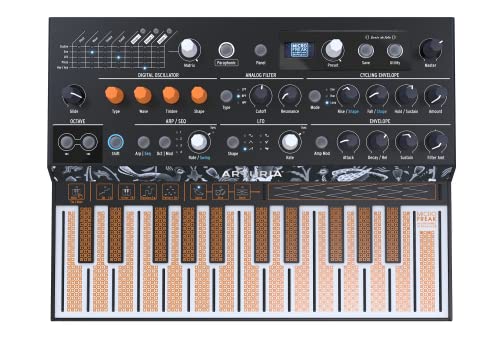
Arturia MicroFreak 25-Key Synth
Best for: Portable hybrid sound design and modular sequencing
- Number of Keys
- 25
- Key Action
- Poly-aftertouch
- Sound Engine
- Physical modeling to wavetable
- Polyphony
- Paraphonic
- Connectivity
- CV outputs, USB, MIDI
- Color
- Black
The Arturia MicroFreak is a compact hybrid synthesizer featuring a 25-key flat touch plate with polyphonic aftertouch. It combines digital oscillator modes with an analog resonant filter and paraphonic voice architecture. With CV, USB, and MIDI connections, you can route pitch and pressure to external hardware. It suits sound designers who need experimental modulation in a portable 2.3-pound setup.
- 25-key flat PCB keyboard with per-note polyphonic aftertouch
- Hybrid voice structure pairing digital oscillator engines with an analog filter
- CV outputs for sending pitch, gate, and pressure signals
- Built-in 5×7 modulation matrix with user-assignable destinations
- Flat PCB touch keyboard has no moving mechanical keys
- 25-key layout limits performance range to two octaves
- You want individual note pressure control on a lightweight 2.3-pound synthesizer.
- You integrate outboard modular gear using dedicated CV pitch, gate, and pressure outputs.
- You design sounds using hybrid digital engines routed through an analog filter.
- You require moving keys with traditional synth or piano action.
- You need more than 25 keys for wide two-handed arrangements.
Verdict: Arturia MicroFreak Paraphonic Synthesizer gives electronic musicians an expressive touch plate, diverse digital engines, and direct CV connectivity in a compact frame.

Moog Mother-32 Analog Synthesizer
Best for: modular Eurorack setups and analog CV sequencing
- Sound Engine
- Analog
- Connectivity
- MIDI In, CV Jack
- Sequencer
- 32-step
- Color
- Black
- Built-In Features
- Sequencer
- Dimensions
- 4.21 × 12.6 × 5.24 inches
The MOOG Mother-32 is a semi-modular analog synthesizer built for tabletop use or 60HP Eurorack installation. It features an analog voltage-controlled oscillator, a ladder filter, and a 32-step sequencer storing up to 64 sequences. You get CV jacks alongside MIDI and USB-MIDI inputs for flexible routing. It suits musicians seeking genuine analog synthesis with patching capabilities.
- Analog signal path with voltage-controlled oscillator and ladder filter
- Onboard 32-step sequencer storing up to 64 sequences across two modes
- Dual-use design functions on a tabletop or mounts as a 60HP Eurorack module
- Comprehensive connectivity via patchable CV jacks, MIDI In, and USB-MIDI
- Lacks an integrated physical piano-style keyboard
- Offers a single analog voltage-controlled oscillator architecture
- You want an analog signal path with patchable CV routing and a ladder filter.
- You need a compact 32-step sequencer that integrates into a 60HP Eurorack system.
- You plan to sequence hardware via MIDI In or CV connections.
- You need standard piano keys built directly onto the instrument chassis.
- You require polyphonic playing right out of the box.
Verdict: MOOG Mother-32 Semi-Modular Synthesizer provides pure analog sound shaping and modular CV connectivity for synthesists building Eurorack or tabletop production setups.
Specifications side by side
Spec Arturia MicroFreak 25-Key Synth Moog Mother-32 Analog Synthesizer
- Number of Keys
- 25
- Key Action
- Poly-aftertouch
- Sound Engine
- Physical modeling to wavetable
- Polyphony
- Paraphonic
- Connectivity
- CV outputs, USB, MIDI
- Sequencer
- –
- Color
- Black
- Built-In Features
- Aftertouch
- Features
- –
- Dimensions
- 12.2 × 9.2 × 2.2 inches
- Weight
- 2.3 pounds
- Size
- 12.2 inches (L) x 9.2 inches (W) x 2.2 inches (H)
- Model
- 570101
Copied from the Amazon listing. These figures were not measured here.
Frequently asked questions
Which unit is lighter for travel between the Arturia MicroFreak and Moog Mother-32?
Arturia MicroFreak is lighter to transport. It weighs 2.3 pounds, making it over a pound lighter than Moog Mother-32, which weighs 3.48 pounds. MicroFreak measures 12.2 inches long and 9.2 inches wide, giving you a portable option for mobile music production and desktop setups.
What MIDI connectivity features do these synthesizers provide?
Moog Mother-32 lists USB-MIDI connectivity directly in its specifications. This feature lets you connect the hardware unit directly to digital audio workstations or external MIDI controllers. Arturia MicroFreak specifies direct CV connectivity, allowing you to interface directly with external hardware instruments and modular equipment across your production space.
How do the physical dimensions of Arturia MicroFreak compare to Moog Mother-32?
Arturia MicroFreak is thinner and deeper, measuring 12.2 inches long, 9.2 inches wide, and 2.2 inches high. Moog Mother-32 features a narrower, taller chassis measuring 4.21 inches long, 12.6 inches wide, and 5.24 inches high. You can select based on your available tabletop or studio desk depth.
Does Arturia MicroFreak support aftertouch control?
Yes, Arturia MicroFreak features built-in aftertouch control. The 25-key synthesizer registers pressure changes as you press down on the keys, sending dynamic modulation data to alter your sound. This allows you to shape expressive performances without needing separate external modulation pedals or continuous controller wheels during live playback.
Does Moog Mother-32 include an onboard sequencer?
Yes, Moog Mother-32 includes a built-in sequencer in its factory specifications. This integrated sequencer allows you to compose and trigger melodic lines directly from the synthesizer without requiring an external keyboard. You can pair it with the unit's MIDI connectivity to synchronize patterns with external production equipment and hardware rigs.
What colors are available for Arturia MicroFreak and Moog Mother-32?
Both synthesizers come in a black finish according to their manufacturer specifications. Arturia lists model number 570101 for the black MicroFreak chassis, while Moog lists model MOD-MOTHER-32 for its black unit. Both devices integrate smoothly with other standard black audio interfaces, synthesizers, and studio rack gear in your workspace.
Which synthesizer is best for portable hybrid sound design?
Arturia MicroFreak is designated for portable hybrid sound design and modular sequencing. Its 2.3-pound chassis makes it easy to carry, while its 25-key design and built-in aftertouch give you expressive control anywhere. In contrast, Moog Mother-32 is specified primarily for modular Eurorack setups and analog CV sequencing configurations.


