
As Amazon Associates, we earn from qualifying purchases. This means we may receive a small commission at no extra cost to you if you click through and make a purchase.
As an Amazon Associate we earn from qualifying purchases. Links on this page are affiliate links.
When evaluating an arturia vs casio keyboard, you are looking at two completely different musical tools. Both instruments connect to computers through USB and respond to your touch dynamics. However, the Arturia MicroFreak is an experimental paraphonic synthesizer with 25 flat touch keys and advanced sound modulation. In contrast, the Casio LK-S450 is an educational portable keyboard featuring 61 full-size lighted keys, built-in stereo speakers, and 600 preset instrument tones.
Number of keys
25
61
Key action
Flat PCB with poly-aftertouch
Touch-sensitive with key lighting
Sound engine
Hybrid digital oscillator with analog filter
AiX
Connectivity
CV outputs, USB, MIDI
USB-MIDI
Built-in speakers
not listed
Stereo speakers
Weight
2.3 pounds
9.92 pounds
Choose the first if
- You want an experimental hybrid synthesizer with modular CV connectivity, a modulation matrix, and polyphonic aftertouch.
- You need an ultra-compact 2.3-pound unit for sound design and sequencing in a compact workspace.
Choose the second if
- You need 61 full-size lighted keys and guided lessons to learn keyboard technique.
- You want an all-in-one portable instrument with onboard stereo speakers, 600 instrument tones, and 200 rhythms.
Verdict
Choose the Arturia MicroFreak if you want an experimental sound-design synth to integrate with DAWs and modular gear. Pick the Casio LK-S450 if you require a portable 61-key learning board with onboard speakers and standard acoustic sounds. Your choice depends entirely on whether your focus is electronic synthesis or standard keyboard practice.
Arturia MicroFreak vs Casio Casiotone Comparison
Number of Keys
Edge: Casio Casiotone 61-Key Lighted Keyboard
The Casio Casiotone LK-S450 gives you 61 full-size keys, providing five full octaves for traditional two-handed keyboard playing and practice. It also integrates Casio's Key Lighting System to illuminate individual notes. In contrast, the Arturia MicroFreak comes with 25 keys, which covers roughly two octaves. This smaller layout focuses on compact riff entry, lead lines, and bass patterns rather than full-range piano arrangements. You get significantly more physical playing space on the Casio keyboard, allowing you to perform standard repertoire without needing to shift octaves constantly. For players prioritizing standard keyboard range, the Casio model holds the advantage.
Key Action
Edge: Arturia MicroFreak 25-Key Synth
The Arturia MicroFreak uses a flat printed circuit board with no moving mechanical parts. This touch plate tracks notes instantly and features polyphonic aftertouch, letting you alter parameters by applying independent pressure to individual keys. The Casio Casiotone LK-S450 features standard touch-sensitive piano keys that respond to strike velocity, paired with illuminated guidance for lessons. However, the Casio keyboard does not provide aftertouch. If you want deep expressive control over modulation and continuous real-time sound shaping per note, the Arturia keybed gives you capabilities that typical touch-sensitive keyboards lack.
Form Factor and Portability
Edge: Arturia MicroFreak 25-Key Synth
The Arturia MicroFreak measures 12.2 inches long, 9.2 inches wide, and 2.2 inches high, weighing just 2.3 pounds. You can easily slip it into a backpack or position it on a crowded desktop work surface. By comparison, the Casio Casiotone LK-S450 measures 36.6 inches wide, 10.2 inches long, and 3.3 inches high, with a weight of 9.92 pounds. While the Casio includes strap pins for stand-up playing, it demands significantly more desk and storage space. The Arturia synth offers an ultra-compact footprint that fits anywhere you need to travel.
Sound Presets and Rhythms
Edge: Casio Casiotone 61-Key Lighted Keyboard
The Casio Casiotone LK-S450 includes an extensive library of 600 built-in tones powered by its AiX sound engine, including a German grand piano, along with 200 accompaniment rhythms. It also provides a 6-track recorder to build multi-instrument arrangements directly on board. The Arturia MicroFreak takes an experimental synthesis approach, featuring 17 digital oscillator modes like wavetable, noise, and physical modeling paired with an analog filter. It focuses on sound design rather than pre-assembled acoustic instruments and backing tracks. For ready-to-play variety across standard musical styles, Casio delivers far more distinct instrument sounds.
Everyday Use and Audio Output
Edge: Casio Casiotone 61-Key Lighted Keyboard
The Casio Casiotone LK-S450 comes equipped with built-in stereo speakers featuring a SURROUND sound mode, allowing you to turn it on and play immediately without extra gear. It also supports interactive learning with 4-stage voice-guided lessons and links with the Casio Music Space app. The Arturia MicroFreak does not have integrated speakers in its specifications, meaning you must connect headphones, an external amplifier, or an audio interface to hear it. For self-contained everyday practice and learning at home without external cables or audio monitors, the Casio keyboard is ready right away.
Choosing the Right Keyboard for You
Modular synth owners and sound experimenters
Our pick: Arturia MicroFreak 25-Key Synth
You get CV outputs sending pitch, gate, and pressure to modular synths. Its 5×7 modulation matrix lets you rewire controls to assignable destinations. The engine delivers 17 oscillator modes alongside a resonant analog filter. The 25-key PCB detects individual note pressure, giving you expressive paraphonic sequencing in a 2.3-pound chassis.
Beginners needing guided keyboard practice at home
Our pick: Casio Casiotone 61-Key Lighted Keyboard
You receive 4-stage voice-guided lessons paired with Casio's Key Lighting System to assist your practice. Integrated stereo speakers provide instant sound without external hardware. Casio Music Space app integration supports structured study on iOS or Android devices. Its 61 full-size keys give you standard spacing for foundational two-handed keyboard exercises.
Songwriters wanting built-in accompaniment and standalone recording
Our pick: Casio Casiotone 61-Key Lighted Keyboard
You can arrange songs using 600 tones, 200 rhythms, and the onboard 6-track recorder. The AiX sound engine delivers dynamic ensemble sounds and German grand piano tones directly through stereo speakers with SURROUND mode. Weighing 9.92 pounds with built-in strap pins, this instrument functions as a self-contained portable workstation.
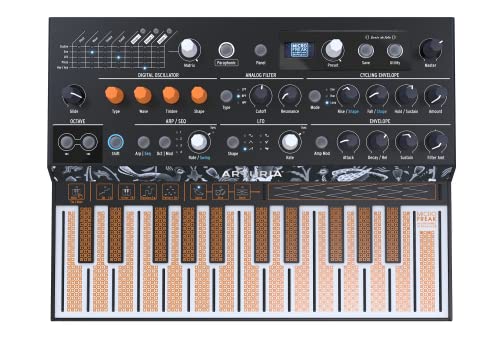
Arturia MicroFreak 25-Key Synth
Best for: modular synth routing and experimental sound design
- Number of Keys
- 25
- Key Action
- Poly-aftertouch
- Sound Engine
- Physical modeling to wavetable
- Polyphony
- Paraphonic
- Connectivity
- CV outputs, USB, MIDI
- Color
- Black
The Arturia MicroFreak is a compact hybrid synthesizer designed for experimental sound creation. You get a 25-key flat PCB keybed with polyphonic aftertouch, digital oscillator engines paired with an analog filter, and paraphonic voice handling. Its built-in CV outputs, USB, and MIDI let you connect directly to modular gear and computer setups for flexible electronic composition.
- 25-key flat PCB keybed supports individual polyphonic aftertouch
- Digital oscillator engines paired with a resonant analog filter
- CV outputs send pitch, gate, and pressure to external hardware
- Built-in 5×7 modulation matrix and sequencer with automation recording
- 25-key layout limits note range for two-handed playing
- Flat PCB keybed lacks moving mechanical keys
- Paraphonic architecture shares filter across active voices
- You need CV outputs to control modular synth gear directly.
- You want polyphonic aftertouch expression in a 2.3-pound instrument.
- You create experimental patches using digital synthesis modes and analog filtering.
- You need traditional mechanical keys with physical travel.
- You play two-handed acoustic piano music requiring wider key ranges.
- You require full polyphony rather than paraphonic voice routing.
Verdict: Arturia MicroFreak 25-Key Hybrid Synthesizer gives electronic musicians expressive touch-plate control and modular CV routing in a lightweight chassis. It fits sound designers focused on hybrid synthesis engines rather than conventional multi-octave keyboard playing.

Casio Casiotone 61-Key Lighted Keyboard
Best for: beginners wanting lighted keys and portable presets
- Number of Keys
- 61
- Key Action
- Touch-sensitive
- Sound Engine
- AiX
- Preset Count
- 600 tones
- Built-In Speakers
- Stereo speakers
- Connectivity
- USB-MIDI
The Casio Casiotone 61-Key Lighted Keyboard gives you 61 full-size, touch-sensitive keys with an integrated Key Lighting System and voice-guided lessons. Powered by the AiX sound engine, it includes 600 tones, 200 rhythms, built-in stereo speakers, and a 6-track recorder. Weighing 9.92 pounds, it suits learners and portable players wanting built-in visual guidance and USB-MIDI connectivity in a compact frame.
- 61 full-size, touch-sensitive keys with lighted visual guidance
- AiX sound engine with 600 tones and 200 rhythms
- Built-in stereo speakers with surround sound mode
- Integrated 6-track recorder and USB-MIDI connection
- Lightweight 9.92-pound frame with strap pins
- Bluetooth audio and MIDI require an optional adapter
- 61-key range instead of a full 88-key layout
- Touch-sensitive keys lack weighted hammer action
- You want illuminated keys and voice-guided lessons to help learn songs.
- You need a lightweight keyboard under 10 pounds with built-in speakers.
- You want a broad library of 600 instrument tones and onboard recording.
- You need a full 88-key weighted piano action for classical practice.
- You expect built-in Bluetooth without buying an external adapter.
Verdict: Casio Casiotone 61-Key Lighted Keyboard equips beginners and mobile players with lighted practice keys, 600 presets, and simple USB recording in a portable build.
Specifications side by side
Spec Arturia MicroFreak 25-Key Synth Casio Casiotone 61-Key Lighted Keyboard
- Number of Keys
- 25
- Key Action
- Poly-aftertouch
- Sound Engine
- Physical modeling to wavetable
- Polyphony
- Paraphonic
- Preset Count
- –
- Built-In Speakers
- –
- Connectivity
- CV outputs, USB, MIDI
- Form Factor
- –
- Color
- Black
- Built-In Features
- Aftertouch
- Features
- –
- Dimensions
- 12.2 × 9.2 × 2.2 inches
- Weight
- 2.3 pounds
- Size
- 12.2 inches (L) x 9.2 inches (W) x 2.2 inches (H)
- Model
- 570101
Copied from the Amazon listing. These figures were not measured here.
Frequently asked questions
Which brand is better for learning how to play songs?
Casio fits song learners better than Arturia. The Casio LK-S450 includes lighted keys to guide your practice sessions and features 600 built-in presets. Its 61-key layout gives you room for learning melodies. In contrast, the Arturia MicroFreak focuses on sound shaping with aftertouch across 25 keys.
How do Arturia and Casio keyboards differ in weight and portability?
Arturia makes significantly lighter gear in this comparison. The Arturia MicroFreak weighs 2.3 pounds and measures 12.2 inches long by 9.2 inches wide. The Casio LK-S450 weighs 9.92 pounds with a 36.6-inch length. You can pack the Arturia into small bags, whereas the Casio needs standard keyboard transport.
Can you connect Arturia and Casio keyboards to a computer?
Yes, both brands provide computer connectivity for digital music production. The Casio LK-S450 features USB and USB-MIDI connections for simple computer recording. Arturia MicroFreak also interfaces with digital production environments and adds aftertouch response. You can connect either instrument to your system using standard USB cables to transfer performance data.
Which brand offers more built-in instrument sounds?
Casio provides vastly more preset instruments out of the box. The Casio LK-S450 includes 600 built-in presets, giving you an extensive library of sounds ready to play immediately. In comparison, the Arturia MicroFreak uses a hybrid synthesis engine tailored for crafting custom tones instead of browsing pre-recorded instrument voices.
Does Arturia or Casio support aftertouch expression?
Arturia includes aftertouch, while this Casio model does not mention the feature. The Arturia MicroFreak incorporates built-in aftertouch across its 25 keys, allowing you to modulate parameters by adjusting finger pressure after striking notes. Casio LK-S450 concentrates on illuminated guidance and standard USB-MIDI capabilities without pressure-based modulation.
What type of keys do these Casio and Arturia models use?
They feature fundamentally different key interfaces. The Casio LK-S450 utilizes a 61-key layout with illuminated keys designed for traditional fingering. The Arturia MicroFreak uses a 25-key touch-plate surface with aftertouch. This touch-plate mechanism responds directly to skin contact and pressure, creating an expressive platform tailored specifically for electronic sound designers.


