
As Amazon Associates, we earn from qualifying purchases. This means we may receive a small commission at no extra cost to you if you click through and make a purchase.
As an Amazon Associate we earn from qualifying purchases. Links on this page are affiliate links.
When comparing an arturia vs behringer keyboard, you face two distinct design philosophies. Both units deliver synthesizer sound engines in black enclosures, but their approaches diverge sharply. The Arturia MicroFreak focuses on compact digital experimentation with a unique flat interface. The Behringer PRO-800 prioritizes classic analog polyphony in a larger, traditional form factor. You must decide whether you need portable hybrid flexibility or stationary analog warmth.
Number of Keys
25
Not listed
Polyphony
Paraphonic
8-voice
Sound Engine
Physical modeling to wavetable
Analog
Connectivity
CV outputs, USB, MIDI
Not listed
Built-In Features
Aftertouch
Sequencer, Arpeggiator
Dimensions
12.2 x 9.2 x 2.2 inches
22.5 x 16.7 x 8.43 inches
Choose the first if
- You need a highly portable unit that fits on small desks.
- You want to control external modular gear via CV outputs.
- You prefer digital sound design with physical modeling engines.
Choose the second if
- You require true analog warmth and fat detuned sounds.
- You need 8-voice polyphony for chords and pads.
- You want built-in arpeggiator and sequencer functionality.
Verdict
The Arturia MicroFreak suits producers who need a compact, experimental digital tool for modular setups or laptop integration. The Behringer PRO-800 is better for players seeking a standalone analog workstation with rich polyphonic capabilities. Your choice depends on whether you prioritize portability and digital flexibility or traditional analog sound and polyphony.
Key Specs and Build Comparison
Number of Keys
Edge: Arturia MicroFreak 25-Key Synth
The Arturia MicroFreak features a 25-key layout, which keeps the instrument extremely compact at 12.2 inches long. This short keyboard length suits users with limited desk space or those needing a portable setup for travel. In contrast, the Behringer PRO-800 does not list a specific key count in its provided data. However, its physical dimensions are significantly larger, measuring 22.5 inches in length. This suggests a standard full-sized or reduced-key layout typical of desktop synthesizers. You must choose between the MicroFreak’s ultra-portable 25-key constraint or the PRO-800’s likely larger footprint. The smaller Arturia unit offers maximum flexibility for tight spaces, while the Behringer prioritizes a more traditional playing surface.
Key Action
Edge: Arturia MicroFreak 25-Key Synth
Key feel differs drastically between these two units. The Arturia MicroFreak uses a printed circuit board with no moving mechanical parts. This flat surface supports poly-aftertouch, allowing you to detect pressure on each individual note. This unique action enables expressive control without traditional springs or hammers. The Behringer PRO-800 data does not specify its key action type. It is likely a standard weighted or semi-weighted action typical of analog polyphonic synths, but this is not confirmed in the provided specs. If you value the tactile feedback of traditional keys, the Behringer may suit you better. If you prefer the unique, responsive pressure sensitivity of the MicroFreak’s PCB, that is your clear advantage here.
Form Factor
Edge: Arturia MicroFreak 25-Key Synth
Size and weight are major differentiators for desktop setups. The Arturia MicroFreak is remarkably small, measuring 12.2 x 9.2 x 2.2 inches and weighing just 2.3 pounds. Its low profile makes it easy to store or transport. The Behringer PRO-800 is much larger and heavier, measuring 22.5 x 16.7 x 8.43 inches and weighing 3.63 pounds. This bulkier design indicates a substantial internal analog circuitry that requires more physical space. You should consider your available desk real estate carefully. The MicroFreak fits easily on any surface, while the PRO-800 demands a dedicated, sturdy spot. For portability and space-saving, the Arturia is superior.
Connectivity
Edge: Arturia MicroFreak 25-Key Synth
Connection options vary significantly between the two synthesizers. The Arturia MicroFreak offers CV outputs for pitch, gate, and pressure signals, allowing integration with modular gear. It also includes USB and MIDI connectivity for DAW integration, along with included MIDI break-out cables. The Behringer PRO-800 data does not explicitly list connectivity ports in the provided specs. While it likely includes standard MIDI or USB, the specific types are not confirmed in the text. The MicroFreak’s explicit inclusion of CV outputs makes it more versatile for modular system expansion. If you plan to use outboard gear or a modular setup, the Arturia provides clearer, documented connection paths.
Sound Engine
Edge: Behringer PRO-800 Analog Polyphonic Synth
The core sound generation methods are entirely different. The Arturia MicroFreak is a hybrid digital synthesizer featuring 17 oscillator modes, ranging from physical modeling to wavetable synthesis. It combines these digital engines with an analog filter for a hybrid sound. The Behringer PRO-800 is a pure analog synthesizer with 8 voices of polyphony. It uses authentic VCO, VCF, and VCA designs for a classic analog tone. You must decide between digital flexibility and analog warmth. The MicroFreak offers vast sound design possibilities through its digital modes. The PRO-800 delivers traditional analog character with two VCOs per voice. For pure analog texture, the Behringer has the edge.
Which synth fits your workflow best
Modular synth enthusiasts seeking CV control
Our pick: Arturia MicroFreak 25-Key Synth
The Arturia MicroFreak includes dedicated CV outputs for pitch, gate, and pressure signals. This allows you to connect directly to outboard or modular gear. Its hybrid design combines digital oscillators with an analog filter, offering unique integration capabilities that the Behringer PRO-800 lacks. This connectivity is essential for expanding your modular setup.
Producers wanting classic analog polyphony
Our pick: Behringer PRO-800 Analog Polyphonic Synth
The Behringer PRO-800 delivers pure analog signal paths with eight voices of polyphony. It features two voltage-controlled oscillators per voice for thick, detuned sounds. With 400 program memories and classic VCF designs, it replicates the Prophet 600 experience. This makes it ideal for you if you prioritize warm, traditional analog tones over digital flexibility.
Experimentalists needing compact, poly-aftertouch keys
Our pick: Arturia MicroFreak 25-Key Synth
The Arturia MicroFreak uses a flat PCB interface with individual poly-aftertouch detection on each of its 25 keys. It offers 17 paraphonic oscillator modes, including physical modeling and wavetable synthesis. Its small size at 2.2 inches high fits easily on any desk. This unique interface and sound engine suit you if you value tactile experimentation in a small form factor.
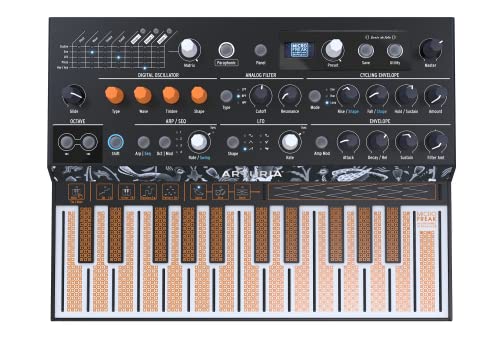
Arturia MicroFreak 25-Key Synth
Best for: experimental sound design and modular setups
- Number of Keys
- 25
- Key Action
- Poly-aftertouch
- Sound Engine
- Physical modeling to wavetable
- Polyphony
- Paraphonic
- Connectivity
- CV outputs, USB, MIDI
- Color
- Black
The Arturia MicroFreak is a compact 25-key paraphonic synthesizer. It uses a flat printed circuit board keybed with poly-aftertouch for precise control. The sound engine combines physical modeling, wavetable, and 17 oscillator modes with an analog filter. It weighs 2.3 pounds and measures 12.2 inches long. This unit suits you if you need a portable, experimental tool for modular setups or DAW integration via USB and CV outputs.
- 25-key PCB keybed with poly-aftertouch
- 17 paraphonic oscillator modes including physical modeling
- CV outputs for modular connectivity
- Compact size at 12.2 inches long
- Paraphonic polyphony limits to one voice per oscillator
- 25-key layout restricts chord playing range
- 2.3-pound weight adds bulk for travel
- You need CV/Gate connectivity for modular gear
- You want a compact synth for small desks
- You prefer experimental hybrid sound design
- You require full polyphonic chord playing
- You need a standard weighted key action
- You want a larger 61-key or 88-key range
Verdict: Arturia MicroFreak 25-Key Hybrid Synth offers unique tactile control and deep sound design in a tiny package. It fits producers seeking modular integration or portable experimental tools, not pianists needing full keys.

Behringer PRO-800 Analog Polyphonic Synth
Best for: Players seeking classic analog polyphonic sound
- Sound Engine
- Analog
- Polyphony
- 8-voice
- Preset Count
- 400 program memories
- Color
- Black
- Built-In Features
- Sequencer, Arpeggiator
- Dimensions
- 22.5 × 16.7 × 8.43 inches
The Behringer PRO-800 is a classic analog polyphonic synthesizer. It features 8-voice polyphony with two voltage-controlled oscillators per voice. This design allows for fat, detuned sounds and unison modes. It includes a sequencer and arpeggiator for performance. With 400 program memories, it offers substantial sound storage. It suits players seeking authentic analog warmth and traditional synth architecture.
- 8-voice polyphony for chord playing
- Pure analog signal path with VCO, VCF, and VCA
- Two VCOs per voice for rich textures
- Unison mode creates fat 16-oscillator leads
- Built-in sequencer and arpeggiator
- 8-voice polyphony is lower than the 21-voice capacity of the Arturia MicroFreak
- Weighs 3.63 pounds, making it bulkier than compact digital options
- You want authentic analog sound character
- You need a sequencer and arpeggiator for live performance
- You prefer traditional voltage-controlled oscillator designs
- You require more than 8 simultaneous voices
- You need a lightweight, portable keyboard for travel
- You prefer digital or hybrid sound engines
Verdict: The Behringer PRO-800 Analog 8-Voice Synth is a solid choice for musicians who prioritize classic analog warmth and unison capabilities over high polyphony counts. It fits players who value traditional synthesizer architecture and built-in performance tools.
Specifications side by side
Spec Arturia MicroFreak 25-Key Synth Behringer PRO-800 Analog Polyphonic Synth
- Number of Keys
- 25
- Key Action
- Poly-aftertouch
- Sound Engine
- Physical modeling to wavetable
- Polyphony
- Paraphonic
- Preset Count
- –
- Connectivity
- CV outputs, USB, MIDI
- Color
- Black
- Built-In Features
- Aftertouch
- Dimensions
- 12.2 × 9.2 × 2.2 inches
- Weight
- 2.3 pounds
- Size
- 12.2 inches (L) x 9.2 inches (W) x 2.2 inches (H)
- Model
- 570101
Copied from the Amazon listing. These figures were not measured here.
Frequently asked questions
Which keyboard is better for modular synth setups?
The Arturia MicroFreak is the superior choice for modular integrations. It features dedicated CV outputs for pitch, gate, and pressure signals. This allows direct connection to outboard or modular gear. Its hybrid design combines digital oscillators with unique tactile control. The Behringer PRO-800 lacks these specific modular connectivity options in its specifications.
Does the Behringer PRO-800 include a sequencer?
Yes, the Behringer PRO-800 includes a built-in sequencer. It also features an arpeggiator for performance tools. These features support players who value traditional synthesizer architecture. The Arturia MicroFreak does not list these specific performance tools in its attributes, focusing instead on experimental sound design and tactile control.
Which synth weighs less for portability?
The Arturia MicroFreak is lighter and more portable. It weighs 2.3 pounds and measures 12.2 inches in length. This compact size suits users needing a portable setup for travel. The Behringer PRO-800 is heavier at 3.63 pounds and larger, making it less ideal for frequent transport.
Is aftertouch available on the Arturia MicroFreak?
Yes, the Arturia MicroFreak includes aftertouch. This built-in feature enhances expressive control during performance. The Behringer PRO-800 specifications do not mention aftertouch. If you require polyphonic aftertouch for nuanced playing, the Arturia model provides this specific tactile feedback capability.
Which keyboard offers classic analog polyphonic sound?
The Behringer PRO-800 is designed for classic analog polyphonic sound. It is an 8-voice analog synth with unison capabilities. This fits players prioritizing traditional warmth over high polyphony counts. The Arturia MicroFreak uses a hybrid digital approach, focusing on experimental sound design rather than classic analog texture.
What are the dimensions of the Arturia MicroFreak?
The Arturia MicroFreak measures 12.2 inches long, 9.2 inches wide, and 2.2 inches high. These compact dimensions keep it small for desk setups. The Behringer PRO-800 is significantly larger at 22.5 inches long and 8.43 inches high. You should consider your available space when choosing between these two distinct form factors.


