
As Amazon Associates, we earn from qualifying purchases. This means we may receive a small commission at no extra cost to you if you click through and make a purchase.
As an Amazon Associate we earn from qualifying purchases. Links on this page are affiliate links.
This arturia microfreak 25 key synth review examines a compact hybrid hardware instrument designed for experimental sound design. Two core specifications define its design: a flat 25-key printed circuit board with individual polyphonic aftertouch and a paraphonic digital engine routed through an analog resonant filter. Instead of traditional moving keys, you interact with a touch-capacitive PCB surface that measures pressure directly. Weighing 2.3 pounds with a footprint of 12.2 by 9.2 inches, it combines wavetable and physical modeling engines with CV, MIDI, and USB connectivity.
- Flat 25-key printed circuit board with individual polyphonic aftertouch and no moving parts
- Hybrid voice architecture pairing digital oscillator modes with an analog resonant filter
- CV outputs for pitch, gate, and pressure alongside USB and MIDI break-out connections
- Internal 5×7 modulation matrix and step sequencer with Spice and Dice randomization
Good fit for
You will find this instrument useful if you build modular synth setups or compact desktop studios. The CV outputs send pitch, gate, and pressure directly to external analog gear, while USB and MIDI handle standard digital sequencing. Musicians who want polyphonic aftertouch without heavy weighted mechanisms gain expressive control from the 25-key PCB surface. Its small 2.3-pound chassis also suits producers who need a portable sound-design unit with diverse digital oscillator modes.
Who can skip it
Skip this model if you require standard moving keys or weighted piano action. The flat touch PCB lacks mechanical travel and physical key depression, which will not suit traditional keyboard technique. If you need two-handed acoustic piano repertoire or full polyphony across multiple voices, the 25-key paraphonic architecture is too limited. Players seeking conventional keyboard controllers with 61 or 88 physical keys should choose an instrument built around mechanical hammer or synth-action keybeds.
Verdict
The Arturia MicroFreak pairs a flat poly-aftertouch PCB with versatile digital engines and an analog filter in a compact 2.3-pound footprint. It delivers flexible modulation and hardware connectivity for experimental electronic sound design.
Key Specifications and Practical Meanings
Number of Keys: 25
A 25-key layout spans two full octaves. You can enter basslines, trigger arpeggios, and record lead melodies easily without crowding your workspace. This setup benefits electronic music producers working in tight home studios or mobile setups. If you want to play traditional two-handed piano arrangements, compare this compact format with 61-key or 88-key keyboards that offer full acoustic-style range.
Connectivity: CV outputs, USB, MIDI
These ports allow you to link with computers via USB, external gear using MIDI breakout cables, and analog instruments through CV pitch, gate, and pressure jacks. Producers combining modern DAWs with standalone hardware benefit from this setup. When shopping for keyboards, compare this against instruments limited to USB-MIDI if you plan to direct control signals into CV-compatible hardware.
Sound Engine: Physical modeling to wavetable
This engine combines diverse digital synthesis types, ranging from acoustic physical simulations to evolving wavetable textures. Sound designers and electronic producers benefit from having varied sonic flavors within a single unit instead of needing multiple specialized synthesizers. When comparing digital pianos and keyboards, contrast this versatile digital synthesis engine with sample-based instruments that primarily replay pre-recorded acoustic instrument recordings.
Weight: 2.3 pounds
At 2.3 pounds, this chassis is exceptionally light and simple to move around. Touring musicians and mobile beatmakers benefit because they can slip it into a backpack without significant physical strain. When browsing digital pianos and keyboards, compare this lightweight footprint to full-size portable keyboards or stage pianos, which often weigh significantly more and require dedicated stands or permanent studio desks.
Hardware Dimensions and Interface Control Layout
According to the listing, the Arturia MicroFreak measures 12.2 inches long, 9.2 inches wide, and 2.2 inches high. It features a black finish and weighs 2.3 pounds. This low weight and compact footprint let you place the unit on crowded studio desks or slide it into a gear bag for mobile use. Instead of conventional keybeds, the instrument uses a flat 25-key printed circuit board with no moving parts. According to the listing, this PCB surface detects touch speed and individual note pressure without mechanical switches, reducing physical chassis height.
The control panel organizes sound manipulation into discrete hardware clusters. Four dedicated knobs manage the Digital Oscillator section, allowing you to select and adjust oscillator modes quickly. Across the interface sits a 5×7 modulation matrix with user-assignable destinations, letting you reconfigure your signal chain directly from the front panel. Dedicated controls for Spice and Dice sequencer functions provide immediate access to pattern variations.
Hardware connections sit along the chassis to link the synth with various production environments. The unit includes USB connectivity for DAW integration alongside MIDI break-out ports with included cables. Dedicated CV outputs route pitch, gate, and pressure signals to outboard gear, letting you drive modular rigs directly.
Setup and Everyday Workflow
Setting up the Arturia MicroFreak involves establishing connections with your existing music equipment. You can connect the instrument to your digital audio workstation through a standard USB cable. When interfacing with traditional MIDI devices, you use the included MIDI break-out cables. If you operate modular or outboard hardware, the unit provides dedicated control voltage outputs to send pitch, gate, and pressure signals directly to external gear.
Everyday operation focuses on the digital oscillator section, the printed circuit board, and the sequencer. You use four dedicated knobs to switch between seventeen oscillator types, including wavetable, physical modeling, vocoder, and noise modes. The sound engine routes through a resonant analog filter. To shape your signal chain, you route controls through the 5×7 modulation matrix, configuring user-assignable destinations to alter your patches.
During daily play, you trigger notes on the flat 25-key printed circuit board, which lacks moving parts and tracks individual key pressure for polyphonic aftertouch. When composing, you can edit notes per step in the onboard sequencer, record up to four automations, and trigger the Spice and Dice functions to introduce randomization into your evolving musical patterns.
Before Buying the Arturia MicroFreak
Before adding the Arturia MicroFreak to your music workstation, evaluate your existing gear and playing needs. This instrument operates differently from the standard digital pianos and multi-octave controllers found in 2026. With 25 touch-sensitive PCB keys, it is built for compact sound design rather than traditional two-handed keyboard repertoire. To integrate the unit into your setup, you need compatible hardware or software. You can route its pitch, gate, and pressure CV outputs directly to modular synthesizers. For computer production, verify that you have an open USB port to connect your digital audio workstation. If you work with external hardware, check that your instruments accept connections from the included MIDI break-out cables. Maintenance is straightforward because the flat circuit board features no moving mechanical parts, which prevents physical dust accumulation inside traditional key slots.
Check before you buy
- Confirm your modular gear accepts CV outputs for pitch, gate, and pressure signals.
- Ensure your computer setup has an available USB port for digital audio workstation connection.
- Verify your external instruments support the included MIDI break-out cable connections.
- Decide if a 25-key flat printed circuit board matches your playing style.
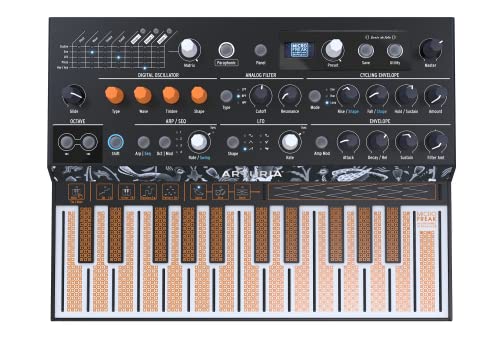
Arturia MicroFreak 25-Key Synth
Best for: experimental sound design and modular synth setups
- Number of Keys
- 25
- Key Action
- Poly-aftertouch
- Sound Engine
- Physical modeling to wavetable
- Polyphony
- Paraphonic
- Connectivity
- CV outputs, USB, MIDI
- Color
- Black
The Arturia MicroFreak is a compact hybrid synthesizer built for expressive sound design. It combines a flat 25-key PCB touch plate with polyphonic aftertouch and a digital engine featuring 17 paraphonic oscillator modes. You can route signals through an analog filter, a 5×7 modulation matrix, and CV outputs. It suits creators who need experimental synthesis in a 2.3-pound format.
- Flat 25-key PCB keybed with per-note polyphonic aftertouch
- 17 paraphonic oscillator modes paired with a resonant analog filter
- 5×7 modulation matrix for user-assignable routing
- Dedicated CV outputs for pitch, gate, and pressure
- Flat printed circuit board keybed has no moving mechanical parts
- Paraphonic voicing shares the analog filter across all notes
- Compact 25-key layout limits two-handed playing
- You want polyphonic aftertouch on a lightweight 2.3-pound instrument.
- You connect hardware sequencers or modular systems using CV outputs.
- You want diverse synthesis engines like wavetable and physical modeling in one unit.
- You require traditional moving piano keys instead of a touch-plate surface.
- You need true polyphony with independent filters for each voice.
- You perform wide-interval keyboard pieces requiring more than 25 keys.
Verdict: Arturia MicroFreak 25-Key Hybrid Synth gives modular enthusiasts and electronic musicians versatile algorithmic synthesis and polyphonic aftertouch in a portable hardware format.
Specifications side by side
| Spec | Arturia MicroFreak 25-Key Synth |
|---|---|
| Number of Keys | 25 |
| Key Action | Poly-aftertouch |
| Sound Engine | Physical modeling to wavetable |
| Polyphony | Paraphonic |
| Connectivity | CV outputs, USB, MIDI |
| Color | Black |
| Built-In Features | Aftertouch |
| Dimensions | 12.2 × 9.2 × 2.2 inches |
| Weight | 2.3 pounds |
| Size | 12.2 inches (L) x 9.2 inches (W) x 2.2 inches (H) |
| Model | 570101 |
Frequently asked questions
Does the Arturia MicroFreak support polyphonic aftertouch?
Yes, the Arturia MicroFreak includes built-in aftertouch capabilities. Its touch-responsive keybed transmits expressive modulation data based on finger pressure across individual notes. This feature allows you to alter filter cutoff, pitch, or modulation depth dynamically during live performances or sequencing sessions without needing an external expression pedal.
What are the exact dimensions and weight of the Arturia MicroFreak?
The Arturia MicroFreak measures 12.2 inches in length, 9.2 inches in width, and 2.2 inches in height. It weighs 2.3 pounds. This flat, lightweight casing ensures you can slip the instrument into a backpack or position it alongside other compact synthesizers in tight studio setups without using excessive desk space.
What musical applications is the Arturia MicroFreak best suited for?
This synthesizer is best for experimental sound design and modular synth setups. You can generate complex textures and algorithmic tones that match modern electronic workflows. Its specialized architecture makes it an effective companion for modular gear rigs, ambient composition, or producers seeking unusual timbres beyond standard acoustic piano sounds.
What is the official manufacturer model number for this synthesizer?
The manufacturer model number for the Arturia MicroFreak is 570101. You can reference this standard hardware code when checking technical documentation, verifying firmware updates, or sourcing matching accessories. The unit comes in a black finish, maintaining a consistent appearance with standard electronic production equipment in your music workspace.
Can you integrate the Arturia MicroFreak into modular synthesizer rigs?
Yes, the Arturia MicroFreak is designed specifically to integrate smoothly with modular synth setups. Its versatile algorithmic synthesis architecture provides flexible control options that suit external hardware systems. Electronic musicians can incorporate its distinct digital sound generator into broader analog signal chains to produce intricate, experimental electronic patches.
What color finish does the Arturia MicroFreak have?
The product specifications list the unit in a black finish. This dark color scheme complements most electronic music gear and desktop controllers. Its compact 2.3-pound chassis provides a clean, utilitarian aesthetic that fits neatly into production workstations or portable performance environments without visual clutter.


