As Amazon Associates, we earn from qualifying purchases. This means we may receive a small commission at no extra cost to you if you click through and make a purchase.
Shoppers researching dependable portable energy stations often look for the Anker SOLIX F1500, frequently entering shorthand variations such as the anker solix 536 to find its distinctive 1,536Wh capacity profile. Evaluating a mid-to-large portable power station requires balancing storage volume, inverter output, port accessibility, and physical portability. The Anker SOLIX F1500 is engineered for consumers who require more reserve power than smaller camping boxes provide, but who do not want to manage the excessive bulk and high storage demands of multi-kilowatt whole-home power walls. Delivering an 1800W continuous output alongside durable lithium iron phosphate battery cells, this station is built to support critical home appliances during blackouts and manage heavy electrical loads during off-grid travel.
In this review, we examine the true functional capabilities of the Anker SOLIX F1500 across key practical categories. We cover the core hardware features, detailed performance specifications, continuous delivery thresholds, and the longevity of the internal battery system. We also explore real-world use cases, assessing how the unit performs for both residential emergency preparedness and rugged outdoor expeditions. By comparing its capabilities with smaller alternatives and outlining the manufacturer specifications, this guide provides the information necessary to determine if this power station matches your daily or emergency power needs.
What You Get With the Anker SOLIX F1500
Anker SOLIX F1500
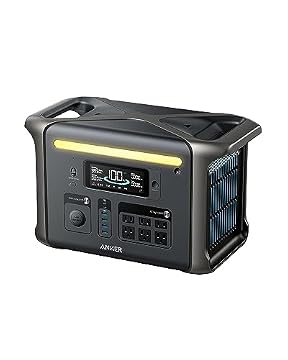


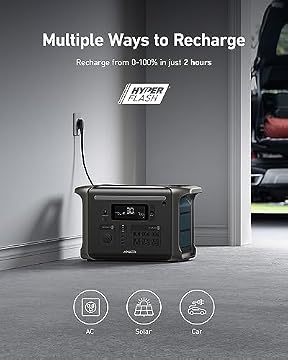


Photographs published on the Amazon listing.
The Anker SOLIX F1500 arrives packaged with the primary power bank and an assortment of manufacturer-supplied cables tailored for diverse input charging methods. Rather than requiring third-party adapters for everyday power connections, the factory package includes dedicated cords for wall outlets, automotive sockets, and renewable solar arrays, backed by formal manufacturer coverage.
- Anker SOLIX F1500 Portable Power Station with 1,536Wh internal storage capacity
- AC charging cable for standard residential wall outlets
- Car charging cable for 12V vehicle aux power sockets
- Solar charging cable compatible with external solar panel connections
- Owner user manual and operational documentation
- Five-year full-device manufacturer warranty coverage
- Customer support and technical service access
- Integrated 1800W pure sine wave inverter capable of 2400W starting surge wattage
- Six AC power output ports for household appliances
- Four USB-A ports for personal smart mobile accessories
- One 12V car cigarette lighter outlet for vehicle equipment
Key Specifications
Attribute
Detail
- Model Name
- Anker SOLIX F1500 Portable Power Station
- Battery Capacity
- 1,536Wh
- Battery Chemistry
- EV-Class LFP (LiFePO4) Batteries
- Continuous Output Wattage
- 1800 Watts
- Starting Peak Wattage
- 2400 Watts
- Output Frequency
- 60 Hertz
- Simultaneous Connected Devices
- Up to 13 Devices
- Fast Solar Recharging
- Recharges to 80% in 1.4 Hours with 600W Solar Input
- Manufacturer Warranty
- 5-Year Full-Device Warranty
- Product Lifespan
- Designed for 10-Year Daily Operational Lifespan
Copied from the Amazon listing. These figures were not measured here.
Power Output and Appliance Capability
The core capability of any backup energy station centers on continuous wattage and initial starting surges. The unit functions as a high-output anker 1800w power station, supporting appliances that consume up to 1,800 running watts while absorbing electrical startup spikes up to 2,400 watts. This makes the station capable of running standard inductive loads like sump pumps, mid-sized portable air conditioning units, kitchen appliances, and power tools that would trip the breakers on smaller 300W or 500W power banks. The steady 60Hz pure sine wave output ensures that sensitive microelectronics inside laptops, CPAP medical devices, and modern flat-panel displays run without harmonic distortion or electrical buzz.

With an integrated anker solix 1536wh battery, the unit supplies substantial reserve capacity when the electrical grid goes down. For baseline communication devices, this capacity translates into dozens of full recharges for smartphones, tablets, and mobile radios. More importantly for residential situations, anker solix f1500 for home backup provides adequate energy to run a full-sized refrigerator for several hours during an outage, keep network modems active, and illuminate essential living spaces. For lighter desktop tasks, some individuals opt for smaller desktop banks like the anker solix c300 ac, but the F1500 operates in an entirely different weight class designed to handle heavy kitchen and workshop appliances.
Managing the electrical load across multiple electronics is simplified by the extensive port layout. The front fascia accommodates up to 13 devices at the same time across six standard AC sockets, four USB-A ports, and a dedicated 12V automotive receptacle. This generous port allotment eliminates the need for power strips or multi-tap wall adapters during an emergency, allowing multiple family members to plug in essential phones, lights, and portable electronics simultaneously without creating messy wire clusters.
Recharge Performance and Solar Input
A high-capacity battery is only as useful as the speed at which it can be replenished after depletion. The anker solix f1500 recharge time benefits directly from proprietary HyperFlash charging architecture, which allows rapid power throughput from both AC electrical lines and renewable sources. When paired with a 600W solar panel array under optimal sunlight conditions, the unit can recharge from empty to 80 percent capacity in just 1.4 hours. This rapid turnaround represents an essential advantage during multi-day grid failures where sunlight hours are limited and fuel-powered generation is impractical.
For standard wall replenishment, the supplied AC charging cable connects directly between the unit and a standard residential electrical outlet without requiring an external transformer brick. Bypassing bulky power bricks simplifies cord storage and prevents unnecessary heat buildup near the charging site. The integrated bi-directional inverter handles the AC-to-DC conversion internally, keeping the exterior setup clean and straightforward whether recharging in a garage, a utility closet, or at an RV hookup post.
Field recharging via vehicles is also accounted for through the included 12V automotive charging cable. While vehicle auxiliary charging operates at a slower rate than dedicated wall outlets or 600W solar arrays due to automotive fuse limits, it provides a crucial replenishment avenue during transit. Travelers on extended overland journeys can continuously trickle power back into the 1,536Wh battery bank while driving between campsites, ensuring adequate capacity upon arrival at remote destinations.
Battery Durability and Chemistry
Battery longevity remains a vital metric for long-term power station value. The anker solix f1500 lifepo4 architecture utilizes EV-class LFP (lithium iron phosphate) chemistry, which offers significant thermal stability, structural resilience, and cycle endurance compared to traditional nickel-manganese-cobalt (NMC) batteries. The manufacturer rates the F1500 for a 10-year everyday lifespan, ensuring that frequent cycles of full discharge and rapid replenishment do not rapidly degrade overall storage efficiency or cause early capacity drop-off.
Complementing the robust cell chemistry is a manufacturer-backed 5-year full-device warranty. While many consumer electronics offer limited 1-year or 2-year terms that exclude specific battery cell degradation, this 5-year coverage reflects high confidence in the internal battery management system (BMS). The internal BMS continuously monitors cell temperatures, voltage thresholds, amperage limits, and short-circuit protections across every input and output circuit.
Because LFP chemistry avoids the thermal runaway risks inherent to older lithium formulations, the station can be safely operated and stored inside living rooms, bedrooms, or enclosed vehicles without noxious exhaust fumes or excessive fire risks. Unlike gasoline generators that demand ongoing oil changes, spark plug replacements, and outdoor ventilation clearances, the electric battery power source operates silently and cleanly with zero localized emissions.
Outdoor Practicality and Field Ergonomics
Taking a large-capacity station off-grid requires examining its physical handling and transportability. Deploying the anker solix f1500 for camping provides off-grid enthusiasts with reliable power for portable 12V compressor fridges, electric skillets, camp lighting, and photographic equipment. Having six AC outlets on a single outdoor power box allows group campsites to run shared appliances without juggling cords, making basecamp cooking and outdoor utility work effortless.
While the exterior design includes integrated carrying handles molded directly into the rugged black chassis, moving a unit with 1,536Wh of EV-class battery cells requires physical effort. It is well-suited for vehicle-based overland travel, car camping, tailgating, and job-site support where the station rests securely in a truck bed or trunk. However, for casual backpacking or day hikes where extreme mobility is paramount, ultra-compact equipment such as the anker solix c300 dc portable power station serves as a much more portable choice.
The unit also features an intuitive digital display screen on the front panel that gives immediate visual clarity regarding incoming charging wattage, outgoing power draw, remaining percentage, and real-time operational runtimes. This operational feedback eliminates guesswork, letting campers and homeowners know exactly how many hours of run time remain when running specific appliances like electric heaters or refrigeration units.
Setup and Operational Compatibility
Operating the power station is straightforward right out of the box. Users turn on the main power toggle and selectively activate either the AC inverter or the DC power banks using independent physical buttons. This independent switching structure prevents parasitic power drain by ensuring the 1800W internal inverter does not consume standby power when you only need to charge a smartphone from a USB port.
When reviewing the anker solix f1500 specs, prospective buyers should note the 60Hz operating frequency, which matches standard North American grid-connected devices. The 1800W running capacity easily manages common household kitchen items, power tools, and office gear. However, high-demand whole-home installations requiring 240V split-phase wiring, large central air conditioners, or hardwired home transfer switches will require larger, modular energy solutions such as the anker f3800 plus.
For basic home emergency staging, the F1500 functions cleanly as an independent plug-and-play power source. Users can place the unit on a counter or table next to essential appliances and plug power cords directly into the six front-facing AC outlets. Its quiet operational profile makes it ideal for indoor use during stormy weather when loud, gas-guzzling generators cannot be operated safely outdoors.
Anker SOLIX F1500 Pros and Cons
Pros
- 1,536Wh high-capacity EV-class LFP battery pack
- 1800W continuous output with 2400W surge support
- Powers up to 13 devices simultaneously
- Fast 1.4-hour solar recharge to 80 percent
- Durable 10-year lifespan with 5-year warranty
Cons
- Heavy chassis requires dedicated physical lifting effort
- Single car outlet limits simultaneous 12V accessories
Check Anker SOLIX F1500 on Amazon
Is the Anker SOLIX F1500 Worth It
Determining whether is anker solix f1500 worth it depends on the scale of your electrical requirements. If you require an emergency energy reserve that can keep critical home refrigeration running, support CPAP medical machines through overnight blackouts, and provide rapid solar replenishment during daylight hours, the F1500 delivers substantial utility. Its combination of an 1,800W inverter, 2,400W surge threshold, and EV-class LiFePO4 cells ensures that it will remain reliable across a decade of use.
Car campers, overlanders, and mobile professionals working out of vans will also find the unit exceptionally capable. It provides ample energy to run power tools, induction cooktops, and high-draw equipment without blowing fuses or draining vehicle starter batteries. The ultra-fast 1.4-hour solar recharging capability makes extended off-grid stays feasible without having to rely on noisy combustion generators.
However, shoppers who only need to keep small handheld electronics charged during weekend tent camping trips may find this 1,536Wh unit larger and heavier than necessary. For those minimalist power needs, smaller low-wattage battery boxes provide easier portability. But for shoppers seeking a serious, long-lasting middle-tier power station that handles heavy residential and outdoor loads, the Anker SOLIX F1500 stands as an exceptionally solid investment.
Other Options to Consider
Backup LiFePO4 Battery provides a compact 292Wh capacity for users who find a 1,536Wh station too heavy and only need light power for weekend camping, short outdoor travel, or small electronic devices.

GRECELL Portable Power Station 500W offers a 519Wh battery pack with two AC outlets and a 60W USB-C port, serving as an intermediate option for buyers who need moderate power for small appliances without stepping up to an 1800W unit.
Pure Sine Wave AC Outlet delivers a 300W output paired with a 256Wh LiFePO4 battery pack, making it a lightweight option for running CPAP machines and small mobile devices during outdoor excursions.
FAQ
What appliances can run on the Anker SOLIX F1500?
With an 1800W continuous running output and a 2400W surge capacity, the Anker SOLIX F1500 can operate the vast majority of standard household appliances. This includes full-sized refrigerators, microwave ovens, coffee makers, portable electric heaters, CPAP machines, desktop computers, television sets, and handheld power tools. Any appliance that operates continuously under 1,800 watts at 60Hz can be safely powered by the unit.
How long does the battery last during an outage?
The total runtime of the Anker SOLIX F1500 depends entirely on the combined wattage of the connected electronics. At its maximum continuous output of 1800W, the internal 1,536Wh battery provides approximately one hour of continuous operation. When powering low-draw essentials such as a 60W CPAP machine, mini-fridge, or basic LED lighting, the station can last between 15 and 25 hours or provide dozens of charges for mobile devices.
How fast does the Anker SOLIX F1500 recharge from solar panels?
Under optimal sunlight conditions, the Anker SOLIX F1500 can recharge from empty to 80 percent in approximately 1.4 hours when connected to a 600W solar panel array. This fast solar turnaround is enabled by the manufacturer’s HyperFlash recharging technology, allowing users to restore energy rapidly during peak sun hours in off-grid environments.
How many devices can be connected to the power station at once?
The power station features 11 dedicated output ports that allow users to connect and power up to 13 devices at the same time when factoring in multi-device charging configurations. The output layout includes six standard three-prong AC outlets, four USB-A ports for personal smart electronics, and one 12V car cigarette lighter outlet.
What battery type is used inside the Anker SOLIX F1500?
The Anker SOLIX F1500 uses EV-class LFP (lithium iron phosphate or LiFePO4) battery cells. This battery chemistry provides enhanced thermal stability, safer indoor operation, and an extended operational lifespan designed to last over 10 years of daily use, supported by a 5-year full-device manufacturer warranty.