
As Amazon Associates, we earn from qualifying purchases. This means we may receive a small commission at no extra cost to you if you click through and make a purchase.
As an Amazon Associate we earn from qualifying purchases. Links on this page are affiliate links.
If you are researching akai professional mpc key 37 g2 alternatives, you have several capable options to consider. The Akai Professional MPC Key 37 provides a self-contained production setup with its built-in MPC3 OS, an 8-core processor, and a 7-inch touchscreen. It handles standalone sequencing, sampling, and synthesis using 37 synth-action keys and 16 MPC pads without requiring a computer. Its USB-C port also supports 24×24 multichannel audio and 32 MIDI channels for studio integration.
You might want a different instrument if your workflow requires more keyboard range, weighted keys, or a battery-powered build. Models with 61 or 88 keys give you broader octave access for two-handed playing, while dedicated MIDI controllers suit setups centered entirely on computer software. We chose these 6 alternatives because their specifications overlap directly with the MPC Key 37. Each option shares core hardware elements, such as performance pads, integrated sequencing, synth-action or weighted keybeds, and USB connectivity.
Comparing the MPC Key 37 Alternatives
Novation Launchkey 61 MK4 with Polyphonic Aftertouch
The Novation Launchkey 61 MK4 expands your playing range to 61 keys, compared to the 37 keys on the Akai MPC Key 37. It also adds polyphonic aftertouch pads for expressive modulation. However, the Launchkey is strictly a USB-MIDI controller and lacks internal sound generation, an audio interface, and the MPC3 standalone operating system. You cannot sequence tracks or sample audio without connecting to a computer DAW. Pick the Launchkey 61 MK4 if you produce inside software and need five octaves of keys rather than a self-contained production workstation.
Novation 61SL MkIII 61-Key Sequencer Keyboard
The Novation 61SL MkIII offers 61 weighted keys, providing more playing range than the 37-key keybed on the MPC Key 37. It features a built-in hardware sequencer designed to control external synthesizers alongside computer software. In exchange, the 61SL MkIII omits standalone audio sampling, the 7-inch touchscreen, and internal sound engines found in the MPC3 OS. At 14.4 pounds and 38.6 inches wide, it is also heavier and larger than the 9.7-pound Akai keyboard. Choose this model if you need a master controller to sequence hardware synthesizers and software DAWs without internal sampling.
Arturia KeyLab Essential 88-Key MIDI Controller
The Arturia KeyLab Essential 88 provides a full 88-key layout and a built-in arpeggiator, giving you more than double the note range of the 37-key MPC Key 37. To achieve this full piano reach, it measures 54.3 inches wide and weighs 17.6 pounds, making it significantly larger than the compact Akai unit. It does not include an onboard sound processor, touchscreen, or standalone sampling capabilities. You need a computer running virtual instruments to generate audio. Choose this controller if your primary focus is playing two-handed keyboard parts directly into your computer recording software.
Arturia KeyLab mk3 61-Key MIDI Controller
The Arturia KeyLab mk3 delivers 61 keys with built-in aftertouch, offering broader range and expressive control than the 37-key keybed on the MPC Key 37. It is built as a USB-MIDI controller, weighing 18.7 pounds in a black chassis. It lacks the MPC Key 37's standalone processor, 16 MPC drum pads, internal audio sampling, and 7-inch display. You cannot produce or record audio without a computer workstation attached via USB. Pick the KeyLab mk3 if you work primarily inside a DAW and want five octaves of keys with aftertouch rather than a self-contained sampling workstation.
Akai Professional MPC Live III Pad Controller
The Akai MPC Live III shares standalone production capability with the MPC Key 37, but focuses on mobile beatmaking. It includes battery power, built-in speakers, and Bluetooth connectivity, allowing complete cable-free operation away from mains power. However, it completely removes the 37-key synth-action keyboard, leaving you with only pad input. At 9.48 pounds and 17.2 inches wide, it is more compact than the 22.9-inch wide Key 37. Choose the MPC Live III if you prioritize portable sampling, battery power, and pad-based sequencing over playing melodies and chords on physical keyboard keys.
M-Audio Oxygen Pro 61-Key MIDI Controller
The M-Audio Oxygen Pro 61 provides 61 keys and aftertouch, expanding pitch range significantly beyond the 37 keys on the MPC Key 37. It functions strictly as a controller for computer software, connecting over standard USB. It lacks the internal 8-core processor, standalone MPC operating system, audio sampling engine, and touchscreen built into the Akai unit. While the Oxygen Pro weighs slightly more at 10.6 pounds, it requires an active DAW connection to produce sound. Pick this model if you want five octaves for software instruments instead of a dedicated standalone production machine.
| # | Product | Best for | Price |
|---|---|---|---|
| 1 | Akai Professional MPC Key 37 Standalone Keyboard Best overall | standalone music production and hardware sampling | |
| 2 | Novation Launchkey 61 MK4 with Polyphonic Aftertouch Best budget | DAW producers wanting 61 keys and aftertouch | |
| 3 | Novation 61SL MkIII 61-Key Sequencer Keyboard Best premium | hybrid setups using modular and MIDI gear | |
| 4 | Arturia KeyLab Essential 88-Key MIDI Controller Best 88-key | DAW producers wanting full 88-key range | |
| 5 | Arturia KeyLab mk3 61-Key MIDI Controller Also great | DAW users wanting 61 keys with aftertouch | |
| 6 | Akai Professional MPC Live III Pad Controller Best portable | battery-powered standalone beatmaking without a computer | |
| 7 | M-Audio Oxygen Pro 61-Key MIDI Controller Also great | DAW producers wanting 61 keys and aftertouch |

Akai Professional MPC Key 37 Standalone Keyboard
Best for: standalone music production and hardware sampling
- Number of Keys
- 37
- Key Action
- Synth-action
- Performance Pads
- 16 MPC pads
- Connectivity
- USB-C
- Standalone Operation
- Standalone
- Skill Level
- Professionals
The Akai Professional MPC Key 37 is a standalone production keyboard that operates without a computer. You get a 37-key synth-action keybed, 16 MPC pads, and a 7-inch touchscreen running the MPC3 operating system. With an 8-core processor and USB-C multichannel audio, this unit suits music producers who want complete beatmaking, sequencing, and sampling capabilities in one compact desk setup.
- Standalone MPC3 OS eliminates need for computer connection
- Built-in 7-inch touchscreen for track navigation and editing
- 16 MPC pads integrated alongside 37 synth-action keys
- USB-C port handles 24×24 multichannel audio streaming
- 8-core processor runs up to 32 plugin instruments per project
- 37-key layout limits two-handed piano arrangements
- Synth-action keys lack weighted hammer resistance
- Weighs 9.7 pounds, heavier than standard MIDI controllers
- You want to produce, sample, and sequence tracks without using a computer.
- You need both a playable keyboard and 16 drum pads in a single piece of hardware.
- You stream multichannel audio and MIDI over a single USB-C cable.
- You need a 61-key or 88-key surface for traditional piano performance.
- You require weighted or semi-weighted key action instead of synth-action.
- You only need a basic USB MIDI controller to trigger software in an existing DAW.
Verdict: Akai Professional MPC Key 37 Production Keyboard provides a self-contained production environment for producers who build beats and sampled tracks without a connected computer. Its 37 synth-action keys, 16 pads, and 7-inch touchscreen combine full MPC sequencing with keyboard performance in one workstation.

Novation Launchkey 61 MK4 with Polyphonic Aftertouch
Best for: DAW producers wanting 61 keys and aftertouch
- Number of Keys
- 61
- Key Action
- Semi-weighted
- Performance Pads
- 16 responsive FSR pads
- Aftertouch
- Polyphonic aftertouch
- Faders and Knobs
- 9 faders
- Connectivity
- USB-C
The Novation Launchkey 61 MK4 is a 61-key semi-weighted MIDI controller that connects via USB-C. You get 16 FSR pads with polyphonic aftertouch, 9 faders, and built-in creative tools like Scale Mode and arpeggio controls. It suits you if you produce music within a computer DAW and need full-size keyboard range with dedicated mix and pad controls.
- 16 FSR performance pads with polyphonic aftertouch
- 61 semi-weighted keys with Scale Mode and chord triggers
- 9 onboard faders and USB-C connectivity
- Native Kontrol Standard support for software instrument control
- Requires a computer connection without standalone audio generation
- Semi-weighted keys rather than fully weighted hammer action
- 35.2-inch width requires substantial desk space
- You need 61 keys and 9 faders to control software instruments and DAW mixers.
- You want 16 drum pads equipped with polyphonic aftertouch.
- You compose primarily inside DAWs such as Ableton Live, Logic, or Cubase.
- You want a standalone production center that works without a computer.
- You require fully weighted hammer-action piano keys.
Verdict: Novation Launchkey 61 MK4 MIDI Keyboard gives computer-based producers 61 semi-weighted keys, 9 physical faders, and polyphonic aftertouch pads for comprehensive DAW control.

Novation 61SL MkIII 61-Key Sequencer Keyboard
Best for: hybrid setups using modular and MIDI gear
- Number of Keys
- 61
- Key Action
- Synth-style semi-weighted
- Connectivity
- USB, MIDI I/O, CV/Gate out, clock out
- Creative Modes
- 8-track polyphonic sequencer
- Color
- Black
- Dimensions
- 11.8 × 38.6 × 3.94 inches
The Novation 61SL MkIII is a 61-key USB MIDI controller designed for complex hardware and software setups. You get semi-weighted, synth-style keys with per-key RGB LEDs, an internal eight-track polyphonic pattern sequencer, and CV/Gate outputs for analog gear. Five color LCD screens provide continuous parameter feedback, making it suitable if you coordinate software DAWs with external synthesizers.
- Internal 8-track polyphonic pattern-based sequencer
- CV/Gate, MIDI I/O, and clock outputs for hardware control
- Five color LCD screens for visual parameter feedback
- 61 semi-weighted keys with per-key RGB LEDs
- Weighs 14.4 pounds and measures 38.6 inches wide, requiring significant desk space
- No built-in sound engine or onboard audio generation
- You need CV/Gate and MIDI clock outputs to sequence external analog synths without a computer.
- You use Ableton Live, Logic, or Reason and want dedicated LCD parameter readouts.
- You prefer 61 semi-weighted keys with per-key RGB visual feedback.
- You need a standalone production keyboard that generates its own internal instrument sounds.
- You work on a small desk that cannot accommodate a 38.6-inch wide footprint.
Verdict: Novation 61SL MkIII 61-Key MIDI Controller suits electronic musicians managing hybrid rigs who need multi-track hardware sequencing alongside deep DAW integration.

Arturia KeyLab Essential 88-Key MIDI Controller
Best for: DAW producers wanting full 88-key range
- Number of Keys
- 88
- Key Action
- Hybrid synth-piano feel, waterfall
- Performance Pads
- RGB-backlit velocity and pressure pads
- Connectivity
- USB
- Creative Modes
- Scale Mode, Chord Mode, Arpeggiator
- Color
- White
This USB MIDI controller gives you a full 88-key layout with hybrid synth-piano waterfall keys. You get creative performance tools including Scale Mode, Chord Mode, an arpeggiator, and velocity- and pressure-sensitive RGB pads. A 2.5-inch LCD screen provides real-time parameter feedback. At 17.6 pounds, it provides full acoustic range for DAW users who need expanded key access without heavy hammer-action mechanics.
- Full 88-key waterfall keybed with hybrid synth-piano feel
- Built-in Scale Mode, Chord Mode, and Arpeggiator
- RGB-backlit pads with velocity and pressure sensitivity
- Dedicated 2.5-inch LCD screen for real-time feedback
- Includes Analog Lab Pro with 2,000 preset sounds
- Wide 54.3-inch footprint requires substantial desk or stand space
- Uses hybrid synth-action keys rather than fully weighted hammer action
- Functions strictly as a USB controller without a standalone sound engine
- You need a full 88-key range for software instruments and DAW production.
- You want built-in chord, scale, and arpeggiator modes for composition.
- You prefer a lighter key feel over heavy hammer-action keys.
- You need a standalone production keyboard that operates without a computer.
- You require traditional fully weighted hammer-action piano keys.
- You have limited studio desk space that cannot fit a 54.3-inch instrument.
Verdict: Arturia KeyLab Essential 88-Key Controller delivers full-range keyboard control and integrated DAW workflows for computer-based producers who do not need heavy hammer-action mechanics.

Arturia KeyLab mk3 61-Key MIDI Controller
Best for: DAW users wanting 61 keys with aftertouch
- Number of Keys
- 61
- Performance Pads
- 12 pressure-sensitive pads
- Aftertouch
- Aftertouch
- Faders and Knobs
- 9 assignable encoders
- Connectivity
- USB-C, sustain/auxiliary pedal inputs
- Color
- Black
The Arturia KeyLab mk3 is a 61-key USB-MIDI keyboard controller featuring channel aftertouch. It includes 12 pressure-sensitive performance pads, 9 assignable encoders, and inputs for sustain and auxiliary pedals. Powered over USB-C, it gives you a five-octave layout for studio composition. This controller fits desktop producers who sequence and perform using computer-based virtual instruments.
- 61-key keybed equipped with aftertouch
- 12 pressure-sensitive performance pads
- 9 assignable encoders for parameter adjustment
- Modern USB-C connectivity for power and data
- Weighs 18.7 pounds, requiring a sturdy desk setup
- Provides 12 performance pads rather than a 16-pad grid
- Requires a host computer without standalone sound generation
- You need 61 full-sized keys with aftertouch for expressive performance.
- You want dedicated inputs for both sustain and auxiliary expression pedals.
- You control software instruments via assignable rotary encoders.
- You want a standalone production center that works without a computer.
- You require a standard 4×4 layout of 16 drum pads.
- You need an ultra-lightweight controller for frequent travel.
Verdict: Arturia KeyLab mk3 61-Key Controller with Aftertouch delivers expansive five-octave playing response and hardware encoder control for DAW-centered music production.

Akai Professional MPC Live III Pad Controller
Best for: battery-powered standalone beatmaking without a computer
- Performance Pads
- 3D-sensing MPCe pads
- Aftertouch
- Pad pressure
- Connectivity
- USB-C, MIDI, CV/Gate, Bluetooth, Wi-Fi
- Standalone Operation
- Standalone
- Form Factor
- Portable
- Skill Level
- Professionals
The Akai Professional MPC Live III is a standalone music production center equipped with an eight-core processor, 8GB of RAM, and a built-in rechargeable battery. You can produce tracks without a computer using its seven-inch touchscreen, 3D-sensing MPCe pads, and 128GB of internal storage. It suits beatmakers who need mobile sequencing and audio connectivity without dedicated piano keys.
- Rechargeable battery and built-in stereo monitors for portable use
- Standalone operation powered by an 8-core processor and 8GB RAM
- 128GB internal storage expandable via SD card or SSD
- Extensive I/O including two XLR/TRS combo inputs and six TRS outputs
- Lacks physical piano keys, relying entirely on performance pads for input
- Weighs 9.48 pounds, making it heavier than many compact pad controllers
- You need a battery-powered standalone unit to produce music away from a computer.
- You prefer pad-based sequencing and sampling over traditional keyboard keys.
- You require direct hardware routing through CV/Gate, dual XLR inputs, and six audio outputs.
- You want traditional full-size piano keys for two-handed playing.
- You prefer a lightweight, bus-powered keyboard controller dedicated strictly to computer DAWs.
Verdict: Akai Professional MPC Live III Portable Center delivers true computer-free sequencing, sampling, and hardware routing on battery power. It fits mobile beatmakers who prioritize standalone pad performance over standard piano keys.
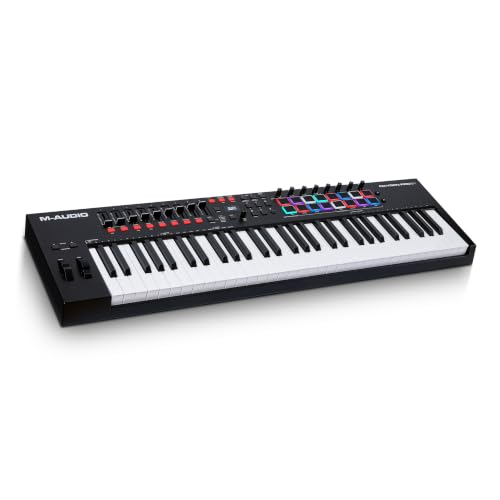
M-Audio Oxygen Pro 61-Key MIDI Controller
Best for: DAW producers wanting 61 keys and aftertouch
- Number of Keys
- 61
- Key Action
- Semi-weighted
- Performance Pads
- 16 RGB velocity-sensitive pads
- Aftertouch
- Aftertouch
- Faders and Knobs
- 8 knobs, 9 faders
- Connectivity
- USB
The M-Audio Oxygen Pro 61 is a USB MIDI keyboard controller featuring 61 semi-weighted keys with aftertouch. You get 16 RGB backlit pads, nine faders, eight assignable knobs, and a 5-pin MIDI output. It suits music creators who need comprehensive tactile DAW mixing and expanded playing range rather than an integrated standalone sequencer with onboard sound generation.
- 61 semi-weighted keys with aftertouch and assignable zones
- 16 RGB backlit velocity-sensitive pads with Note Repeat
- Physical DAW control via 9 faders and 8 assignable knobs
- Standard 5-pin MIDI output for external hardware gear
- Requires a connected computer or external sound module to produce audio
- Footprint of 40.5 inches requires substantial studio desk width
- Single pedal jack limited to sustain input
- You need a 5-octave semi-weighted keybed with aftertouch for virtual instruments.
- You want physical faders, knobs, and pads for software mixing and beat programming.
- You connect to both software plugins and hardware synthesizers using 5-pin MIDI.
- You require a standalone music workstation that operates without a computer.
- You have a compact workspace unable to hold a 40.5-inch keyboard.
Verdict: M-Audio Oxygen Pro 61-Key MIDI Controller delivers full 5-octave semi-weighted performance and physical mixing controls to DAW-centered producers. It fits musicians who prioritize software integration, aftertouch response, and 16 drum pads over standalone sound engines.
Specifications side by side
Spec Akai Professional MPC Key 37 Standalone Keyboard Novation Launchkey 61 MK4 with Polyphonic Aftertouch Novation 61SL MkIII 61-Key Sequencer Keyboard Arturia KeyLab Essential 88-Key MIDI Controller Arturia KeyLab mk3 61-Key MIDI Controller Akai Professional MPC Live III Pad Controller M-Audio Oxygen Pro 61-Key MIDI Controller
- Number of Keys
- 37
- Key Action
- Synth-action
- Performance Pads
- 16 MPC pads
- Aftertouch
- –
- Faders and Knobs
- –
- Connectivity
- USB-C
- Creative Modes
- –
- Standalone Operation
- Standalone
- Form Factor
- –
- Skill Level
- Professionals
- Suitable For
- –
- Color
- Grey
- Built-In Features
- –
- Features
- –
- Dimensions
- 12.3 × 22.9 × 4.09 inches
- Weight
- 9.7 pounds
- Model
- MPCKEY37GEN2
- Size
- –
Copied from the Amazon listing. These figures were not measured here.
Frequently asked questions
Which alternative offers standalone production without a computer?
Akai Professional MPC Live III provides standalone production without a computer. While the MPC Key 37 features 37 keys, the MPC Live III uses a portable pad-controller layout. It includes built-in speakers and Bluetooth connectivity, giving you full sampling and sequencing in a 9.48-pound battery-operated chassis.
Can you get hardware sequencing on a controller without built-in sounds?
Yes, the Novation 61SL MkIII includes an onboard hardware sequencer. It does not generate standalone audio like the MPC Key 37, but its 61 weighted keys and USB-MIDI connections let you sequence external hardware synths and software instruments simultaneously across complex hybrid studio setups.
Which alternative provides a full 88-key playing range?
Arturia KeyLab Essential 88 gives you a full 88-key range for your studio. The MPC Key 37 stops at three octaves, whereas this white USB controller measures 54.3 inches wide to accommodate full acoustic piano arrangements. It also includes an onboard arpeggiator for quick melodic generation.
What is the lightest alternative for portable production?
Akai Professional MPC Live III is the lightest standalone option on this list at 9.48 pounds. It edges out the 9.7-pound MPC Key 37 in weight while trimming width down to 17.2 inches. Its portable form factor omits physical piano keys to maximize travel convenience.
Which 61-key controllers include aftertouch for expressive playing?
Novation Launchkey 61 MK4, Arturia KeyLab mk3, and M-Audio Oxygen Pro 61 all provide aftertouch functionality. Each gives you five octaves of weighted keys alongside USB-MIDI connectivity. These models require a connected computer or sound module, trading standalone operation for extended keyboard range and tactile modulation.
Do you need a computer to use the Novation Launchkey 61 MK4?
Yes, you need a computer or external sound generator. Unlike the standalone MPC Key 37, the Launchkey 61 MK4 operates strictly as a MIDI controller. It routes performance data over USB and USB-C to trigger virtual instruments, DAW mixers, and software synthesizers inside your digital audio workstation.
